
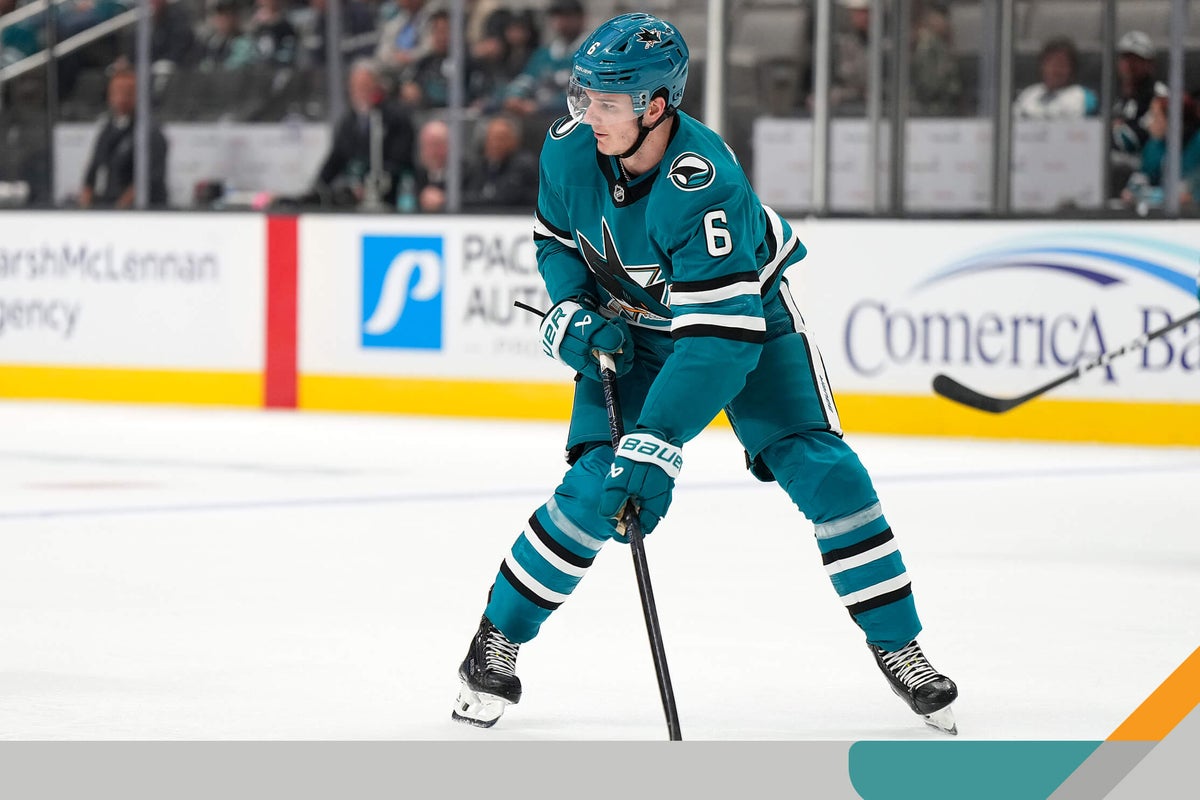
Welcome to Scott Wheeler’s 2025 rankings of every NHL organization’s prospects. You can find the complete ranking and more information on the project and its criteria here, as we count down daily from No. 32 to No. 1. The series, which includes in-depth evaluations and insight from sources on nearly 500 prospects, runs from Jan. 8 to Feb. 7.
The Sharks’ pool has a star prospect at every position (forward, defense and in net), quality that runs into the double digits and depth well into the teens, with two players slotted in the teens here who’ve already played NHL games. And that’s excluding defenseman Shakir Mukhamadullin (who just barely aged out) and, of course, Macklin Celebrini.
They’ve also got two more first-round picks on the way in the 2025 NHL Draft — their own, which could be another high lottery pick, and now the Stars’ as well.
2024 prospect pool rank: No. 4 (change: +3)

GO DEEPER
NHL prospect pool rankings 2025: Scott Wheeler evaluates all 32 farm systems
1. Will Smith, C, 19 (San Jose Sharks)
Though Smith has played exclusively with the big club this year, I decided to include him because of the combination of his age and the development treatment he has gotten in the NHL this season (I included Zach Benson when he was with the Sabres last year and also Conor Geekie and Marat Khusnutindov despite both being full-time in Tampa Bay and Minnesota this year). It’s starting to click for him, though, and he has played his best hockey of the season over the last couple of weeks.
Smith is a brilliant handler and manipulator of the puck, including at full speed. He’s a tantalizing and slippery talent who blends deception, baits and fakes (with his eyes, shoulders and head) into his movements to not just make opposing players miss but often send them the wrong way.
Crafty is the best word to describe his game. He went from a point-per-game U17 season (the only player on that team to do so) to more than two points per game in his U18 campaign and then led college hockey in scoring with 71 points in 41 games (tying Jack Eichel for the most by a U19 skater in the 21st century) as a freshman last year.
Beyond his natural skill in possession, he also impresses with his smarts with the puck, his cerebral play style and his ability to play to his linemates’ strengths as a facilitator and playmaker. Smith is one of the very best slot-passing prospects in the game and uses his unique puckhandling ability to dodge close-outs, weave off the wall (he almost always takes his first touch to the middle as a tool to draw attention) and make plays through holes in coverage in possession with ease, regularly hanging onto pucks to delay his way into his spots or carve in.
He’s the kind of player who can beat you with a pass, a dangerous wrister (which beats goalies with timing and accuracy more than power) or a deke. He’s a treat to watch when the puck’s on his tape and he processes the game at such an advanced and rapid level. The way he wheels across the top of the circles and then playmakes from the high slot or slips off the wall to the middle is special. The way he walks through coverage and hangs onto pucks is special. There’s just this elusiveness to his game where you never know where he’s going with the puck. I like the growth he has shown in the last couple of years to hunt and come up with more pucks (I quite like him on stick lifts), too.
He still has some work to do to round out his game (he’s a little too eager to flee the zone at times, isn’t very physically engaged, could use a little more jam and can try to do a little too much occasionally). But I’ll be shocked if he doesn’t become a playmaking star-level player and PP1 creator alongside or behind Celebrini. I expect him to become a big-time point producer. His individual skill and creativity are rare.
2. Sam Dickinson, LHD, 18 (London Knights)
Dickinson is a very projectable defenseman who has size, high-end skating and an offensive game that really rounded into form last season and has taken an even bigger step this year. Two years ago, he stepped right onto a deep Knights blue line at 16 (which is rare) and played bigger minutes by year’s end than some drafted guys (rarer), including in key situations in the playoffs. Last season, he played a leading role in all facets of the game on another strong London team (which included successfully quarterbacking one of the power-play units and developing his shot to nearly hit 20 goals), making two huge plays in the Memorial Cup final. This year, he has been one of the most productive defensemen in junior hockey and is averaging 30 minutes per game (you read that right) with London to excellent goal differential results.
He’s a strong 6-foot-3/4, 210ish-pound defenseman whose skating is a major strength (forward, backward, four-way mobility — the full package for a defender his size). He plays to who he is and what makes his game so successful. He defends at a very, very high level for his age both man-to-man, down low and positionally in his own zone. He has skill and command with the puck in the offensive zone and shows real vision and an NHL shot consistently. There are times when he needs to pivot and set his gaps earlier (when he’s ready and in flow to accept the rush he’s an excellent defender) but his only major hiccup is decision-making under pressure in his own zone. He still needs to read the ice and move it quicker at times and there are moments in games when he doesn’t process it fast enough coming out of his own zone and can turn over pucks. On offense, he shows comfort, speed, presence and even deception past opposing forwards and has developed a nice feel for the game offensively when there are plays to be made. He just needs to count, and read, and problem-solve faster in his own zone. Some have concerns about his IQ for that reason but he has all of the physical tools you look for, he can really shoot it (which I know he has worked on to turn into a real weapon), he comfortably handles and skates it, he has a high floor and he could have a very high ceiling (at both ends) with continued development along the path he’s on. There are also some who want to see him play a little meaner but he’s a dominant defender at the junior level and he competes/plays hard across huge minutes. He’s also helped by a June birthday that gives him some runway to continue to find new levels/layers and get the reps in with the puck in his own zone. He can dominate a game in all three zones and four corners of the rink, which is saying something for a defenseman his age. His size, skating, defense and blossoming offensive game make him a true top prospect. He looks like he’s going to be a two-way top-four stud in the NHL and if he can clean up some of his outlets/handling of pressure I think there’s first-pairing upside. He’s also by all accounts a great, easygoing kid who has twice worn a letter for Hockey Canada.
3. Yaroslav Askarov, G, 22 (San Jose Barracuda/San Jose Sharks)
Askarov has for years been one of the top goalie prospects in the NHL. He was a top goalie in the MHL at 16 and starred for Russia at U17 worlds, two Hlinkas (where he was in net for a bronze and a memorable gold) and U18 worlds (where he won a silver and the tournament’s top goaltender award). He had a career .937 save percentage across three years and 16 games in the KHL as a teenager. He played 48 and 44 games to a .911 save percentage in back-to-back seasons as a starter in the AHL at 20 and 21 (he had a stretch of play last year where he won 21 straight games in the AHL and looked completely unbeatable). And now in his 22-year-old season, he has played to between .930 and .940 in the AHL and has had some impressive games in the NHL behind a porous Sharks team.
Askarov’s got high-end tools and legitimate No. 1 talent. His raw talent has always separated him. His ability to change directions in the net, stay on top of shooters, track their hands and make reactionary saves is elite. His athleticism is, too. He regularly makes second- and third-chance saves holding firm in his positioning even when he’s lying on the ice or getting back onto his toes quickly for a desperation push.
There are still times when he gets frozen over his glove hand, but he has made important progress catching pucks as a southpaw. He can look jittery in the net, bouncing on his toes and moving to pucks (which he says is to keep himself focused and make some of those quick-twitch saves I talked about) but he plays over the top of pucks in a similar hunch to Sergei Bobrovsky and some other Russian goalies and it allows him to stay engaged and active with shooters/on rebounds. His agility, explosiveness and reads are so impressive that he can steal games when he’s at his best and make the difficult saves that others just can’t get to or stick with. There isn’t a goalie prospect in the world with quicker feet through shuffles or more explosiveness side-to-side or low-to-high than Askarov. That blend of power and speed combined with his extended track record at a young age gives him a very high upside.
4. Quentin Musty, LW, 19 (Sudbury Wolves)
The top pick in the 2021 OHL Priority Selection, Musty was one of the focal points of the Wolves’ offense in his draft year and would have been their leader in shots on goal, assists and points were it not for a few weeks lost last January to a hand injury. In his post-draft season last year, though he has dealt with a couple more minor injuries, he led the OHL in points per game (1.92) and paced for 130 points, which would have cleared league scoring champ and linemate David Goyette by 13 points. This season, after impressing the Sharks at development camp and the preseason rookie tournament, Musty sat out the start of the season while he looked for a trade (which, it should be noted, the Sharks supported) and eventually returned and then broke his hand in November, sidelining him for another couple of months. He returned in January with a five-point game and has been productive again on the whole this season.
He’s a big (6-foot-2, 200 pounds), strong, sturdy, athletic winger with slick puckhandling skill one-on-one and a balanced stride. He can unload from his hip into a heavy snapshot or drop and attack the net into a tuck play in tight. He’s also really comfortable passing from the perimeter and hitting seams in coverage, which gives his game added dimension inside the O-zone. He’s great along the wall on the cycle, but he can also occasionally make a play that pulls you out of your seat. The raw potential is there in spades and the production and statistical profile are that of a legit NHL prospect. He’s got time to continue to find new levels and develop his game thanks to his summer birthday as well (he’s still got some rounding out to do, though I think that has been overstated by some). There has been talk over the years about his body language and attitude as well but I’ve heard mixed reviews on that front and some think he’s misunderstood. There was a time when folks thought Musty was the best American-born 2005 prospect and while that’s no longer the case, there’s still a lot to get excited about. Some questioned his will/competitiveness earlier in his career, but I think those concerns have also been overstated (he can be a little inconsistent but I’ve seen him have plenty of standout games where he’s in the thick of everything as well). I think he’s got a real chance to become a skilled second-line winger in the NHL. The tools are there and I’m looking forward to seeing what he does at the pro level when he makes the jump to the AHL next season.
5. Luca Cagnoni, LHD, 20 (San Jose Barracuda)
Cagnoni had one of the most productive post-draft seasons by a WHL defenseman in decades last season, putting up comparable or better numbers to names like Olen Zellweger, Josh Morrissey, Kevin Korchinski and Shea Theodore, the last three of which were first-rounders and the first of which was drafted with the second pick of the second round. In fact, he had the most productive U20 season by a WHL defenseman since 1995, almost 30 years prior, registering 90 points in 65 games. He then built on that with an excellent NHL camp with the Sharks and has led all U21 AHL D in scoring while playing 20 minutes per game for the Barracuda (second among their D).
Cagnoni’s challenge, like Zellweger before him, is that he’s small (the Barracuda list him at 5-foot-9). Importantly, though, he’s a superb skater. His feet noticeably kick back through his forward skating stride, but he’s a plus-level skater for me in every other way and his mobility is a major strength on the whole. He also wins on his smarts more than his skill, though I think because his hockey IQ is so high and that’s the first thing people talk about, his skill level doesn’t get enough love (it’s legit for me). He walks the line really well, defends with his feet and can lace shots through or attack into space to use his quick release. He played a huge role on a top junior team for an established coach who has developed a lot of defensemen, has legitimate playmaking ability and distinguishes himself on the back of his smarts (he understands spacing and plays within the flow of play and often one step ahead of it), rounded skill and footwork. He also plays at a playable weight (180 pounds) and has made important progress defending in man-to-man engagements. He’s going to have to keep proving people wrong to reach his upside as a No. 4/5 offensive defenseman with skating, IQ and offensive elements, but I’m a real believer. He was a second-rounder and not a fourth-rounder for me and I think he has a real chance to run one of the Sharks’ power plays of the future (which is something their current blue line lacks) and challenge Sam Dickinson for those minutes.
6. Filip Bystedt, C, 21 (San Jose Barracuda)
Bystedt is a big boy who moves well (especially when he builds a head of steam through the neutral zone) and thrives in puck control, with the skills of protection out wide to his body that you expect in a player his size, but also the propensity to pull and drag pucks through his feet. Though he isn’t a very adjustable skater in tight/against coverage, he skates well north-south and around wider crossover paths once he gets going. Those tools make him noticeable and intriguing by default and have allowed him to really hold pucks against his peers and work his way into being a good SHL and AHL contributor at an early age. This season, he has played 17 minutes per game in his first full camp gain with the Barracuda and has been a contributor on the power play and penalty kill.
The reach, length and size (6-foot-3/4, now 210 pounds) make him really strong in puck protection for a player who just turned 21 days ago. When he’s carrying pucks and looking to attack, he’s a lot to handle. He’s got some real dexterity. He stays around it, he goes to the front of the net, he involves himself physically and he has become a much more consistent game-to-game, shift-to-shift player over the last two years. His one-timer has some pop because of his strength and size. There were times in his draft year, in viewings across the J20, SHL and U18 worlds, where he played a different style in each and seemed to have a bit of an identity crisis. I think he found himself in the SHL as a driver who needed to use his decent skill and skating where required instead of out of necessity. He was one of the SHL’s better young players in consecutive seasons and there’s more than meets the eye with his game offensively at two good pro levels now. His game also works well on North American ice. He projects as a good third-line center for me, though he does need to improve in the faceoff circle.
7. Igor Chernyshov, LW/RW, 19 (Saginaw Spirit)
Chernyshov is a November 2005 who has progressed in line with his older age within his cohort. He established himself as a point-per-game MHL player and scored his first KHL goal (at 16 years and 352 days, he was actually the 11th-youngest player to ever play in a KHL game) two seasons ago and bounced between the MHL and KHL in his draft year last year, showing mostly well in limited usage with Dynamo Moscow’s pro team and registering 28 points in 22 games when he played with his peers. At the junior level, I felt he created more looks than his production suggested in the first half of the season. Then, in the second half, the points really started to fall and his production elevated back to where it belonged to reaffirm his first-round merits for me (he finished No. 23 on my board and the Sharks selected him with the first pick of the second round at No. 33 after he was unable to showcase himself at Gold Star’s pre-draft camp due to, of all reasons, a severe sunburn he got in Florida). After undergoing shoulder surgery in August, he then missed the first half of his post-draft season but has now returned and lit it up in early games with the Spirit in the OHL.
Chernyshov’s a big, strong (6-foot-3, about 200 pounds) winger and modern power-forward type where driving is a part of his identity but not to a bullish fault as his only focus and his skill/finesse might take on greater emphasis. He plays a straight-line game and has the individual skill and a quick release to go at defenders and make plays off the rush or finish from the slot with a quick, one-touch shot in zone. He’s a smooth enough skater and his stride has some real power, which complements his impressive rush package without needing dynamic burst. Add in a relatively committed game off the puck (there’s still some room for growth there but he competes fine) and there’s a lot to like about his mold. He can attack defenders in a variety of ways, threaten on the puck or get open off it and he works hard enough. With his tools and versatile skill, he profiles like a pro; a future top-nine NHL winger and a secondary creator on a line. Patience will be important after he lost crucial development time this fall but he’s got the makings of a solid contributor.
Here’s Spirit head coach Chris Lazary on his first impressions of Chernyshov: “Powerful. Really great release and very accurate with his shot. Great puck skills. Underrated passer. Will be a good NHL player that can play heavy with lots of skill. … Picks up concepts quickly. Usually if out of position in structure just a misunderstanding with terms. Smart. He loves hockey. Dialled in. His goal in his second game, watch the release and shot location past a defender — nasty.”
And here’s Spirit general manager Dave Drinkill: “He’s an impressive player. His mix of size/skill is eye-popping. Very powerful in his strides and has a pro shot/release. Looks like a man skating with us at times. He will be a force and will figure out quickly what works and what doesn’t in our league.”
8. Collin Graf, RW, 22 (San Jose Barracuda/San Jose Sharks)
Graf was a college free agent who had a ton of NHL interest coming out of Quinnipiac before he signed with the Sharks. He finished third in NCAA scoring behind Logan Cooley and Adam Fantilli as a sophomore and just outside of the top 10 as a junior, winning a national championship with the Bobcats and finishing his NCAA career well above a point per game. Though he has been inconsistent in his time with the NHL club, Graf has been a top forward for the Barracuda as a rookie, leading them in ice time at nearly 20 minutes per game and contributing on both the power play and penalty kill. He’s a 6-foot-1 winger with the skill of a smaller player that harkens back to when he was 5-foot-9 as a teenager. Graf’s a smart, talented player with some finesse tools, an ability to make plays from the perimeter and talent on the puck as a handler and distributor. I’d like to see him use his body and involve himself in the fight a little more and there are some evaluators who wonder if he’s got the drive to get to the inside and score enough for the NHL level but he’s got the other tools of a top-nine/PP2 winger.
9. Leo Sahlin Wallenius, LHD, 18 (TPS/Växjö Lakers HC)
When the Sharks drafted Sahlin Wallenius with their second pick of the second round and fourth pick of the draft in 2024, he was the fourth player they’d taken from my top 32 (he was No. 27 on my board when he was picked No. 53). His post-draft season since has been a bit of a unique one split between four levels as well. He’s signed with Växjö in the SHL and dominated with their J20 team but struggled early on in the season, resulting in a loan to Nybro in the second-tier HockeyAllsvenskan. Shortly after the New Year, he was then loaned to TPS in Liiga for a level of competition between the SHL and HockeyAllsvenskan. In Liiga over the last month or so, he has played significant minutes, averaging 20 minutes per game. That may feel like a discombobulated season but I don’t view it that way. There are only two 18-year-old D who’ve played regularly in the SHL this year, so I don’t think it’s a knock on him that he didn’t stick there. I don’t mind him going in search of the highest pro level he can play in either and while I think the gap between Liiga and HockeyAllsvenskan has shrunk over the years, it’s a slightly stronger league and none of its 18-year-olds have played bigger minutes than him in it.
Sahlin Wallenius is an excellent skater and natural playmaker in motion who transports pucks through neutral ice, joins the rush, jumps in and out of lanes and then has the cleverness needed to hold and play pucks into space with proper timing and stick and positioning needed to complement his mobility and make him a plus-level defender. He has been a leader and big-minutes player in the 2006 age group internationally for Sweden as well and should be a big part of their World Junior team next year in St. Paul/Minneapolis.
He takes what’s given while maintaining an eager and involved game. He can make north-south and east-west plays. He’s got good hands for a defenseman. His offensive-zone instincts are already there. And whenever I watch him, it feels like plays with confidence and finds ways to impact play. He’s able to get back into the play if he has jumped up into it and competes well enough (his skating makes his defense a strength but I’d like to see him play a little harder in corners/along the boards at times). There were two legit 2024 D prospects on Växjö’s J20 team last season, and I was partial to Alfons Freij coming into the year but Sahlin Wallenius looked like the better prospect throughout the season.
10. Kasper Halttunen, RW, 19 (London Knights)
Halttunen’s a big, strong, work-in-progress player with one of the hardest shots outside the NHL.
He was the top prospect in a weak(ish) age group for the Finns in his draft year. He impressed at two U18 worlds in Germany and Switzerland (the latter of which he registered 10 points in five games and scored some pretty goals with his shot and off drives to the crease). He looked like a force against his peers at Finland’s top junior level. But he fought it at the Hlinka Gretzky Cup three summers ago and struggled to make an impact in 28 games in Liiga after registering seven shots on goal in his pro debut. After a move to London for his post-draft season last year, Halttunen led the OHL in regular season playoff goals with 16 because of his one-timer, was the second-leading scorer for the Finns at his first World Juniors and then found another level in the playoffs and the Memorial Cup, leading the OHL playoffs in goals with 17 in 18 games and making the Memorial Cup tournament all-star team after scoring another four in five games in Saginaw, including one in the final. This year, after starting the season with the Barracuda in the AHL and scoring four points in six games, he returned to the Knights for another run at a Memorial Cup (in London and with the Finns as a returnee at the World Juniors he hasn’t taken a step offensively but has worked to round out his game in other areas).
Halttunen has promise as a driven, shot-first, power-forward style winger who can really impose himself against his peers with his ability to get to his spots, outmuscle opposing players, rip the puck and play a physical and competitive style off the puck.
He’s got a pro-built game and frame (6-foot-3 and over 200 pounds and though he does carry around a little bit of excess weight he has worked it) but he can also make plays for himself and his shot. He plays to the inside and then he’s got the skill needed to make plays around the net for his size. He can definitely be a lot to handle for opposing players when he builds a head of steam, drives into contact in possession and they have to engage with him. He’s strong on pucks, shedding bumps to drive past his man well (though I think he’ll find it harder to attack into his spots at the pro level). He wins most of his 50/50 engagements against his peers. He protects pucks really well and has sneaky-soft hands through his practiced patterns handling the puck (his hands can look a little sloppy when things get hectic, though). His snapper and one-timer are borderline elite and can cleanly beat goalies from anywhere in the offensive zone (the puck really rattles off his blade).
I do worry at times about his problem-solving, discipline, play selection and pace, though. While he has also worked at his skating, it can look a little slow from a standstill (he’s got decent power once he gets going).
Halttunen doesn’t have star quality but he’s a legit prospect and he’s got a chance to become a third-liner scorer and power-play shooter with size.
11. Cam Lund, C/RW, 20 (Northeastern University)
A bright spot on a Huskies team that has had some warts the last three years, Lund stepped right into college hockey as a freshman and played the same game he played when he stepped into the USHL as a rookie in his draft year. Last year, he played to nearly a point per game as a teenage sophomore. This year, he has played to just above a point per game as a junior and the second-leading scorer on a Northeastern team that has lost more than it has won, playing huge minutes (22 per game and often more as the focal point of the offense at five-on-five and on the power play). He was also one of the final cuts for Team USA’s World Juniors squads for both Halifax and Gothenburg.
Lund tends to be pretty well-liked around the sport for his pro-style game. He’s a pass-and-shot threat who will take what’s available for himself but simplify and play off his teammates where needed, too. He pushes tempo with plus-level skating, plays with a purpose, works to get pucks back and then has enough skill to make things happen between checks and races. He’s a strong, powerful 6-foot-2 player who thrives in transition skating or chasing pucks, hunting on the forecheck, turning defenders and creating breakaways. He finishes his checks. He can score and really shoot a puck. Considering his summer birthday and relative inexperience pre-college, he has progressed well. I don’t think he’s the smartest player and he can play too much on instinct but his speed, athleticism, physical tools, work ethic, good overall skill and increasing roundedness (he has learned the game on the fly) should project to the pros. He’s got bottom-sixer and potentially third-liner potential if he can continue to develop. He can also play both center and wing (he played center coming up, played wing his first two years at Northeastern and has split time between center and wing this season but has played more middle of late). I did think about ranking him a little lower here but I could see it really clicking for him in his early-to-mid-20s and him becoming an NHLer that way.
12. Jack Thompson, RHD, 22 (San Jose Barracuda/San Jose Sharks)
After a really solid rookie pro season stepping onto the Syracuse Crunch blue line and, as the team’s youngest defenseman, looking like he belonged last year, Thompson took another step forward last season in a bigger role, earning his NHL debut with the Lightning (who drafted him in the third round) before being dealt to the Sharks in the Anthony Duclair deal. He had a big year three years ago, leading all OHL defensemen in goals with 21 and finishing sixth in points with 57 (in 65 games) before closing out his junior career with another six goals and 14 points in just nine playoff games and as four points and a plus-10 rating in seven games for a gold medal-winning Team Canada at the summer World Juniors. At the junior level, he established himself as an aggressive, minute-eating all-situations defenseman whose presence was felt at both ends of the rink. At the AHL level, he kept his identity while beginning to make the right tweaks. After starting this year in the NHL with the Sharks, Thompson played 19-plus minutes for the Barracuda through December and January before earning another recall.
Offensively, he’s a shoot-first defender who likes to attack off the line, can beat goalies cleanly with his shot and does a good job getting hard shots through traffic from the point. That aggression that he plays with in the offensive zone has also become a part of his game defensively, where he doesn’t search out hits but plays physically, using his timing to close gaps. He has upside as a third-pairing defenseman and a floor, at the very least, as a No. 7-8 who can chip in offensively and plays firmly on both sides of the puck. He’s not a super creative offensive playmaker, nor does he have the size that teams covet in their staunch defensive types, but he has a little bit of both along with a pro build (6-foot-1, about 190 pounds) and makeup, desirable handedness and a what-you-see-is-what-you-get game that is consistent.
13. Ethan Cardwell, C, 22 (San Jose Barracuda/San Jose Sharks)
Cardwell’s a player I would have drafted in 2020 and was happy to see him get selected as an overager in 2021. He was passed up initially, I think, due to a combination of a midseason trade (which always complicates how a player is evaluated in their draft year due to scouting logistics and the difficulty of evaluating a player who had to adjust to new systems and linemates), his then-raw frame (which has actually filled out to 5-foot-11 and more than 190 pounds now) and a lack of exposure driven by time spent at the Jr. A level in his 16-year-old season. Then in his second crack at it, as teams got more familiar with him and he thrived as the most productive under-19 player in Sweden’s third-rung HockeyEttan (a league that welcomed a lot of good young players from canceled junior seasons in Canada and Sweden), his re-entry selection came into focus. Then he scored 49 goals and 101 points in 74 combined regular-season and playoff games in his last season in Barrie to get signed. Last year, as a rookie in the AHL, he outproduced higher-drafted Sharks prospects with the Barracuda, registering a very respectable 23 goals and 43 points in 71 games. And this season he has continued to build on that as a top forward in the AHL, playing on both the power play and penalty kill for the Barracuda and scoring his first NHL goal.
He has always shown an ability to manufacture plays in dangerous areas. He’s a crafty playmaker who knows his way around the ice, plays fast and works hard to win his races and come away from the wall with the puck to make something happen. He’s got good anticipation and instincts, both on and off the puck. He plays with jump and sense/feel. And while he may just top out as a No. 13 forward type because he’s not the prototypical bottom-sixer in terms of size and physicality, I think he’s got the defensive conscience to potentially become a skilled bottom-sixer who could play up the lineup in a pinch.
14. Daniil Gushchin, RW/LW, 22 (San Jose Barracuda/San Jose Sharks)
After two seasons as one of the top forwards in the USHL, Gushchin became one of the top forwards in the OHL in his only season in the league before turning pro, outscoring his nearest teammate by 22 goals and 27 points on a poor Niagara team. As a rookie in the AHL two seasons ago, he led the Barracuda in shots on goal and finished second on the team in scoring, proving his bee-like game could work at the pro level. Last season, he elevated his production to nearly a point per game, got his first taste with the Sharks and scored his first NHL goal. This season, after making the Sharks out of camp, he has played back in the AHL since November, playing 18 minutes a game for the Barracuda and more than four minutes per game on the power play.
The 5-foot-10 winger plays an up-tempo, feet-moving game that buzzes from one play to the next while manufacturing offense. I’ve been impressed by how threatening he has been off the rush over the last few years (because he has always been impactful inside the offensive zone, so it has added another element). He’s also an effective forechecker for his size who wins races, fights for his lanes, gets under sticks and then makes quick, aggressive plays with the puck when he gets possession. He manufactures offense shift to shift with his ability to knife through seams, get to the net and play in bursts with his impressive footwork and acceleration from a standstill. He doesn’t have any one skill that should hinder him but there’s a general difficulty in projecting players his size to the NHL when they don’t have first-round notoriety (rightly or wrongly). He’s already a top AHL player and has already earned NHL looks. I believe he’s got the chops to be a contributing piece who can play on PP2 but there’s a decent chance that he’s just a AAAA guy, though, too.
15. Eric Pohlkamp, RHD, 20 (University of Denver)
Pohlkamp’s a very unique player type. He’s a 5-foot-10/11 D but he’s really stocky (over 200 pounds and muscular) and strong and he uses that strength to play a physical, competitive and aggressive style defensively that plays to win bumps and engagements. He also has one of the hardest point shots outside the NHL — like he can absolutely bomb it.
Last year, as a freshman at Bemidji State, he played huge minutes (23 on average, most on the team), scored double-digit goals as a defenseman, played for Team USA at the World Juniors and then transferred to Denver to play under his USA head coach David Carle this year. At Denver, he has again played big minutes (22 on average, second on the team to Zeev Buium) and has been a prominent part of both the power play and penalty kill. He doesn’t look or play like your typical sub-6-foot defenseman, playing with decisiveness before poise, attacking past the first layer and often laying big hits. I think he’s got a chance to be an interesting pro defenseman and I think he’ll become good organizational depth at minimum for someone. He’s also a righty. I’m a fan and he wouldn’t rank No. 15 in most pools.
The Tiers
As always, each prospect pool ranking is broken down into team-specific tiers in order to give you a better sense of the proximity from one player — or group of players — to the next.
The Sharks’ pool is divided into three tiers: 1-3, 4-7, 8-15+.
Considered but not ranked were Barracuda defenseman Jake Furlong (the final cut), Swedish defenseman Magnus Havelid (who I’ve always had time for but just hasn’t taken that important next step at the SHL level), competitive Calgary Hitmen forward Carson Wetsch, toolsy Vancouver Giants defenseman Colton Roberts, Victoria Royals defenseman Nate Misskey and UConn forward Joey Maldowney.
Rank
Player
Pos.
Age
Team
1
Will Smith
C
19
Sharks
2
Sam Dickinson
LHD
18
London
3
Yaroslav Askarov
G
22
Barracuda/Sharks
4
Quentin Musty
LW
19
Sudbury
5
Luca Cagnoni
LHD
20
Barracuda
6
Filip Bystedt
C
21
Barracuda
7
Igor Chernyshov
LW/RW
19
Saginaw
8
Collin Graf
RW
22
Barracuda/Sharks
9
Leo Sahlin Wallenius
LHD
18
Nybro/Vaxjo
10
Kasper Halttunen
RW
19
London
11
Cam Lund
C/RW
20
Northeastern
12
Jack Thompson
RHD
22
Barracuda/Sharks
13
Ethan Cardwell
RW
22
Barracuda/Sharks
14
Daniil Gushchin
RW/LW
22
Barracuda/Sharks
15
Eric Pohlkamp
RHD
20
Denver
(Photo of Sam Dickinson: Thearon W. Henderson / Getty Images)