
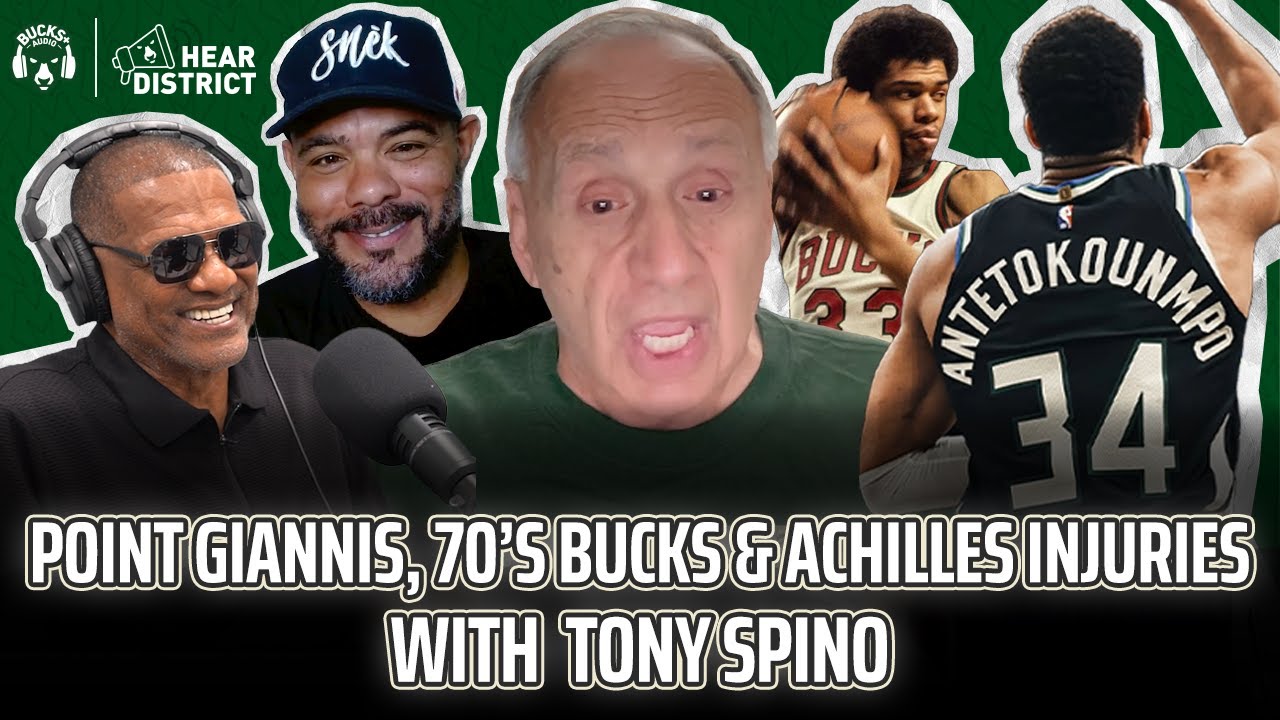
Point Giannis, Summer League & Free Agency + Achilles Insights w/ Tony Spino (Hear District Ep. 71)
Doc said, “We’ve got to play faster.” That’s what I’m talking about. They was trying to cajol these guys. You like that word? Cajol these guys into playing faster last season. You don’t like cajol? Yeah. Think about it. Fit. Fit is everything. And that’s what horse needs to get credit. The guys he brought in, they fit very well to the current structure, current court, the bus guy. Five time allstar Marcus Johnson alongside Marcus Johnson. What’s up everybody? Hey, this is the here district, captain of this vessel. And I got my first mate, my number one son, Christian Johnson. What up? Talk to me. Holla. Let it rain, man. Let it rain. I guess I go. Guess what? We’re going back. Can’t pass the break. Go fight. Go fight. Welcome everybody to the here district. Marcus Johnson. You’re listening to a Bucks Plus audio production on the Bucks Plus Network. Your weekly pulse on the Milwaukee Bucks straight from a Bucks legend. This is Here District with Marcus Johnson alongside his son and 1995 NCAA champion Chris. Here’s MJ. All right, welcome everybody to Here District, the fantastic voyage as we follow the the comingings and goings and doings of the Milwaukee Bucks. said, “Man, has it been some excitement, a whole lot of stuff has been going on, a lot of movement with this Bucks team, and I’m liking what I’m seeing.” I’m Marcus Johnson, the captain of this festival. My first mate, Chris Johnson, the only father and son tandem in the history of NCAA basketball to win a national championship at the same school, UCLA. What’s up, Chris? How you doing? Good. How are you? I’m doing great, man. Doing great. So, this is the this is a fun time of year. Summer league is officially started. Yep. In Las Vegas. the whole Bucks contingent of saw they pulled up deep out there. Yeah. Players, coaches, personnel, front office. That’s how you got to roll up. Chefs. I mean, that’s my my my one detriment is that all the all the all the good all the good cooking chefs are no longer here in Milwaukee. They’re in Las Vegas now. So, it’s so wild how everything is centered around your meal and you’re eating at the That’s nuts. I mean, everything centers around that. M but it’s always breakfast and lunch. It’s it’s always it’s and and and if you could and you’ve had you’ve had a taste you had a taste of of the of the of the of the cuisine. I see why I grew up with weight problems like living in a household where food and the thought of food and what we’re going to eat. You’re tripping on the dude being in Las Vegas. Crazy. This is what the big guy two of my favorite chefs too. I mean they the blueberry pancakes no more. I mean, the the the afternoon, man. Man man, don’t let don’t don’t get but but but I did have a swan song uh French toast that that the lady chef hooked up the other day. That was outstanding. Was this No, no, she just she was cooking it on the grill. I’m like, what’s that? She’s like, that’s French toast. I’m like, okay, you got enough for got enough for for OG. MJ the charmer. She’s like, sure, I got How many pizzas you want? Two, three. Just give me two. They were huge, too. And she cut them in half, man. And I put that syrup on there. Just sapped up that syrup. They were they were off the hook. But listen, so summer league started watching the first game. Uh Doc Rivers, great interview that he did with Steve Smith and and and Chris Miles for NBA TV. What’s the one area? We’re not even talking about a player that you want to see the Milwaukee Bucks improve in. Well, pace. Okay. Play a little faster. Yeah, we got to play faster. Uh defensively though, we started out slow and then by the end of the year, we became a really solid defensive team. Uh, we want to pick up where we left off defensively. Uh, and you know, the second half of the year when I put the ball in Giannis’s hands, you know, we did it by default. I’d love to say I’m this genius and I thought, hey, let’s let’s play Giannis at the point guard spot. I can tell you when I brought it up with our coaches, they thought I had lost my mind. And when I brought up with Giannis, he thought I had lost my mind cuz he’s already has the ball in his hands. But like having them bring it up every time, it eliminated, you know, how the whole league right now everybody’s pressuring the ball. Nobody’s pressuring Y. Nobody. And so it allowed us even against Indiana to bring the ball up pressure free. You know, um the most dangerous guy on our team had the ball already. And when you put shooting around that, and that’s where the Gary Trench and AJ Greens, like I think both of those guys are going to have breakout years for us. That’s where that all came into play. So, I want to pick up from that and build on talked about him playing uh kind of a point forward role and and as the guy who came up with that term, invented that term. I’m not the original point forward. You can go all the way back to Maurice Stokes and Rick Barry and and guys like that and Robert Reid and Johnny Johnson, blah blah blah blah. But I’m the first guy to ever utter those words. point forward came out of my mouth first in 1984 in a playoff series in May against the New Jersey Nets back in the day. But but but my point is this. Doc said Chris, forget about point forward. Yiannis was going to be the point guard. The ball is going to be in his hands and and and some great numbers here that our producer Dylan Carter came up and 28,000 career minutes. Giannis has played, and I don’t know how they come up with this, but this is a stat that that’s on in the books. Giannis has actually played the point guard position from the one for a total of 4% of the minutes of his career. Yeah, 4%. So, your thoughts on Point Giannis? I mean, when you look at the current roster structure, Giannis, the ball in Giannis’ hands is your best bet. There’s no offense. uh meant to Dane, but for my liking and and what I saw last season, he brought up the ball too slowly. I didn’t I never was a big fan of that. Now, I don’t know Giannis is going to obviously not go full speed all the time, but I love the Giannis’s ability to put pressure on defenses. Yeah. More so than Dame. Giannis is a different breed. Now, he doesn’t have the three that Dame had, but at that position, you got to make some decisions and you got to make some choices. And if you surround Giannis with a roster of guys that can knock down shots, attack close out, make plays in space, you guys are going to have a hard time. It’s going to be a headache. I think this is a new brand of basketball that Doc is sort of hey, you know, it’s kind of, you know, Doc is you got to try it. I mean, you got to go for something. You got Last It’s just He’s at a point, I think, where this type of move makes a ton of sense. You can’t get the Bucks Nation too pissed off at you for putting Giannis at the point because you know what? How can Bucks Nation be mad at you for this? You’re putting the ball in the hands of the man. Who’s going to put the ball in the hands of KPJ? But but but but my my my thing is is hasn’t Giannis had the ball I mean he led the league in usage rate like a couple of years ago like about 37. He’s always up around 35 to to 38 39% usage rate. may have been maybe been a tick lower last year because of Dane the last couple of years, but he’s always had, you know, he’s always had the ball in his hands. Now, the one thing Doc did say and and it’s to your point when he was asked like point blank directly by Chris Miles, what needs to change for this Bucks team this season compared to last season, this coming season? Doc said pace. Yeah. He said, “We’ve got to play faster.” And he was and he was trying to cajol these guys. You like that word? Cajol these guys into playing faster last season. You don’t like cajol but but but of Dame it up. Bounce. Let it bounce. Like now I’m not knocking Dame, but that you know Dame that’s a rhythm thing. Like MJ, we you know what I’m talking about. Like you saw it last year. you saw the difference when certain lineups were in and just the way the ball would hop around and move and I think that that’s going to be an emphasis and the biggest difference. I don’t think sticking is is no longer going to be a thing. Giannis at the one dominating the ball. I think it’s the best bet. I love it. Let other guys D and knock down threes. I mean Yeah. And to and to your point, Giannis averaged a career-high six and a half assists last year, but check this number out. In 16 regular season games without Dame Lillard, Giannis averaged pretty much eight assists a game, you know, and that’s that’s that that’s not without really having a mindset like I’m the point guard, I’m I’m the you know, if he goes into it with that mindset, eight assists, he could he could boost that up to close to double digits in assists. And if he does that, we’re talking about averaging something you’ve talked about, averaging a triple double or getting close to it for the season, which would put him right that that would have to elevate him, you know, from number three MVP discussion to top two, I would think, depending on the Bucks Shay and Shay and Joic going to be going to be tough to crack, right? That that that I don’t think it’s about Shay and Jokic. I think it’s really about this weird bucks bias that the national media has whether it be whatever it is I don’t know but it’s something strange like we can no longer deny this we this is not a figment of our imagination small small market bias I mean it’s I’ve been around it’s been here since I’ve never been on this side so you you grew up in this you know I’ve never I lived it I’ve never seen this like this and it’s really legitimate I can’t believe the stuff and just how the reports are coming out how differently a Jokic, you know, when Kronkey’s on talking about Jokic potentially not signing for whatever and how that’s going to look and then, you know, how they just don’t cover it the same way and then everything about Giannis is just it seems like they’re trying to push Giannis to make a move to a bigger market. Um, everyone and so that that’s the part that I don’t like about it. Um, anyway, that’s just my my thing. But, but back to the point that think about it’s relevant. It’s just relevant. It’s relevant because I mean, and to your point, hold your thought. Make sure you keep that thud in mind. But even the Miles Turner narrative that that sh that shifted, you know, that that shifted mid-stream from the top free agent, one of the most desirable free agents out there, top two or three in in rim protection stats the last five or six years for 39.6% from the three-point line. And now all of a sudden, he’s not the second coming of Kareem. I don’t know. He’s no Bob Laneir. I don’t know why you guys, they didn’t say Bob Laneir, but I just threw that up because he’s a former teammate. But it shifted. It shifted like so what? Who’s going to get him the ball? So what? But to your point, that’s that that’s that small market buy. They want Yann. They’re trying to talk Giannis into New York, into Golden State, into Chicago, into one of these these big markets. Like, let let him be, man. Let let us let us let let us have some nice things here in Milwaukee for a while. And if this young man wants to spend the entirety of his career and and and and and and shout out to to John Horse because I had no idea what he could do, if he could do what’s available. Now all of a sudden I read the Bucksside Miles Turner. I’m like what the then the next thing I read the Bucks stretch out Dame Lillard and that took some coahones to make that move the way he did. So I mean go ahead finish your point. No shout out John Horse definitely made some moves. My point was um just that just how you know we lose Brooke now Jericho Sims is going to be counted on to bring some athleticism and some stuff above the rim. Think about this. Imagine if Jericho Sims and Giannis can get some chemistry, develop some chemistry on this lob work. You know, the record for lob points in a season was I think lob city. I think they averaged like 12 13 points a game on lobs in 2014 with Giannis at the one and dog on Jericho in the dunker. Just imagine imagine the possibilities. So that was something that I was looking at as well. And then also to my point, Ryan Rollins is going to have to do some handling. KPJ is going to have to do less handling and creating at the one. He only showed it a 17.3% playmaking load uh last season which was you know pretty you know I don’t know set 98 percentile for reserves. Can he handle 25% plus as a starter or are we good with Ryan Rollins and Giannis splitting that position and then KPJ playing more of a creator off that wing off the two you know how much of KPJ at the point. So, these are just some things I was thinking about uh after I heard the doc conversation because I really feel like that they’re going to lean all the way into this and we’re going to see a lot of creativity out of all this sets with Giannis with the ball. Okay. So, you mentioned Jericho Sims, right? Have you seen the video of him shooting with his left hand? So, yeah, he been he he he’s been doing that apparently. Um, I don’t know if that was a some reverse angle that that was all out of whack, but he’s that’s but he’s actually but he’s actually shooting with this. I mean, they they kind of looked at it and said, “Well, the numbers and the and the lettering is is is is is cool. So, he’s actually shooting with this and and so what the guy and I’m drawing a blank here, but but you’ll know him. Um, LeBron’s guy in Cleveland, he he was he was with Tristan Tristan Thompson. He kind of went from a from a right-hander to a left-hander. I remember uh one of the Plumbley brothers started shooting free throws like with an opposite hand and had some success with that. But this is this is just a it’s just a weird thing to me just watching him, you know, hit bucket after bucket. And I think his coach at Texas, Shaka Smart, who’s now at Marquette, but even mentioned that that, you know, he was ambidextrous, you know, he was amphibious, but he’s ambidextrous at Texas. And so the Bucks are going to, I guess, lean on that and see see, you know, see what happens. That’s going to be fascinating for me to see him do something like that. So 1.28 28 points per possession as a role man that that number will can increase. I’m excited to see what he adds to the table. A lefty am I mean an ambidextrous finisher. You know, that just gives you options. It gives you options on on pick and roll on finishing and what you can do. Yeah, there was a play that Dame had a block on Seakka maybe in the playoffs. Dame blocked Seakka. But if you look in the background, Jericho Sims is also pursuing that layup. He takes off from the dotted and his head is about this high over the rim. It’s just the most incredible, you know, and I just I’m I’m watching Dames block and I’m looking behind him and I see Jericho with his head like, you know, he’s got nose rim level and uh I’m just I’m just excited to see what he’s going to bring to the table. Also, Doc talked about breakout seasons and he talked about a couple of guys, Chris, that he thought were um in store for breakout seasons. Gary Trent Jr. was one. Now, Gary Trent Jr. I mean, after a miserable start, and a lot of it had to do with some some some I think it was some injury. It was hip it was hip injury. Something was going on with him at the start of the season that that that caused him to not knock down shots like he’s capable of. But he still wound up shooting like 41% 40% from a three, 43% over his last 25 games. So averaged 14 points per game during that stretch. What’s a what’s a breakout season for Gary Trip? What kind of numbers would you would you would you would you say define a breakout season for Gary Trent Jr. this year? I mean, we’re talking breakout. Isn’t a dub a breakout season? Isn’t 20 points per game breakout or does he does he have that in him? A dub is not easy to get the average in today’s NBA. I don’t know. I don’t know. I think it’s a lot easier than it was than when you were playing and in the 90s. I think it’s a lot easier. Now, look, I’m not trying to act like him act averaging 20 points a game. is just, you know, that that’s some like, you know, easy task. But my point is, why would Doc say breakout? I think he might have something in store. More shots for for Gary, more looks for Gary, more actions ran for Gary, more stuff for Gary. When you have a coach that believes in you and that’s talking about you and that’s kind of, you know, singing your praises in the summer league interview, there’s something going on there. There’s a belief there. There’s a confidence there. And there may be a plan to increase his usage as far as getting him shot. Yeah. and and that’d be a good plan. And and also and we talked about this a lot and and and the numbers bore out and this is, you know, when when I was talking to my good friend Ed Waters, coach at Crunchawer High School, Maxine Waters, his son, been best friends since seventh grade. But he was talking about analytics. So I was telling him how um the eye test told me that that triumvirant of Kevin Porter Jr., Gary Trit Jr., and AJ Green was really effective together, especially with Giannis. And then I just happened to go to cleaning the glass, my favorite site to look up analytics and um Ben Faulk runs that, but looked up their numbers, their oncourt numbers with Giannis, and they were in the 90th percentile across the board offensively and defensively. That was that that was the shocker offensively hitting shots, scoring points, all that good stuff. But defensively, they were in lockdown mode on the perimeter, those three guys. And then you watch them and the energy. You talked about that just and that’s what Kevin Porter Jr., Gary, Trent Jr., they got some dog in them, man. They got And AJ also, they got some dog in them. No, they do. They all have dog in them. And the guy that another guy I think that’s probably the most underrating signing of the Bucks off season is Gary Harris. Gary Harris is a dog too defensively. You lose PC, who was 1.01 points per possession defensively in isolation. You bring in Harris, who’s 83 in isolation defenders, and he can knock down. Wait, wait, wait, wait, wait. Slow, slow down, slow down. Pat Conetan, his isolation defensive efficiency per NBA advanced stats PC in as an isolation defender, right? 1.01 points per possession. That’s solid. That’s not terrible, right? I mean, it’s okay. Or is it But I I don’t you know, verse the league average, I’m not sure, but I do. But Gary Harris was 83. Wow. So, literally 91st percentile. So you’re picking up a guy who can lock up at a a much different level. So that just adds on top of what you’re talking about with this kind of group of perimeter wings. Now I mean that that move is very underrated. I know people were kind of like Gary people were kind of like Gary Harris whatever. I was like let me look up Gary Harris’s stuff. Let me look at him next to PC and see what’s going on. What are they what are we losing and what are we gaining? And that to me was the biggest thing. How tall is Gary about? 63 64 65 is he they give it they they give him 6’5. I know they got this this new me this new measuring. I mean he may have been 6’5 at one point but I think now they’re new measuring him at 6’4 which is which is good. That’s like being 66 5 years ago. You know 6’4 is like being you know 66 66 and a half you know 10 years ago you know but but 6’4 solid strong iso is tough from Michigan State is tough. And you’re talking about that 089 defensive uh efficiency and isol and his three-point shooting. Yeah. I mean, he’s what probably 38 39 somewhere in there for his I mean that that’s a signing now. Now he’s 37. He’s 37 for his career. Okay. Which is which is out which is solid. Yeah. And you know small sample size for last season only in 15 minutes a game. But the ma what matters is he’s not going to play too much more than 15 minutes a game for the Bucks. So he’s if he can come in and duplicate that type of production on the defensive end get last year he shot 35.6 from the three. Now if you can get that up a little bit which I think he will with this type of crew and the type of looks he’ll get more open looks because of Giannis and all the Bobby being on the block drawing doubles like it’s going to be a different look. He could be, you know, a pretty valuable guy coming off the bench is like a ninth ninth tenth guy. Think about it. Fit. Fit is everything. And that’s what horse needs to get credit. The guys he brought in, they fit very to the current structure, third quarter, the bus guy. Chris Livingston looks really good right now. Just 21 years 21 years old. He looks really, really good right now. I mean, just watching him, his confidence, some of the stuff he’s doing offensively. He’s always had the great energy defensively, rebounded, active, but offensively, Chris, he’s starting to slow down and get a understanding of of where his strengths are as an NBA player. And that could This is a guy that LeBron and what’s LeBron’s agent? Um, Rich Paul. They made a special trip to Las Vegas or were in Las Vegas to see him play an AAOU game when he was like 15, 16 years old. He’s supposed to be the next LeBron coming out of Akran. So, he’s got so so he’s got that weight, that pressure. One and done at Kentucky. He’s just 21 years old. He looks good. But also, Chris, keep your eye on this young man, Carmarmac Ryan. Carmarmac Ryan is about a 65 66 shooter. Had a great great debut. Uh knocked down three or four early jumpers in Las Vegas in their first game against the Denver Nuggets. But just just just keep your eye on him. He’s got a way about him that’s like Sam Merrill like and then some of these some of these design you know Duncan Robinson he comes off of screens Chris like Duncan Robinson or handoffs and then you know how Duncan Robinson pushes that ball out and creates four or five feet of separation before he gets into his shot. Carmarmac Ryan is is is out of that same mold man and keep your eye on him. Go ahead. Let me ask you a question MJ. How much do you put into summer league performances when you’re evaluating whether or not a guy is going to be able to help the main roster? Like what are you looking for? What are you looking at? What stands out about those two specifically that you feel like will give them a shot to make the main roster? Well, just how how comfortable they look doing what they do. You know, how how comfortable they look going to their strengths. Now, if it, you know, if a guy’s strength is is is is shooting and he can’t get his shot off in the summer league, he damn sure ain’t gonna get a shot off in the NBA, you know? So, so we saw Wimby, we saw So, you’re saying just shot off. You’re not talking about hitting shots like when we see a Cooper flag go five for 21, it doesn’t hurt you as much because my thing is, okay, so he’s missing shots. It’s his first night. Everybody just Wimby had a tough start to summer league. Got dunked on all kind of stuff. the NBA transcend it. So, how do you MJ decide whether or not this guy is just a summer league dude or this guy? Look, look, I hear you. The way they do what they do, but how do we like Look, man, man, look, I I’mma keep it I’m going keep it a buck. I’m going to keep it at a 100. I mean, I I saw Cooper flag his first summer league game against the Lakers and Bronny and I was not blown away. Not the fact that he struggled to hit shots and he did a, you know, but they they put the ball in his hands. He they didn’t have quite the And look, he’s what 19 years old or whatever he is. The one of the second youngest uh 18 18 the second youngest NBA pick, but I was expecting so a little a little more explosion. A little more explosion. I’m just saying explosion. He and he’s explosive, don’t get me wrong, but but I I I did but but in a crowd against contact, he wasn’t able to get into domination mode in a crowd of of of physical players like I kind of had anticipated he’d be able to do. He’s a good player. He’s a really good player. Whether he’s going to be this transformative and look, he’s 18 years old, so you know, you got to put you got to factor, you know, that that’s crazy. He just got factor too. Yeah, you got to factor that into the equation. But I I just I don’t know, man. So, you think he’s going to be a transformative Larry Bird level type alltime LeBron great LeBron great, you know. Maybe maybe LeBron is a little bit too much just because I I always looked at Cooper kind of like as a LeBron, a younger LeBron. Everybody always gave me a hard time on Twitter cuz he doesn’t even have no explosiveness. But I’m talking about more about how he goes about his business, how he plays the game, his his skill set, the shots he takes. It just he has some brun in him. But again, I think strength is also one of the biggest things like for everybody when they’re coming into the league like he needs to get with the NBA weightlifting for three months and then after that come fall, we’ll be able to see truly who this guy is. He say the crowd when you’re in the crowd not being able to jump through things that’s a strength issue. I think he’s going to address that this summer. Yeah. And and it reminds me of some of the critiques that the ladies on the ladies side with Caitlyn Clark in terms of what she was voted like as one of the ninth best players. She was voted the ninth. She was voted the best guard by the by the players. But they point to just the strength factor and and getting her, you know, and turnovers and pressure, how that how that the flopping and all that stuff. And and not to say Cooper’s on that on that same page, but you know, and I, you know, and I and I haven’t made a definitive opinion. It’s just my my very first impression was like, is he, you know, is he he’s not LeBron? LeBron averaged 20 points a game as a as a as a kid straight out of high school. Yeah. We haven’t seen Cooper. You don’t know what Cooper’s gonna average this year. Yeah. Yeah. You’re right. You’re right. getting some buckets, bro. Like with the ball in your hands, life is different. Like like like we’re like like they talk about on Gills Arena all the time like how salty those dudes are. When you get the ball, when you get the shots, when you are christened as the guy. Yeah. It’s you have a different existence. 19. Well, and you Well, and you when you factor in your your maiden voyage, you know, all the hoopla, all the attention, all the focus, all the eyeballs are on you. you’re going against Brian and the Lakers and and I and I would and he’s from he’s a Maine kid, a small town Maine dude and I would imagine that that that you know that that there was a little bit of nerves and anxiety and anxiousness and all that good stuff that probably impacted how effective that he’s going to be. I you know my my my jury is still out but but just I’m just giving you the first impressions. It wasn’t like oh my god this guy here is second coming of whomever. So what were your first impressions on the Bucks second round draft pick? Bogey. Bogey. It’s interesting. The Bucks are going to use this summer league to ascertain whether or not he’s got what it takes to stay on the roster for the season or does he need another year? He’s only 19 to turn 20. Uh Cyrus’s birthday on the 12th of July. My son Cyrus, he got the same birthday. He’ll he’ll turn he’s he’s 20. He’s basically for all intents and purposes just 20 years old. Um, again, Jury’s still out. I mean, he did some some okay things, some good things, did some things that is going to need some work, but he’s a young player. You expect that. I I I almost anticipate and and again, it’s way too early. I haven’t seen enough of him of of him in summer league. still early in the process, but he could probably my my my instincts knee-jerk kind of tells me that it wouldn’t hurt him. Even though he did average like 14 and six or seven in the Adriatic League and at the same age, Joic averaged like 11 and six. Uh but it’s all subject to change, Chris. He gets comfortable and same thing with Cooper Flag. But if Bogey gets comfortable in the next few games that the Bucks are going to play in Las Vegas, I could see just watching him going up and down in practice situations. The dude is good, man. He’s talented. So, I I like him. He’s got tremendous upside, but if you have the luxury of not needing him this year, you know, unless you got to unless you feel like he’s going to contribute in a valuable way, it’s almost better. You know what I’m saying? if if if you let him go back and continue to to get some seasoning as we used to say, you know, bogey. Uh, and Tyler, you know, Tyler, this is a he’s young, too. What is he like 20 21 maybe? I don’t even know if he’s 21 yet. Tyler young as as heck and and he’s put in so much great work just on his hand handle. He looks smooth. He looks good. You got to increase Tyler who’s just 20 years old. Thank you, Dylan. 20 years old. I think this is the time to give him some some some just throw him in the fire a little bit more. Not a lot, you know, spoon feed him, but still throw him out there in some in some meaningful minute type situations and and see what he does. I mean because he he he’s got my Bo acting coach Rick Edelstein who worked with Barbara Stryand for years and years and years but Rick would talk about the molecular structure when you’re in character and how you change Denzel and and then Dairo and Christopher Walk and how how there’s a molecular structure that changes. Tyler Smith right now Chris his molecular he looks like a man. He don’t look like a you know you know what I mean? He didn’t look like a 20-year-old kind of deer in headlights kind of. He looks like I belong out here. I know what I’m doing. Give me the rock. Uh Tween behind Tween. Step back lefty jumper. Yeah. But I was watching him. But then my boy that I really love and and Jamari Buouay, you know, that hit the game winner that beat Denver. He he he after they’d gotten down by two, he went by the coach love who’s coaching the summer league and said, “Coach, should I shoot a two or shoot a three?” They’re down two. And and the coach love said, “I’m league, bro. Shoot a three. We let’s let’s win. Let’s let’s let’s win it. 5 seconds left.” But but but but Jamari Buouay, man, that last game against the Pistons, fan appreciation door, they he had a 20 plus point game. Nobody remembers that because Conton had 43 and then Pete Nads had a great game, 20, and all these guys were scoring crazy numbers. 20 in the first quarter or something. Cuz had 20 to start. They just came out the gate just firing. And so uh but but Jamari Buouay man it may not be here with the Bucks because of a numbers issue. Yeah. But he’s been around with some San Antonio and Golden some different or Miami different organizations. He played for Todd Golden at USF. Todd Golden coached Florida to a national championship. He played I remember Bouet. No I remember Bouet over there. I remember buy Yes. USF. I remember that. Yeah. Yeah. He’s all West Coast Conference two years in a row. Blah blah blah. I forgot he played over there. He’s got game, man. I’m telling you, he he’s got the same thing, Chris, that that that I saw in Ryan Rollins in training camp last year. Just something about him that that the it factor that makes it seem like he belongs on this level. And and everybody some sometimes it’s so easy for young guys, especially in his circumstances, to to be struggling and searching for it. He’s got it. He just he he’s comfortable. He’s confident with it, man. And so, I expect big things from from him. So, uh, you know, it’s going to be interesting to see. This is what makes the summer league really, really important for guys like Andre Jackson Jr., like, you know, Chris Livingston, like on a lot of levels. On a lot of levels, dudes are deciding their future like in a major way. Carback Riot, his future’s big. Could Could Ryan be like PC was? Uh, is he as athletic as PC? A younger PC? He’s not as athletic. Is he live defensively? I mean, is he does he get after it at all on the defensive end? Yeah, he he’s tough. He’s tough. He’s hard-nosed defensively, but could it be could he could it translate to the NBA level? Yes. Yes. Without a question. Yes. But but he’s he’s a much better he has a much better offensive mindset in terms of buckets. He’s got that Duncan Robinson Samro, you know, type type mindset when it comes to getting buckets out there. He going to bust your ass. Well, you know, you can’t leave him and and he’s he knows how to find the openings, knows how to move without the basketball, knows how to play off of the ball handler. So, with him and Giannis, you know, Giannis used to love to to have these guards, uh, Brent Forbes and guards like that, Delivadova, that could set screens and give that ghost screen, that slip and and slip into space and then Jiannis would hit him for an open jumper. A guy like Carmarmac Ryan could make a freaking fortune like AJ Green. They do he does that with AJ Green a little bit. He can they can he can make a he can make a living playing with Giannis and just running that action over and over again. So that’ll be fun to watch. But this is what you love to see from the Bucks, the emergence of developing young talent that are going to come on the cheap. Remember we talked about this before with the second apron and all this other stuff like finding the gyms in the gym are going to be every single front office’s goal every single year. And I’m hoping that this guy this guy fits uh uh checks out well. And that will be our theme for the upcoming episodes of Here District while the summer league is in play in Vegas. The gyms in the gym. Yes, sir. Finding the gyms in the gym. I love that. We’re going to be looking for it, man. All right, man. Sounds great. We have got a great guest coming up. A guy that I’ve known since I was a freshman at UCLA. He was my trainer then. A rookie in Milwaukee first couple of years. He was my trainer then Tony Spino and he’s got some really really astute observations about all these Achilles injuries and plus he’s going to talk about his association with the legend John Whitten. So uh stay tuned for the BB block. We got some great stuff coming up here at district coming right back with Tony Spino. Chris and I are the only father and son tandem in the history of NCAA basketball to win a national championship at the same school. And speaking of that school, UCLA, we have a guy that is a UCLA icon, right, Chris? I mean, just just one of the old time great icons of of UCLA. Uh, and a and a friend of mine and and and Tony Spino. Tony, welcome first of all to to Here District. Glad to have you. Thank you. Yeah, I’m happy to be here. Thank you for asking me on. Yeah. Yeah. No, we we had to bring you in to get your ex expertise on a variety of different subjects, but but trainer Tony was at UCLA starting in 19 what 71 or so I believe and then stayed at UCLA for four years until 75 and then became the trainer for the Milwaukee Bucks back in 1975. Um, and that was under Larry Costello. And that’s when, you know, Junior Bridgeman and Dave Myers were rookies and a lot of lot of young young talented players. So Tony was uh was was kind of here at the beginning with the Milwaukee Bucks. So we got a lot lot to talk about, but but Chris, I don’t know if you knew this, but our nickname for Tony with the Bucks was the Rock. The Rock. The Rock. And if you any guy any guy from that era, you talk about spin. Oh, how’s The Rock doing? Tony, do you where did that come from? Do you remember how you how that nickname came about? I really don’t. I think it came from you. But um I think we were we were uh we were up in we were playing Denver, the Denver Nuggets in the playoffs and and we were in game seven and we were about to get off the bus and I said, “Today we need to give them the knockout punch.” Yeah. Yeah. And I think someone said, “Oh, the Rock is going to knock them out.” Well, it came all the way down to the last play and we game seven. We would have went on to play in the finals of the West. Yeah. Yeah. Because we were in the West back then, not in the East and uh in the Western Conference. And you know, we missed the missed the shot and uh lost the game. Yeah. Yeah. And that was a Nuggets team. Larry Brown was the coach. Larry was sporting Chris uh like the psychedelic shirts with the fly collars and the overalls and the the denim denim denim overalls and all the David Thompson and Bobby Jones and Dan kind of had an afro. He kind of had his own little version of it afro. He had it going and I think the rockus Tony’s from New Jersey. I think part of that and that was 1977ish78 I think. The the the Rocky Balboa the the the Sylvester Salone piece was out right around then the first Rocky. I’d have to look that up. But I think that was a part of it because Tony had that tough, you know, that tough kind of New Jersey Philly thing going on. And uh Junior Bridgeman used to love love calling him that. The Italian Stay and The Rock. Yeah. It was it was it was all about that, man. But Tony, what Oh my. Yeah. But but but and I mentioned Junior Bridgeman, man. And we lost him few months back. Just some some memories about Junior. talk about Junior and just your your reflections on Junior Bridgeman, one of the owners uh of the Milwaukee Bucks. We would always hold a lot of conversations and stuff and and he always told me, he said, you know, I want to be a Supreme Court judge someday. And he says, I’m going to take law classes in the summer because the season ended in May. So, he went up to University of Wisconsin in Madison every summer and took two or three courses. Uh and uh you know that was going to be his goal, you know, because he always knew that playing wasn’t forever and he was going to have to he wanted to do something and uh you know I knew he he grew up really poor and he he grew up in uh um you know in a real tough neighborhood. He told me some things that he witnessed uh you know things that he would have liked to see different and he told me the story about how he you know wanted to join the the you know the boy scouts. One of his friends was a boy scout. Came home with a uniform on. Junior brought him over to see his parents and he asked his parents if he could join to to get one of those uniforms and his parents said well how much would it cost? And they said $1.25. And the parents said, “Sorry, Junior. We don’t have the money for it.” Wow. See, and people today, it’s just hard to even relate to to that that kind of a story, but Junior was working with his dad like at at the dad would get him up at 4:00 a.m. to go work and clean buildings before school. You know, this is before school. His dad worked in the same steel mill with Joe Jackson, the father of the Jacksons, because the Jackson family lived on the same block with with Junior. Okay. And his his dad and Junior’s dad used to work in a steel mill together. Wow. In Gary, Indiana. Yeah. Wow. See, that’s that’s you’re telling me stuff I you know, I thought I knew pretty much everything there was to know about Junior’s life, but but that that’s a fascinating story, Tony. It was just u uh an article was just released uh a couple of days ago where Eden Bridgeman, Junior’s daughter, said that the family was going to stay active with their 10% ownership stake with the Milwaukee Bucks. that, you know, she felt like, you know, Jimmy Hasslam and and the people in place would would be uh more than fine handling the day-to-day stuff, but they wanted to maintain that connection because that was such a major deal, man. How did you feel when you when you when you heard that Junior was, you know, was finally was finally going to get a piece of an NBA team after years of trying? Well, I mean, I I I talked to him about it when he got very successful with Wendy’s, and I said, “Junior, why haven’t you bought into uh you know, an NBA team?” And he said, “The return was not as great as it was when when Jim Fitzgerald did the Bucks and then he bought the Golden State Warriors and then he sold, you know, both of those. His returns were really great.” Well, I mean, you know, Junior, I mean, he did his homework on it and he knew um he would have always liked to and I always say, “Why don’t you buy a team?” Then he says, “But the return won’t be as great.” So it was interesting because then he ventured off in giving his children and letting them run the you know Bridgemond Foods Incorporated and he invested in Coca-Cola which um Julius Irving was when he played was very in very vested in Coca-Cola and I don’t know if you know but like his wife got to fly to all the all the games all the road games in a private plane provided by Coca-Cola Julius. Yeah. Purple wife. Okay. Wow. And uh so Junior jumped into that and he became like on the the biggest uh in the eastern seaborn and in Eastern Canada he had the biggest distributing company of Coca-Cola. So he was making a real good living off of that cash cow. And his dream was always to be also once he got into the business he wanted to become a billionaire. and he finally became a billionaire and then he lost his life which is so hard. I mean I mean hit me like a ton of bricks. I mean you know this guy was so generous in giving to the community. I mean I’ve stayed at his house with his family when his kids were little. We would go to church together. Um you know he was very very uh religious. He he you know he always wanted to help others uh in the community you know cuz he never forgot his roots. He never forgot what he went through as a child and he always wanted it to be better not only for him but for everyone. Yeah. And and um you know I mean and so you know we would always talk even when I was gone you know he he would come in the summer out here work out. he’d come up to the training room and I’ I’ I’d work on his knee or I’d work on, you know, one of his, you know, injuries and, you know, he would ask me for advice. Um, so we always stayed in touch. Yeah. Um, you know, through the years and and I’m telling you that this hit me really hard. I mean, it’s boy, I I I I’ve had a real hard time with it. Yeah, we all, you know, we all have. And I told you my story about, you know, how my my housekeeper Irene I had a a poster, a big gigantic poster, Chris, behind my bed, still in cellophane. Junior had an endorsement for Cousin Subs in Milwaukee. So he’s at the front of the poster holding a sub sandwich, super sub. And then the entire team is paired up behind him. I’m with Paul Pressie and the coaching staff and everybody is in this picture, Bob Laneir and Randy Brewer and Sydney Mreef and everybody. And I look at it every morning because she put it up without my permission. I was kind of mad at first, but now it’s like a bigger purpose was involved in in her putting that thing up. And it’s still in cellophane. Never took it out of cellophane. Just hang it on the wall in cellophane. That’s how tacky I am. I you know, I got a poster hanging up in cellophane. But it’s just a constant reminder of of that team, Tony. The good times that we had, you know, what do you remember? I want to I want to know what you what do you remember about me coming in as a 21-year-old rookie? I mean, could you could you tell I had a little bit of a knucklehead aspect to me that I was going to kind of venture off the road a little bit at times? But what was your impressions of you knew me since I was a freshman? I remember a lot, you know, a lot of, you know, players when, you know, juniors especially and Dave Meyers, you know, and those guys Quinn Quinn Buckner, Ken Benson. Yeah. Buckner, who I always say, you know, he’s the president in the border regions at the University of Indiana now. Ken Benson is Okay. Yeah. Quinn Quinn Buckner. Quinn Quinn Bucker. Well, I remember I mean you’re you’re in that famous video of Ken Bis our very first game in 1977 opening night against the Lakers when Ken had made some comments in the papers to Bob Wolf of the Milwaukee Sentinel the morning the the morning paper and said that he was going to rough Kareem up going to give him an elbow see how he took it. So Kent gives Kareem an elbow and then Kareem double clutches. Chris, you’ve seen this video. And then plants this right foot and then socks Kent in the side of the jaw and Kent goes down. I didn’t see it. I was guarding Jamal Wils out top. I heard it. You just heard a thud. I turn and Kent Kent stumbling and Kareem is dancing over Chris like Muhammad Ali. Get up. Get up. Mfer, get up. And I’m like and I knew Kareem. So like Kareem, Kareem, you know, he’s not getting up, man. Back off, man. Back off. He’s not getting up, you know. Right. And then Tony was the guy. There’s a famous photo of Tony. You know, Kareem is in the background dancing. Tony Ken has got his arm around Tony. Tony’s kind of helping him off the floor. But man, that that was a crazy night, right? That was that that was my maiden voyage, Tony. It was my first game as a rookie with the Bucks. Yeah. Um Yeah. You know, Nelly really encouraged him to rough him up. And I I think what happened and um I mean it was a horrible situation because Kent really struggled with it kind of really hurt his career. Yeah. And he was a solid player. He was I always felt a little a little I had a Chris I was in my feelings a little cuz I thought I should have been the number one pick and they traded Swin Nater to to to to get the third pick from Buffalo. Drafted Kent number one drafted me number three. And so my first week of practice I was trying to dunk on him every time just to prove a point. But but you mentioned Nelly. Why didn’t Don Nelson ever get a team into the NBA finals? What do you think of Don Nelson as a I know you and Nelly, you and Nelly, you and Nelly had had your moments to say the least. You and what was what was what was your impression of Nelly as a coach? And why do you think he was never able to get this team? One thing, you know, that I remember he was one of the first guys to bring in video of of of and re and record and go over the plays. He spent more money on a video video guy and hired a video guy and got all this equipment than anybody was in making players or anybody. He spent muko bucks on this. So he was way ahead of the game there. I I I think you know he he was very slick. He learned a lot from Red Hourback. Okay. I remember when they fired Larry Costello. We were in Seattle and he came to my room and said, “What do you think they fired Larry? what do you think I should do? And I said, if you and this is what I told him. I said, this place is a mess. And I said, the only way it’s going to get straightened out is we need a head coach who’s the general manager, only one opinion, and that guy’s got to run the show just like Red Hourback. I said, if you want to be successful, you got to be like Red, I said. And he took that and ran with it. And obviously, you know, it down the road, I think he forgot it and let me go. But, you know, I wasn’t on the contract. I mean, I could have been let go anytime, you know. Um, I mean, my salary, I was a trainer. I was the equipment manager. I was a strength and conditioning guy. The traveling secretary. Traveling secretary. And Chris, I wash the uniforms on the road. Yeah. So, how did you balance all that though? Like, you got to make travel and tape ankles. How are you balancing that, Tony? You have a schedule. You had a method because I know you you’re meticulous and you’re calculating how you do stuff. Talk to me. Well, what I did is I took care of the players first. That was number one. When they left for the day, I stayed all day. I mean, they practiced for two and a half hours. They took a shower, they got their treatment, they went home. I stayed there and took care of that. So, treatment was number one, okay? Like, if it was a game day, I’d stay there all day. I wor with the ball boys. We’d set up the visiting locker room, the umpire’s room, uh the officials room, um you know, so I we would get everything ready. So by the time they came back to get ready for the game, I was already there and I organized that when we were on the road, I did the same thing. I took care of the, you know, I had to I had to book the flights. Yeah. And then I had to get the buses. Okay. And then I had to get the rooms and make sure everybody had their room. And we were fortunate we everybody had their own room at the Bucks. We didn’t have roommates. Oh, cool. Yeah. So, but a lot of teams had roommates and a lot of teams would go to the airport and didn’t even know if they could get on a plane back then because they didn’t know if their bills would be paid or their tickets would be paid. It’s a different day. Different day, man. It’s a different day. And so, I would, you know, I would take care of that and then we, you know, I would arrange for the bus to go to shoot around, you know, or practice. Yeah. And then, uh, I would arrange for the bus to go to, um, you know, to the game. And then after the game, you know, I would do treatments there or ice people down and I would check with everybody and then I’d go to the laundromat and I would wash the uniforms and then I would dry them and then I’d fold them up. I had a big army duffel bag, a green duffel bag and I’d fold up all the uniforms and put them in there. I used to I used to carry 12 bags on the road. 12 of them. Wow. Wow. Doing the Lord’s work. Because I had to I had to bring 12 basketballs. That was two bags right there. Tony, let me ask you this. having seen that entire generation of of of ball players who didn’t have the technological advancement that a lot of the players have today. A lot of, you know, the conversation is centered around that era, athletically inferior, um, skills inferior. I’d like plumbers. Plumbers play we were playing against plumbers back in those days. Plumbers, right, Tony? So, I want to know from you just your opinion on as a trainer, right? Like do you feel like yesterday’s athlete would be able to compete in today’s NBA? Oh, there’s there’s absolutely no question because today they have they have the conditioning, they have the weights, they’re bigger, they’re stronger, they mean and the game I mean like coach Wooden always told me, you can’t compare errors, but you know to look at the players back then I mean you got to understand one thing that we only had 11 guys on the roster. We there was no D-League, GLeague. Two only two Americans could play in Europe on a on a on a team if that’s what they choose to do. I mean, if you got cut in training camp, you went on with your life because there was no basketball left for you. Um and and those guys, they had to play through everything. They had to play hurt. They knew they had to come every day with it to give them their best. And I mean, you mean to tell me that Julie Iving couldn’t play, Marcus Johnson couldn’t play today? Dominic Wilkins, Larry Bird. Right. Right. Yeah. I was out at I was out Larry Bird. Yeah. You know, I was out uh several years before the pandemic out at the Pro Summer League with Wayne Embry and we were sitting there and we were discussing things and he was telling me they had a guy in Toronto, the 15th player on the team, didn’t play at all, was a guy who traveled. He was one-year contract for 45 million. 45 million. And I went, “Wait a second, man. If these guys when I was in the league could play now, oh my gosh.” I mean, what would they be making? Yeah. That’s You know, what would they be making? I mean, it’s, you know, I mean, I don’t know if you’re aware of this, but Cooper Flag, who played at Duke last year, Yeah. 25 million he got for one year. Wow. 25 million. He got for the NIL for Duke. For Duke. Yeah. Play at Duke. 20. Really? And they offered him 45 million to stay another year. That’s why he was thinking about coming back. Yeah. The word is he’s he got real big money. Uh Duke has it. They got the tech bros, the VC kind of fun. They got like There’s a great art there’s a great article in the Wall Street Journal. I saw that Duke puts their money through the the stock market. Yeah. Wow. That’s that is absolutely nuts. I asked Coach Wooden, I said, you know, coach, I said, “How did how does you know, how does Coach K, and I love Coach K, don’t get me wrong. I love him. I we have a great relationship, he and I. Um, I said, “How does coach coach How does coach K get these players?” And he said, “20 Tony, everybody has their ways.” Well, listen, man. Let’s let’s let’s move forward here and talk about speaking of errors. I mean, I don’t remember, and correct me if I’m wrong, but I I’m trying to remember one teammate of mine in Milwaukee that had an Achilles. I think Tiny Archer Ball may have had something during the course of his career, but and and we’ve had seven this year. Yeah. And and they you get all these excuses, Tony, in terms of not excuses, but but but rationalizations about wearing low top shoes, wearing three/4er shoes, everybody should wear high tops. It’s the shoes. But you’ve got some observations on maybe what you think is the the the culprit behind all these Achilles injuries. Yeah. Well, you know, my question is, you know, the style of shoes today is people are more interested in the style than than, you know, the safety of it. Yeah. Are they making shoes just for looks or are they really making them for support? Um, you know, I mean, the the player at Duke who’s in the NBA now, didn’t he blow out his shoes right on national TV? Dian Williamson. Yes. Yes. I mean, he blew them right out, right? Um, and you know, I mean, I remember back when everybody used the gum rubber soul and nobody had these injuries. Nobody. They And they had Converse and they were just thin. Paper thin. Yes. Paper thin. They were paper thin, but they had a great soul and they, you know, they gripped the floor. Um, and you know, I I I just think, uh, you know, I think it’s, you know, the the conditioning to jump higher, the uh, you know, I think it all goes back. You know, we didn’t see all these injuries when there wasn’t weightlifting. As soon as they put all this weightlifting in, and everybody wants to be bigger and stronger. I mean, that’s great, but your muscles will get bigger and stronger, but your ligaments and your tendons will hold the stress from that. They do not get bigger and stronger. They do not expand. They break. They rip. And they’re taking a brunt of all that all that power you’re trying to generate. It’s on the on the muscles and tendons. Sure. But Tony, my question is how much how much do the shoes matter? How much do the shoes matter? I I don’t think it’s the shoes. I I do the type of shoe matter more like the shoes back in the day versus the shoes today. Now they you know, I look at that. I see that you got MJ, you guys were playing in kind of hard soul, didn’t have the same cushioning, didn’t have all the technology stuff, but you had less injuries. So, I’m just trying to get my wrap my head around what your what your kind of the science behind it, Tony. Yeah, I mean there, you know, there is a science behind it. And, you know, I I know that, you know, there’s there’s been a lot of research done, but I mean, I’ve never seen so many Achilles tendon. I remember tiny Nate Archal played for the Boston Celtics. He tore his Achilles tendon, say on the on the left side, he came back a year later, put all of his weight on his right side, blew out his his right Achilles tendon. His career was over. This is a career-ending injury in a lot of cases. The only person when that I’ve looked up like and I’ve been studying this a little bit, Kevin Durant stayed out 18 months. Yeah, he he said, “I’m not coming back until I’m 100%.” And if I’m not 100%, I’m not coming back because all these other guys, I think they’re trying to rush coming back from these surgeries. And I understand when you put a guy and you monitor all season long to reduce his minutes and then all a sudden you put them in the playoffs and they’re trying to win an NBA title, they ain’t going to get no reduced minutes. They’re going to be out there the whole time. Especially a superstar player, you know? I mean, Boston lost the NBA title because of an Achilles tendon. Jason Tatum. Yeah. Yeah. Well, so you mentioned Kevin Durant. So, just this a quick story, Chris. Um, Kevin Durant hurt his his solus or some the lower calf when he was with the Golden State Warriors. They played him in the in the playoffs that year. He wind up hurting the Achilles. It was it was a connection there some kind of way. Now, he sat out that time, Tony, went to Brooklyn, game seven against the Milwaukee Bucks. Chris, you remember this game, June 19th, your daughter Khalila’s graduation from high school at Sofi Arena. Then we rushed home to watch the the final quarter of that game seven Bucks against the uh Brooklyn Nets uh Eastern Conference semis maybe I think at that point. And and and and and my point is this, Tony, that Steve Nash, the coach of Brooklyn, Kevin Durant had been out 18 months. Steve Nash played Kevin Durant the whole game. That was an overtime game. He played him the whole game, 53 minutes. But there was this famous shot that KD hit where his toe was on the line. And everybody likes to say, well, if he would have had a shoe size one size smaller, 16 instead of a 17, they would have beat the Bucks. It wasn’t that. fatigue makes cowards of us all. He played the whole game and just kind of I and I kept saying as as a family were watching the game in my den at home and I’m saying, you know, he’s not Steve Nash is not going to give this guy one break after he’s been out the length of time he’s been out. It’s going to come back to hurt them some kind of way. So, he missed. So, he made that shot, but his foot was on the line. Had a big shot to win it in overtime, a three-pointer, shot an airball. And so, so to me, just having an understanding if you’re Ste I always I always held Steve Nash responsible for that as opposed to Kevin Durant’s shoe size. He’s been wearing a 17 shoe, you know, since he’s been an adult. It’s not like his foot grew an inch over the summer or something. He They didn’t give him an extra size shoe. Yeah. Yeah. Yeah. But I’m saying the fatigue, I mean, you can’t play a guy that long who plays that hard that effectively and not expect some kind of diminishing returns at some point. Right. And I And I’m I’m going to say this. Excuse me, Chris. Kevin came into the Wooden Center to work out. Yeah. All by himself. And I like we closed the we dropped the you know curtain down and he played on the court and I I went out I give him some water, you know, some Gatorade and I watched him for a while and he missed every single shot he was taking from all different angles on the court. And he looked at me and he says, “Why do you think I’m missing all my shots?” I said, “Kevin, when have you taken a day off?” And he says, “I have.” I said, “Take the rest of the day off, take tomorrow off, come back the next day, and I bet you won’t miss a shot.” He took day and a half off, came back, didn’t miss a shot. Yeah. Yeah. It’s overuse. And that’s the thing that that Well, I told him, “Yeah, you need you need to recoup your body.” I said, “You need a rest.” So, but like for but like Tony like when you’re an athletic trainer the team medical staff and you’re faced with a conundrum like the Pacers and the Bucks you had Tyrese Hallebertton kind of limping around pushing through an injury in games you know two and three I believe and then Dame Lillard kind of you know not looking like himself but kind of laboring a little bit fa not laboring but favoring slightly as a medical trainer when you’re seeing that and you’re in the throws of the playoffs how hard is that call who’s that call on to shut a guy down because had you shut down a halle burden this wouldn’t have happened but then with the you know the Pacers obviously wouldn’t well who knows what type of chance they would have had but again I’m just trying to get to the how you the thought process Tony and shut down the thought process is you feel you and the team position feel hey he he shouldn’t play this game and then the coach says hey what are you crazy and and then the player says I’m playing this games. This is the net. This is the championship. Do you know how hard it is to win an NBA championship? It took Milwaukee Bucks 50 years. I know. Yes. Yeah. It’s very hard. Even to win a college championship, it’s very hard people. I mean, very few teams repeat. Unless all the guys come back and they’re healthy, it’s very hard to repeat. And And yeah, you may have said, “I don’t think you should play.” The doctor could say, “I don’t think you should play.” Now you got the the coach looking at you like, “What are you crazy? My job is on the line. I gotta win the NBA title.” Yeah. But you know what? By playing him, it not only hurt the him, but it hurt the team. So they lost in both ends. But Tony, quick, a followup to that. You were responsible for rehabilitating Edel Bannon, who had one of the most serious knee injuries that we’ve seen uh on the basketball floor. do the same type of pressures to speed Ed’s recovery to get Ed back on the floor. Did the same type of pressure exist at UCLA as it does in the NBA? Absolutely. I had I mean that was one of the worst and longest 18 months I ever had in my life because I had a mon coaches were for were trying to force him to come back. They even forced him to go to a different doctor who told him that he’d have him back in four months. Wow. And that guy, and I I’ll go online say that guy ruins his life. He ruins his career because when he got in there, he didn’t know what to do to how to repair it. And he’ll walk around today and say, “I repaired Ed Oannon’s knee because no one at UCLA knew what to do.” But so you’re thinking you’re saying he made it worse. This doctor actually Oh, absolutely. Oh, wow. Okay. Absolutely. Is that why it took so long? You got to understand Ed had five things wrong with that. He didn’t have just an ACL. He had a fracture. He had he tore his meniscus. He tore both ligaments, uh, medial and collateral ligaments. I mean, that knee was shattered. I mean, when he went to the Combines, I told his parents, “Don’t, if you want him to be the number one pick in the NBA, don’t send him to the Combines.” Yeah. Because what do the Combines do? They give you a physical. They give him an MRI. I had 15 phone calls. Who’s Who did this knee? Who did that knee? I said, “We didn’t do it.” He went outside and that’s all I said. So, Finman didn’t do the knee. No. No, he was in Hawaii on vacation when it happened and Oh, Dr. Grower, who was his assistant, was going to do it. Dr. Grower was waiting in the operating room that morning and Ed never showed up. He went out to the valley to have this guy who worked on skiers and said, “Oh, I I can get back in four months.” Yeah. Yeah. Wow. Wow. 18 months later, Ed came back. 18 months later, he finally got off the bench. I had a worry every single day. And I and I because I don’t know if you remember this, Chris, but we didn’t practice Ed all week. I treated him and got the swelling down so he could play. And we were fortunate to have a lot of games that year on Friday, Sunday. So Ed always had those days off. Yeah. And it was just it was just treatment. Just treatment. Wow. nothing else. Yeah. And I used to try to get and he would wear that sleeve over his knee because he got so upset about people staring at his knee. Why is this always swollen? Why won’t it go down? Yeah. And what do you tell him? The guy screwed up. Yeah. What do I do? I’m in the middle of this for five years, right? Well, one thing, Tony, I I got to give the Bucks credit for because Giannis had a situation in April of 2024 against the Boston Celtics. And I always say that that he had this this little bit of a titty t with Drew Holiday in the in the key and Drew kind of drove him down to the ground and stayed there for a moment. It looked like his left foot got caught up under him. He fell awkwardly. But later on in that game, he continued to play, continue to dunk and run and jump. But later in that game, no contact. He’s just walking back down the court and he drops to the floor and it’s a solius and we all thought it was an Achilles but it was actually the solius muscle but to the Buck’s credit they didn’t rush him back. He missed the whole playoffs. We lost in the first round or whatever it was to Miami I believe that year. But I mean to your point I mean you you’ve got to have that medical staff that’s looking at the long game looking at looking at the big picture. So you look at the the long term for for him, you know, I mean the solius is connected to the calf which is connected to the the Achilles tendon. Yeah. So if what would have happened is if he would have pulled that muscle or tore that muscle, he could have easily tore his Achilles. Wow. And and ruptured his Achilles. Yeah. And I think that’s what happened to Kevin Durant. Kevin, it was initially it was like a solius type injury and then that turned into Well, and that’s the thing I was going to mention that a lot of these Achilles are are are are overlooked because they’re looking they’re they’re examining the calf and the solius, but they’re not looking at the the Achilles. Yeah. The Achilles is attached to the heelbone right in the back and it goes all the way up and when it ruptures it curls all the way up into the calf and they have to pull that down and sew it back down. Yeah. You know, and and what happens is you get a you get a little tear in there and they say, “Well, you know, you got a little tear in the calf, you know, it’s or the solius, it’s going to be all right.” Well, that leads to a rupture. Yeah. and bang, you know, and I think they’re looking up too high and not looking down enough. And they may be and I, you know, I’m not in the league. I, you know, I’m not there anymore. I don’t really, you know, I I can’t really say that people are wrong, but something’s going on. And there’s no way you can have that many. I mean, yeah, you know, that many. So, pace, so pace of play doesn’t factor into this. How the, you know, they’re trying to say the pace has something to do, Spino. Do you think it has anything to do with it? The pace, the pace, pace of play, how fast they play up and down, how fast the NBA game is now with threes. No, that that’s just conditioning. And what I look at and what I’ve mentioned, you know, before is, you know, Gatorade is great. Okay, but are they getting enough water? Are they A cramp can lead to this a cramp? You you can cramp which will cause a pull which will cause a rupture. I mean in any part of the body, are they drinking enough water? I mean, Gatorade does not reduce cramps. If you get cramps and you go in for an IV, you look at what’s in that bag, it’s fluid and sodium. which they don’t do sodium anymore. That’s salt. We take salt pills back in We take Ducky Drake would hand out salt pills at practice back in the day. Yeah. To prevent cramp prevent cramping. You know what we did in football? We had a tablespoon for every gallon. We had one tablespoon for every gallon. And we would fill up these 10 gallon jugs. We’d put tons of ice in there, stir it up, and we would go to the Rose Bowl or the Coliseum back then, and it’d be September, and it’d be 110 degrees on the field, and we didn’t have one single cramp. Yeah. Yeah. No, that’s that’s a Yep. You know, there was no cramping. I mean, and cramps can lead to more serious injury. They’re researching all this out and everything, but seven or eight Achilles in one season. Well, they’re supposed to have a a report uh to be presented at the board of governors meeting in in the summer league because Adam Silver, he’s trying to address this issue. What do you fewer games, try and change the training regimen? Um Matt Barnes had a great observation uh responding to uh this this podcast, it is what it is with uh Mace and Cameron. They were talking about it’s it’s the low cuts, it’s the three/4er cuts and his observation, Chris Tony, was that these young men today play so much AAU basketball during the off season where you’re playing six, seven games a week during the course of Friday, Saturday, and Sunday. Two or three two and three games a day every single weekend. I mean, it’s a money grab. you’re playing every weekend. A and and and and the fact that there’s no uh versatility. Back in the day, you played baseball in the summer or football in the fall and and you didn’t put as much stress on that basketball, you know, muscle Achilles wise. And then what do you what are your thoughts on that just in terms of just too much wear and tear by the time they get to the NBA? They played so many games that that it’s just it’s just Well, and and you know, even when you’re growing up, you play on really tough surfaces. Yeah. You play on cement, right? I mean, you go on the playground, you’re not gonna have a a wood floor. You’re going to have cement. Yeah. And over the over time, as you get older, you know that your body starts breaking down and you’re wear, you know, these injuries can occur because you have you have, you know, just um so much wear and tear in your body before it starts breaking down. And if you’re doing this at a very young age, Yeah. at a at an age of, you know, from 25 to 35, that’s when you’re going to start feeling it. It’s like if you don’t have any issues when you’re 35 and you start having issues when you’re 75 or 70, then you’re going to say, “Where’d that come from?” Well, it came from all the hard work you did over the years. Now, should they have less practice time? you know, I mean, I know they have much better travel facilities now and they get to travel on a, you know, on a private plane and they can come home after a game or they can get to the next city after a game and things like that. But I mean, are they practicing them one hour, two hours, three hours, you know, three hours? I I calculated one year we had a coach Walt Walt Hazard and I calculated for a whole season our third hour of practice and every one of our injuries were in the third hour. Wow. Wow. Every one of my injuries were in the third hour. Not the first, not the second, but because mentally you get tired. You you’re not hearing the coaches anymore and you’re just reacting and you’re you’re going to get hurt. Yeah, because you’re you lose a step and you’re just not quite as sharp as you were the first and second hour. Well, well, speaking of succinct and deliberate and organized practices, the guy I played for at UCLA the first two years, John Wooden, two hours, man, we went from, you know, 3:30 to 5:30, whatever it was, 3:00 to 5, that was it. Every drill, structured fiveminute drills. People may not realize this, Tony, but you were coach Wooden’s personal caretaker. what the last 20 years of his life I believe. Just can you give us a few a few John Wooden stories because you got a chance to be around him and and to share some things with him that uh we can only dream about. Man, can you give us a few stories about the kind of people he was conversing with and the friendships that he had in terms of people some notable notable folks out there? Yeah. Well, I I used to kid him a lot and you know, I mean, we I spent 35 years three days a week. No one at UCLA knew it. Um, I I went and met with him because he had a shoulder injury and I had to take him to the doctor and the and the physician said gave him, you know, injection. He had a little inflammation and the doctor said, “Tony, always take care of the coach. Help him out. Always take care of him.” So for three days a week, Monday, Wednesday, and Friday, I would go to his place at 6:00 in the morning and from 6:00 to to 9:00, I would be with him. We would do therapy if sometime I’d bring him up to UCLA for traction on his back or Yeah. or or things like that and I’d bring him back. I’d bring him to breakfast. I bring him to his doctor’s appointment and by 9:00 I was gone and I went back to work. I did that for 35 years and no and I did it on a handshake that I’m doing this for free. I’m doing this for you. You do a lot for others and somebody needs to do something for you. And I said, ‘If once someone finds out about this and they say I’m doing it for money or any other reason, I go, I’m going to stop. And we shook on I shook handshake on it. And that’s how it started. Um and so um and then um yeah, then I you know when we were alone in the car, uh like if we went to dinner, met his daughter, we I would drive home. Um he always loved it because he could talk to me and he could tell me anything that was on his mind. Um, and uh, you know, he he felt very comfortable and he always enjoyed that that time, that quiet time. Although we would play the radio and if a song came on, we both would sing and neither one of us could sing. So that Yeah. Um, but I I got a story about, you know, people always ask me, you know, what kind of guy was John Wooden? You knew him pretty well and this and that. Well, one morning and I was living with him at that time and uh the phone rang and he had he had his chair in the corner and the phone was on a on a little table with a with his calendar, his daily calendar and the phone rings and he says, “Tony, answer the phone.” I said, “Okay, coach.” So, I answer the phone. I said, “Hello, it’s John Wooden’s home.” And they said, “Uh,” they said, “This is the White House calling.” And I said, ‘Oh, okay. And they said, ‘You know, this is uh is John Wooden there? And I said, ‘Yeah. I said, ‘Can I can I help you? And he says, ‘Yeah, this is uh President Bill Clinton. Uh oh. And I said, “Oh, oh, really? Okay.” So I said, “Please hold on.” So I put my hand over the over the receiver and I said, “Coach,” I said, “President Clinton is on the phone. Wants to speak to you.” Yeah, sure he is. Sure. Who? Come on. Who’s on the phone? And I said, “Coach, I think Clinton’s on the phone.” I said, “He wants to talk to you.” So he said, “All right, give me the phone.” So he goes, “Hello.” And and uh and he goes, you know, Bill says, “You know, this is President Clinton.” And coach looked up at me. He goes, “You weren’t kidding.” and they go, “No, listening.” You know, and uh so he started talking to him and he was coming out here and he wanted to have lunch with coach and coach says, “Okay, give me your give me my calendar. Let me look at my calendar.” So I’m leaning over the chair and he’s looking at his calendar and on a Wednesday there was this all girls school from Iowa, a college team small. The coach was out here. He had made appointment to bring the girls over to meet coach on that Wednesday morning, but Thursday was wide open and they were going to be in town for a week. And I said, “Coach, we’ll change it.” And he looked at me and he says, “I don’t change my commitments.” Wow. And and we never had the lunch with President. So, you know, I mean, things like that. I mean, you know, I I looked I said, “Okay.” You know, I just said, “Sorry.” You know, he b I had to hang up. So, and coach, it’s funny. My one of my great memories hanging out at the condo on Margate in Enino. Tony was uh he had this recording of Bill of Bobby Knight. He had someone had recorded him, you know, serendipitously without him knowing and and and and every other word was f this and f him. I mean, it and coach would just get so tickled like he played it for you. Like listen listen to listen to Bobby Knight’s halftime halftime talk to his team and and he would get so tickled, man. Just just listening to Bobby just go to tiraate and cuss players out, man. And there was no love lost, I don’t think, between those two. No, he he you know, Bobby Knight did a lot of things, a lot of things for people on the street for for you know, he really had a soft side that he never wanted anybody to see. Sure. Yeah. He he did some kind things for people along the way, but Coach Wooden always said, “My son couldn’t play for you.” Yeah. Sorry. Two different styles, man. Well, look, man. Yeah. Yeah. We look, we we’re going to let you go, man. We appreciate you coming by, man, and shedding and dropping the knowledge on the Achilles, on the injuries, man. Nobody better to do it than you. You’ve been around this game a long, long time. And uh we just appreciate you for for for taking care of coach. I do in particular. Uh we just knowing the affinity that I that I have for him. And I just appreciate you, man. You were really instrumental in my career. And just people don’t people don’t understand, Tony, that an athletic trainer and Chris can relate to this. I mean, you’re more than just a trainer, you know. You’re you’re you’re a psychologist. You know, you’re you’re the guy that helps us when we’re feeling at our lowest because we can’t play. We don’t know if we’re going to come back 100%. We don’t don’t know when we’re going to come back. And you are always so good, man, at just being diligent with the rehab, but also the mental aspect, man. Keeping me focused and feeling good and that I was going to be, you know, better than before when I came back as long as I followed, you know, whatever regimen you laid out for me, man. And people just don’t have a have a have a have a clue that are not in the game how important that is. Right Chris? Yeah. No. And the second on uh second that Tony was uh when I had the knee I think before UCLA and then when I had the stress factor. So two of the most catastrophic injuries I had personally suffered going into my freshman year. Literally the summer of my freshman year and then that December. And Tony got me back both times. But dad, you talked about the mental aspect and I remember Tony, our sessions up at the pool at Sunset Wreck when you had me with the weight vest and you know, I’m trying to lose weight and you’re talking to me about the the weight loss and getting in the shape. That stuff really resonated and it meant the world to me and I’ve always appreciated you for that. And I like to end end it by saying this. Sure, there’s a lot of athletic trainers out there and I’ve had my experience with many of them. There’s no Tony Spino. So MJ, to your point, Tony is a different breed. Like that’s why we view him through the lens in which we view him. He’s not your normal athletic trader. He is like a highle. He’s your friend. He’s your person that cares about you deeply, but also plugged into the mental aspect. Tony, I just want to say I appreciate everything you’ve done and continue to do for us and our family, man. You’re you’re always the man and we love you. uh and listen, if there’s some UCLA people out there and in and sports administration, you need to get this guy in the Hall of Fame. You know, we we’ve been trying to get him in for years and years. And Tony’s not, you know, he’s not the kind of guy that’s going to going to beat his own drum, but but he deserves to be just for the fact he took care of Coach Wooden. He’s been around the program since the early 70s. He’s he’s, you know, been the trainer for myself, for my son, for for for for hundreds of athletes. And and I had Josiah. Don’t forget Josiah. Had all the Johnson’s had Josiah also, man. That’s that’s crazy, man. So, you’ve been really good to my family, man. Thank you so much. We appreciate, you know, you guys have been good to me. And and you know, I I I’ve really appreciate all the old Bruins, all the Bruins that you know, you know, they always said that, and I not said this, but they’ve always said to me, you kept coach around a lot longer so we can enjoy him. And I think that means a lot to me, you know. um you know because people he I mean I used to say you’re like the pope won’t you charge these people. I said I said you know I said everybody comes to you for your wisdom and everything else. I said and I asked him one time I said coach as smart as you were did you ever think about being a president of the United States? And he looked at me and said nobody in their right mind wants to be president. That’s coach man. Look man we got to end it on that man. Have a great afternoon. We appreciate you coming by to here district, man. And we got to get you back on here. Thanks for having me. This has been wonderful. Hey, love you, man. Tony Spino here district. Appreciate you. This has been a Bucks Plus audio production.
In this week’s Hear District, Kris & Marques Johnson are joined by former Bucks Trainer & UCLA athletics legend, Tony Spino, to reflect on the ’70s Bucks & understand why Achilles injuries are plaguing the NBA. But first, MJ & Kris react to Doc Rivers’ latest comments and how he plans to unleash ‘Point Giannis’ next season. They assess how this plan could unlock core Bucks players like the newly re-signed Jericho Sims, Gary Trent Jr. & AJ Green. They also look at how Gary Harris can add to the team and which Bucks players are standing out most in the early stages of NBA Summer League. MJ drops a hot take about Cooper Flagg before introducing Tony, who shares memories of Kareem, a rookie Marques Johnson, the great Junior Bridgeman & that era of the Milwaukee Bucks. They dive into the state of NBA injuries and why seven players lost their seasons to Achilles tears after decades of that injury being a rarity. They finish with a hilarious story about Coach John Wooden & former U.S. President Bill Clinton, and other musings about Tony’s relationship with the Johnson family & his place in UCLA history.
0:00 — Intro
3:15 — Point Giannis
11:39 — Jericho, GTJ & Gary Harris
20:38 — Summer League Observations
33:53 — Welcome, Tony Spino
36:53 — Junior Bridgeman Memories
43:08 — Rookie MJ & ’70s Bucks
49:05 — NBA Eras Debate & NIL
52:32 — Achilles Injuries & Trainer’s Insights
1:11:30 — Coach Wooden & UCLA
Subscribe to the Hear District podcast to enjoy the biggest names in basketball sounding off on your favorite team.
Apple Podcasts: https://podcasts.apple.com/us/podcast/hear-district/id1733360203
Spotify: https://open.spotify.com/show/5WI3L2MP4ZgSjWwXqxvK58
For more, follow @bucksplusaudio — the official podcast network of the Milwaukee Bucks — on Instagram, Twitter, TikTok and Facebook, and check out all Bucks+ podcast content at www.bucks.com/plus.
Instagram: https://www.instagram.com/bucksplusaudio/
Twitter: https://twitter.com/bucksplusaudio
Facebook: https://www.facebook.com/bucksplusaudio
TikTok: https://www.tiktok.com/@bucksplusaudioSUBSCRIBE:
SUBSCRIBE: http://bit.ly/BucksYTSub
All-Access: Welcome to Milwaukee – https://youtu.be/-CvqyrKHgtU
All-Access: Tipoff – https://www.youtube.com/watch?v=-oXtBK6JXDE
NBA Finals All-Access: https://youtube.com/playlist?list=PLrkYUe261zvdsraTw4w6fHGs5qXqFl7p0
All-Access: Bucks Meet Neymar & Mbappe – https://youtu.be/eY_Pfgx6sDE
All-Access: Bucks Travel To Paris, Visit PSG & More – https://youtu.be/Wbmmn4D8Z8w
Get highlights on-demand, watch games LIVE and get full stats in our FREE app for iOS and Android. Download: http://Bucks.com/App
Connect with the Bucks
Facebook: http://facebook.com/bucks
Twitter: http://twitter.com/bucks
Instagram: http://instagram.com/bucks
#nba #milwaukeebucks #milwaukee #bucks #fearthedeer #greekfreak #giannis #damianlillard #dametime #414
8 comments
Giannis is the biggest PG in NBA History! Can Giannis average over 10 assists a game? We shall see!
Im seeing the same thing with carmac ryan. He looks like hes a solid jumper from being a significant player in the nba.
Cole Anthony’s our point guard. Giannis is still going to have a majority of the touches but I dont need him to have to think about getting more guys involved than what he does now
Yhh Ryan is a really good shooter, we need him in the team for the future
Great show as always! Although as a foot and ankle surgeon I disagree with the point about pace and miles not affecting the Achilles injury rates. The pace of play is up near where it was in the 1970s and the amount of miles traveled with this spacing era is way higher as well. Players are doing more explosive motions which is the textbook example of an Achilles tear. I agree conditioning plays a part in the tear rates, but I think there needs to be more of a focus on muscle/tendon flexibility, shoe gear/playing surfaces, as well as tracking explosive movements per game. I’d love to see the NBA do more research into this because it has obviously become a bigger problem in recent years and I don’t foresee it going away if the game continues to be played in the pace and space style we see today
Cole Anthony look like a younger Damian Lillard
Marques would burn today's NBA. He'd average 30 7 and 5 a game…shhh. man.
Awesome show….magnificent. I was mesmerized by your guest Tony Spino and the old stories and info and whatnot….And I too think the Bucks team with Giannis as the point forward can really work the collection of players GM Jon Horst has here now and the fit they can have with GA34. I agree with the narrative too of how the peanut gallery now flips with the Myles Turner being the #1 free agent, but once the Bucks got him then all of a sudden they downplay it or call it a risky move or some other nonsense. I this can be a record setting year offensively for the Bucks and in 3pt shooting. Great Junior Bridgeman stuff, and great questions MJ and Kris.