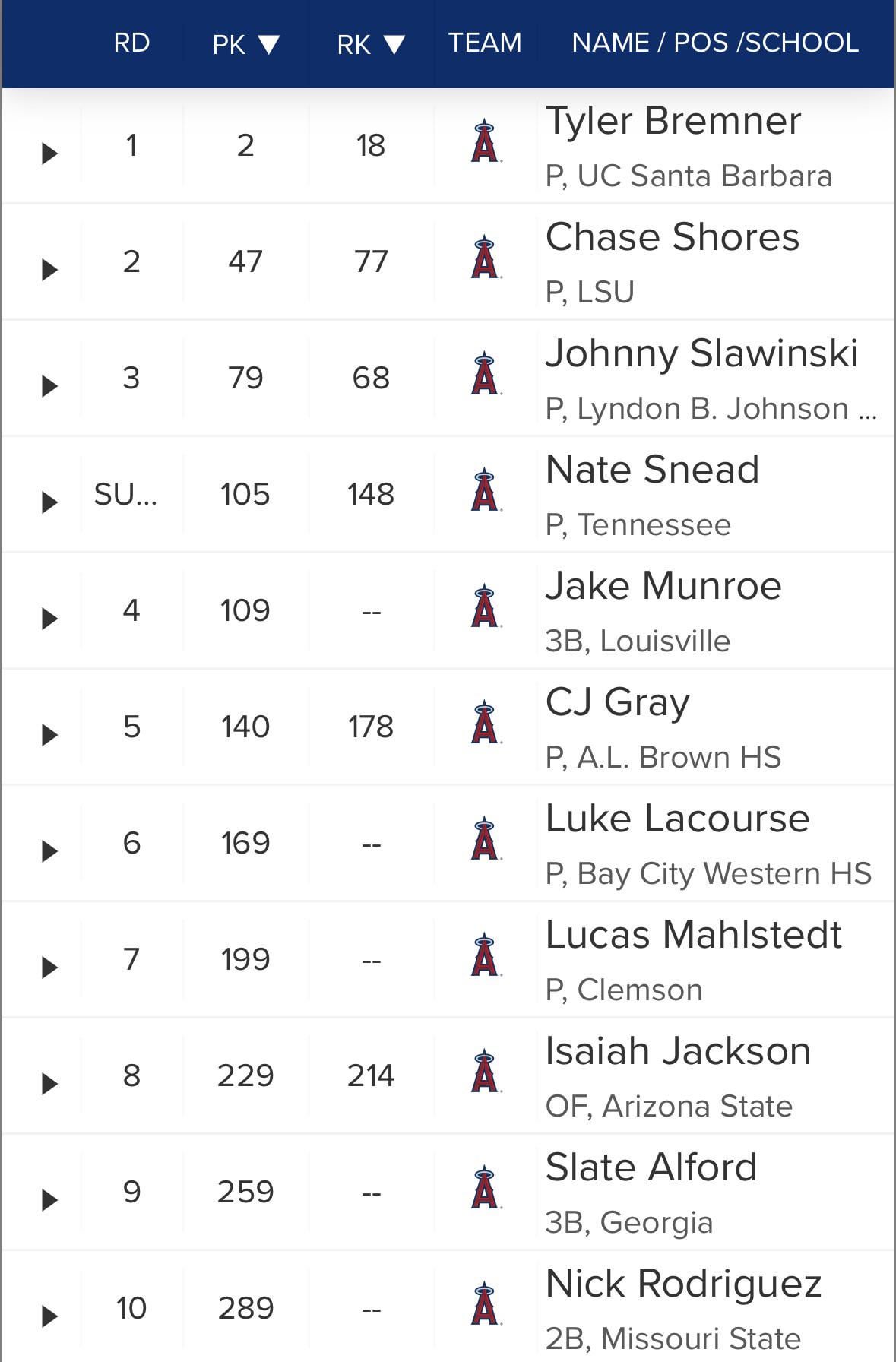
That’s a lot of pitchers… you think we have a pitching problem?
Pitchers and 3B, looks like there was a concerted effort to pick based on mlb roster positional needs rather than best talent available.
I like Monroe and y’know what? I’m okay with this draft the only issue is our buns ass pitching development and organization
It’ll be interesting to see how the teams Top 30 prospect list shakes out after the draft, 17 of the current top 30 are pitchers.
Asked ChatGPT to summarize and this is what I got For Nick Rodriguez & it did cite a local newspaper that was covering him along with bigger papers, Baseball America, USA Today, etc. If you guys want I’ll do it for the other picks going bottom to top.
Nick Rodriguez, 2B – Missouri State (Round 10, Pick 289 – Angels)
Rodriguez was one of the most productive seniors in college baseball this year. He slashed .372/.444/.733 with 16 HR, 21 doubles, and a school-record 33-game hit streak, showing off elite contact skills and surprising pop from the left side. His bat carried Missouri State, leading the MVC in slugging and runs scored.
Defensively, he made big strides after moving full-time to second base, finishing with a .980 fielding percentage and just 4 errors. Coaches praised his work ethic and game-planning on both sides of the ball.
Scouts describe him as a “performance-over-tools” type—nothing flashy, but the kind of consistent, smart player who grinds his way into a system. Not a burner or a big raw tools guy, but he knows how to hit, and he’s steadily gotten stronger each year.
Could be a sneaky-good pick for the Angels. Definitely earned more attention than he’s gotten.
Jack Bauer’s still available, I hope we pick him, or someone does soon. It’s absurd that a kid throwing 103 in HIGH SCHOOL hasn’t been drafted yet.
A physical corner bat at 6 ft 3, 220 lb, Alford put together a .331/.440/.649 slash line as a senior, with 19 HR, 63 RBI, and 71 runs scored in 60 games—good for a massive 1.089 OPS in SEC play . Over his career at Georgia, he collected 160 hits, 29 doubles, two triples, 36 HR, and 132 RBI across 120 games .
Defensively, he posted a .938 fielding percentage at third base and showed reliable arm strength and soft hands .
Scouts rave about his prodigious raw power—Alford launched moonshots at 115 mph exit velocity off Florida and 112 mph vs Arkansas . He was a First-Team All-SEC pick, rode a 37-game on-base streak, and cut strikeouts from ~21% to ~17% this year thanks to a refined approach and better discipline .
Bottom line:
• Offense: Elite power bat with a left-field line-drive stroke, walks at a high clip, and ability to hit in pressure situations.
• Defense: Solid third baseman: sound hands and arm strength, though not flashy.
• Risk/Reward: No burner, no gold-glove, but a guy who’s going to mash and should move quickly if he keeps that OPS up.
A terrific mid-round value for the Angels—high-upside slugger who can anchor a lineup.
Summary for Isaiah Jackson, OF – Arizona State (Round 8, Pick 229 – Angels)
Jackson is a physical, left-handed outfielder (6′3″, 220 lb) who broke out in 2025 with a .309/.440/.614 slash line, 16 HR, 65 RBI, and 29 XBH over 57 games. He came up big in clutch spots (.383 with RISP) and improved his two-strike approach after an offseason swing overhaul. Massive raw power (110+ mph EVs) and great plate discipline made him one of the most feared bats in ASU’s lineup.
Defensively, he was perfect—0 errors in over 140 chances—and earned All-Defensive honors as a center fielder with good range, smooth routes, and a strong arm.
⸻
Pros:
• Power + Discipline: Legit lefty pop with a great eye at the plate.
• Clutch gene: Hit .383 with RISP; came through in pressure moments.
• Flawless glove: 1.000 fielding %, plays a clean center field with plus arm strength.
• Size + Athleticism: Strong frame with room to tap into even more power.
Cons / Development Areas:
• Swing decisions: Can chase breaking balls at times; still refining strike zone discipline.
• Contact consistency: Power is loud, but some scouts think his hit tool is average and will be tested at the next level.
• Base stealing/speed: Athletic but not a burner; basepaths aren’t a huge part of his game.
⸻
Overall: Jackson is a great value in Round 8—high ceiling, strong tools on both sides, and standout defense. If he continues to refine his approach at the plate, he could develop into an everyday big league corner outfielder with sneaky center field versatility. Solid pickup by the Angels.
Summary for Isaiah Jackson, OF – Arizona State (Round 8, Pick 229 – Angels)
Jackson is a physical, left-handed outfielder (6′3″, 220 lb) who broke out in 2025 with a .309/.440/.614 slash line, 16 HR, 65 RBI, and 29 XBH over 57 games. He came up big in clutch spots (.383 with RISP) and improved his two-strike approach after an offseason swing overhaul. Massive raw power (110+ mph EVs) and great plate discipline made him one of the most feared bats in ASU’s lineup.
Defensively, he was perfect—0 errors in over 140 chances—and earned All-Defensive honors as a center fielder with good range, smooth routes, and a strong arm.
⸻
Pros:
• Power + Discipline: Legit lefty pop with a great eye at the plate.
• Clutch gene: Hit .383 with RISP; came through in pressure moments.
• Flawless glove: 1.000 fielding %, plays a clean center field with plus arm strength.
• Size + Athleticism: Strong frame with room to tap into even more power.
Cons / Development Areas:
• Swing decisions: Can chase breaking balls at times; still refining strike zone discipline.
• Contact consistency: Power is loud, but some scouts think his hit tool is average and will be tested at the next level.
• Base stealing/speed: Athletic but not a burner; basepaths aren’t a huge part of his game.
⸻
Overall: Jackson is a great value in Round 8—high ceiling, strong tools on both sides, and standout defense. If he continues to refine his approach at the plate, he could develop into an everyday big league corner outfielder with sneaky center field versatility. Solid pickup by the Angels.
Summary for Lucas Mahlstedt, RHP – Clemson (Round 7, Pick 199 – Angels)
Mahlstedt is a polished senior reliever who parlayed a physics degree into laser-level command and results. Over 39.1 innings, he struck out 54 batters while walking only 6 (a 9:1 K/BB ratio), posted a 2.06 ERA, and saved 15 games—ranking second nationally—and tying the Clemson single-season saves record . He earned semifinalist nods for both the Dick Howser Trophy and National Pitcher‑of‑the‑Year Award .
What sets him apart is his sidearm delivery, hitting mid‑90s from a low slot, with a low-90s fastball and sweeping breaking pitches. Clemson coach Erick Bakich praised his situational utility, often bringing him in multi-inning or high-leverage roles .
⸻
🏅 Pros:
• Elite command and control: Clearly demonstrated by the 54 K to 6 BB in under 40 innings.
• High-leverage experience: Season-long closer duties with 15 saves, plus multi-inning outings in big games  .
• Unorthodox delivery: Sidearm slot speeds deception, hides ball well—scouts noted he added 3 mph following spring tweaks .
• Award recognition: National semifinalist honors for both top reliever and overall college player .
⚠️ Cons / Development Areas:
• Role projection: Primarily a reliever; how long he can stretch out or if he can start remains unclear.
• Velocity threshold: Mid‑90s fastball is solid but not elite; may need premium spin or movement to thrive long-term.
• Arm slot consistency: Sidearm can be hard on the body; maintaining healthy mechanics over a longer season is key.
⸻
Bottom line: The Angels nabbed a smart, high-leverage lefty reliever (technically a righty throwing sidearm!) in Round 7—command, deception, and polish in spades. If he stays healthy, he could climb fast in the bullpen hierarchy. A savvy, low-risk, high-upside pick. 👀
Summary for Luke LaCourse, RHP – Bay City Western HS (MI) (Round 6, Pick 169 – Angels)
LaCourse is a polished high school arm who passed on Michigan State to sign with the Angels for around $515,000 . Over four varsity years he put up a 31–7 record, 1.67 ERA, and 340 strikeouts in 239⅓ innings . In his junior year alone he was 12–1 with a 0.57 ERA and 115 K, and as a senior he went 8–3 with a 1.68 ERA and 126 K/11 BB .
Scouts rave about his “spin-monster” slider, clocking 3,500 RPM with sharp two-plane break, a 94 mph fastball with ride, plus a cutter/changeup combo—all from a 6′4″, 220 lb frame . He also throws a curve and changeup, though the latter is a work in progress .
⸻
🏅 Pros:
• Dominant HS track record: 340 K’s, 1.67 ERA, plus state awards and national attention .
• Plus slider: 94‑mph heater and do-it-all secondary arsenal—slider leads the show .
• Athletic with polish: Multi-sport athlete with good build; improved velocity this spring .
• Mound demeanor: Coaches praise his calm, focused approach and leadership .
⚠️ Cons / Development Areas:
• Polish missing: Delivery needs repeating consistently, secondary pitches (curve, change) need refinement .
• Velocity ceiling: Mid‑90s FB is solid, but lacks stretcher velocity; may need premium spin/movement .
• Projection risk: HS arm always carries risk; skipping college is smart, but he’ll need pro coaching to refine mechanics long-term.
⸻
Bottom line: A polished HS arm with three solid pitches, a killer slider, and elite strikeout ability—plus the demeanor to match. If he locks in mechanics and refines secondaries, he’s a top talent with huge upside. The Angels pulled off a savvy mid-sixth-round grab and slapped it with a six-figure bonus. Keep your eyes on him. 👀
Summary for C.J. Gray, RHP – A.L. Brown HS (Kannapolis, NC) (Round 5, Pick 140 – Angels)
A two-sport standout (football QB + baseball), Gray skipped a commitment to NC State to go pro after the Angels scooped him up for around $519K slot value . He dominated high school with a .508 average and 11 HR at the plate, but it’s his arm that’s got scouts hyped—touching 97–98 mph, with a sharp curve and projectable changeup .
⸻
🏅 Pros:
• Electric fastball: Sits 93–96, spikes to 97–98 mph with ride and tail ().
• Athletic, multi-sport: Frame of 6′1″, fluid mechanics, with potential to touch triple digits .
• Secondaries with upside: Has a sharp curve and slider; changeup still in development .
• Athletic makeup & leadership: QB experience speaks to body control, competitiveness, and headspace ().
⚠️ Cons / Development Areas:
• Mechanics still raw: Needs consistency in delivery and release point for better command .
• Command inconsistent: Walks and HBPs at times—spin/feel needs polish .
• Secondary pitches not locked in: Curve is promising; slider and changeup need more refinement .
• Role/value projection: Likely reliever with upside to stretch out; long-term health and role transition are unknowns.
⸻
Bottom Line: Angels took a flier on a super-athletic, high-upside prep arm in Round 5 with C.J. Gray. If pro coaches can harness his velo and refine his secondaries and mechanics, watch out—this guy could be a late-inning weapon with starter traits. Risky, but the kind of upside that makes mid-round picks pay off.
A big-bodied right-handed bat (6′2″, 230 lb) who lit up Louisville in 2025, Munroe slashed .346/.451/.593 over 66 games with 13 HR, 61 RBI, 13 doubles, 4 triples, and 38 walks—helping power Louisville to the CWS and earning a spot on the College World Series All-Tournament team .
Before Louisville, he exploded in JUCO at John A. Logan with a combined .415/.510/.881 line, 23 HR, and 81 RBI, earning GRAC Player of the Year honors .
⸻
🏅 Pros
• Big, short swing = power + contact: Shows plus power (100+ mph exit velos) and makes consistent contact .
• Plate discipline: Walk rate (~12.9%) exceeds strikeout rate (~16.9%), showing solid strike-zone control .
• Postseason performer: Hit .378 with 4 HR in Omaha CWS – came through in the clutch .
• Proven performer at multiple levels: Success in JUCO and SEC-level ACC shows adaptability and maturity .
⸻
⚠️ Cons / Dev Areas
• Defense is shaky: Average range, occasional sloppy glove—13 errors at third base this season .
• Speed is limited: Below-average runner; base paths not a weapon and likely capped defensively ().
• Pull-heavy swing: Compact swing leans pull side—may struggle with off-speed and inside pro pitches .
• Position risk: If defense doesn’t improve, may need to shift to 1B or DH long-term.
⸻
Bottom Line: Munroe is a classic power-hitting guy—think bat-first, big-game bat, with contact skills and elite plate discipline. Scouts love the bat, less so the glove and wheels. Angels grabbed a fourth-rounder with serious middle-of-the-order upside if he can clean up third base or stick at first.
Snead is a 21-year-old flame-thrower who Texas-Tennessee fans will remember for his clutch bullpen work and high-velocity arm. The Angels grabbed him with the final pick of the first day—he’ll reportedly get a ~$730K bonus slot. Snead had a 4–2 record, 5 saves, and a 4.53 ERA over 49.2 innings this spring. He also tossed 75 innings in 2024 (10–2, 3.11 ERA), helped win UT’s first National Championship, went 5–3 across both seasons (125 innings), struck out 102, walked 47, and picked up 11 saves .
MLB.com grades his fastball 60-grade (capped at 101 mph), curve ~55, slider/cutter ~50, changeup ~45. Control sits around 50 overall—suggesting starter potential if he improves command . Angels plan to try him as a starter first—MLB.com even called him a “rare reliever with a five-pitch arsenal” .
⸻
🏅 Pros
• Triple-digit heaters: Fastball touches 100–101 mph with added movement .
• Five-pitch mix: Fastball, curve, slider, cutter, changeup—gives starter upside .
• High-leverage pedigree: Pitched in big games—College World Series, championship series saves, midseason All-American .
• Performance over two seasons: 14–4 record combined, led Vols in saves & innings .
⸻
⚠️ Cons / Dev Areas
• Control inconsistency: With 47 walks in 125 innings, his command doesn’t yet match his stuff .
• Fastball push: MLB.com noted his heater “has more sink than carry” and can get hit if left up .
• Reliever background: Worked mostly in bullpen—starter role is untested .
• Changeup not trusted: Lower-grade changeup (~45), still needs trust-building to stick as a starter .
⸻
Bottom line: Snead is a high-ceiling, high-risk pick—triple-digit fastball, five-pitch mix, and big-game experience make him intriguing starter material. If he sharpens his control and develops his changeup, he could climb quickly. Otherwise, look for him to settle into a late-inning role. The Angels scooped up a polished, high-upside arm with upside to grow into a frontline starter or back-end weapon. 👀
Day two has been very, very solid. There’s a reason why you wait until the end of a Draft before judging it.

16 comments
That’s a lot of pitchers… you think we have a pitching problem?
Pitchers and 3B, looks like there was a concerted effort to pick based on mlb roster positional needs rather than best talent available.
I like Monroe and y’know what? I’m okay with this draft the only issue is our buns ass pitching development and organization
It’ll be interesting to see how the teams Top 30 prospect list shakes out after the draft, 17 of the current top 30 are pitchers.
Asked ChatGPT to summarize and this is what I got For Nick Rodriguez & it did cite a local newspaper that was covering him along with bigger papers, Baseball America, USA Today, etc. If you guys want I’ll do it for the other picks going bottom to top.
Nick Rodriguez, 2B – Missouri State (Round 10, Pick 289 – Angels)
Rodriguez was one of the most productive seniors in college baseball this year. He slashed .372/.444/.733 with 16 HR, 21 doubles, and a school-record 33-game hit streak, showing off elite contact skills and surprising pop from the left side. His bat carried Missouri State, leading the MVC in slugging and runs scored.
Defensively, he made big strides after moving full-time to second base, finishing with a .980 fielding percentage and just 4 errors. Coaches praised his work ethic and game-planning on both sides of the ball.
Scouts describe him as a “performance-over-tools” type—nothing flashy, but the kind of consistent, smart player who grinds his way into a system. Not a burner or a big raw tools guy, but he knows how to hit, and he’s steadily gotten stronger each year.
Could be a sneaky-good pick for the Angels. Definitely earned more attention than he’s gotten.
Jack Bauer’s still available, I hope we pick him, or someone does soon. It’s absurd that a kid throwing 103 in HIGH SCHOOL hasn’t been drafted yet.
Summary for Slate Alford, 3B – Georgia (Round 9, Pick 259 – Angels)
A physical corner bat at 6 ft 3, 220 lb, Alford put together a .331/.440/.649 slash line as a senior, with 19 HR, 63 RBI, and 71 runs scored in 60 games—good for a massive 1.089 OPS in SEC play . Over his career at Georgia, he collected 160 hits, 29 doubles, two triples, 36 HR, and 132 RBI across 120 games .
Defensively, he posted a .938 fielding percentage at third base and showed reliable arm strength and soft hands .
Scouts rave about his prodigious raw power—Alford launched moonshots at 115 mph exit velocity off Florida and 112 mph vs Arkansas . He was a First-Team All-SEC pick, rode a 37-game on-base streak, and cut strikeouts from ~21% to ~17% this year thanks to a refined approach and better discipline .
Bottom line:
• Offense: Elite power bat with a left-field line-drive stroke, walks at a high clip, and ability to hit in pressure situations.
• Defense: Solid third baseman: sound hands and arm strength, though not flashy.
• Risk/Reward: No burner, no gold-glove, but a guy who’s going to mash and should move quickly if he keeps that OPS up.
A terrific mid-round value for the Angels—high-upside slugger who can anchor a lineup.
Summary for Isaiah Jackson, OF – Arizona State (Round 8, Pick 229 – Angels)
Jackson is a physical, left-handed outfielder (6′3″, 220 lb) who broke out in 2025 with a .309/.440/.614 slash line, 16 HR, 65 RBI, and 29 XBH over 57 games. He came up big in clutch spots (.383 with RISP) and improved his two-strike approach after an offseason swing overhaul. Massive raw power (110+ mph EVs) and great plate discipline made him one of the most feared bats in ASU’s lineup.
Defensively, he was perfect—0 errors in over 140 chances—and earned All-Defensive honors as a center fielder with good range, smooth routes, and a strong arm.
⸻
Pros:
• Power + Discipline: Legit lefty pop with a great eye at the plate.
• Clutch gene: Hit .383 with RISP; came through in pressure moments.
• Flawless glove: 1.000 fielding %, plays a clean center field with plus arm strength.
• Size + Athleticism: Strong frame with room to tap into even more power.
Cons / Development Areas:
• Swing decisions: Can chase breaking balls at times; still refining strike zone discipline.
• Contact consistency: Power is loud, but some scouts think his hit tool is average and will be tested at the next level.
• Base stealing/speed: Athletic but not a burner; basepaths aren’t a huge part of his game.
⸻
Overall: Jackson is a great value in Round 8—high ceiling, strong tools on both sides, and standout defense. If he continues to refine his approach at the plate, he could develop into an everyday big league corner outfielder with sneaky center field versatility. Solid pickup by the Angels.
Summary for Isaiah Jackson, OF – Arizona State (Round 8, Pick 229 – Angels)
Jackson is a physical, left-handed outfielder (6′3″, 220 lb) who broke out in 2025 with a .309/.440/.614 slash line, 16 HR, 65 RBI, and 29 XBH over 57 games. He came up big in clutch spots (.383 with RISP) and improved his two-strike approach after an offseason swing overhaul. Massive raw power (110+ mph EVs) and great plate discipline made him one of the most feared bats in ASU’s lineup.
Defensively, he was perfect—0 errors in over 140 chances—and earned All-Defensive honors as a center fielder with good range, smooth routes, and a strong arm.
⸻
Pros:
• Power + Discipline: Legit lefty pop with a great eye at the plate.
• Clutch gene: Hit .383 with RISP; came through in pressure moments.
• Flawless glove: 1.000 fielding %, plays a clean center field with plus arm strength.
• Size + Athleticism: Strong frame with room to tap into even more power.
Cons / Development Areas:
• Swing decisions: Can chase breaking balls at times; still refining strike zone discipline.
• Contact consistency: Power is loud, but some scouts think his hit tool is average and will be tested at the next level.
• Base stealing/speed: Athletic but not a burner; basepaths aren’t a huge part of his game.
⸻
Overall: Jackson is a great value in Round 8—high ceiling, strong tools on both sides, and standout defense. If he continues to refine his approach at the plate, he could develop into an everyday big league corner outfielder with sneaky center field versatility. Solid pickup by the Angels.
Summary for Lucas Mahlstedt, RHP – Clemson (Round 7, Pick 199 – Angels)
Mahlstedt is a polished senior reliever who parlayed a physics degree into laser-level command and results. Over 39.1 innings, he struck out 54 batters while walking only 6 (a 9:1 K/BB ratio), posted a 2.06 ERA, and saved 15 games—ranking second nationally—and tying the Clemson single-season saves record . He earned semifinalist nods for both the Dick Howser Trophy and National Pitcher‑of‑the‑Year Award .
What sets him apart is his sidearm delivery, hitting mid‑90s from a low slot, with a low-90s fastball and sweeping breaking pitches. Clemson coach Erick Bakich praised his situational utility, often bringing him in multi-inning or high-leverage roles .
⸻
🏅 Pros:
• Elite command and control: Clearly demonstrated by the 54 K to 6 BB in under 40 innings.
• High-leverage experience: Season-long closer duties with 15 saves, plus multi-inning outings in big games  .
• Unorthodox delivery: Sidearm slot speeds deception, hides ball well—scouts noted he added 3 mph following spring tweaks .
• Award recognition: National semifinalist honors for both top reliever and overall college player .
⚠️ Cons / Development Areas:
• Role projection: Primarily a reliever; how long he can stretch out or if he can start remains unclear.
• Velocity threshold: Mid‑90s fastball is solid but not elite; may need premium spin or movement to thrive long-term.
• Arm slot consistency: Sidearm can be hard on the body; maintaining healthy mechanics over a longer season is key.
⸻
Bottom line: The Angels nabbed a smart, high-leverage lefty reliever (technically a righty throwing sidearm!) in Round 7—command, deception, and polish in spades. If he stays healthy, he could climb fast in the bullpen hierarchy. A savvy, low-risk, high-upside pick. 👀
Summary for Luke LaCourse, RHP – Bay City Western HS (MI) (Round 6, Pick 169 – Angels)
LaCourse is a polished high school arm who passed on Michigan State to sign with the Angels for around $515,000 . Over four varsity years he put up a 31–7 record, 1.67 ERA, and 340 strikeouts in 239⅓ innings . In his junior year alone he was 12–1 with a 0.57 ERA and 115 K, and as a senior he went 8–3 with a 1.68 ERA and 126 K/11 BB .
Scouts rave about his “spin-monster” slider, clocking 3,500 RPM with sharp two-plane break, a 94 mph fastball with ride, plus a cutter/changeup combo—all from a 6′4″, 220 lb frame . He also throws a curve and changeup, though the latter is a work in progress .
⸻
🏅 Pros:
• Dominant HS track record: 340 K’s, 1.67 ERA, plus state awards and national attention .
• Plus slider: 94‑mph heater and do-it-all secondary arsenal—slider leads the show .
• Athletic with polish: Multi-sport athlete with good build; improved velocity this spring .
• Mound demeanor: Coaches praise his calm, focused approach and leadership .
⚠️ Cons / Development Areas:
• Polish missing: Delivery needs repeating consistently, secondary pitches (curve, change) need refinement .
• Velocity ceiling: Mid‑90s FB is solid, but lacks stretcher velocity; may need premium spin/movement .
• Projection risk: HS arm always carries risk; skipping college is smart, but he’ll need pro coaching to refine mechanics long-term.
⸻
Bottom line: A polished HS arm with three solid pitches, a killer slider, and elite strikeout ability—plus the demeanor to match. If he locks in mechanics and refines secondaries, he’s a top talent with huge upside. The Angels pulled off a savvy mid-sixth-round grab and slapped it with a six-figure bonus. Keep your eyes on him. 👀
Summary for C.J. Gray, RHP – A.L. Brown HS (Kannapolis, NC) (Round 5, Pick 140 – Angels)
A two-sport standout (football QB + baseball), Gray skipped a commitment to NC State to go pro after the Angels scooped him up for around $519K slot value . He dominated high school with a .508 average and 11 HR at the plate, but it’s his arm that’s got scouts hyped—touching 97–98 mph, with a sharp curve and projectable changeup .
⸻
🏅 Pros:
• Electric fastball: Sits 93–96, spikes to 97–98 mph with ride and tail ().
• Athletic, multi-sport: Frame of 6′1″, fluid mechanics, with potential to touch triple digits .
• Secondaries with upside: Has a sharp curve and slider; changeup still in development .
• Athletic makeup & leadership: QB experience speaks to body control, competitiveness, and headspace ().
⚠️ Cons / Development Areas:
• Mechanics still raw: Needs consistency in delivery and release point for better command .
• Command inconsistent: Walks and HBPs at times—spin/feel needs polish .
• Secondary pitches not locked in: Curve is promising; slider and changeup need more refinement .
• Role/value projection: Likely reliever with upside to stretch out; long-term health and role transition are unknowns.
⸻
Bottom Line: Angels took a flier on a super-athletic, high-upside prep arm in Round 5 with C.J. Gray. If pro coaches can harness his velo and refine his secondaries and mechanics, watch out—this guy could be a late-inning weapon with starter traits. Risky, but the kind of upside that makes mid-round picks pay off.
Summary for Jake Munroe, 3B – Louisville (Round 4, Pick 109 – Angels)
A big-bodied right-handed bat (6′2″, 230 lb) who lit up Louisville in 2025, Munroe slashed .346/.451/.593 over 66 games with 13 HR, 61 RBI, 13 doubles, 4 triples, and 38 walks—helping power Louisville to the CWS and earning a spot on the College World Series All-Tournament team .
Before Louisville, he exploded in JUCO at John A. Logan with a combined .415/.510/.881 line, 23 HR, and 81 RBI, earning GRAC Player of the Year honors .
⸻
🏅 Pros
• Big, short swing = power + contact: Shows plus power (100+ mph exit velos) and makes consistent contact .
• Plate discipline: Walk rate (~12.9%) exceeds strikeout rate (~16.9%), showing solid strike-zone control .
• Postseason performer: Hit .378 with 4 HR in Omaha CWS – came through in the clutch .
• Proven performer at multiple levels: Success in JUCO and SEC-level ACC shows adaptability and maturity .
⸻
⚠️ Cons / Dev Areas
• Defense is shaky: Average range, occasional sloppy glove—13 errors at third base this season .
• Speed is limited: Below-average runner; base paths not a weapon and likely capped defensively ().
• Pull-heavy swing: Compact swing leans pull side—may struggle with off-speed and inside pro pitches .
• Position risk: If defense doesn’t improve, may need to shift to 1B or DH long-term.
⸻
Bottom Line: Munroe is a classic power-hitting guy—think bat-first, big-game bat, with contact skills and elite plate discipline. Scouts love the bat, less so the glove and wheels. Angels grabbed a fourth-rounder with serious middle-of-the-order upside if he can clean up third base or stick at first.
Last one until the draft is finished
Summary for Nate Snead, RHP – Tennessee (Round 3, Pick 105 – Angels)
Snead is a 21-year-old flame-thrower who Texas-Tennessee fans will remember for his clutch bullpen work and high-velocity arm. The Angels grabbed him with the final pick of the first day—he’ll reportedly get a ~$730K bonus slot. Snead had a 4–2 record, 5 saves, and a 4.53 ERA over 49.2 innings this spring. He also tossed 75 innings in 2024 (10–2, 3.11 ERA), helped win UT’s first National Championship, went 5–3 across both seasons (125 innings), struck out 102, walked 47, and picked up 11 saves .
MLB.com grades his fastball 60-grade (capped at 101 mph), curve ~55, slider/cutter ~50, changeup ~45. Control sits around 50 overall—suggesting starter potential if he improves command . Angels plan to try him as a starter first—MLB.com even called him a “rare reliever with a five-pitch arsenal” .
⸻
🏅 Pros
• Triple-digit heaters: Fastball touches 100–101 mph with added movement .
• Five-pitch mix: Fastball, curve, slider, cutter, changeup—gives starter upside .
• High-leverage pedigree: Pitched in big games—College World Series, championship series saves, midseason All-American .
• Performance over two seasons: 14–4 record combined, led Vols in saves & innings .
⸻
⚠️ Cons / Dev Areas
• Control inconsistency: With 47 walks in 125 innings, his command doesn’t yet match his stuff .
• Fastball push: MLB.com noted his heater “has more sink than carry” and can get hit if left up .
• Reliever background: Worked mostly in bullpen—starter role is untested .
• Changeup not trusted: Lower-grade changeup (~45), still needs trust-building to stick as a starter .
⸻
Bottom line: Snead is a high-ceiling, high-risk pick—triple-digit fastball, five-pitch mix, and big-game experience make him intriguing starter material. If he sharpens his control and develops his changeup, he could climb quickly. Otherwise, look for him to settle into a late-inning role. The Angels scooped up a polished, high-upside arm with upside to grow into a frontline starter or back-end weapon. 👀
Day two has been very, very solid. There’s a reason why you wait until the end of a Draft before judging it.
Go Dawgs!