
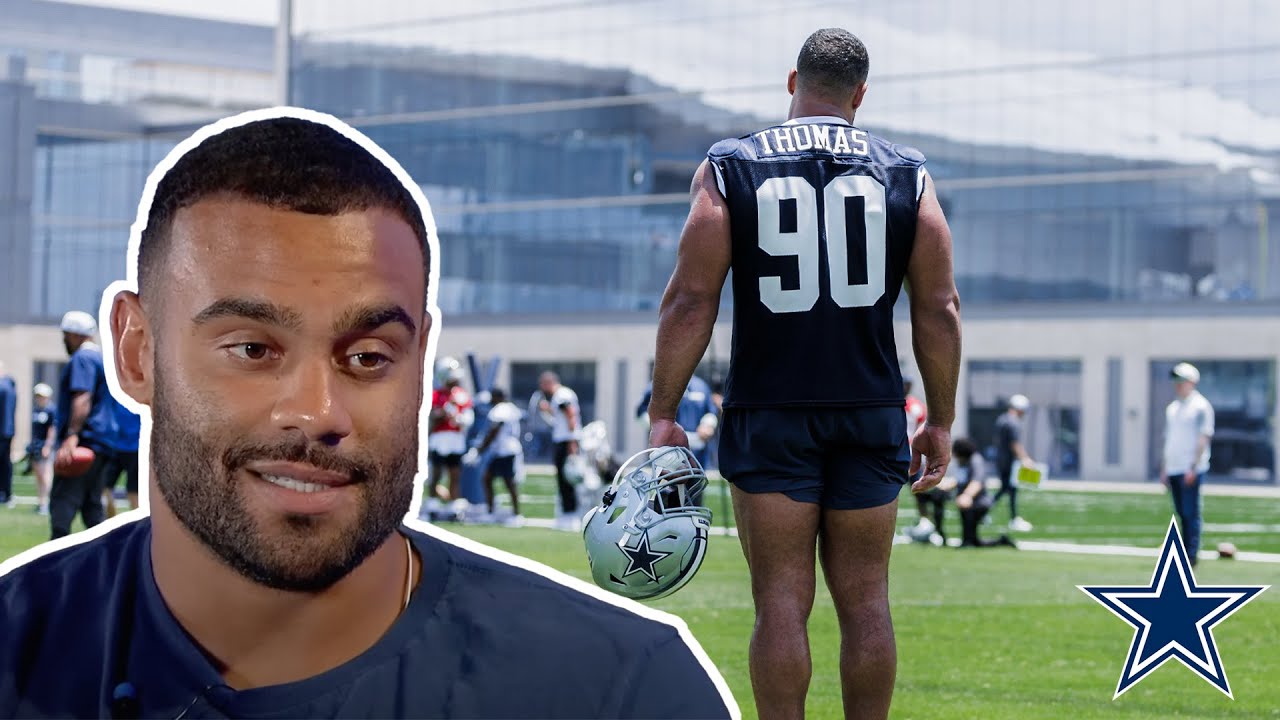
Solomon Thomas and Tommy Yarrish Interview | Dallas Cowboys 2025
Hey folks, Tommy Yarish here along with Cowboys defensive tackle Solomon Thomas. Solomon, thanks so much for making some time today. It’s been quite a whirlwind for you these last couple of months. You come back home, you’re a Capel Cowboy, now a Dallas Cowboy, recently engaged, and now you get to play in front of your family. I know that’s something that means a lot to you. What’s this last couple of months been like, and now being back at home, getting to play for your hometown team? Well, thanks for having me, Tommy, and it’s a honor to be here. Um, it’s just been the world being home. Like growing up here, growing up in Copel, going to Cowboys games, growing up, and now getting to play in front of my hometown crowd, in front of coaches that I played for, my family, my fiance, just my friends. Um, you know, I’ve loved Dallas. I’ve spent all my offseasons here. I have my trainer out here, um, my treatment guy who takes care of my body, gets my body right. So, everything’s just kind of been falling into the silver lining, just like being home, being around my people. Um been an amazing off seasonason back with coach White Cotton here and being able to see coach Shotti take control of the team which has been super cool and getting to know the guys has been amazing. And then on top of that, you know, like life milestone milestone moments like getting engaged to my fiance who supports me every day, lets me do this and um just makes me a better person has been amazing. So um it’s an honor to be here and I’ve just been loving it being back home and loving being in Dallas. I know it’s been a long road to get to this point and you’ve been through a lot of challenges, especially early in your NFL career. How much of those experiences made you appreciate the good moments like right now? I mean, they made me appreciate them so much more. Like, I don’t take anything for granted in this league. I’ve been blessed and lucky enough to play to go go into my ninth year and I’ve been through all you can be in in NFL season like own personal ups and downs and then starting off with a team who was own 14 the first you know 14 weeks of the season and then um losing head coaches in the middle of the season you know going to the Super Bowl losing um you know I’ve I’ve seen it all so like you know my experiences I’m thankful for each and every one of them because they made me who I am today um but they also make me appreciate all these moments of you you know, playing in certain places, but also now getting to play in front of your hometown crowd and being on such a star-studded talented team with a great head coach and um a position coach that I love dearly. Um it just makes me appreciate them so much more and makes me want to come into work, give my all, be the best player, best sol that I can be um and help, you know, my hometown team, you know, win a Super Bowl. And that’s that’s my whole goal. Over the course of your career, you’ve gone by a lot of titles. You’re the third overall pick. You’ve been a Walter Payton man of the year award nominee several times, but I know it’s one from earlier in your career and earlier in your life that means a little bit more, and that’s Ella’s little brother. Why does that title mean so much to you? Um, you know, it means the world to me just cuz like my big sister was my everything growing up. You know, she was the person who taught me how to be myself and how to love myself and how to be vulnerable. You know, Ella was just this person who had who could take control of a room. you know, she she had this uh this laugh and this smile that would uh encapsulate a room and she just knew how to make let people be herself. And that’s what she taught me. You know, she um would just let people like she like one of her best friends would call her the human narrator because she could get a group of jocks, the band team, the debate team. She could make everyone in the room feel okay being themselves. And that’s just something she taught me. Um and growing up, Ella was always a cool one. and she was the better athlete. She could make friends, she could dance, she he, you know, she dated people, all these things. And um, you know, so I always grew up as Ella’s little brother. And it wasn’t until I went to Stanford and got in the NFL where, you know, she was my sister. And um, you know, just reminds me of where I came from, who I am, and just the person that she means to me. And, um, you know, that’s she’s my why. She’s the reason I do the things I do in the community. She’s the reason I’m vulnerable and put my feelings out there. Um, and she’s the reason I want to, you know, make the world a better place, you know, and let people know it’s okay not to be okay, you know, understand the importance of mental health and, um, just stay here in moments of, uh, depression and, um, you know, when they feel like their backs against the rope. And, you know, a lot of people think that for football players and especially for you, the day your life changed was that you got drafted, but it was really about nine months later on January 23rd in 2018. What changed that day? Um, you know, that was to this day the worst day of my life. Um, you know, woke up thinking it was going to be a regular day. Go to training. Um, you know, in my mind, my mindset’s like, “Hey, I’m going to come back and have um a stellar second season and prove to everyone why I was a third pick, you know, prove myself right type of mentality.” And, um, get a phone call from my dad later that day and and realize that, you know, my sister had died by suicide. Um, and completely shocked my world. Um, flipped my world upside down. Um, you know, my sister, like I said, was my best friend. and she was my everything. She taught me how to do everything. She was a person who in a world where I felt alone at times, she made me feel the most comfortable in this life. And now just all of a sudden from a phone call, she’s gone. And her physical body is gone forever. Um, you know, and it was the hardest moment for my family and I and the hardest moment for me to lose a sibling and my only sibling. Um, and especially by suicide, you know, um, even though the conversation of mental health has gotten more comfortable, people talk about it, it’s been trending. Um, even in 2018, it wasn’t something that people talked about much. It was, um, you know, still people talked about Ella dying, but they wouldn’t talk about how she died or why she died or, um, what was the reason for this or like how to even include mental health or suicide in the conversation. And so um it just made me and my family feel very alone and felt like you know it wasn’t something okay to talk about you know especially a man in the locker room who you know who grew up in the locker room where we don’t talk about feelings we don’t cry you know we make fun of these things like it’s not something that comfortable or welcome I just felt like I couldn’t result to that and you know and because of that you know losing Ella and being in the locker room when I’m trying to prove myself as a third pick and in a time where fans would use that as oh he’s using that as an excuse for not playing well. And um you know, I just resulted to the darkness. I I I stayed in the darkness. And um anytime these feelings came up of anxiety, grief, depression, um confusion, anger, I would just push them down cuz I was like, I’m a man. I can’t feel that. Um you know, I have to take care of my parents. I have to hold everything down. Um but these would keep bubbling up and festering. And and it got to a point where my whole world was dark. And you know, I didn’t want to be here anymore. I didn’t want to wake up. I didn’t want to go to sleep. I was just constantly stuck in suicide ideation where you know the thought wouldn’t go away. Um and you know through my mom and my general manager at the time John Lynch who um let me know it’s okay to get help and let me know hey we have help here for you. I started going to therapy and from that just learned how to deal with my grief, how to deal with my depression, how to um, you know, bring my grief with me every day, bring my sister with me every day, how to honor her through crying, how to honor her through talking about my feelings and being vulnerable just like she taught me. Um, you know, I I found myself again. I found the light again. And from that, you know, and losing a sister to suicide, I just saw the huge problem we have in our society, in the United States, and in the world with mental health and how we live in this archaic mindset of like, oh, be a man, be tough. Mental health is just a feeling. It’s something you can get over. Um, and it motivated me and my family to do something from that. And, you know, we wanted to change that. We wanted to make sure no one felt like Ella. We wanted to make sure no one felt like me, my mom, and dad feel from losing someone to suicide. And so, you know, from that we got this courage and strength and we started a nonprofit called the defensive line where our mission is to end the epidemic of youth suicide, especially for young people of color by transforming forforming the way we communicate and connect over mental health. And you know, we started going into schools, businesses, collegiate sports programs, and just teaching those how to have the conversation about mental health. Um, you know, we run these suicide prevention programs where we would equip everyone in the room, whether you’re a coach, CEO, teacher, um, janitor, if anyone over a group of youth, anyone that can mentor or oversee someone, how to have the conversation, how to equipping them with the language to talk about it. Um, giving them making them write up uh, um, action plans for if a situation came up so they’re comfortable with it and they know how to handle it. um connecting them with the resources in the area so they can send a student to su um send a student to um therapy or teach them how to breathe, how to do box breathing, teach them how to journal, meditate or just take a breath and and you know understand things are okay in life and they’re going to be okay. um you know and it’s been a really hard journey like this work is not easy and um that day of January 23rd, 2018 like is the reason why we’re doing this work and it’s the reason our motivation for this work um and you know we’re just going to keep going to keep as many people here as we can. And you mentioned the locker room aspect of it and the fact that you know the locker room culture seems to be all right we’re tough just shake it off or or move on and find a way but it it’s never that easy. How did how did you see yourself kind of battle that and how did you see your teammates at the time and even over the course of your career respond and support you along the way? Yeah. No, I mean being in the locker room is really hard. Um and it’s not easy for any player to be vulnerable and talk about the mental health. You know, we’re being criticized, judged, um we’re being monitored on every aspect, whether it’s from scouts in the building, other scouts around the league, fans, family members, you know, whoever it may be. like we’re put on a pedestal and just being con constantly judged. So, it’s hard to feel like we have that space and comfortability to just be vulnerable and and tell people how we really feel. So, that’s like where a lot of the resistance comes from. And even just like being the the arcade mindset of being a man of like, you know, there, you know, if you’re silent, you’re strong. If you can, you know, push it down and not cry, like that’s like what being a man is. So those mixed together have made this behavior or made this culture in the in the locker room like this thing. And so um even my first year in the league when I was a rookie, we had a um a team uh psychologist or clinician and I remember she was sitting at the at the lunch table and this is before my sister had passed. Um and I was about to go sit down with her and he said, “Hey, you can’t sit with her. People are going to think you’re crazy.” And I just like was so confused in that moment. sat down with him and I was like, I don’t I didn’t understand why he said that. That didn’t really make sense to me. Um, and then my sister dies and then like I’m now in the space where I’m struggling, but I don’t know how to ask for help. And I’m just trying to figure out like, you know, how to get my life back on track. And then I’m trying to take this big courageous leap of being vulnerable and telling my sister’s story and my story of mental health and my story with suicide ideation and just depression and struggling. Um, and that was one of the hardest things that for me to break that barrier was like, what are guys in the locker room going to do? Are they going to judge me? Are they gonna um think I’m being weak or think I’m trying to make excuses? Like, and that was the hardest thing in therapy that to get over with my therapist and um of coming out and doing stories with ESPN or um you know, whoever may wanted to do an article or write up on you know, my family’s tragedy at the time. Um, but when I did it, you know, I was so fortunate and very blessed to be around some amazing teammates who lifted me up and and helped me through those times. Guys like Eric Armstead, DeForest Buckner, Joe Staley who just made me feel comfortable and like, you know, they would come to me after article and be like, “Hey, sorry, like that was a really powerful article.” Or ask me how I was doing. Um, you know, you know, guys like DJ Jones who are my close friends at the time just like really helped me through the way. And after I started speaking and and doing these things, I started seeing the behavior in the locker room change, like my the year after Ella died, after I’d spoken out a few times and started being vulnerable and and living a new lifestyle and talking about us publicly, um I would have guys in the locker room quietly come up to me and ask like, “Hey man, how do I get into therapy?” Or, “Hey man, how was therapy?” And having those small conversations or, “Hey, I’m have a loved one struggling. How do I get them help?” And you know, that was the beginning of it. And then I go to the Raiders and I just have so many guys come up to me and being like, “Hey man, I want to get in therapy. Like, how did you start? Like, what’s the process like? Can you recommend me to someone?” Um, and you even had one of my close friends to this day at the Raiders like credit one of his best seasons in his career due to starting therapy and and being able to be his best self and how therapy has helped him. Um, and then from there it just took off. like at the Jets, we just started having regular conversations about mental health in the locker room and in the Dline room. Um guys being like, “Hey, I got to go to therapy and not hiding it, not being like, “Oh, I got to talk to my mom or my girl.” Like like no, like I actually got to go to therapy. Um, and it’s been just been super cool just to see the transition and the um, just the progression in like guys from the locker room being vulnerable and they all not a credit just to me but to all the guys who speak out like Max Crosby, Darren Waller, AJ Brown, um, Dak Prescott, you know, who’s a huge proponent of mental health um, and has a similar story as mine. Like these are all guys who are changing the environment and the behavior of it and letting men know that this is okay. Like we all go through these things. It’s normal to go through them actually. Like we’re all going to go through them at some point in our life. So if we go through them and talk about them publicly and I mean not publicly, vulnerably like it lets others know that hey it’s okay. I’m not the only one going through it and you feel more human and then you can live a full human experience. You mentioned Dak Prescott there and the similar story that the two of you share and I know when with your defensive line foundation even before you were in Dallas, you and Dak Prescott’s Faith Fight Finish Foundation had kind of worked together in the past. Now that you’ve gotten to share the field together and share the building together, how have you seen your relationship with Dak grow? And what do you think the two of you kind of working together continually through your foundations can continue to do to kind of push to end the stigma? Yeah, I mean just in general just having Dak as a teammate has been awesome. Like I haven’t been around too many teammates like Dak who are able to connect with every single player on the team. Like he goes out of his way to talk to every player, um, every staff member. He treats everyone like family, which is super rare, but just a power and testament to the teammate and the leader he is. Um, so just to see like my relationship with him just grow from that and just get to know him even more just as a teammate, not just as a a friend through a tragedy, um, has been huge. But, um, you know, our foundations have done a lot of work together. Um, his Faith Fight Finish Foundation is amazing. They do they do so many areas and sectors of of the community that need help and you know, they pour so much into it, which is huge. Um, but you know, I’m super thankful for them. They’ve lifted us on a pedestal. Um, because we’re a smaller nonprofit. Um, and they’ve donated to us. They help they they’ve helped us run our programs. Um, they’ve helped fund them and and they’ve like given us a light um that we have needed and um I’m super thankful for that and I’m just excited to do more to do more work with them. we’re already in talks of that and they’re helping us get into more schools and more school districts in Dallas and um they’re just helping our light shine and you know it’s I’m super thankful for him and his foundation and all the work they do um and just thankful for his vulnerability um you know it’s different being a Dallas Cowboys different being the Dallas Cowboys star quarterback and um the whole world of America is looking at you it’s America America’s team and so his the audience that he can hit with his voice and his vulnerability is huge and he does that and he’s changed and helps so many lives and I’m super thankful for his vulnerability, his strength. you and your foundation put on your annual youth camp a couple of weeks ago at your alma mater in Capel and you know I thought one of the interesting things from that camp is a lot of times you go there it’s drills you play a little game you take a picture with the athlete and the kids go on their way but you started the camp a little bit different with meditation and a conversation about mental health with a lot of kids who are maybe in middle school or going on to high school you don’t really see that and you don’t really see people who have gone through a tragedy like yours be so open about it. Usually they just want to, you know, not think about it so that it doesn’t bring the pain back, but you’ve been the inverse and you’ve talked about it as much as you can to try and push it forward for that next generation of kids and even older folks as well. Why is that so important to you and what’s what’s why is that message so important? Um, it’s so important to me because when you look at the statistics of mental health and when kids start dying by suicide or start struggling with mental health, they start at ages as early as as late elementary school, fifth, sixth grade. Um, so these are the age groups that are coming to my camp. And I want them to learn from the things I’ve learned from, and that’s from holding my emotions in, trying to be a man, trying to be someone in the locker room that’s, you know, cool and lives up to everyone everyone else’s standards. I want to try to have them learn from that and understand you don’t have to be that. There’s no strength in the silence. That being a man is being vulnerable. Cuz that takes real strength. You know, when I was at my worst struggling, it was so easy for me just to be like, “Hey, I’m okay.” But what would the what was the hardest thing for me was to be like, “Hey, like I’m struggling. I need help.” That took all the strength in the world. So, I want to teach them these lessons and I want to teach them a little bit about my like every day and like how I get through a game day. And I start every game day with my um sports psychologist. We do a meditation and we just go through it because you know I’m anxious before a game. I may have things going on in my head and I’m just trying to be centered and like meditating and breathing get me back control and my heart rate down let me focus on the task at hand. Take one things at a time kind of like I can control the day instead of the day controlling me and I just want to take them through that. So, um, and me showing them how to meditate and having them meditate maybe the first time, it might be something that helps them. Like some of them might be high anxiety kids, high stress kids, they may feel like life can never calm down. So, teaching them how to meditate and be centered is something that I want to do for them. Um, and just to give them that that resource, that avenue of of help and another coping mechanism. Um, you know, that that’s huge for me. And so I just want them to understand that hey this is a cool thing to do like to take care of yourself, take care of your mental health is cool and this is how I practice it. So how about we do it all together and you know it’s my favorite part of my camp. I started doing the meditations like three years ago. Um and you know it’s always been my favorite part just to see kids like try it for the first time and try to breathe and close their eyes and it may be a little weird or awkward the first time but you get more of a hang of it and um it can be a really useful tool. So, I just trying to pass on tools and resources to them um just like I was given later in my life just so they can get it earlier and and start that so they can kind of get that help going. You’ve already done so much up to this point for foundation for mental health and in your career. What’s next for Solomon Thomas the football player and Solomon Thomas the mental health advocate? Um for me, what’s next? I mean, I’m every day I’m just trying to be the best me I can be. you know, I’m just trying to live every day like, you know, I’m thankful for it, like I’m grateful for it. Um, I want to find a way to get better every single day. I’m I’m a big Kobe guy, so like it’s always like 1% better every day. You know, you know, be present, you know, focus on what you can control. So, those things. So, um, every day, like I wake up with the mentality like, hey, I’m working to be an allp pro. Like, never done in my career, never been close, but, you know, I’m I’m going to work for it every day and I’m going to go try to be the best Solomon Thomas, best all pro football player I can be. And being the allp pro player, I want to help my team win a Super Bowl. Like that’s my total goal. I want to be the best Solomon. I want to win a Super Bowl. Um, you know, I want to be an allp pro. I want to make a Pro Bowl. I want to do all these accolades and things because I know it’s inside of me and I know I can do it. Um, but then on top of that, I just want to be the best me. I want to, you know, in such a short time in this life of playing in the NFL, you have a small window to impact others on this pedestal of being an NFL player. Um, and I understand what comes with that. The, um, I understand the gravitational pool that comes with like being that pro pro football player. And I want to use it for good. You know, I want to take advantage of every second I have of it to give back to the community, give back to kids, make people’s life better. You know, I’m very fortunate and my parents always taught me like, you know, you give back, you help others when you, uh, where you can. And so whether that’s at schools, um mental health, um you know, feeding the homeless, you know, doing all these things, like I want to make sure that I’m finding a way to impact everyone in every way they can be, you know. Um we’re here to influence others. We’re here to help others along the way. Um and I’m just trying to do my part and um do all I can to make this world a better place and keep people here alive and keep people here understanding that they’re going to get through whatever dark storm they’re going through, that it’s okay not to be okay. um and that they can they can make it. One guy that I know has helped you a lot and that you really admire is Aaron Whitecott, the new Cowboys defensive line coach. You spent some time with him your last sit in New York. How have you seen your new teammates respond to him and his coaching style? And what are your overall impressions of the defensive tackle room in Dallas? Um I love Coach Wcon. You know, me and him have been together for like four or five out of my nine years now. And um he just means the world to me. you know, he’s a guy who is going to demand every ounce of energy out of his guys. He’s going to push it out of you. He’s going to yell in your face. He’s going to make you feel um angry at times, but it’s all because he loves you. And that’s what I’ve seen here at the Cowboys. I’ve seen the guys love him because if he loves them, like a lot of coaches like who would get in your face and yell or get angry or be high intensity, sometimes you stray away from. with him because you can tell he actually cares about you as a human being and as a player and he wants the best for you. Guys buy into that. So, it’s been cool to see the way he’s impacted this room. Like the guys love him already and they work their tails off for him, which has been super cool. Um to have a coach come in right away and see guys work like that for him. Like the leadership he provides in the room, the standard he sets. Um no one waivers on that because they don’t want to let him down and he makes you know you’re letting yourself down if you’re not standing up um not lining up to that standard. Um, so it’s been super cool and just the room’s been awesome. I love the guys. They’ve welcomed me with open arms and embraced me as a new player and, you know, as a new player. I’ve been to a new player three times now and it can be hard. It can be hard coming in with no friends and not knowing who is who and um, they’ve just kind of made me part of the room and it’s been, we’ve gotten super close really quick. You know, the culture in our D line room is family. Um, and no one messes with us but us. And uh, it’s been awesome just to see us grow and to see us grind. you know, some of the hardest workers on the field and um you know, we’re setting the standard of like raising that defense to be one of the defense, one of the best defense in the league. Um and it’s going to be fun and we’re looking forward to see it. Solomon Thomas, Cowboys defensive tackle. Thanks so much for your time. Thank you, Tommy.
Cowboys defensive tackle Solomon Thomas sits down with beat writer Tommy Yarrish to tell his story, including why he started his foundation “The Defensive Line” and how he’s trying to help teach the next generation about the importance of mental health.
#DallasCowboys #CowboysNation #NFL
Subscribe to the Dallas Cowboys YouTube Channel: https://bit.ly/2L07gMO
For more Cowboys content: https://www.dallascowboys.com/
Follow us on Instagram: https://www.instagram.com/dallascowboys/
Follow us on TikTok: https://www.tiktok.com/@dallascowboys?lang=en
Follow us on Twitter: https://twitter.com/dallascowboys
Like us on Facebook: https://www.facebook.com/DallasCowboys/
Get the App: https://apps.apple.com/us/app/dallas-cowboys/id548528027
18 comments
Chacune de vos vidéos est une véritable découverte ! Merci pour vos idées ! 😛💕
Very inspiring! I will look forward to more videos! 💕😚
YARRISH. GREAT GREAT INTERVIEW. CONVERSATIONS LIKE TBIS OPEN PPLS EYES UP TO THE STRUGGLES OF ATHLETES LET ALONE PPL. I COMMEND U SIR. #TEAMNOC. LOL.
LETS GO COWBOYS
Incredible work by Tommy in navigating this.
Solomon's story is an inspirational one.
🏈 LET'S GOOOOOOOOO 🏈
He looks like Dak! I think this was a GREAT! Move in adding him to our roster! A Texas Native and a good person. GO COWBOYS!
Daks big brother lmao! Dudes solid as hell man!! Love it, cant wait to get a big soloman thomas dallas cowboys card this year!
Awesome, go "Cowboys"
Underrated with the jets
Cant wait to see this brother against the fucking bitchass EAGLES! GO COWBOYS!
Solid dude rooting for u Solomon
Love it, glad he’s here.
This was a beautiful interview!!! It’s shows the human side of sports.
Great interview, I believe Solomon will be a great Cowboy and leader here. I can see why they were so taken with him.
Thanks for sharing and caring Solomon and Tommy! I hope you both have great seasons.
Dak's twin without a doubt!!!
Dak's lookalike with big muscles Solomon Thomas is a awesome addiction to the team and a dominant piece to the D-Line. A very great interview, it was nice to hear about Solomon's story.