
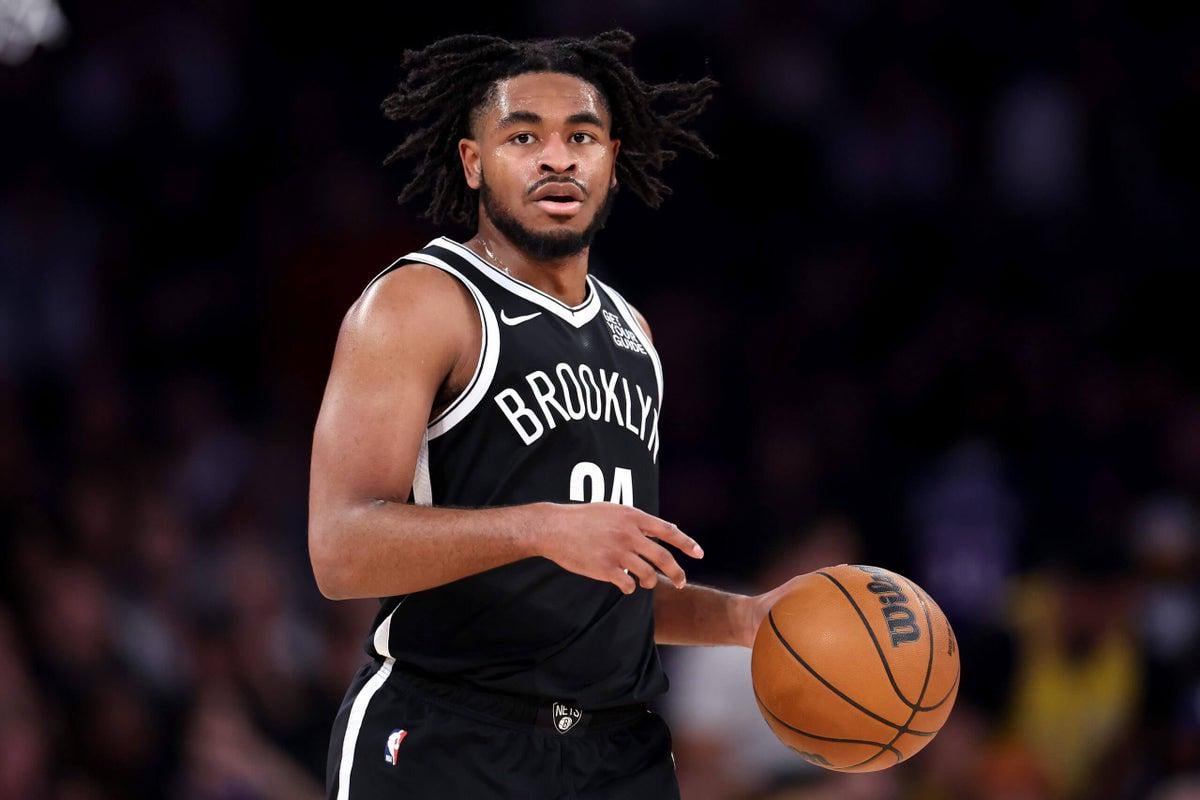
No NBA team is more desperate for shot creation than the Brooklyn Nets.
The offense’s best chance to fabricate an open look comes possibly from an unpolished 19-year-old, Egor Demin, who Brooklyn selected with the No. 8 pick in last month’s draft. Or maybe it’s from a veteran scorer who feasts on spot-up jumpers but isn’t known for his work off the dribble, Michael Porter Jr. Or it’s potentially from former second-round pick Tyrese Martin, who caught fire in spurts pulling up from long range this past season but was on a two-way contract until February.
As of now, these are the best options to run the Nets’ attack. And yet, the team’s former scoring machine, Cam Thomas, still rests untouched in the wilderness of restricted free agency.
The Athletic recently polled 16 members of NBA front offices (including no one from the Nets), asking what they would consider a “fair” contract for each restricted free agent who remains unsigned: Thomas, the Golden State Warriors’ Jonathan Kuminga, the Chicago Bulls’ Josh Giddey and the Philadelphia 76ers’ Quentin Grimes.
The Kuminga, Giddey and Grimes results have already been published. Now, it’s on to Thomas, who inspired the widest range of responses out of anyone in the poll.
On one side are the people who believe that Thomas’ gaudy numbers warrant a payday. The highest average annual value proposed for him was $30 million a year. On the other are those who question if his score-first approach is conducive to winning.
Thomas averaged 24.0 points and improved as both a pick-and-roll ballhandler and facilitator in 2024-25. But he played only 25 games due to a hamstring injury and still has to improve as a passer and defender. His status left even high-ranking front office personnel wondering what his next deal might look like. No matter the response provided, participants in the poll were uncertain if their answer was mainstream or against the grain.
“This is the hardest one,” one executive said.
Another respondent deemed a two-year, $32 million contract for Thomas fair, but provided a caveat.
“I wouldn’t be shocked if this was way lower or higher,” he said. “His scoring is very much ‘eye of the beholder.’”
The one consistency in responses for the 23-year-old Thomas was short-term contracts. For instance, compare his results to those of Grimes. People in this poll were more willing to give Thomas a higher average annual value ($16.7 million for Thomas compared to $14.7 million for Grimes), but they were more comfortable handing Grimes total money ($47.7 million guaranteed for Grimes compared to $42.7 million guaranteed for Thomas).
Participants mentioned all types of structures for Thomas.
One person suggested a two-year contract but with a team option on the second season. That one was worth $20 million a year. Seven other respondents suggested two-year deals: two contracts were for $20 million total; one was for $28 million; one was for $29.3 million (the exact value of the midlevel exception); one was for $30 million; one was for $32 million; and one was for $50 million.
But that $50 million contract came with an asterisk: not all of it was guaranteed.
The first year pays Thomas $25 million. The second is guaranteed for only $5 million. So Thomas receives either $30 million for one year of service or $50 million for two, handing him a pseudo-expiring contract for the upcoming season or a definite expiring deal for the next one.
A bloated, one-year payment, this executive argued, could be enough to sway Thomas against picking up the qualifying offer, which would pay him $6 million in 2025-26 but allow him to hit unrestricted free agency next summer.
“It keeps the Nets’ (cap space) alive for next year, gives Cam the money he wants per year in the short term, and he doesn’t lose Bird rights if he’s traded (like he would if he took the qualifying offer),” the executive said.
The Nets have one element going for them in negotiations: Creating leverage is not easy for Thomas. Since he is a restricted free agent, Brooklyn can match any offer sheet he signs with another team to bring him back for the same price. Of course, Thomas would struggle to find a suitor anyway. The only team with enough cap room to make him a meaningful offer is the one he played on last season.
Brooklyn is preparing for another season at the bottom of the standings. The Nets are looking to the future, one reason participants in the poll concentrated on them retaining Thomas for what they would consider a tradeable salary.
The executive who suggested the two-year, $30 million contract focused on keeping the second year, not the first, under the midlevel exception, which projects to be a shade above $15 million in 2026-27. In that case, Thomas could receive $15 million in each season, instead of approximately $14.5 million in Year 1 with a conventional five- or eight-percent raise to follow.
This would allow Brooklyn to trade Thomas into another team’s MLE either next summer or next season without having to match salaries.
Five respondents proposed three-year contracts: one for $48.6 million (with a player option), one for $50 million, one for $51 million and one for $90 million, which was the most total money and the highest average annual value suggested for Thomas.
“I wouldn’t personally give (it to) him … But I justified it as ‘fair’ because if I’m him, I’m saying I’m better than Jalen Green and that’s way less than he got,” said the staffer who suggested the $90 million contract.
Green received a three-year, $105 million extension this past summer after averaging similar scoring numbers on comparable efficiency. Of course, Thomas put up his statistics on a 26-win team. Green has a cleaner health history and was a former No. 2 pick, which arguably should not matter in these negotiations but often does. Thomas was the 27th selection in the same draft.
Three respondents submitted four-year contracts: One for $50 million, one for $60 million and one for $80 million.
In the end, eight of the 16 participants in the poll suggested a three-plus-year contract for Thomas. For perspective, 15 of the 16 proposed deals of at least three years for each of Kuminga, Giddey and Grimes.
“The teams clearly don’t feel like the player or current market dictate longer deals at higher dollars,” one executive who proposed a short-term contract said. “If I am the player (or) agent, then give me the ability to get out a little early, retain my Bird rights, and make an at least respectable salary that I can sell myself on taking.”
There is the issue of archetype, too. Off-guard scoring is not at a premium right now.
The Utah Jazz waived Jordan Clarkson, who then signed a minimum contract, and dumped Collin Sexton without receiving future pieces. Tim Hardaway Jr. signed for the minimum. Gary Trent went for the minimum last summer and barely above it this one. The Miami Heat traded a couple of veterans not on Norman Powell’s level to acquire Powell.
But no team needs a player of this ilk, someone who can get a bucket off the bounce or even occasionally create for a teammate, quite like the Nets do. Thomas is waiting for a contract. Whether he receives a handsome payment will depend on the eye of the beholder.
11 comments
https://preview.redd.it/fthd5ik2a1gf1.jpeg?width=1179&format=pjpg&auto=webp&s=6dcd311db55db386ebf0c75c2895b73037c1dc46
I’ll add this back. Now tell me it’s fair with a straight face.
>No NBA team is more desperate for shot creation than the Brooklyn Nets.
Only if you assume we’re actually trying to win games, which we are not.
If I was a team owner I’d try to find out who said $30 million and if he worked for me, I’d fire his ass so fast his head would spin.
Why would an anonymous NBA front office person give honest answers on an ESPN survey? They would go low if they wanted him, and high if they didn’t.
The Nets should give Cam a 2–3 year deal in the $17–20M a year range. That’s fair value for a young scorer and way better than offering some non-guaranteed 2-year, $10-14M team option deal no decent agent would accept and agents remember that type of stuff.
$17–20M is cheap under the new CBA, easily tradable if he flames out, and shows you actually value his efforts to a degree. It also helps us hit the salary floor without wasting money on bad contracts just to avoid penalties which would end up happening if no trades happen and he takes the QO something people keep forgetting. This is smart cap and asset management.
That’s called doing good business, frankly getting ahead of this (RFA protest) going on is one of the best things we could get ahead of right now and still have cap flexibility.
Justin Fields is going to make more than Cam Thomas this season.
That is INSANE. Fields has never been good.
Marks, just get the deal done.
The Nets are below the salary cap anyway. Make it a one year deal or a high team option next year or something.
I cannot wait till
This saga is over
This is a good read and well researched and fairly balanced article.
It sucks for CT that this summer there is zero cap space to help establish a market for him (and other RFAs).
Cam was having a very good season last year before his injury.
The Nets essentially wasted his first three seasons in the NBA and yet Cam still showed in his limited minutes he is an elite scorer.
Cam Thomas has has four head coaches in his first four seasons. This is important. There has been no consistency in coaching or his development. CT had two head coaches that actively did not want to play him (both Nash and JV) despite Cam single handedly winning multiple games for those head coaches who still have terrible W-L records because of their awful coaching.
No-one has played with less NBA talent than Cam Thomas the past two and a half seasons. This means CT has dominated the ball and also attracted the vast majority of defensive attention. This has surely dragged down his efficiency.
CT will level up and up and up when surrounded with other top tier talent.
The cap rises over the next several years. A contract similar to Claxton ($100m/4) would be very team friendly I believe especially in years 3&4.
As Katz said he has improved every season in the league so why would he not continue to improve especially once you start putting complimentary players around CT.
16? Interesting
Not 15? Not 17?
There were many games Thomas could have played last year but they kept him out to keep the tank going. This guy desperately needs to go to a functional team where his abilities – whatever they are – can be put on full display for others to see. Because he isn’t going to have that opportunity here
Best chance for shot creation is Egor Demin? The kid who had more turnovers than assists in the summer league? He ain’t ready yet.
Pay Cam Thomas.