
All MLB teams AREN’T TRYING the same?
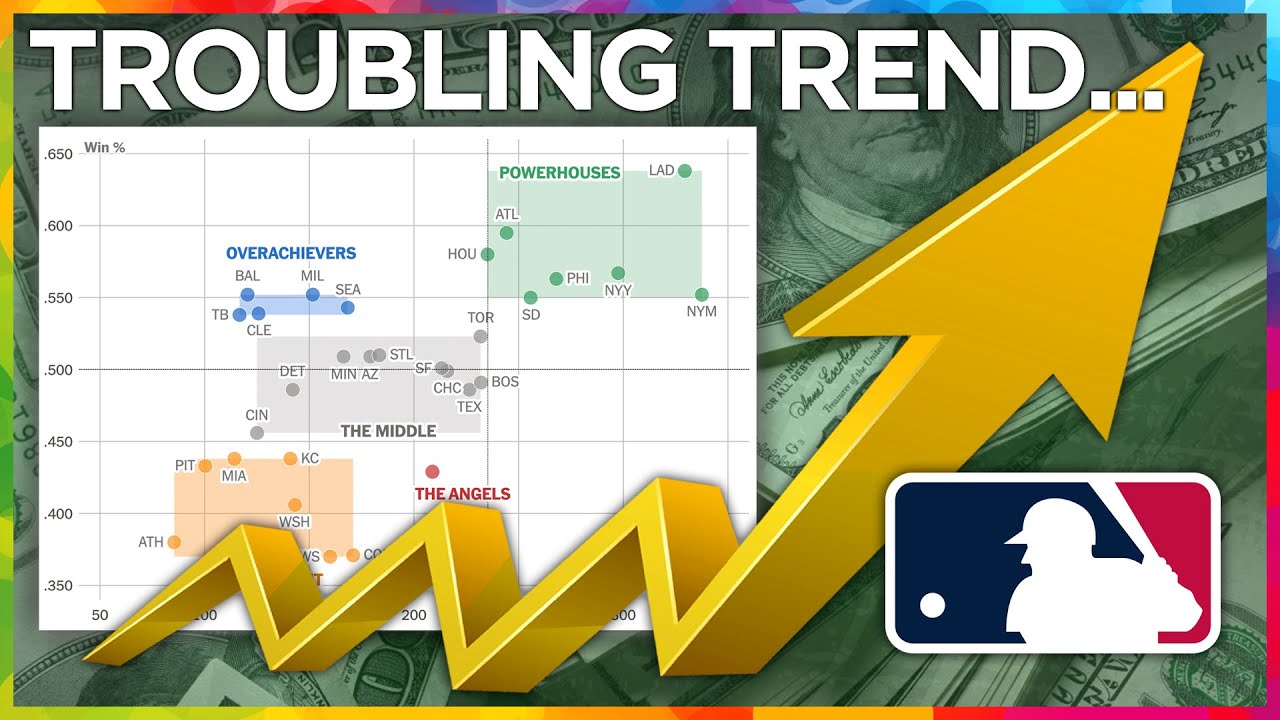
Here’s Brody Brazil. This is definitely one of the most interesting conversations in baseball right now. It’s the intersection of how much teams are spending on their players and their payrolls versus how much of an opportunity they actually have to win games in a season, to win a championship, and to win games over the long term. This was pointed out in a recent piece by The Athletic. Actually, I believe this was from a couple months ago, May of 2025, but it still holds true and relevant to what’s going on this season. And the headline says, “Which MLB teams are actually trying charting a divided leagu’s halves and have nots?” And again, the halves are spending the money and generally winning the games, and the have-s are mostly not winning. Some teams defy the odds, but they just don’t do it for a very long time. And again, this is a point of conversation that’s been around for quite some time. It’s especially relevant as we approach the beginning of negotiations for a new collective bargaining agreement and what a lot of people think is going to be a work stoppage following the end of the 2026 Major League Baseball season. Salary cap or not, that’s all part of winning and spending and what we’re about to discuss here. The article, I’ll give you the first two paragraphs, but you can read it for yourself. I’ll link to it down below. The article starts off like this. In the eyes of Major League Baseball executives, money alone cannot guarantee you the World Series. I fully agree. Look, that’s not what we’re talking about here. We’re not necessarily talking about the Dodgers spending the most and winning the World Series. That happened, but that’s also kind of not the the backbone of this entire conversation. To capture a title requires execution, determination, and perhaps most of all, good fortune, right? It doesn’t always work out that way. Ask the Yankees. They also spent a lot and didn’t win the last World Series. The baseball postseason can be a crapshoot, especially in its recently expanded format. That’s right. Wildcard teams, more teams than ever in the postseason. But here is something I a thousand% agree with. What money does provide executives on both sides of MLB’s payroll divide will tell you the divide of spending and not spending. More opportunities to win it all. more opportunities in one season, more opportunities to get a better playoff spot, more opportunities o over the course of multiple seasons. If you keep your really good team together because you paid for it, you’re going to give your chance self a chance year after year to try and win more baseball games. If October is a lottery, spending helps produce more tickets. It’s a great way of putting it. The correlation between spending and winning is obvious. A team with a top 10 payroll has won five of the past six championships World Series. The outcome last October made the sports disparity appear even starker. Right, it was the Yankees and Dodgers in the World Series. So without further delay, let’s just get into the visual here which should tell the entire story. This is quite simply spending more and spending less on this axis. Spending more goes that way. This is losing a lot of games. This is winning a lot of games. So, you’ll notice a team that spends a lot and wins a lot. There they are, the Los Angeles Dodgers. And a team that, well, I’ll do it in their colors, doesn’t spend a lot, and loses a lot, are the Athletics, not to bag on the franchise, but this is just the black and white of the numbers and the stats here. And there is this general line if we’re looking at every, you know what, I’ll I’ll do this in multiple colors so you can see it quite clearly. There is that general trajectory of the more you spend, the more you win. Because look at all these teams. Look at that group of teams. Look at this group of teams. And look at this group of teams. The athletic, which by the way does such a tremendous job in in visualizing this and explaining it. They classify these in the powerhouses, the middle, and the basement. So this is generally where gosh, look, if I if I circle that group, that is almost all the teams in Major League Baseball, a high majority. There are some overachievers. Now, I do want to point this out about the overachievers group. This is the conversation that sometimes the athletics have been in. The Marlins haven’t really ever been in that. The Pirates haven’t really ever been in that. Uh I think the Nats have been up there maybe before, but they were also spending. I think sometimes the White Socks, sometimes you can sneak up into that overachievers category. What is that? That’s a team that’s not spending that much. They’re spending in in a smaller window between 100 and 200 well $150 million, let’s say. But they’re also above a 500 record. The problem is this group right here generally they cannot now you can see my handwriting. They cannot sustain. They can’t do this forever. They can’t be that group over there forever. Now look, sometimes you spend a lot like the Mets. You spend more than anybody and you still have a winning record. I do believe that if the Mets didn’t spend like they did, they wouldn’t have a winning record. Spending might assure you some things. It might punch more tickets for you as the article says, but it it doesn’t get you a title. And there is this other group of teams here which spends a lot, but they also win a lot. You can see here there’s kind of an absence of teams that spend a lot and are below 500. They don’t that doesn’t exist. If you spend a lot, you’re you’re guaranteeing yourself a chance to be in the playoffs. Not a chance to win at all, but probably a chance to be genuinely successful. There are a lot of 500 team. Look at this. 500 in terms of the payroll and 500 in terms of the winning percentage. Like I can’t I can’t make this much more clear. I hope this is sinking in. There’s also always going to be an outlier. Well, like the Angels. If you want the biggest example of a team that spends a lot, I mean above $200 million and doesn’t win a lot as in a four, I don’t know, 35 win percentage at the time of this graph being made. Like the Angels have had Mike Trout over the years and show Otani for a while, enough of a time over the years, and they’re paying the Anthony Rendone contract. And they spend and spend. They they generally don’t spend over the luxury tax. They spend a lot of money and they rarely ever win. They are simply, in my opinion, just bad at identifying talent. They got a lot of fans that still come to their games in Anaheim. They have a good fan base. They just cannot put together a winning baseball team. They spend, I will say that, but they probably spend not irresponsibly, but sometimes irrationally or just not strategically in the best way. That’s the opposite. And by the way, I’ll I’ll compliment the athletics here. The reason that they can go from here to here sometimes is because they have such a great eye for talent. That eye for talent can again put you in that overachievers group. But this group doesn’t last long. And I’m not here to knock the Mariners or the Brewers or the Orioles or the Guardians or the Rays. I’m not here to say we’ll enjoy this time because but you know what? Like unless Baltimore jumps in that group and I think Seattle and Cal Rowley’s got a, you know, a chance to get taken care of and and that group can be held together, will the Brewers ever be a a big market team? I mean, Cleveland, man, for Steven Vote and his squad, I hope I hope they can be go this way rather than this way and this way, but I I don’t and the raise like maybe with new ownership, maybe they’re back over here. So again to summarize this, you can’t last here for long. You can’t maybe you can’t last here for long if you can’t afford to pay for everything. But this, you know, somewhere in here is great. If you can jump up here, that’s fine. You just definitely don’t want to be down here. And you certainly don’t want to be the angels. Okay, we’ve stared at that for long enough. Here are my beliefs. that general trajectory that I just showed you, that line going, you know, the other way on the screen. It goes, yeah, this way on the screen. Uh, it proves that spending can have you avoid losing records, but it also, I think, proves that you can win. Some teams do it without spending, but you can’t sustain that over long periods of time. There are times to spend heavy. Like, let’s also look at that graph and say, well, this is reflective of a team’s payroll this season. Some years maybe you go a little bit more slim. You don’t spend as much because you realize something. Something about your business, something about the timing, something about whatever. There are circumstances where you want to save heavy. Okay. But there also have to be the corresponding times that you want to spend heavy. You want to go for it. And if you’re looking at a team that’s never had a track record of going for it ever, a team that has only once ever spent, you know who I’m talking about, $100 million on a payroll, they’ve only they’ve had great teams and they’ve only spent that once. There’s something wrong at one point or another. You’ve got the right horses. You’ve got the right group. You’ve got the right people to pay and take care of and secure for the long term. If you’ve never gone for it, there’s something wrong with you in your situation. So, there we go. It’s a great conversation. The halves and the have nots, the teams that spend, the teams that don’t, winning and losing, it’s all tied together in terms of success of Major League Baseball. And like I said before, it’s really tied together in terms of the potentials of a work stoppage following the end of next season, whether there’s a salary cap or not. And the competitive balance of baseball right now is definitely off, right? You would love to see a lot more of those teams in a smaller group or at least you you’d love to not see those lower spending and lesser winning teams in that mix. How can we push that group out of the out of the seller that they’re in? That’s kind of the question right now for baseball. Let me know what you think about all this in the comments section below. Also, thumbs up down below helps me the video and the channel. Don’t forget to hit that subscribe button. I would love to see you back here next time.
Join channel, access perks ✅ http://brodie.bz/join
LEAVE ME A VOICEMAIL 📞 (833) 4-BRODIE
In the eyes of Major League Baseball executives, money alone cannot guarantee you the World Series. To capture a title requires execution, determination and, perhaps most of all, good fortune. The baseball postseason can be a crapshoot, especially in its recently expanded format.
What money does provide, executives on both sides of MLB’s payroll divide will tell you, is more opportunities to win it all. If October is a lottery, spending helps produce more tickets. The correlation between spending and winning is obvious. A team with a top-10 payroll has won five of the past six championships. The outcome last October made the sport’s disparity appear even starker.
Read More: https://www.nytimes.com/athletic/6370765/2025/05/21/mlb-chart-haves-and-have-nots/
*Subscribe now, get more* 📺 http://brodie.bz/YouTube
[[ *MY PLAYLISTS* ]]
San Jose Sharks: https://brodie.bz/sharks
San Francisco 49ers: https://brodie.bz/49ers
San Francisco Giants: https://brodie.bz/giants
Golden State Warriors: https://brodie.bz/warriors
Howard Terminal Ballpark: https://brodie.bz/HowardTerminal
Oakland Athletics: https://brodie.bz/athletics
[[ *MY OTHER CHANNELS* ]]
*BRODIE BRAZIL AVIATION* ✈️ http://brodie.bz/Aviation
*HOME STUDIO PRO* 🎥 http://brodie.bz/HomeStudio
📸 *Instagram* ➡️ http://brodie.bz/IG
🐦 *X /Twitter* ➡️ http://brodie.bz/X
👍 *Facebook* ➡️ http://brodie.bz/FB
*Support this channel* 🎉 https://brodie.bz/PayPal
#mlb #baseball #sports
4 comments
My issue isn’t whether a team like the Pirates can spend as much as the Yankees do. It’s whether they are even trying. While the Pirates can’t throw money around, they can be strategic with how they spends their money.
All business decisions involve some kind of risk.
Salary cap and floor
Pirates fans have known this for literally 15+ years
The Mets finally open up the purse and are the basement team of the powerhouse teams. How very Met of them.