
Which NHL Teams Are Best Suited to Thrive as the Cap Rises Dramatically
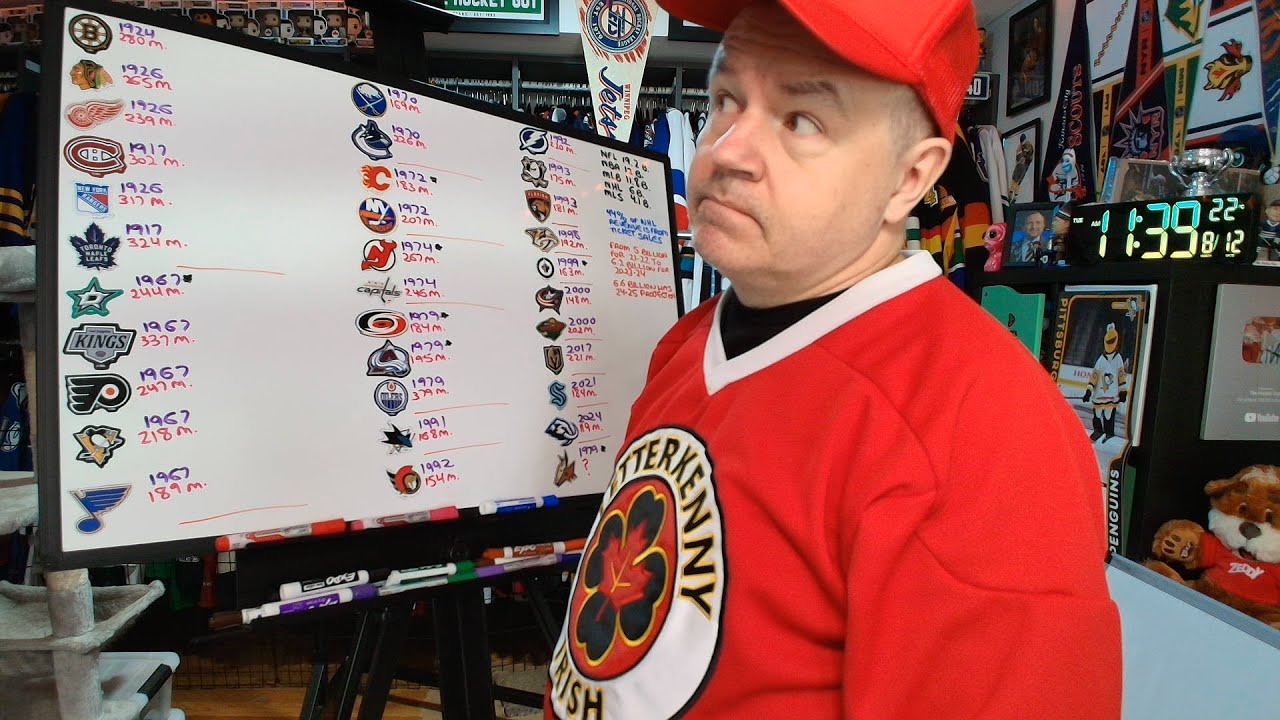
Welcome back. All right, so today I want to take a look around the National Hockey League. And the way I’ve got this arranged is from the oldest franchises, so the original six here through to the newest franchise being Utah, although I’ve got Arizona here, because it’s kind of in a holding pattern, right? Uh, but I wanted to talk about this because we always get into these financial discussions around the National Hockey League. And so I wanted to have a financial discussion about the National Hockey League today. Uh, first off, the NHL is the fourth biggest league in North America, and it’s pretty firmly entrenched in fourth. Uh, the NFL’s at 19.2 billion. Uh, the the most recent estimate that I saw, and I’m sure it’s more than that now. Uh, the NBA at 12 billion. Uh, Major League Baseball 11.8 billion. It shows the NHL at 6 billion, which is actually low comparatively speaking with where this past season probably was, and Major League Soccer at $4.1 billion. Uh that’s the one that of course a lot of people will say hey MLS is passing hockey and it’s not. Uh the National Hockey League is not really staring down a situation where MLS is taking money away from them to an extent where you know the NHL’s in any level of trouble. And the NHL is not in any level of trouble. However, with the salary cap going up and it’s gone up this summer and it’s going to go up the next couple of summers as well. There are some teams that may be more vulnerable. Now, I don’t think we’re going to see a situation where a team has to move, but it’s going to get more difficult for teams to keep, you know, increasing their salaries every year and making a profit. So, that definitely will be an issue. While the leaguewide salary cap goes up, the top teams are definitely driving that. And for the teams at the bottom, there’s that revenue sharing that’s going to kick in for probably a decent share of them. So 44% a recent number I found of the NHL’s revenue comes from ticket sales. When I see people talking about I don’t know the NHL should make a lot more money. You’re basically asking them to raise ticket prices which is a weird way to go about it. Um and of course uh half of the revenues go to the players, half the revenue goes to the league. So, the players, it’s in their best interest for the league to be as big as it can be, which might be part of the reason why we see more and more discussion now about how much the league makes comparatively speaking to other leagues. Uh, how many how much players in the NHL make compared to other leagues? I really don’t compare cuz it’s apples and oranges. To me, it’s um I I guess an example I would use is like if you’re using F1 uh to compare it to almost any other racing around the world, well, it’s F1, right? And so, and that’s even the same sport. In this case, these are different sports. So, the NHL is, I think, it’s not a niche sport like it used to be, but there is still a niche aspect to it where I I think the league sometimes tries to win over markets where it may not work. And I I I applaud them for trying, but there are times where it won’t necessarily work. Now, the league’s revenues passed the 5 billion threshold in 2021 2022, past the 6 billion threshold for 2023, 2024, and the projections for this season were in the $6.6 billion range. Sponsorships are going up, ad revenues are going up. Uh you’ve seen the TV deals get better for them on both sides of the border. Uh the new Rogers deal is very pricey, and so the NHL is making a lot of money. uh the NHL is uh making record revenues and I I don’t see any reason why that won’t continue, but it is easy to get uh kind of upset about it when the comparison is, well, we’re not making as much as the NFL. Of course, you’re not you’re not going to you’re not going to make as much as the NBA. It’s just not going to happen. So, and and I’ve I’ve said to my wife on numerous occasions, you know, if I had started this back in 2016 talking about basketball or baseball or football, I probably would have got more subscribers. Um, her response is, “But then you’d have to talk about those sports.” And she doesn’t she doesn’t like those sports. I’m fine with those sports to be honest, but she’s not. Um, not not as big a fan about of the other sports as as I am. So, looking at the original six, obviously, if the salary cap goes up, the original six have the money. Um, I was going to get into like owners and everything, but I’ve talked about owners. Um, there are a lot of owners with deep pockets. Basically, now to be an owner in the NHL, you kind of have to have more than a billion dollars in your valuation. Doesn’t mean you have to have more than a billion dollars in the bank. That’s a completely different thing. Uh these guys are billionaires on paper. It doesn’t mean they can just hand you a billion dollars tomorrow and and be done with it. So Boston, of course, is famous for at times being cheap at times. I’m not saying they are now. In fact, recent history would show they’re not as cheap as they used to be. Um and so there’s that. But they had they made a or 280 million in revenues according to the Forbes list from last year. I’m just just focusing on revenues, not on franchise valuations, which is completely different. But $280 million in revenue for Boston. They’ve been in the league since 1924. They’re as stable as it gets. Same with Chicago. 1926 they came into the league. 265 million in revenues is listed. Uh Detroit 1926 they committed the league and 239 million in revenues for Detroit. Uh Montreal came into the league in 1917. They were a a holdover from the National Hockey Association and they made $32 million. Montreal a big cash um driver. Uh the New York Rangers come in in 1926 made $317 million in revenues. uh the Toronto Maple Leafs, 1917 for them, same as Montreal, 324 million in revenues. And so if you’re looking at at at basically any of these, and what I’ve done is I’ve sectioned them off by expansion years. Yeah, the original six are still easily the most stable uh financially secure markets. And while people may point to, well, there’s taxes in these six markets, I I feel like as a hockey player, you can make way more money with sponsorship deals and commercials on TV and all that fun stuff. I think there’s a lot of money to be made. And in Toronto’s case, you have national media. Same with Montreal. These are well-known storied franchises with fans all the way across Canada. So that makes a difference. And when we’re talking about Canada, all of the original six teams have fans all the way across Canada. If you go to a Vancouver game, they’re hosting Boston, uh, Detroit, and the Rangers, especially of those American teams because they only make one visit to Vancouver every year. Uh, you’re going to see a lot of jerseys in the crowd for Boston, for Detroit, and for the Rangers. Boston, even with Vancouver in 2011, there’s still a lot of Boston jerseys in the crowd, uh, including a couple of times I’ve worn a Boston jersey to a game in Vancouver. Now, uh, the expansion in 1967, kind of a mixed bag. Oakland’s not on the board because, uh, they ended up being moved and then they disappeared. Uh, they they got merged with the Minnesota Norars, who are also not on the board, but the Dallas Stars are. So, the asterisk means the team has moved since that expansion in 1967. But Dallas, $244 million in revenue. And um I will say this, based on the reports of minor league hockey around Dallas, they’re making some good money. They are making and that’s another thing to take into consideration. So, with the teams that have a really robust uh youth league going for them and there’s there’s fees being being uh brought into this for-profit company, that wouldn’t go into NHL revenues. I don’t think I don’t think that qualifies for NHL revenues. So, that’s money that’s being made by some of these teams that does not end up going to the union and goes to the team specifically. So, if you have a really robust youth hockey league in your area that’s that’s run by an NHL team, that’s some money that they’re making that we’re not even talking about here. That wouldn’t be count. I don’t think it would be counted in the 244 million. That has to be I guess for the Forbes valuation. No, for the Forbes valuation, I’m pretty sure this is just the NHL revenues. Uh the valuation of the franchise may take into account the youth hockey and all of the assets that come with that. But it is something to keep in mind when we’re talking about stable teams. Uh the LA Kings 337 million in revenues. I’m not surprised the Kings are really high up. Uh the Kings do generate money. There’s the discussion about their attendance when the team isn’t very good. Sure, but they’re not the only team in the league with that issue. Uh Philadelphia and Pittsburgh, I feel like you can talk about both of them. They’re both Pennsylvania. Uh both of them with with similar histories. The difference being Philadelphia, I’ve never heard anything about that market and any concerns about the team. Uh $247 million in revenue for them. Pittsburgh, $218 million in revenues for them. Pittsburgh very stable as well uh with the arrival of Crosby, but really the the whole stabilization was getting a building. Uh they at one point uh there was a lot of talk about the moving because they needed a new arena. since they got that arena, which is now PPG Paints, uh there there really isn’t any concern that Pittsburgh is in any trouble. Uh St. Louis, they come in in 1967 as well, $189 million in revenue. So St. Louis, the first one with less than $200 million in revenues on this side of the board. So, the teams that have been around the longest, or at least the franchises that have been around the longest, because obviously Dallas uh came in in 1993, the teams that have been around the longest as franchises seem to be arguably the most stable and some of the biggest money makers. So, then we go to the 1970 expansion, the first expansion after the big one, and that’s of course Buffalo and Vancouver. Now, there’s a lot of talk about Buffalo. Look, $169 million in revenue is on the lower side of a lot of these teams, but by all accounts, Buffalo still makes a profit. I was looking for this video. I searched for like 25, 30 minutes to try to find if any of these teams are operating in the red, and I couldn’t find anything. I mean, revenues tell you how much money they’re making. It does not tell you expenses. And so, that’s that’s one thing I did look at debt load. Uh, some of these teams have like a 5 to 7% debt. there isn’t really anybody that has a debt load that you can look at and say that’s a problem. At times with Arizona that was something we could look at and say how are they going to pay for all this? So Buffalo isn’t in any danger. And while I always hear all these discussions about Buffalo, the one thing I would say is with the salary cap going where it’s going, it will be more difficult for Buffalo. um you know that free agents don’t necessarily pick Buffalo at the top of their list or near the top of their list and players may not be willing to give the same kind of um discount to stay in Buffalo that they might to stay somewhere else. So there is a valid question to be asked about Buffalo when the salary cap is ridiculous and up to about 113 million. Where’s Buffalo going to fit into that? Uh Buffalo has not been a playoff team since 2011, which is a huge factor into why this team doesn’t generate attendance figures like other teams do. Um anytime I see people, oh they they just don’t draw and they should move them, the team isn’t any good. Has nothing to do with the fan attendance, nothing to do with and and I I would argue that they they haven’t been huge spenders in general. So I I don’t think there’s any danger of them losing money. Uh, Vancouver, $226 million in revenue. They came in in 1970 alongside Buffalo. Considered the cursed expansion, and and I won’t disagree. Here’s an example of why. Cup cup. These teams have all won the cup. They’ve won the cup. Won the cup. Uh, yep. Yep. Yep. Um, no. Yes. Yes. Yes. Yes. Yes. Yes. Yes. And then and then we go back to kind of cursed. No. No. Yes. Yes. Yes. No, no, no, no. So, the 1970 expansion, that’s kind of cursed. However, Vancouver with a rising salary cap shouldn’t have a problem. I The only problem Vancouver has now is it seems a perception that there’s chaos at all times and players don’t necessarily want to play in chaos when they have an opportunity to go somewhere else and not have to deal with chaos. So, there is that argument to be made, but definitely a cursed expansion. 1972, Atlanta and the Islanders join. Of course, Atlanta moves to Calgary. Uh Calgary 183 million in in revenue. Uh according to uh the the Forbes report from November of 2024. I will be interested to see the numbers when they come out for this year. Uh the Islanders $27 million. And the Islanders at one point in time there was discussions about how healthy that market was, but they got their new building too. a lot of teams that when people talk about market health and and how things are going, a new building helps to fix a lot of those woes. And that seems to be the case with the New York Islanders as well. 1974, you get the Kansas City Scouts, who are now the New Jersey Devils, as well as the Washington Capitals. Uh New Jersey 267 million in revenues, and there was a point in time where New Jerseyy’s uh long-term viable future as an NHL franchise was debated. Uh they got past that. the Washington Capitals, 246 million in revenues, and Washington has had some struggles here and there along the way, but they’re a very healthy franchise at this point in time. Uh, then you get into the WHA expansion. This is where Arizona would have come in as the Winnipeg Jets. Carolina came in as the Harford Whalers, Colorado came in as the Quebec Nordics, and the Edmonton Oilers came in as the Edmonton Oilers. Uh when these teams all ended up moving except Edmonton, uh Gary Bman infamously said the problem in the NHL uh was three letters, WHA. So the NHL does not forget that the WHA did WHA things. Now looking at the 1979 teams, and this is where I think Utah can come in. I can mention Utah for a bit. The 119 million for Utah because it mentions the 2024 calendar year. This has to be what was made by the Arizona Coyotes. So Utah’s numbers will probably be more in the range of I would say like Buffalo’s 169 million. I it will be interesting to see how much Utah made and and what that does to their valuation. I would think all these franchises their valuation goes up. Uh Carolina 184 million in terms of their uh revenue. So 1 million more than Calgary. 195 million for Colorado. Very healthy franchise. And the Oilers, 379 million in revenues, higher than Toronto, higher than the Rangers. That’s interesting to me. Uh the Oilers make a ton of money. So, if we were in a league where we did not have a salary cap, these teams that have over $300 million in revenue, and I’ll just go ahead and and and just indicate them here on the board. So, if they’re more than 300 million, these are the teams that would be spending a lot a lot of money, a lot a lot a lot to get people and uh and and try to try to keep them with the team. So, you have Montreal, uh Rangers, Toronto, LA, and the Oilers uh by by the current revenues or the most current revenues I was able to find. Um and so the question becomes when when we’re at that 113 million, when we go higher than 113 million as the salary cap ceiling, will those teams become the ones that everybody’s going to? Will these teams open their their their checkbooks and basically be willing to spend get a blank check? I would say of the five, I think the Oilers will be willing to do it. I think Toronto and the Rangers are absolutely itching to do it. Montreal, it will be interesting because where Montreal is right now with their rebuild and everything, I don’t know if they’d want to throw $20 million at a player to bring him to Montreal unless it was like a prime talent like say a McDavid, that kind of thing, right? Um and and obviously 20 million salaries that’ll be four or five years down the road before we’re talking about that. But at the rate that things are growing in the National Hockey League, we could see a player making 15 plus million as as a salary cap and say, you know, that’s not bad. It’s not bad for what he does because the salary cap’s going uh up uh tremendously. So San Jose comes in in 1991 uh 168 million in their revenues uh in 2024. Um, I still say that’s a stable franchise and I don’t see any reason to think that they’re not. San Jose has shown over the years, too, that when they’re good, they’re willing to spend the money to stay good. Uh, the Ottawa Senators came in in 1992, 154 million in revenues for them, which is one of the lower numbers on the board and one of the reasons why it is so important that they finally got that land in Labretton Flats. We are going to have a brand new arena for the Ottawa Senators, which should I would think that would bring them into that $200 million range once they’ve got that new building put up, the entertainment district and everything. I think Ottawa’s going to be in that 200 million plus range. Uh then you’ve got Tampa, $220 million in salary. Tampa, very stable, very good franchise. And I would think, and I I’ll get into it, too. I’ll talk about some others. Uh, and I’ll put definitely blue dashes next to others as we go along here cuz it’s not just the big money teams that’ll probably be willing to spend a lot of money. And so I’ll come back to that. Uh, 93, we got Anaheim and Florida, the Disney and Blockbuster expansion. Uh, the Mighty Ducks. Uh, now the Anaheim Ducks, 175 million in revenues this past year. Their their attendance is starting to go up again. Uh, Florida, 181 million. and Florida’s numbers have been trending in the positive. There was a time where Florida was discussed a lot as to whether or not that was a stable market and then all of a sudden the team was good and now it’s a stable market. It’s almost as if part of the reason people weren’t buying tickets in Florida was cuz the team wasn’t any good. Uh then you’ve got Nashville 1998 they came in $192 million for them in terms of their revenues. Uh Nashville’s a a good market. I would be interested to see if when the salary cap starts to, you know, really do that jumping that it’s doing this summer and it just keeps doing it. Does Nashville open up and and spend a bunch of money or do they not? Uh then you’ve got the Winnipeg Jets who of course the Atlanta Thrashers came in in 1999. You end up with the Winnipeg Jets out of that. So Calgary and Winnipeg benefited from the two Atlanta expansions. uh 163 million in revenues for Winnipeg uh which is just below San Jose. And there’s a lot of discussion about Winnipeg, but their owner’s worth what $72 billion. Yeah, they’re all right. And they’ve already come out and said, Mark Chipman’s already come out and said, look, you know, everything’s fine here. Uh the attendance went up for them this past season. uh the Winnipeg Jets. The one thing I’ve always had a concern with with the Winnipeg Jets is that their attendance is lower by the way that that building is set up. I know the ticket prices are high and that’s part of it, right? You have that scarcity and you have to charge more cuz you have fewer seats to fill than anybody else. I’ve always thought that Winnipeg would benefit from having an arena with the same um attendance in terms of numbers as say Vancouver or Calgary or any of the other Canadian teams uh at the very least. But I understand it’s a smaller market and when salaries go through the roof, it will be interesting to see if Winnipeg keeps up with the other teams that are willing to spend. 2000 we get Columbus and Minnesota. So the Minnesota Northstars uh go to Dallas in 93. The NHL fixes that seven years later by going back. No one complained when they went back to Minnesota because we all knew Minnesota got screwed in that whole deal. Uh Minnesota never should have lost the Northstars. Um but Columbus $148 million in terms of their revenue. They don’t get talked about when we talk about which teams are, you know, maybe in trouble, that kind of thing. But I think that’s because really there’s been no reason to think that there’s any issue with Columbus in terms of their profitability or, you know, their their their ability to pay players and everything. Uh Minnesota 22 million for their revenues. Uh also coming in in 2000 and the Minnesota Wild, we’ve had the debate about their spending, but they’ve been willing to spend in the past. If the salary cap’s going to go right through the roof, I have no reason to think Minnesota won’t spend again. Uh Vegas is going to spend uh 2017. and they came in uh their revenues at $221 million. Uh the Vegas Golden Knights draw and they draw a lot of locals. Um there has been a drop in tourism for Vegas that’s been talked about a lot right now. I don’t think that’s going to impact their ticket sales at all because there’s a lot of locals that go out to buy tickets and they’ve always had a waiting list for season tickets and and just for single game tickets. They’ve had waiting lists of points time points in time too. So I don’t see any reason for that to change. I I would be interested to see if Vegas falls off on the ice, if they end up being a non-playoff team and having to do a retool or a rebuild and if we’re not seeing the tourism in Vegas at levels that it was in the past if that negatively impacts them. But I don’t I don’t think so. I think Vegas is pretty stable. They’ve got good ownership. They’ve got smart leadership at at the general manager position. They’ve got a good coach. I have no reason to think Vegas is going to fall apart anytime soon. Uh Seattle comes in in 2021, of course, uh $184 million in their revenues. Uh Seattle’s a good market. It’s a good It’s a big market and is great for for Vancouver to have a team that close uh to home. Uh Utah, as mentioned, comes in uh 2024. We haven’t seen the numbers yet, and I keep waiting for the numbers. I’m kind of surprised. It feels like they they gave us the the actual, you know, salary cap rising. Here’s what the salary cap’s going to be. And we didn’t get an idea of the financials, which makes me wonder if uh the NHL’s closer to the 7 billion mark because that’s been talked about too that maybe they’re closer to 7 billion than this 6.6 billion estimate of what they were going to make this year was going to be. The NHL is never going to be as big as the other three big markets or or big leagues. They’re never going to be football, basketball, or baseball. It’s okay because I don’t know how much carryover there is between the fans. I think there’s more NFL fans that watch the NHL than baseball or basketball. That’s just that’s just my hunch that there’s more crossover between those two sports. Um I personally if if I had to cover a second league, if you said, “All right, you got to cover a second league every week,” it’d be the NFL. Uh the NFL would be the one that I feel like I could sit and watch every game and enjoy every game. I don’t know that I’d have the same experience with basketball or baseball. Um, baseball it can be tedious and basketball it can be a lot of points and a lot going on. And um, I I don’t even know if I was reviewing a basketball game how that would work. If I was trying to do it like hockey, I don’t think it would work. I’d have to have a completely different setup. So, going back to which teams I Okay, actually, let’s do it this way. Let’s do it this way. Um, the salary cap we know is going to fly. It’s going to go up a lot. uh the teams that I think might be challenged under that system to keep up with others. Uh I I do think it would negatively impact Winnipeg. I do think it would if if that cap keeps going up that that could hit them. Um there isn’t really a whole lot of teams though that I look at and I say this could be a problem. I don’t think it would be a problem for Carolina. I don’t think it’d be a problem for San Jose. And now I just feel like I’m picking on Winnipeg cuz I I I do like I’ve seen these articles on okay there there could be halves and have nots in the NHL, but I I think that’s going to depend on the state you’re in. So if you’re and I don’t mean like the physical state like you know Texas versus California. I mean like is the team in a rebuild? If they’re in a rebuild, you don’t go to the salary cap ceiling. And if you’re not in a rebuild, if you’re, you know, trying to go for the Stanley Cup, then you do it. Um, okay. The way one way I could look at it here is teams that are just willing to get into a bidding war to win it. I would say the Rangers, uh, Toronto. Um, I I want to say Chicago, but I I really can’t. Um, bidding. You know what? St. Louis showed in the past that they could and they would. Um, bidding war. Bidding war. I think Vegas would absolutely do that. Uh Edmonton I think has that has that potential especially right now. Those might be the big ones. Yeah, I think so. I think those are the big ones. Although Dallas has never been shy about spending money either when you look back. Uh some of the contracts they signed before we had a salary cap were well interesting. Um but yeah, so I’d be interested to know your thoughts with the salary cap set to to explode. Which teams do you think will struggle? Because for me personally, um I I think that I think Columbus would be one to watch that way. I think um Columbus might have a hard time. I don’t think Utah will. Utah’s re revamping their arena. I think Ottawa, I think there’s a legitimate maybe some concern before they get the new arena, after they get the new arena. and I’ll I’ll go back to Winnipeg even though their owner has uh very deep pockets. I I don’t know if they would get into a bidding war to win it or not. And I’m talking about like we don’t care what he wants, we’re going to give it to him. And yeah, I would I would go with Buffalo. Buffalo I think I think there’s a legitimate reason to to think, you know, as the salary cap goes up, what happens with Buffalo and their money? So, keep in mind there is a revenue sharing pro uh uh program that’s in the National Hockey League uh where the top earners will share with those who are not top earners and that kicks in at certain price or certain points uh in terms of financials for teams. And it’s as exciting as the rest of this video has been. And I thank you guys so much for watching. If you got all the way through, uh thank you so much. It’s greatly appreciated. Uh if you didn’t get all the way through this, totally understand. Uh, but let me know your thoughts in the comments section below. With the cap going where it’s going, which teams do you think are going to struggle to keep up and and pay and and you know, put a team on the ice that’s going to be competitive? And which ones are like, you know what, just keep just keep putting that salary cap up. We are fine. We’ll pay all the signing bonuses. We’ll give them all the no trades and no move they want. And good luck to the teams that are trying to compete with us. Uh, one thing that I don’t think gets talked about enough, uh, when we talk about teams that might have an unfair advantage, there are teams that make a lot of money and they can pay upfront big huge signing bonuses, which is a benefit to the players. They can offer these signing bonuses that the smaller markets really can’t. And that is one thing to keep in mind that yes, there’s a tax advantage to some, but there’s also an advantage to being in a big market, making a ton of money, and being able to say, “We’re going to pay you $10 million in a signing bonus and a $775,000 uh salary, which another team can’t can’t match. It’s not the same.” So, let me know your thoughts in the comments section below. As always, hit like and subscribe in the event you may not have done so already. Thank you guys so much for all your support. It’s greatly appreciated. I will talk to you again soon.
Hey all and it’s a video looking at every team’s financial state with the cap rising over the next few years,
Join this channel to get access to perks:
https://www.youtube.com/channel/UC_AFyA9FqrZ57bb9QRH77wg/join
Join us on our discord to chat hockey, talk with others during the game, share pet pictures, and more.
https://discord.gg/thehockeyguy
Order jerseys from Ben H Sports while saving 10% off the listed eBay prices by sending him an email regarding jerseys you spot in his listings. ben.hoogenband@yahoo.ca Just tell him Shannon sent you.
Support The Hockey Guy via Patreon https://www.patreon.com/thehockeyguy
https://www.facebook.com/youtubehockeyguy/
Instagram: thgshannon and thg_cats
Spoutible: https://spoutible.com/TheHockeyGuy
TheHockeyGuy.yt@gmail.com
Contact me via snail mail at:
The Hockey Guy
PO Box 13063 RPO Highstreet
Abbotsford, BC
V2S 0C4
CANADA
In the USA: some times it takes us a few weeks to get items up to us
Shannon Skanes
1125 Fir Avenue
Suite 119
Blaine, WA 98230
Shop THG Store:
www.thgyt.ca
23 comments
I think the Avs could be included in the spending big money to win category too.
What is the source for this data?
I think Seattle, Florida, Anaheim and LA are going to look to spend eventually also
Most of the attendance issues are from teams south of the border, mostly because Baseball, Basketball and especially Football are WAY more popular. If you want to turn a decent profit, you HAVE to build a winner since there's so much competition for the entertainment dollars.
Fascinating look at this. Thanks
Shannon
I think you are grossly underestimating the Kings willingness to spend to the cap. Locally, they are competing with 2 NBA teams, 2 NFL franchises, 2 MLB franchises and 2 MLS franchises and yet they are still the 2nd highest revenue generating team in the NHL. Southern California fans have a lot of choices for spending their entertainment dollars, so yes, attendance can fluctuate during lean times.
Anne Kopitar’s ($7 million AAV) contract expires next summer (2026) and Drew Doughty ($11 million AAV) and Darcy Kemper’s ($5.3 million AAV) expire in the summer of 2027. That’s over $23 million in cap space freeing up and the cap will rise by an additional $18 million by the summer of 2027. So, that gives the Kings approximately $41 million to spend at their discretion. Of course Adrian Kempe ($5.5 million AAV) will likely cost another $5 million to $6 million but that still leaves the Kings $36 million and they have not been bashful about spending all the way to the cap.
What this video is proving is the Hockey is in very good shape who cares what rank we are in professional sports
I know that it would be a very improbable task, but, LA $ will be higher, because prices are higher & expensed prices will be higher. Therefore, Chicago's revenues, although lower than LA, may get them farther along & my make them in a better situation & thus, Chicago may use the Salary Cap to a better advantage. Let me know what you think
The two richest cities of each country + deadmonton, with Mcdude, New Arena, wealth population with nothing to do.
I think you're on point when it comes to teams that'll struggle. I think the big question, and perhaps one we'll have to answer when it becomes an issue, is whether teams will be forced to relocate as a result of the struggles.
Re: Wild – F Norm Green
MLS has a much better tv deal, and is growing fast. The product they provide the viewer is far superior to any league except the NFL, which is a polished machine.
Dallas and Florida have fans when their winning. When their losing its over 1/2 empty.
I thought I heard rumbles of the Winnipeg arena being expanded to 2.5k more seats and renovations would start soon, turns out that didn't happen, anybody else remember this?
Crossover very often depends on what's available in your market. In Montreal and Quebec City when they had a team, the Expos (baseball) was very popular, and there is a Baseball Quebec, each sizeable cities has their home leagues and then there is the level up like in hockey, as we called it when I was playing both (I was a call-up from Pee-Wee A to "regional", which was the big leagues in hockey), in baseball, I was in regional after my first season home league Pee-Wee, second year of Pee-Wee, Bantam and then Junior, I played in the regional, then provincial tournaments when my team made it to those. Because of the Expos we had that organization in all regions of QC. After the 1994 MLB strike, Expos went from best team in the league, or realistically in the top 5 of the teams, with Atlanta, Cincinnati, Chicago White Sox, San Francisco Giants LA Dodgers and maybe Toronto again, things in the AL being less clear than in the NL, being the other top teams guaranteed to make playoffs in 94 – Expos traded or let go free agents that would become hall of famers in the future because of the no new stadium problem. But the little leagues persisted, football, high school or college was kinda fringe, there was more popular interest in basketball, I remember.
When the Expos left and a bit before, the CFL's Montreal Alouettes were very dominant for a while and yep, I live in a college town in QC and there's one big new football stadium next to one of the colleges I went to, which at the time did not have a team, there was only home league between high schools and that was it for football, no government funded leagues, now there is, because baseball is gone and the 1994 treason by the players and a Bud Selig who seemed not to care, seemed not to want "america's pastime" to be won a third year in a row in Canada again, and Expos statistically with advanced stats that year, were sure to make playoffs, in front of the 5 star pitcher rotation Atlanta Braves, and the second most likely to win the World Series. That being known was devastating, but little league baseball carries on, even if the chances of making it to the MLB reduced even further with just the Jays remaining now, for a Canadian that is, I played until I was 20 in Juniors, until I could play in an organized league, that team I was in from 17 to 20 went to provincial tournament all 3 years I was there – nobody's ever seen a scout for even just an "A" level league team in the MLB system ever. Guys like Larry Walker, Denis Boucher, Eric Gagné were just enormously talented, otherwise you're invisible. Meanwhile there's a lot of chances to get to the CFL or even the NFL, a dude from QC was with the Kansas City Chiefs when they won the Superbowl, the first time in that streak.
Not easy being a Jets fan 🫤 hope True North steps up and are willing to spend!
Montreal Canadiens was established in 1909
Would be amazing to see what the NHL could do with competent management and decent owners. They constantly make puzzling decisions yet it is still growing.
it's 1 business, not 32. The owners get franchise rights. They make their money and do their tax evasion with that. Everything else is league revenue, including ticket sales.
The USA has huge debt problems, which it will respond to by monetizing much of that debt. This is going to mean consistently high to moderate inflation. So, NHL revenue will increase but that probably won’t indicate real growth over all. I’m surprised that players signing long term contracts aren’t requesting an inflation rider. Though those are probably against the CBA.
Love that Letterkenny Irish jersey, have the same one. Cheers
Would you please do a video and explain the revenue sharing… when and how much? winners and losers?
The most popular teams should figure out how to make arenas seat 30000-40000