
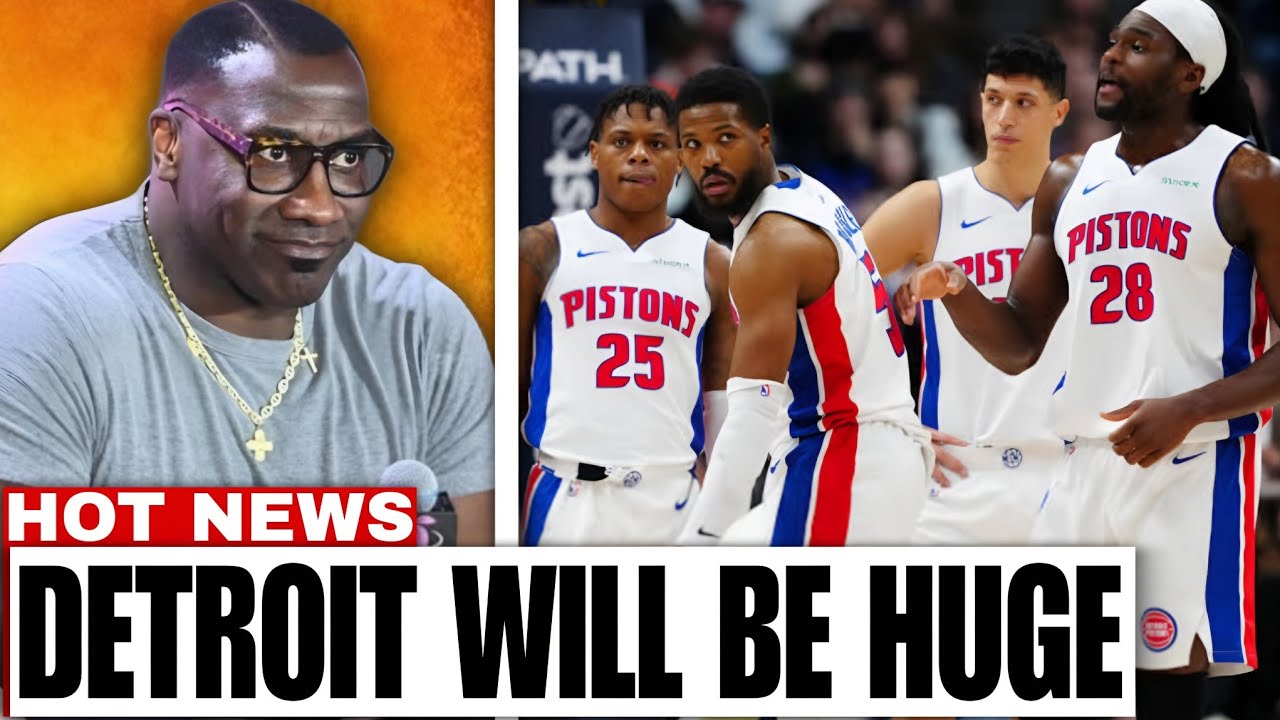
How The Detroit Pistons Are BREAKING The Entire NBA
prolific seasons by a Pistons guard ever. He’s probably headed for all NBA consideration, already been an all-star. That’s one. Secondly, this is a very hard team to play against. They rough you up on the interior. They have a lot of size. Jaylen Durren is huge. We know Isaiah Stewart is in there pounding guys away. Plays very hard. Tobias Harris, talk about the best revenge is living well. Malikica, how do you think uh the 76ers feel about watching Tobias Harris Detroit and have success? And not only that, but Beasley is a tr one of the best signings that we’ve seen all year. $6 million. The B, he was okay for the Bucks last year. They couldn’t afford to keep him. The Pistons come in, get one of the best value signings you can see. He’s been a terrific addition. When the Pistons keep winning, we’re talking about them chasing potential home court in the first round. Yeah, the Pistons, if you have not been watching them so far this season, now is the time. It is not. The Detroit Pistons recent turnaround is one of the most dramatic reversals in modern NBA history. Beginning from a point of absolute collapse and evolving into a season that has positioned the franchise as a legitimate Eastern Conference threat. In the 2023 to 24 season, Detroit finished with a 14-68 record, marking the worst in franchise history and one of the worst in the league’s 78 years. That season included a record- setting 28game losing streak, which stands as the longest single season losing streak in NBA history. For two straight months, the Pistons failed to record a victory. A span that not only damaged morale, but also made them the subject of widespread ridicule across sports media and social platforms. General manager Troy Weaver’s roster decisions exacerbated the problem as his absorption of veterans like Joe Harris and Alec Burks into valuable cap space yielded little oncourt impact. The offense sputtered, finishing 29th in the NBA in three-point percentage at 34.8% and 27th in offensive rating at 108.1 points per 100 possessions. Head coach Monty Williams, brought in on a six-year 78.5 million contract, was unable to stabilize the team. He used 36 different starting lineups and benched promising young players like Jaden Ivy, creating confusion and disunityity within the roster. Players once projected as future stars, including James Wiseman and Marvin Bagley III, failed to deliver meaningful contributions, while fan frustration boiled over into booze at Little Caesar’s Arena and historic attendance lows. Social media criticism further cemented Detroit’s place as a leaguewide punchline framing them as a franchise without direction or hope. After this nater the Pistons organization committed to a dramatic reset. Weaver was fired and Williams was dismissed after just one season despite the team still owing him $65 million. These firings represented more than simple staff changes. They marked a declaration that Detroit would no longer tolerate prolonged mediocrity. The franchise then hired Trejan Langden, an executive with more than a decade of front office and scouting experience as the new general manager. Langden quickly established a vision rooted in discipline, cultural cohesion, and competitive improvement. His first major decision was the hiring of head coach JB Bickerstaff, known for fostering identity, and accountability. Bickerstaff had recently guided Cleveland to playoff appearances, and his reputation for defensive structure fit Detroit’s needs. Langden’s roster overhaul was deliberate and effective. He acquired Tim Hardaway Jr., who had shot 35.3% from three during Dallas’s 2024 NBA Finals run, providing needed perimeter scoring. Malik Beasley was signed to a one-year $6 million deal, considered one of the league’s best value contracts as he was coming off a season in Milwaukee where he hit a franchise record 292 three-pointers at a 41.3% clip. Tobias Harris was added to supply veteran leadership and versatile scoring after an underwhelming Philadelphia stint. The 2024 draft yielded Ron Holland with the fifth overall pick, giving Detroit an athletic forward with significant upside. These acquisitions transformed Detroit’s roster from an incoherent group into a structured and balanced unit. The team’s win total tripled, finishing 44 to 38, a turnaround unmatched in NBA history for an 82game season. By the All-Star break, the Pistons were riding an eight-game win streak highlighted by dominant victories over elite opponents such as the Los Angeles Clippers and Boston Celtics. Central to Detroit’s resurgence was Cade Cunningham. the 23-year-old guard who evolved from potential field prospect to bonafide superstar. Cunningham averaged 26.1 points, 6.1 rebounds, and 9.1 assists, joining Nicola Joic as the only players to meet those statistical benchmarks that season. His shooting efficiency improved across the board, hitting 47% from the field, 36% from three, and 85% from the free throw line, resulting in a career-high 52% effective field goal percentage. His two-point shooting also rose to 52%, signaling growth in shot selection and finishing ability. Cunningham’s leadership extended beyond scoring as he spearheaded Detroit’s playmaking and offensive rhythm, raising the Pistons offensive rating to 113.2, 16th in the league. His accolades included his first all-star appearance, an AllNBA team selection, and a third place finish in the most improved player voting. Analysts began projecting Cunningham alongside Luca Donic and Sha Gilis Alexander as one of the next elite guards in the league. His emergence provided Detroit with both a present star and a cornerstone for future contention. While Cunningham stood out, the Pistons success was also fueled by a young supporting cast. Jaylen Durren at 6’10 established himself as a reliable interior force, averaging 12 points and 10 rebounds per game while shooting 69%, ranking among the league’s most efficient big men. His rim protection and lob catching ability anchored Detroit’s defense, which ranked second in opponent points in the paint, allowed at 44.2 per game. Oscar Thompson overcame a blood clot issue to contribute as a defensive disruptor, recording 10 points, five rebounds, and nearly two steals per game. While his athleticism made him a versatile perimeter defender, Jaden Ivy, before his season ending leg fracture after 30 games, delivered 17 points, four assists, and 41% three-point shooting, thriving as a secondary ball handler and energizer for the second unit. Isaiah Stewart provided defensive depth off the bench, averaging 1.5 blocks per game, and offering switchable coverage against multiple positions. This collective effort elevated Detroit’s defense to a top 10 rating at 109.8 points allowed per 100 possessions, while their pace and athleticism contributed to ranking second in fast break points per 100 possessions at 15.8. Together, the young core added versatility, intensity, and cohesion, making the Pistons a difficult matchup on both ends of the floor. The offseason following their breakout presented another challenge. Key contributors Beasley and Hardaway Jr., who accounted for 46% of Detroit’s three-point makes, departed in free agency. Langden responded with targeted signings to maintain balance and floor spacing. The Pistons acquired Duncan Robinson, a 6’7 sharpshooter who attempted 6.5 threes per game at a 39% conversion rate last season, bringing size and reliable shooting. Carris Levert, a 6’6 wing, joined after averaging 12 points, three assists, and 37% from deep with Cleveland and Atlanta, providing versatility as both a scorer and playmaker. The team also resigned Paul Reed, who added energy and defensive activity in limited minutes, averaging 4.1 points and 2.7 rebounds across 45 games. Javvante Green was brought in as a defensive-minded wing who owns a career 37% three-point shooting percentage. These moves preserve Detroit’s status as one of the league’s most frequent three-point shooting teams, ranking 11th in attempts at 35.2 per game while addressing depth and defensive needs. Detroit’s trajectory entering the 2025-26 season reflected optimism backed by measurable growth. Their 44 to 38 finish secured the sixth seed in the Eastern Conference and Las Vegas set their projected win total at 45.5 with some analysts predicting up to 50 wins and a top five seed. The pairing of Cunningham’s allNBA level play with Ivy’s return from injury created one of the more dynamic backourts in the league. Robinson and LeVert offered complimentary shooting and secondary creation, potentially elevating an offense that already climbed from 27th to 16th in efficiency. Defensively, Detroit’s 10th ranked rating could climb higher with continued improvement from Duran in rim protection and Thompson in perimeter coverage, raising projections of a top five defense. However, challenges remained. Eastern Conference rivals such as Milwaukee, Toronto, and a healthy Philadelphia posed obstacles to Detroit’s playoff aspirations. Success would depend on Robinson and Levert providing consistent spacing to compensate for the departure of nearly half of the team’s three-point production. Additionally, Iivey’s reintegration following injury would need to be seamless to maximize offensive balance and depth. The Pistons transformation can also be measured by contextualizing their progress against the broader NBA landscape. In a league where parody has increased, the shift from a 14- win team to a 44- win playoff squad in just one season underscores organizational clarity and execution. Few teams in NBA history have engineered such a leap without a major superstar acquisition via trade or free agency. Detroit achieved it by cultivating internal growth, drafting well, and making efficient mid-tier signings. Their case contrasts sharply with franchises that rely on splashy but risky moves, highlighting how calculated front office decisions can be equally impactful. Despite these questions, the Pistons ceiling appeared higher than at any point in recent memory. Analysts began to project a legitimate championship window opening within 2 to 3 years. Driven by Cunningham’s growth, the young core’s defensive foundation, and the front office’s willingness to act decisively. What was once a franchise at risk of collapse is now positioned as a darkhorse contender. The Pistons recovery illustrates how swift organizational changes, precise roster building, and player development can reverse years of dysfunction and restore relevance. Their rise from 14 wins to playoff contention within a single season is unmatched in NBA anals and represents both the resilience of the team and the significance of bold leadership.
The Detroit Pistons are shocking the NBA — not by winning titles yet, but by breaking the league’s balance in unexpected ways. From their young core of Cade Cunningham, Jaden Ivey, and Ausar Thompson, to the bold front office moves reshaping the roster, Detroit is no longer just a rebuilding team.
In this video, we break down how the Pistons are quietly changing the NBA landscape, why their future is brighter than people think, and how they could become the most disruptive team in basketball.
Detroit is cooking something dangerous — and the league isn’t ready for it.
🔔 Subscribe for more NBA breakdowns, team deep-dives, and player analysis.
📌 Comment below: Do you think the Pistons are actually building the next great NBA dynasty?
4 comments
Ayo pause ⏸️
That's just not true at all. They are a mediocre team with a lousy roster surrounding one great player, and they are run by morons.
Scottwickett1273. Your a bum. Lets go pistons
Improved from 14 to 44 wins in one season while bringing back competitiveness to the league. No flops, no foul-baiting, no rest days (8 players played More than 70games), no dirty play. Just unselfish teamwork, hardnosed defense, and tons of effort. We need a Sheed type scoring big and we're going places…