
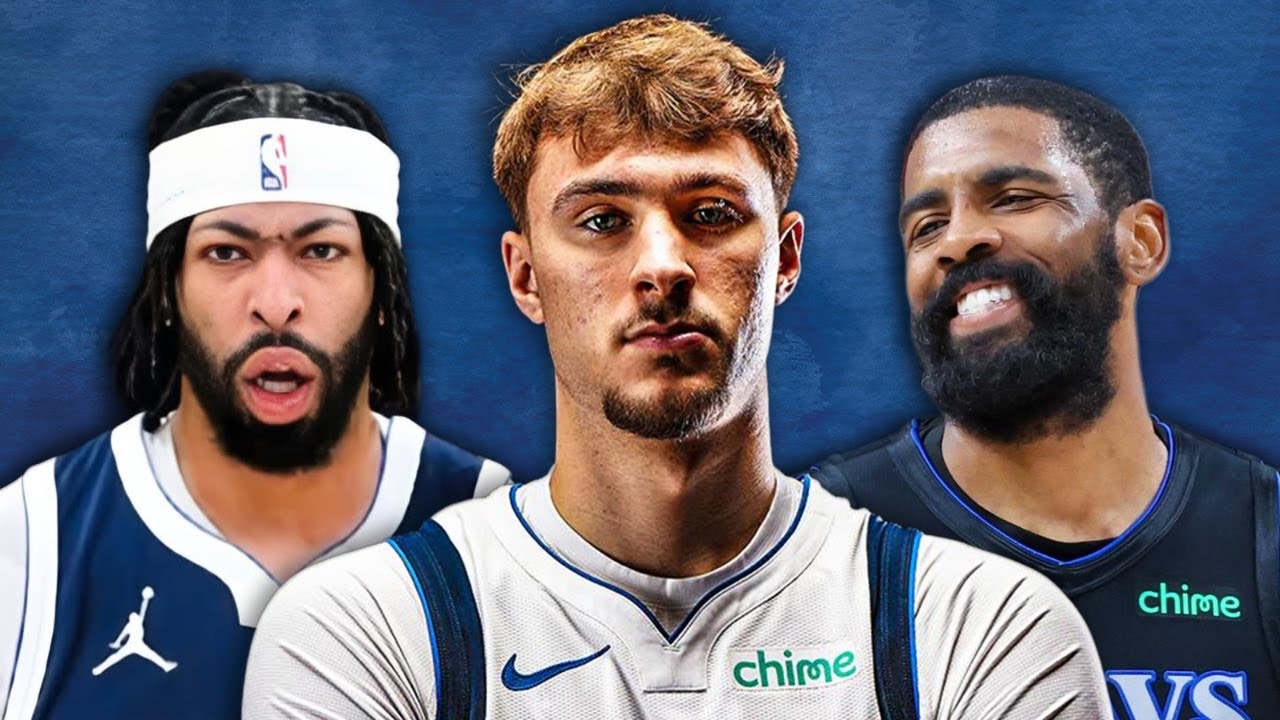
What To Expect From Dallas Mavericks Going Into 2026…
The Mavericks are going to be a lot better than people think. Let’s start with Cooper Flag. Cooper Flag’s statline from summer league already gave people a reason to perk up. He averaged 31 minutes per game and only turned the ball over three times across two games. That kind of ball control as a rookie isn’t normal. His decision-making under pressure was sharp. And his role handling the ball, especially when coach Jason Kidd tested him out at point guard, just made that even more impressive. That’s not just efficiency. That’s poise baked into stats. He shown range, too. From deep, he shot with confidence and actual accuracy. His three-point numbers weren’t flukes, either. They mattered because of how he moved within the offense. He spaced the floor, made it easier for veteran guards to work, and hit catch and shoot threes like he’s been doing it for years. That’s big when you’re joining a team with Kyrie and Anthony Davis. He’s not just being plugged in, he’s actually fitting in now. The defense is where Flag is going to cause even more noise. The numbers don’t lie. He’s already guarding multiple positions. He’s got the lateral quickness to switch on to guards, the instincts to block shots at the rim, and the speed to recover if something breaks down. Watching him rotate across the floor and track players is just clean basketball IQ translating into results. His presence should boost their switch heavy schemes immediately, especially since Davis is anchoring the paint. That combination could tighten up a Maverick’s defense that hasn’t exactly been known for locking teams down. With Davis and Kyrie drawing attention, Flag’s role will be a mix of secondary playmaker and spot-up shooter. His versatility gives Kid more options, especially with Kyrie being able to play off the ball. If Kyrie’s knee holds up, that combo can work. Flag can start the offense or finish it depending on what’s needed. He’s that flexible, and it’s not like the Mavericks are just experimenting. Flag’s projected to start from day one. That’s rare for a number one pick, landing on a team with actual playoff expectations. Most top picks go to squads in rebuild mode, but not here. That means he gets to grow without the weight of having to carry the team, which lets his stats shine in context instead of just volume. The Mavericks are projected to land in the playin tournament with a 73.1% chance and have a 23.1% chance percent shot at a low-end playoff spot. So expectations aren’t wild, but they aren’t low either. If Davis and Kyrie can stay on the floor, and that’s always a big if, Flag has the setup to quietly pile up numbers that matter. Not hollow stats, but impact ones. The long-term stats say he’s expected to make his first All-Star team by year three. That’s the 2027 to 2028 season. 57.7% of ESPN panelists believe that’ll happen. For a rookie not expected to be the main score, that’s a serious trajectory. Add in a projected 46.2% chance to win at least one MVP, and now you’re talking franchise changing numbers. championship odds. 76.9% of those same experts say Flag will win at least one ring. And it’s not all wishful thinking either. When you stack his stats next to other recent number one picks, Flag holds up well. He’s got the lowest turnover rate of any top pick in the last 5 years based on summer league numbers and one of the highest defensive efficiency ratings across his age group. Forget the hype. The actual data says Cooper Flag is set to deliver on both ends of the floor. Not because people want him to, but because the numbers back it up. But then let’s talk about Anthony Davis. Anthony Davis is back at Power Forward, which is what his body has been begging for over the last few years. Now with actual centers next to him, Daniel Gaffford and Derek Lively, he’s not stuck banging against 7 foot monsters every night. That shift should keep him fresh, extend his season, and unlock more of what he does best. Rome, disrupt, and dominate. He had eye surgery in July to repair a detached retina from last season, and reports say he’ll be fully ready for opening night. So now, not only does he get to move back to his natural spot, he also finally gets to see clearly again. Wild concept. Now for the fun part, the numbers. His projected per 36 minute stats for this season look solid across the board. He’s expected to put up 25.4 points, 12.3 rebounds, 3.6 assists, 1.2 steals, and 2.2 blocks. That’s a full buffet right there. His shooting splits are sitting at 52.9% from the field, 28.4% from deep, and 78.8% from the line. His true shooting percentage is projected at 58.8%. Which is definitely efficient enough for a big who gets as many touches as he will. His career efficiency stats are no joke either. His career player efficiency rating is 26.8, and he’s projected to be right around 26.3 this year. His career win shares per 48 minutes sit at 0.197, which places him in elite territory for impact per minute. In 51 games last season, split between the Lakers and Mavericks, he averaged 24.7 points, 11.6 rebounds, 3.5 assists, 1.2 steals, and 2.2 blocks while shooting 51.6%. That’s not washed, that’s productive. Davis is still one of the best defense players in the league. Full stop. He’s been named to five alldefensive teams and led the league in blocks three times. He’s got the mobility, the length, and the timing to still be a nightmare on that end. With Lively and Gaffford behind him, and wings like Caleb Martin and Naji Marshall beside him, this Maverick’s defense could crack the top five. In the nine games he played for Dallas last season, he still averaged 2.2 blocks and 0.6 steals, even while dealing with injuries. Offensively, Davis is going to take over while Kyrie recovers from that ACL tear. He’ll be the first option in pick and pop, isolation, and mid-range actions. That usage bump could push his counting stats higher. He’ll still play inside, hit the short roll, and take a few threes just to keep defenders honest. His career three-point shooting is 29.6%, so not great, but he still provides spacing because defenders can’t leave him entirely. His clutch numbers have always stood out. Back in the 2014 to 2015 season, he shot 83.3% on potential go-ahead shots in clutch time. That kind of composure is part of what makes him so dangerous when it matters most. With rookie Cooper Flag beside him, the Maverick’s front court might be one of the most versatile in the league. Flag takes some pressure off Davis as a defender and gives him a smart and mobile partner. When Davis shares the floor with either Lively or Gaford, those double big looks will protect the rim and clean the glass. Davis career offensive rebound percentage is 9.8% and he still finishes 72.2% of his shots at the rim. Add in a projected 3.6 assists per 36 minutes. And you’re looking at more playmaking, too. Last season wasn’t kind to his health. He had an adductor strain in his Dallas debut that sidelined him for about 6 weeks, then took a knee injury in the playin tournament. But now he’s motivated. He’s out to shut people up who keep calling him injuryprone and remind everyone he’s still a top 10 guy when healthy. The Maverick’s projected win total is 39 and a half, but with Davis active and defending like he can, they could blow past that. He’s even sitting in the background of MVP and defense player of the year conversations. Dallas is ranked second in their division behind Houston. And if things break right, they could make a real run. Davis just needs the minutes and the eyesight to do what the stats already say he can. Anyways, Kyrie tore his left ACL in early March against Sacramento, and that ended his season right there. The current expectation is he’ll be back somewhere between late January and early February. Though there’s no hard date yet, he said he’s not rushing anything, which makes sense. At 33 years old, with a long injury history, rehab takes priority over a dramatic comeback montage. Once he returns, expect a restriction that could stretch into the spring. Before the injury, his numbers were basically what you’d expect from him. He averaged 24.7 points, 4.8 rebounds, 4.6 assists, and 1.3 steals per game. He shot 47.3% from the field, 40.1% from deep, and a ridiculous 91.6% from the line. His player efficiency rating for that season was 19.9. Not quite peak Kyrie, but still high level output for a veteran playing big minutes on a playoff chasing team. His career shooting splits are still elite. 47.4% 4% from the field, 39.4% from beyond the ark, and 88.8% from the strike. And that’s across 14 full seasons in over 770 games. His scoring efficiency has always been one of his best traits. His career true shooting percentage sits at 58.4%. And that includes all the games where he had to carry teams, missing other stars. Looking ahead, his projected per 36-minute numbers for this season are right in line with what he’s done before. 24.7 points, 4.9 rebounds, and 4.8 assists. That comes with shooting splits of 47.8% from the field, 39.5% from three, and 90.5% from the free throw line. Basically, the efficiency is still there even after major surgery. His projected win shares per 48 minutes is 0.139, which puts him in the high impact tier when healthy. Without Luca Donuch, who was traded for Anthony Davis, the Mavericks are now Kyrie’s show, at least when he’s on the court. That means more usage, more ball handling, and more pressure. He’ll be the main offensive creator once he returns and the guy who sets the pace. He’ll also be mentoring Cooper Flag, which is more basketball responsibility than leadership expectations, but still matters. Kyrie’s shot creation and spacing open up the floor for Flag to operate, and that’s a big deal in how the team wants to develop both players. When he’s not playing, the Mavericks are thin in the back court. That’ll likely put more pressure on him once he’s cleared, which isn’t ideal for a player coming off a torn ACL. The team will try to manage his minutes, but that only works if they’re not desperate to win games. If their record’s shaky in February, that restriction plan could go out the window fast. Still, the playoff math changes with Kyrie. ESPN gives the Mavericks a 73.1% chance to land in the playin tournament and a 23.1% shot at a fifth or sixth seed. Those odds spike if Kyrie comes back and looks like himself. Stephen A. Smith even went out of his way to say that if Davis and Kyrie stay healthy, Dallas could win the whole thing. That’s a big if, but it shows how much Kyrie’s return matters to their ceiling. His contract is 3 years for $118 million, which isn’t bad by superstar standards. It gives the Mavericks flexibility under the second apron. He and Davis both have player options after the 2026 to 2027 season. So, the window to win is open now, not later. That means Kyrie’s return isn’t just about recovery. It’s about urgency. With 91 career win shares and a history of being a high impact, high efficiency score, Kyrie’s return could push Dallas from average to dangerous. If the knee holds up, the numbers suggest he’ll still be one of the league’s most reliable offensive weapons. I can’t wait to catch NFL games in person this season. But let’s be real, actually buying tickets can be a nightmare. You’re stuck in cues, logging in and out, and then the price jumps right when you’re about to check out. All you want is to be in the stadium cheering with everyone else. That’s why I’ve been using game time.co, the app that gives fans the advantage. With just a couple taps, you unlock amazing tickets and experiences, and the price you see is the price you pay. No surprise fees ever. I just use Game Time to grab tickets for an upcoming NFL game. Seriously, it took me minutes. I pulled up the app, saw great seats starting around a h 100red bucks, and checked out instantly. The best part, I could see the exact view from my seat before I bought. That’s a gamecher. Plus, Game Time has features that make it so easy to save. Exclusive zone deals where you pick the section and they pick the seat. Alerts when your favorite teams have new deals in their guarantee that covers you with the lowest price. Game time will even credit you 110% of the difference if you find a better deal. So, take the guesswork out of buying NFL tickets with Game Time. Download the Game Time app, create an account, and use code CLNS for $20 off your first purchase. Terms apply. Swipe, tap, ticket, go. Download Game Time today. Last season with Dallas, he played 72 games, and averaged 14 points, 3.4 rebounds, and two assists in just over 27 minutes per game. His shooting splits were solid, hitting 41.2% 2% from the field, 39.1% from three on 7.7 attempts, and over 90% from the free throw line. Even if he’s not a star anymore, those are role player stats every coach wants. His advanced metrics show he’s still making an impact. He posted an effective field goal percentage of 53.5 and a player efficiency rating of 12.9. That peer is not elite, but it’s above replacement level, and that matters when you’ve got multiple stars who’ll need spacing and consistency. He totaled 1.8 win shares, which again in a bench role is valuable production over a long season. In the playin tournament, he stepped up too, averaging 20.5 points over two games and shooting 57.7% from the floor and 50% from deep. Even if the legs aren’t what they used to be, the shot is still very much alive. Over his career, Thompson has been one of the best three-point shooters in the league. He shot 41.1% from beyond the arc across 12 seasons, taking more than seven threes per game on average. That kind of volume and efficiency is rare. He remains a master of moving without the ball, forcing defenders to chase him around screens, and that opens the floor for everyone. Defenders can’t cheat off him, which helps players like Cooper Flag and Anthony Davis get cleaner looks and more space to work with. But the legs don’t lie. His defense has slipped. He used to be on the alldefensive team back in 2019, but since then multiple injuries, including a torn ACL and a torn Achilles, have taken a toll. Last season, he averaged just 0.7 steals and 0.4 blocks per game. His lateral quickness is down, and it shows when teams attack him in isolation. His overall field goal percentage dipped from his peak years, too. He shot 46.8% in 2017. So, the current 41.2% isn’t exactly trending upward. His projection for this season is built around a smaller role. Per 36 minutes, he’s expected to average 19.7 points, 4.4 rebounds, and 2.7 assists with shooting splits of 41.7% from the field, 38.5% from deep, and 89.7% from the line. The expected role is around 25 minutes per game, probably coming off the bench or starting spot duty, and averaging 12 to 15 points per night. That’s exactly what Dallas needs from him in terms of fit. His presence opens things up. The Mavericks have guys who drive. Cooper flags developing that part of his game. And Davis will draw doubles in the post. Klay forces defenses to stay glued to him. So help defenders can’t cheat. He can play shooting guard or small forward, which lets the team mix and match lineups around matchups. Whether it’s going small with more shooters or big with multiple defenders behind him. There are challenges, too. Dallas was middle of the pack in defense last season. and Klay’s inability to switch and chase hurts them in certain matchups, but pairing him with Davis and Lively helps mask that. At 35, health is also a factor. He missed time last season with a footspring, and the team will probably manage his minutes through backto-backs and longer road trips. If he stays healthy and accepts the role, Klay Thompson can still bring elite floor spacing and veteran poise. His contract status adds some questions. He’s on an expiring deal which might become part of the trade deadline chatter. But until then, he’s still a threat from deep. Still knows how to win and still gives Dallas real value in 25 minutes a night. But what about a new pickup? DLO D’Angelo Russells stepping into the starting point guard role while Kyrie recovers from that torn ACL. And like it or not, the team’s early season flow is going to ride on him. He signed a 2-year deal worth $13 million using the mid-level exception, which already says a lot. It’s a budget move with upside if his shot returns. In the meantime, he’s expected to start next to Klay Thompson and later shift into a six-man role once Kyrie’s back in the mix. His numbers last season weren’t exactly thrilling. In 58 games split between the Lakers and Nets, he averaged 12.6 points, 2.8 rebounds, 5.1 assists, one steal, and 0.4 blocks. The shooting wasn’t kind. Just 39% from the field, and 31.4% from three. Even his true shooting percentage was a modest 52.2%. His player efficiency rating was 14, which is below his career average of 16.2. It’s not disaster territory, but it wasn’t efficient either. The projection for this season is a bit more optimistic. Per 36 minutes, he’s expected to put up 18.7 points, 3.8 rebounds, 6.9 assists, 1.2 steals, and half a block. He’s projected to shoot 42.7% from the field, 36.1% from deep, and 82.8% from the line. That bounce back to his career three-point average is what Dallas is betting on. His projected win shares per 48 minutes, sits at 0.082, not elite, but passable for a rotational guard with a bigger role early on. He’s always been a capable playmaker, averaging 5.7 assists across his career. Last season, even with reduced usage, he managed 5.1 assists per game. His best value is still in the pick and roll. And with Anthony Davis on the floor, someone he already played with in Los Angeles, that pairing could unlock some clean twoman actions. Davis gravity in those sets makes Russell’s job simpler. Just find the open man or pull up when defenders sag. His offball game matters, too. In 2024, he shot over 41% from three, but that dropped hard last season. The Mavericks hope he regresses back to his career average of 36.5% which would space the floor properly for Cooper Flag and Davis to operate. Flag as a secondary initiator lets Russell float a little more cutting, spotting up or curling into quick release jumpers. That version of Russell fits nicely. Defense is a different story. He’s never been a lockdown guy. Last year he averaged one steel and 0.4 blocks per game. That kind of production isn’t going to win him any alldefense votes. The Mavericks will need Davis, Flag, and Daniel Gaford to pick up the slack on that end because backcourt stops aren’t coming from Russell. His defensive rating usually trails the league average and switch heavy schemes will put him in some tough spots. Once Kyrie returns, Russell will likely head to the bench and lead the second unit. That role actually might suit him better. Less pressure, fewer defensive mismatches, and more control over tempo. He can get his touches and shots without having to force the issue against starting lineups. His durability helps, too. He played 76 games the year before last in 58 last season. Most of his absences came from minor injuries, ankles, knees, and the usual seasonal flu stuff. For a guard in his prime, he’s available more often than not, and that’s huge when you’re patching a hole left by a missing all-star. The Mavericks are projected to win 42 games this season, putting them right in play in range. If Russell gives them something close to his 20 23 form, 17.8 points, 6.2 assists, and nearly 40% from three, Dallas could squeeze out a few more wins than expected. His impact may not show up in flashy metrics, but he’s the one holding things together while Kyrie’s out. But what about the big man? Derek Lively is stepping into year three with a statline that already makes him look like one of the league’s most efficient centers. Across his career so far, he’s averaged 8.8 points, 7.1 rebounds, 1.6 6 assists, 1.5 blocks, and 0.6 steals in just over 23 minutes a game. His shooting percentage 72.9 from the field. That’s not a typo. It’s a highlight reel of lobs, dunks, and point blank finishes. Exactly what you want from a rim running big who stays in his lane. Last season, he played only 36 games due to a mix of ankle injuries and a hip issue. But when he was active, he delivered. He averaged 8.7 points, 7.5 boards, 2.4 assists, 1.6 blocks, and shot 70.2% from the floor. Even his free throws improved, going up to 63% after hitting only 50.6% the year before. He recorded eight double doubles despite limited minutes, which gives a good sense of his permitt production. In the playoffs, the numbers stayed respectable. He averaged 7.9 points, 7.4 four rebounds and a block per game in 22 minutes across 21 games. That kind of consistency matters, especially when the spotlight’s on. In the 2025 playin games, his counting stats dipped to 2.5 points and 3.5 rebounds, but he showed flashes as a passer with 3.5 assists per game and still blocked shots and got steals. He did all of that in just 19 minutes a night. He had offseason surgery in July to remove bone spurs in his right foot, but that was more preventative than reactive. Recovery is going faster than expected, and he’s on track for a full training camp with no limitations. That’s a good sign, especially given how much of Dallas defensive identity relies on him being mobile and available. Looking ahead, his role is expected to expand. Offensively, he’s been green lit to attempt three-pointers. That’s right, zero makes in the regular season across two attempts, but he hit his only postseason three in the 2024 finals. Mark Cuban and the staff believe in the shot and it’s being built into his workload. Even if the volume stays low, the threat changes how teams defend him. Add that to his already elite pick and roll presence and it’s trouble for opposing defenses. His finishing near the rim is elite by every metric. He stayed above 70% from the field in both of his seasons, making him one of the most efficient players in the league in that area. If he adds more post moves and continues to work on touch around the basket, his scoring average could take a bump up even without needing more touches. Defensively, he’s a foundational piece. His mobility lets him switch on to guards, and his length allows him to recover and protect the rim. His career average of 1.5 blocks per game speaks to that. But the actual in-game impact goes beyond that stat. He clogs lanes, challenges shots, and rotates with purpose. His rebounding sits at 7.1 per game across his career, and there’s room to grow if he improves boxing out and staying out of foul trouble. He’ll be sharing time with Daniel Gaffford and Anthony Davis, which means his minutes could shift based on matchups. Davis will likely close games at center in certain lineups, especially in playoff situations, so Lively may have to earn closing minutes based on performance. But the regular season is long, and his impact during the first 40 minutes of games still matter. He’s only 21, and the Mavericks already view him as a cornerstone. He’s considered their defensive engine, and his energy builds chemistry with teammates. He fits perfectly in pick and roll sets, and his connection with guards like D’Angelo Russell makes offensive execution smoother. Lively’s production isn’t loud, but it’s efficient, focused, and increasingly important. If he stays healthy and takes even a small leap offensively, he could become one of the most impactful young bigs in the entire league. But how about the other big man, Daniel Gaffford, might be the most quietly effective center in the league right now. Last season with Dallas, he played 57 games, and averaged 12.3 points, 6.8 rebounds, and 1.8 blocks in just over 21 minutes a game. That’s the kind of production most teams would beg for from a starting center, and he did it without needing the ball or a play drawn up for him. His field goal percentage, a laughable 70.2%. That’s not just efficient, it’s record book material. He’s now sitting on a career field goal percentage of 70.9%, which puts him in a club with only the most selective interior finishes in league history. He even made 33 straight field goals at one point, which is second only to Wilt Chamberlain. That’s not some gimmick stat. It’s what happens when a player takes only high percentage shots and finishes them with force and consistency. Add in a 71.6% true shooting percentage and it’s clear he’s not wasting possessions. His block numbers are solid, too. Last season, he averaged 1.8 per game, and that jumps to three per 40 minutes. He’s also grabbing 12.7 rebounds per 40 with 1.5 of those coming on the offensive glass. That’s where he really hurts opponents. second chance points. He doesn’t just clean up misses, he turns them into easy poop backs or forces defenders to crash in and open up shooters on the perimeter. But he’s not perfect. His free throw shooting sits at 68.9% and that’s actually above his career average of 67.2%. In close games, teams aren’t shy about sending him to the line. He also has no shooting range. Not a little bit of range, none. He has never even attempted a three-pointer in his career. That limits what the offense can do when he’s out there, especially in half court sets. He also picks up fouls quickly, averaging 2.7 personal fouls per game last season. That limits his minutes and forces the coaching staff to juggle rotations more than they’d like. It’s part of the reason why his minutes are projected to hover between 22 and 25 per game. Any more than that, and the risk of foul trouble becomes a problem. That said, he’s still expected to be the starting center for Dallas this season. Even with Derek Lively in the mix and Anthony Davis playing center in some lateg game lineups, Gaffford’s energy, efficiency, and defense keep him in the starting five. Per 36-minute projections have him putting up 22.9 points, 12.7 rebounds, and three blocks. That kind of output per minute is rare and valuable, especially on a team trying to keep stars like Davis fresh. His fit with the rest of the roster is clean. He’s a perfect lob threat in pick and roll situations with D’Angelo Russell and Kyrie. Those two draw defenders away and Gaffford rolls hard to the rim every time. His chemistry with Davis is important, too. When they share the floor, Davis handles the more mobile defensive assignments while Gaffford holds down the paint. That combo has the potential to suffocate opponents inside. He also fits next to shooters like Washington who can stretch the floor and let Gaffford operate in space. Even though Gaffford can’t shoot outside the paint, lineups around him can make up for it. That flexibility matters when Coach Kid starts experimenting with rotations in the early part of the season. Gaffford’s player efficiency rating last season was 22.9 per 40 minutes and his usage rate was 18.9%. That shows he stays involved without hijacking the offense. He totaled 1.8 win shares, which for a role player getting limited minutes is right where you want to be. He’s 27 now, just entering his prime. and the Mavericks locked him up with the three-year, $54 million extension. That cap hit of just over $14 million this season is good value for a player producing elite efficiency numbers. Gaffford doesn’t need the spotlight, but he does need a consistent role. If the fouls stay down and the minutes stay steady, he’s going to be a big part of why Dallas competes deep into the season. But how about a forgotten piece? PJ Washington is walking into the season as one of the most important bench players in the league, and his stats actually back up the hype. Last season, he averaged 14.7 points, 7.8 rebounds, 2.3 assists, 1.1 steals, and 1.1 blocks across 57 games for Dallas. He shot 38.1% from deep and played both forward spots, plus some small ball center when needed with Anthony Davis and Cooper Flag soaking up most of the starting front court minutes. Now, Washington shifting into a six-man role, and he’s expected to thrive in it. Per 36 minutes, he’s projected to average 16.5 points, 8.2 two rebounds, 2.8 assists, 1.3 steals, and 1.2 blocks this season. That’s on shooting splits of 44.5% from the field, 37.5% from deep, and 75% from the line. The projected win shares per 48 minutes, sits at 0.120, which is efficient production for a bench piece who’s going to play around 25 to 28 minutes a night. His advanced metrics from last season also showed steady all-around value. His true shooting percentage was 55.6. 6% usage rate was just under 20% and he posted a turnover rate of only 11.8%. That’s a solid mix of involvement and control. His assist rate was 13.1%. High for a forward which shows how often he initiates plays in second unit sets. He rebounds at a solid rate too, 9.6% overall. And that number jumps when he plays the five in smaller lineups. Washington can shoot, pass, switch on defense, and finish at the rim. He spaces the floor with that 38% from deep and he can put the ball on the floor when defenders close out too aggressively. The Mavericks leaned on that versatility in the playoffs last year and he delivered even though he went zero for three. In the play-in loss to Memphis, the larger body of work shows his value in clutch spots and rotationheavy games. Defensively, he gives them flexibility. He averaged over a block and a steal per game, and he can switch one through five depending on matchups. His frame and strength let him hold up against bigs, and his foot speed keeps him from being a liability against wing. In the playoffs, he was part of the group that disrupted Oklahoma City’s flow, providing timely help and forcing tough shots. That defensive flexibility is what’ll keep him in closing lineups, even if he’s not starting. Now that Dallas has Davis, Flag, Lively, and Gaffford in the front court, Washington won’t need to carry as many defensive minutes, but that just makes his contributions more efficient. He can anchor the bench unit or plug into matchups when the starters need rest. And with Kyrie out to start the season, his two-way play gives Dallas another creator who can keep the offense humming while still bringing physicality on the other end. He’s also up for a contract extension. Eligible for four years at $90 million, but likely to land something closer to 3 years at $60 million. If extended, he won’t be traded. Eligible for 6 months. So Dallas is locking in his presence through the entire season. That extension might limit what they can do later with cap space, especially when it’s time to look at new deals for Derek Lively. But for now, Washington’s value outweighs that risk. His minutes are going to matter, especially early in the season while Kyrie recovers with his projected usage at just over 20%, a rebound rate in the top 30 for forwards, a block percentage inside the top 20, and assist numbers that beat most players at his position. Washington checks every box for a high-end six-man. Dallas doesn’t need him to be a star. They need him to be exactly what he is. Productive, switchable, steady, and efficient. But lastly, let’s talk about a player I really like. Naji Marshall’s coming into this season as one of those glue guys who actually fills the cracks. Last year in 69 games with 31 starts, he averaged 13.2 points, 4.8 rebounds, three assists, and one steal in just under 28 minutes a night. He shot 50.8% from the field and 81.3% from the line. from deep, not great, 27.5%, but everything else about his game held steady or jumped. He had a big stretch in March where he basically looked like a different player. Over 16 games, he averaged 19.8 points, 7.3 rebounds, 3.6 assists, and 1.4 steals. That run included a 38-point game against New York, a near triple double against Phoenix with 34 points, nine rebounds, and 10 assists, and a 17 rebound night against Memphis. It wasn’t a fluke. He played 34 minutes a night during that run and was producing like a borderline starter on a contending team. His true shooting percentage for the season came out to 58.4% which is solid for a wing who doesn’t rely on jump shots. Most of his buckets come from slashing, cutting, or finishing in transition. He’s not a finesse shooter. He’s physical, aggressive, and gets to the rim. That’s how he shoots over 50% from the field despite defenders playing off him at the ark. The three-point percentage is the obvious gap. He shot just under 28% from deep last season after hitting 38% the year before in New Orleans. That’s a steep drop and it affected how teams guarded him. If he can get that number back up closer to his career highs, he becomes way more useful in lineups next to Cooper Flag, Kyrie, and Anthony Davis. If he can’t, then defenses are going to keep sagging off and jamming the paint. Even with the shooting dip, he still made an impact. His assist numbers are solid for a Ford. three assists per game and even a 10 assist performance show he can create for others when the offense stalls. His turnover rate is manageable at 1.6 per game, though he had a few ugly ones like the four turnover night against Sacramento in the playin tournament. Defensively, Marshall brings toughness and versatility. He can guard twos through fours and doesn’t shy away from physical matchups. He averaged a steal per game and had multiple games with two or more steals. His block numbers are low, just 0.2 and two per game, but his ability to switch and contest shots helps more than the raw stats show. He’s the type of defender who chases, bodies, and scrambles. Not the highlight block guy, but the one who blows up a set with one good switch. His role this season is going to shift with PJ Washington, Anthony Davis, Cooper Flag, and even Derek Lively in the mix. Minutes at the forward spots are limited. Marshall’s likely to see a reduced role from last year’s 28 minutes, but he’ll still be a rotational piece. He’ll play when Dallas needs energy, wing defense, and guys who don’t need the ball to make a difference. He’s one of the few players who can slide into multiple lineups without changing the rhythm. He’s also on a solid deal, three years for $27 million, so there’s no pressure to overperform. He gives Dallas veteran stability in a locker room full of stars and young talent. He’s one of the few non-stars who shown he can lead by effort and toughness, and that matters in long stretches of the season when things get messy. He averaged 0.139 win shares per 48 minutes last season, which shows he contributes when he’s on the floor. He brings the ball up sometimes, runs offense when needed, and never looks out of place. If he finds his jumper again, he’ll be one of the most dependable wings on the roster. Even if he doesn’t, the defense, slashing, and effort keep him valuable in a system built to win. Now, if you enjoyed this, I’m going to be posting a lot here. I would greatly appreciate it if you could subscribe. Thanks for watching.
check out the new channel please https://www.youtube.com/@bballexplainedd
subscribe for more nba content!!!!
inquires: ModernJamMedia@gmail.com