
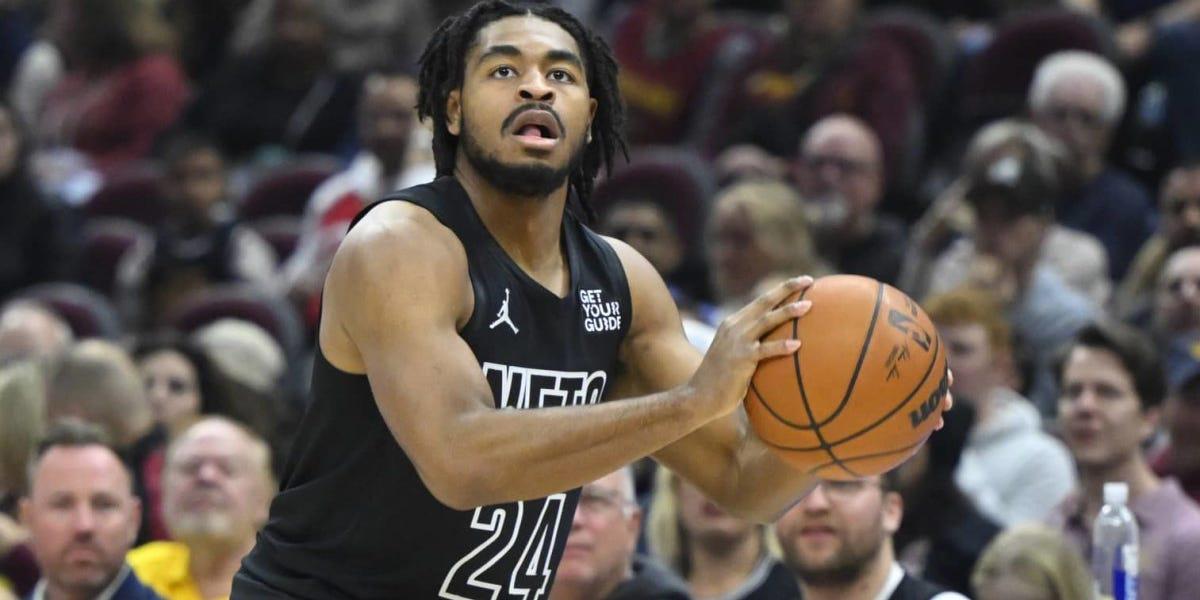
A few upcoming decisions that I think are interesting. I'm curious to hear your thoughts.
(1) The Roster Spots Decision
The Hornets currently have 18 players on standard contracts. By the first day of the season (10/21), they need to reduce this number down to 15. Here’s the general mandate in the CBA, for those interested:
During the period from the first day of the Regular Season through the last day of the Regular Season (or, for Teams that qualify for the “postseason” … through the Team’s last game of the Season), each Team agrees to have either fourteen (14) or fifteen (15) players, in aggregate, on its Active List and Inactive List. Article XXIX, Section 2(a).
A few players that stand out as potential trade or waiver candidates as we head toward the roster compliance deadline:
- Pat Connaughton: Expiring salary and a plausible buyout candidate down the road. Rather than waiver or buy-out, the Hornets are probably more likely to trade him in a pre-season salary dump to open up additional flexibility under the Tax Level for in-season transactions. (See yesterday’s Brooklyn trade idea).
- DaQuan Jeffries: Non-guaranteed salary, low financial impact, little opportunity cost, and an uncertain role on this year’s team = a straightforward cut candidate.
- Nick Smith Jr.: The looming deadline to exercise his 2026-27 team option makes him a natural trade or waive chip if Charlotte has already made its evaluation.
- Mason Plumlee / Spencer Dinwiddie: Both signed one-year veteran minimum deals. The Hornets could cut them without any financial obligation extending past this season. While it might perhaps be odd to waive players they just signed, that’s a sunk cost. It’s hard to see the long-term value of holding either player.
My read: Jeffries looks like the first domino. From there, Charlotte has to decide whether to sacrifice veteran depth (Plumlee/Dinwiddie), cut ties with Smith Jr., or re-route Connaughton in a deal.
If I were a betting man (I’m not) and had to make a bet today (I don’t), I’d say the three cuts end up being Jeffries, Smith Jr., and one of Plumlee or Dinwiddie. Connaughton’s expiring $9.4 million feels just a shade too useful as matching salary in a midseason deal to waive outright.
This isn’t to say that a pre-season trade involving other players is out of the question, either.
Miles Bridges, Collin Sexton, Josh Green, and Grant Williams stand out as potential consolidation-trade candidates should the right deal come along before the opener (Dinwiddie and Plumlee are excluded here due to the standard trade restriction on newly signed contracts, which runs through December 15).
In sum, Charlotte has a good bit of flexibility to get to 15 standard contracts. They can afford to wait and see if a trade opportunity presents itself in the pre-season. Otherwise, there are straightforward cuts to make.
(2) The Tax Room Decision
If we assume Charlotte trims the roster by cutting DaQuan Jeffries, Nick Smith Jr., and Spencer Dinwiddie, the Hornets will sit about $14 million below the luxury tax line. That’s comfortable breathing room.
There is almost no world in which Charlotte crosses into tax territory this season. I suppose there’s a plausible path where they start hot and follow it up with a splashy deadline move to chase a playoff run. But barring that, the tax is not the constraint — it’s the cushion.
And so, the “Tax Room Decision” is not a question of whether to have the room, but of how to use it.
Charlotte can leverage its Tax Room in a few different ways:
- As a trade facilitator. Charlotte can comfortably absorb money as a third team, helping others balance the books in multi-team deals (in exchange for draft capital).
- To take on undesirable contracts. The Hornets can accept unwanted salary from tax teams (in exchange for draft capital).
- To acquire a big-money player. By packaging two or three mid-tier deals (Connaughton, Bridges, Sexton, Williams), Charlotte can bring back a larger contract without sweating the tax math, broadening their pool of possible trades.
The hypothetical trades that fit into the facilitator and undesirable contracts buckets are plentiful and mostly dependent on market conditions — Charlotte is the conduit when another team needs one.
But the acquire a big-money player bucket is more pointed. It ties directly to Charlotte’s roster build and team needs, and it’s therefore a bit more fun to explore. And, unsurprisingly, Charlotte has plenty of flexibility to get to almost any salary-matching figure it needs to.
And there will come a time when Charlotte looks to land that player. As Jeff Peterson put it this summer:
"There's going to be a time that we cash in. We take all of our chips, assets, whatever it is, and we're gonna go get that guy. That's gonna happen at some point, but right now we have to stay very committed to our process. But to do that, you gotta lay the foundation with winners."
Here are some sample outgoing contract packages to reach various bands of incoming salary (note: for fun, and to show just how much flexibility this team has, I’m not even going to use the Miles Bridges $25 million):
What jumps out is how many different combinations of mid-tier deals Charlotte can roll up. This isn’t a roster with just one or two movable salaries. It’s a roster with half a dozen tradable contracts that can be mixed and matched to land in almost any trade conversation.
The above table assumes the Hornets are using the Expanded Player Traded Exception while also staying under the Tax Level this season. Use of the exception hard-caps a team at the First Apron Level, but Charlotte is already hard-capped there, so nothing changes in practice.
Now, of course, the important decision is which player to acquire and when. That’s a separate conversation. I’ll probably write about it at some point. For now, the takeaway is simple: the Hornets have the flexibility to match salary for virtually any player in the league today.
(3) The LaMelo Ball Decision
The flexibility discussed in the previous section also cuts the other way. Rumors popped up over the offseason with Shams Charania stating the team should be "all ears" to a massive offer, though they aren't actively shopping him.
And this shouldn’t be shocking. The primary arguments for trading LaMelo Ballcenter on two realities: his injury history — which has limited both his availability and the team’s consistency — and Charlotte’s broader struggles to build a winner around him. Those factors have left Ball lagging a bit behind his draft-class peers in terms of trajectory and league-wide perception.
That said, I’m a bit skeptical that a LaMelo trade is on the horizon in the immediate term for a few reasons:
- Contract structure. Ball still has four years and roughly $169 million left on his deal. That’s a huge commitment for another team to take on without the confidence of seeing him healthy for a full season first.
- The health paradox. If Ball is healthy, Charlotte is less inclined to move him (while other teams would be more eager to trade for him). If he’s not healthy, Charlotte might be more inclined to move him (while other teams would be less eager to trade for him). Either way, when health is the primary motivator behind a trade, the incentives and timing are hard to match up.
- Charlotte’s flexibility. Charlotte isn’t boxed in. They can still give it another clean run at building around him if he stays on the floor. If the Hornets are bad, they drift toward the lottery and stockpile prospects; if they’re good, they can lean into building around him. Both outcomes are tolerable in the near term.
- No ticking clock. The roster doesn’t face a forced decision point anytime soon. Brandon Miller’s potential rookie extension kicks in for 2027-28, and the cap sheet has a natural “hard exit ramp” that season with just LaMelo Ball under a guaranteed contract.
In short, the Hornets can afford to wait. The highest upside option for this team is likely a healthy LaMelo Ball. If that happens, then great. If not, there is enough flexibility to continue to build even with an injured Ball on the books.
Honorable Mentions (because I can’t help myself):
- Who needs a 2026 first-round pick? The Hornets have an interesting asset in the least favorable of PHX/WAS (top-8 protected)/ORL/MEM. That pick is pretty likely to land in the 20s, which is exactly the kind of slot I always circle as a prime trade candidate. Why? Because there are a handful of teams — LAC, NOP, ORL, PHI, PHX, and POR — who are either without a 2026 first or at risk of losing one. That creates Stepien-related restrictions, limiting their ability to trade future firsts until they resolve the 2026 issue. Charlotte can offer relief. By shopping this 2026 pick to one of these teams, the Hornets could unlock that team’s Stepien flexibility and, in return, ask for a higher-value future pick. Just something to keep an eye on.
- Who needs a 2029 first-round pick? Same logic applies here. Charlotte owns the least favorable of UTA/CLE/MIN (6–30). It’s too far out to project with confidence, but we could assume this pick will land outside the lottery.That makes it another candidate to be moved. The same Stepien-related dynamics will still apply down the road: teams missing or encumbered on their 2029 firsts will need relief in order to open up trading flexibility.
I also wrote about this, and other stuff, on my substack. Feel free to check it out: https://lukemccartney.substack.com/p/charlotte-hornets-three-upcoming
3 comments
You dont hand Plum and Dinwiddie money for free to cut them
Sexton fits the culture that Jeff and Charles want perfectly, I don’t see him being moved before the season. The ideal situation for me would be to package NSJ, Green, either Plumlee or Moussa and picks to get a high-level center
Shams said the team “should” be all ears, not “would” re: LaMelo. That’s a big difference.