
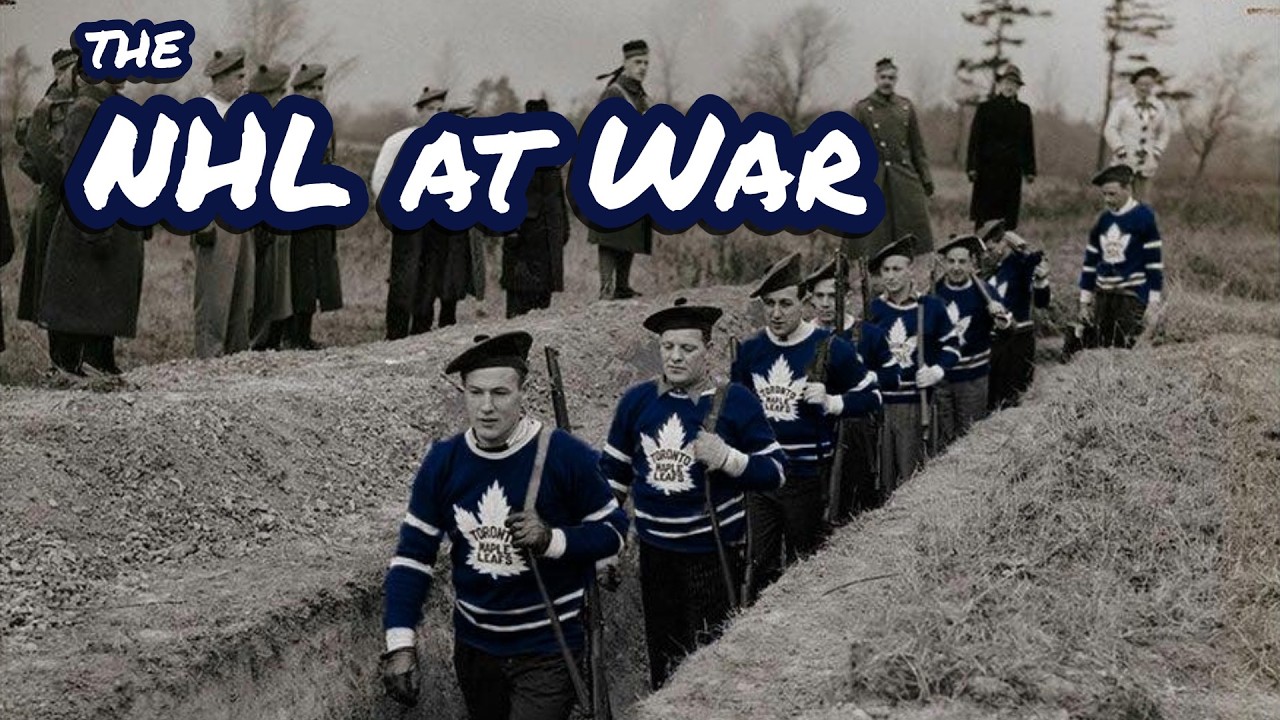
How WW2 Transformed the NHL and its Stars
[Applause] Today we’re going to talk about a chapter in hockey history that’s often overlooked amid stories of Stanley Cup glory and record- setting seasons. How World War II reshaped the game and turned players into heroes. From Moerwitz’s daring charges into machine gun fire to rescue his squadron mates, Red Garrett’s tragic loss at sea on a torpedoed ship, Hec Killer’s heroic rescues under fire, Sam Lrey’s 42-day survival in a lifeboat after his vessel was sunk, and Rocket Rashard’s morale boosting 50 goals in 50 games. It’s the story of how the game was shaped by the largest global conflict of the 20th century. We’ll start with some historical context on the war itself. Look at how it nearly derailed the NHL and explore the stories of the players who traded their hockey sticks for rifles. Some served overseas, others boosted morale on the home front, and a few paid the ultimate price. Let’s dive in. World War II broke out in September 1939 when Nazi Germany invaded Poland, dragging much of Europe into the conflict. Britain and France declared war on Germany and Canada with its ties to the British Commonwealth followed suit on September 10th, 1939. The United States entered later after the Japanese attack on Pearl Harbor in December of 1941. This was total war. The Axis powers of Germany, Italy, and Japan against the Allies, including Britain, the Soviet Union, the US, and Canada. It spanned continents from the beaches of Normandy to the Pacific Islands involving aerial bombings, tank battles, and brutal infantry combat. Between 70 to 85 million people died worldwide, including civilians in events like the Holocaust and the atomic bombings of Hiroshima and Nagasaki. For Canada, the war was a massive national effort. More than 1 million Canadians served in the armed forces out of a population of just 11 12 million. At home, there was rationing of food, gasoline, metal, rubber, and other products. Factories shifted to producing tanks and planes with women stepping into roles traditionally held by men, and war bonds were sold to fund the fight. The US mobilized in a similar manner with over 16 million serving. Morale was key to the war effort with governments seeking out distractions to keep spirits up, and that’s where professional sports came in. In an atmosphere of total war, the realms of hockey and combat intersected and the conflict reshaped the NHL. The NHL was already on unstable footing in the late 1930s, reeling from the Great Depression. By 1942, things were getting dire. The New York Americans, renamed the Brooklyn Americans, folded midway through the season due to long-standing financial difficulties worsened by the war, leaving just six NHL teams standing. ushering in the original six era that lasted until 1967. Shutting down pro hockey was seriously considered on both sides of the border. Canadian politicians in particular, including Minister of National Defense JL Rston, believed the NHL should cease operations for the duration of the war, arguing it was the patriotic thing to do and that able-bodied men should be fighting, not playing hockey. But NHL President Red Dutton, a World War I veteran who’d recently lost two sons who were airmen in the Royal Canadian Air Force, pushed back, insisting that NHL hockey boosted morale, noting that the military status of every NHL player was known to the government, and that all active players had already been rejected or discharged as medically unfit or deferred as farmers on seasonal work. South of the border, prominent American lawyer and statesman Charles Sawyer was dispatched by the NHL to lobby the anti-hockey politicians in Canada, echoing the sentiments of Dutton. After much deliberation, the NHL was given the go-ahad with the understanding that no player would be absolved from military duty in order to play hockey. Over 80 NHL players enlisted with the number exceeding 100 when factoring in minor leaguers and prospects. Teams scrambled, filling rosters with over-the-hill veterans, players who are medically exempt, and teenagers who should have been playing junior hockey. Dink Carroll wrote in the Montreal Gazette, “After 3 years of war, the ranks of the NHL teams have been depleted to the point where the vacancies must be filled by lads only a year or two out of their knicker blockers. In the ordinary course of events, Carol continued, they might still be expected to play a year or two of junior hockey or perhaps go to the miners for a year seasoning, but these are not ordinary times.” At the start of the 1942 to43 season, the NHL’s victory lineup starkly illustrated the war’s toll on its rosters with the New York Rangers losing 19 players to military service. The Boston Bruins 16, the Toronto Maple Leafs 14, the Montreal Canadians 11, the Detroit Red Wings 8, and the Chicago Blackhawks 7. To counteract the decline in game quality due to wartime talent shortages, the NHL introduced the center red line in the 1943 to 44 season. Before 1943, a player wasn’t allowed to make a forward pass across his own blue line, which trapped teams in their own end and created stagnant, low-scoring games. The new rule allowed a player in his own defensive zone to make a breakout pass as far as the red line. This adjustment sped up the game, fostered endto-end action, and increased scoring, which boosted fan interest, and marked the beginning of hockeyy’s modern era. The NHL also axed regular season overtime to meet wartime train curfews, a change that stayed in place until regular season OT was reintroduced for the 1983 to84 season. Attendance remained strong during wartime with the Maple Leafs playing to 89% capacity in 1944 and the Habs playing to a full 100%. The four US teams also enjoyed large crowds. In addition to regular season play, the NHL raised money through benefit exhibition games, and players help the war effort by purchasing and promoting victory bonds. The league also found other creative ways to contribute to the war effort, like having players donate fines incurred for on ice incidents to the Red Cross. Perhaps no single individual did more to boost the morale of service personnel and fans than legendary Canadian broadcaster Foster Hewitt. His hockey night in Canada radio broadcasts reached 74% of Canadians at home and were transmitted to servicemen on the front lines. In addition to NHL hockey, military branches in Canada and the United States formed hockey teams, often mixing enlisted NHLers and amateurs to entertain the troops, war workers, and civilians. In Canada, teams proliferated across Royal Canadian Air Force, Royal Canadian Navy, and Army bases, such as the Ottawa RCAF flyers, who later won Olympic gold in 1948, the Halifax Navy Team, and the Ottawa Commandos, fostering interunit rivalries and benefit games that raised money for the war effort. The War Industries Hockey League also emerged, featuring factory-based teams like Canadian Vicers and Fairchild Aircraft. In the US, similar initiatives included the US Coast Guard hockey team, the US Navy Armed Guard Gunners based in Brooklyn, and various Army teams, all of which regularly played against Canadian military or civilian clubs. An interesting story of hockey being played overseas during the war came in 1943 when over 1500 Allied airmen, including many from the Royal Canadian Air Force, were interned in neutral Sweden after making emergency landings in damaged bombers during raids on Nazi Germany. Bored during their internment, the Canadians formed hockey teams and played roughly 20 exhibition games against local Swedish clubs. Their physical style of play drew large crowds and significantly boosted hockeyy’s popularity in the region, contributing to the sport’s growth in Scandinavia. Now, from the homeront to the front lines, let’s explore how players serve their countries off the ice. Moerwitz, a gifted Jewish Canadian athlete from Montreal, born on January 28th, 1919, as one of 13 children to immigrant parents from Russia and Romania, excelled in multiple sports, including hockey, boxing, and wrestling. A standout hockey player for teams like the Montreal Royals and the Quebec Senior Hockey League, Heroitz caught the eye of NHL scouts and was offered a try out with the Boston Bruins in the early days of the war. but he turned it down to enlist in the Canadian Army, prioritizing military service over a potential professional career to combat Adolf Hitler and the Nazis persecution of Jews, stating that he wanted to save his brothers overseas. Joining the Canadian Grenadier Guards in 1941, Herurwitz trained as a tank crewman and deployed to Europe in 1944, participating in major battles in Normandy, France and the Netherlands as part of the Allied advance, where his unit supported infantry operations and engaged German forces in intense armored combat. He earned the military medal for bravery during an August 1944 action in the Battle for FileZ Road near Sento, France, where as second in command, he led an assault on foot after being pinned under a tree and burned from an explosion caused by an enemy self-propelled gun blowing up, which killed and wounded several men in his troop. Despite his injuries, he extricated himself, picked up a Bren gun, and alongside his officer, led the assault on a strong enemy position that had been holding up the entire squadron, capturing 31 prisoners, killing a number of enemy soldiers, and enabling the subsequent capture of the town of Sento in an action described by historians as one of the most swiftly successful troop actions by Canadian tanks in the entire Normandy campaign. A month later, Herurwitz won the Distinguished Conduct Medal for his actions during the Battle of the Shelt, where commanding number four troop and assisted by three anti-aircraft crusader tanks and sea company of the Algangquin Regiment, he sees the railway station at Slouchkill by dismounting from his tank with two crew members armed only with a pistol and personally charging two German machine gun posts, unnerving the enemy crews and capturing 25 soldiers. This allowed Herwitz’s troops to move into a dominating fire position, enabling the main force to advance and seize the station, resulting in an additional 150 prisoners taken and valuable equipment captured, effectively sealing off German forces in the Brekin’s pocket. In October of 1944, during a night attack on Wo Plantage near Bergenzam in the Netherlands, Heruritz was severely wounded when his tank was knocked out by a German bazooka during an intense engagement. He and his crew dismounted and fought on foot until overwhelmed by superior enemy forces, leading to his capture as an unofficial prisoner of war. He died of his wounds on October 28th, 1944 at age 25 in a German hospital near Dorrich in the Netherlands. as one of the most highly decorated non-commissioned members of the Canadian Army in World War II and specifically the most decorated NCO in the Canadian Grenadier Guards and among Jewish Canadian soldiers. Herwitz’s legacy is honored through memorials including the Sergeant Moerwitz project by Project 44 historians to preserve his story. a 1948 memorial in the Canadian Grenadier Guards Sergeant’s Mess. His grave site and tributes at the Bergenz Canadian War Cemetery, a 2014 rededication of his medals in Montreal, and widespread recognition as a symbol of Jewish Canadian valor in the fight against fascism with historians describing him as the regiment’s most purposeful and persistent soldier. Hector Hec Kilray, a tenacious forward nicknamed Hurricane Hec for his blazing speed and aggressive style of play, put together a solid NHL career from 1925 to 1940, tallying 167 goals and 130 assists in 633 games for the Ottawa Senators, Detroit Red Wings, and Toronto Maple Leafs. He won three Stanley Cups, scoring the cup clinching goal for the Senators in the 1927 Stanley Cup final against the Bruins and contributing to the Red Wings back-to-back titles in 1936 and 1937 as an elite penalty killer and checking forward. After retiring in 1940 and becoming a US citizen while coaching the AHL’s Indianapolis Capitals, the 35-year-old Kilray attempted to enlist in the Canadian Army in 1942, but was rejected due to his age. Undeterred, he joined the US Army in 1943 as an infantry man, training rigorously and rising to staff sergeant in Company L of the 116th Infantry Regiment, 29th Division. Deployed to Europe after the D-Day landings, Killer saw intense combat in Normandy, where on July 16th, 1944 near Sanlow during a heavy German counterattack, he earned the Distinguished Service Cross, the US Army’s second highest honor for extraordinary heroism. Disregarding his own safety under intense enemy artillery, mortar, and small arms fire, he crawled into an open field 75 yards ahead of his lines to rescue five wounded soldiers, dragging each back to safety over 6 hours despite being wounded himself in the process. He was wounded at least twice during his service, earning the Purple Heart along with the Bronze Star for meritorious service and the French Quad Degare for valor, solidifying his reputation as one of the NHL’s foremost war heroes. After being discharged in 1945, Kilray returned to coaching in the miners and later worked as a shipping clerk for Ford Motor Company in Detroit. He remained humble about his exploits until his death from lung cancer on September 8th, 1969 at age 62 and was survived by his wife Florence and his brothers Ken and Wall-E who also both played in the NHL. Sam Le Prey, the American goalie from Minnesota, joined the Blackhawks in January 1941 after impressing in the minor leagues with the St. Paul Saints. In his first NHL season, Lreie made history when he faced a league record 83 shots in a 3-2 loss to the Bruins at the Boston Garden. In 1942, Lreie enlisted in the US Navy, quipping that it was probably safer to face Nazi hubot in the North Atlantic than vulcanized rubber in North America. He served as a gunner mate aboard the SS Roger Vani, a cargo vessel transporting supplies across the Atlantic to support the Allied war effort. In February of 1943, the ship was torpedoed twice and sunk by a German yubot in the Mid-Atlantic. Initially listed as missing in action and thought to be the first casualty among American professional athletes in the war, LRI survived alongside 28 other crew members by crowding into a single lifeboat with minimal rations, drifting 2500 m southwest over 42 days before being rescued off the coast of Brazil. Lesty was credited with saving the men’s lives by catching the only fresh food they had during the ordeal after noticing dolphins swimming around their boat. According to another sailor, L prei improvised a weapon by lashing a sheath knife to a boat hook. He plunged into the ocean and caught a 35-lb dolphin. The men hauled it into the boat, drank its blood, and cooked its flesh in a metal bucket with rags and kiraosine. After recuperating in a Santos hospital, Lreie returned to pro hockey in the minors, earning MVP honors in the United States Hockey League in 1949 to 50. He never played another NHL game, retiring in 1951 after stints in senior amateur leagues. He later owned a tavern in Eveith, Minnesota, and watched his son Pete play goal for the Minnesota Northstars and Edmonton Oilers. Le Prey’s legacy as a war hero endured, earning him an induction into the United States Hockey Hall of Fame in its inaugural class of 1973. Ken Rearen, a rugged defenseman from Winnipeg, Manitoba, joined the Montreal Canadians in 1940 after impressing in junior and quickly established himself as a tough, physical player with offensive flare. Over his first two NHL seasons, Rearen amassed 45 points in 78 games and became known for his hard-hitting style that resulted in fans at Madison Square Garden forming a we hate Rearen club due to his antagonistic play against the Rangers. In 1942, the 21-year-old Rearan enlisted in the Canadian Army, serving overseas in Europe with the Royal Canadian Artillery as a gunner and rising to the rank of corporal. During intense combat in Normandy, he demonstrated exceptional bravery under fire, maintaining his position and aiding operations despite heavy enemy bombardment, for which he was personally awarded Field Marshall Montgomery Certificate of Merit. Discharged in 1945 after being wounded, Rearen returned to the Habs for the 1945-46 season, contributing to their Stanley Cup victory that year. After retiring in 1950 with 122 career points in 341 games, he worked in management serving as the Canadians assistant GM and later vice president during which the Habs won five straight cups from 1956 to 1960. Rearen was inducted into the Hockey Hall of Fame in 1966 and was celebrated as a war hero and hockey trailblazer until his passing in 2008 at the age of 86. [Music] Red Garrett, a promising young defenseman from Toronto, played junior hockey for the Toronto Marlboro in the Ontario Hockey Association before signing with the New York Rangers at age 18 amid the NHL’s wartime talent shortages. He made his NHL debut in the 1942 to43 season, appearing in 23 games for the Rangers, showcasing solid defensive play on a depleted wartime roster. Driven by patriotism as World War II intensified, Garrett enlisted in the Royal Canadian Navy in 1943, serving as a left tenant aboard the HMCS Shaigan, a convoy escort vessel tasked with protecting merchant ships from German yubot in the North Atlantic. On the night of November 24th, 1944, while patrolling the Cabat Strait of Portortobas, Newfoundland, the Shawigan was torpedoed and sunk by a German submarine. The explosion was so sudden that no distress signal was sent and all 91 crew members, including the 20-year-old Garrett, perished in the frigid waters, marking one of the Royal Canadian Navy’s worst single ship losses of the war. Only six bodies were recovered, including Garretts, which was identified and buried with honors in Toronto’s Mount Pleasant Cemetery. In tribute to his sacrifice and potential, the American Hockey League established the Dudley Red Garrett Memorial Trophy in 1947, annually honoring the league’s Rookie of the Year. [Music] Joe Turner, a promising goalending prospect from Windsor, Ontario, developed his game in the Miners, starring for teams like the Indianapolis Capitals in the American Hockey League. Amid the NHL’s wartime roster shortages, the 22-year-old Turner earned a one-game call up to the Detroit Red Wings in February of 1942 at Olympia Stadium, where he made 23 saves in a 3-3 tie against the Maple Leafs. Demonstrating potential as a future NHL regular before returning to the Miners. Despite his Canadian birth, Turner, who’d been living and working in the United States, enlisted in the US Army later in 1942, serving as a sergeant in the 85th Infantry Division’s 310th Engineer Combat Battalion, a unit involved in constructing bridges, clearing mines, and supporting infantry advances in Europe. Deployed to the Western Front, he was killed in action on December 13th, 1944 at age 25 when he was struck by an enemy artillery shell during the protracted and costly battle of Herkin Forest in Germany, a dense fortified woodland campaign that inflicted heavy casualties on Allied forces in late 1944. In his memory, the International Hockey League renamed its championship trophy the Turner Cup in 1945, which was awarded annually until the IHL’s dissolution in 2001. Howie Mer, a versatile forward from New Hamburg, Ontario, played junior hockey before enlisting in the Canadian Army in 1943 at age 19. While training in England in early 1944, just months before the D-Day Normandy landings, Miker suffered a near fatal injury when a fellow soldier accidentally tossed a live grenade during an exercise, which exploded at Mer’s feet, sending shrapnel tearing through his lower body and nearly killing him. Doctors initially feared he may never walk again due to the severe damage to his legs. But after three months of grueling recovery and rehab, Miker defied the odds, regaining full mobility and even playing hockey in military exhibition games. Discharged in 1946, he joined the Maple Leafs, winning the Calder Trophy as NHL Rookie of the Year with 45 points in 55 games, and contributing to four Stanley Cup championships between 1947 and 1951. Miker’s post-war career extended to coaching, politics, and broadcasting, where his presence as an enthusiastic hockey night in Canada analyst made him a household name until his retirement from broadcasting in 1998. He was inducted into the Hockey Hall of Fame as a broadcaster and awarded the Order of Canada in 2010. Cons, the visionary owner of the Maple Leafs, who transformed the franchise into a powerhouse after purchasing it in 1927 and oversaw the construction of Maple Leaf Gardens in 1931, was already a decorated World War I veteran, having earned the Military Cross for bravery as an artillery officer and aviator, surviving being shot down and enduring 14 months as a German prisoner of war before returning to Canada in 1919. Despite being in his mid-40s with a young family, a thriving sand and gravel business, and his hockey empire, Smith felt a patriotic duty to serve again in World War II. Initially, he was a captain in charge of a troop with the Canadian Officers Training Corps based at the University of Toronto. But in 1941, along with Colonel Richard Greer, he formed and became a commanding officer of a sportsman’s anti-aircraft battery, a 40 gun unit composed largely of Smite’s employees, friends, and hockey associates. As part of the Royal Canadian Artillery, the battery served on Vancouver Island to defend against Japanese attack before deploying to England in September of 1942. In July 1944, the battery landed in Normandy to support the Allied advances where Smith was severely wounded in a German Luftwafa strafing attack. He suffered shrapnel wounds that shattered bones and caused a spinal cord injury that left him with a permanent limp and lifelong bowel and urinary tract problems. The Leafs won two cups during the war and upon Smice’s return in 1945, he led them to further cups in 1947, 1948, 1949, and 1951 before relinquishing control of the team in 1961. His legacy endures through the Consmi Trophy, awarded annually to the NHL’s playoff MVP since 1965. Frank Brimsick, the American-born goalender who helped revolutionize the position, earning the nickname Mr. Zero after posting 10 shutouts in his rookie season, was a standout star for the Bruins. Signed by Boston in 1938, Brimick burst onto the scene as a replacement for the legendary Tiny Thompson, winning the Vzna and Calder Trophy with a 1.56 goals against average and 10 shutouts before leading the Bruins to the 1939 Stanley Cup with a playoff shutout streak of 231 minutes and 54 seconds. He followed that up by backstopping the Bruins to another Stanley Cup in 1941 and won his second Vzna in 1942. Amid the escalating demands of World War II, following the US entry after Pearl Harbor, the 28-year-old Brimick joined the US Coast Guard in March of 1943. Initially stationed stateside, where he continued playing hockey to boost morale and raise funds for the war effort. In October 1944, Brimstick transitioned to active sea duty, serving aboard the USS Albuquerque in the Pacific theater, where he patrolled for submarines and supported amphibious operations amid the dangers of kamicazi attacks and naval combat. Brimick rejoined the Bruins for the 1945 to 46 season, helping them reach the Stanley Cup final, where they fell to the Habs. He retired in 1950 and was inducted into the Hockey Hall of Fame in 1966. [Music] Walter Turk Broda, the affable goalie for the Leafs, whose freckled face earned him the nickname Turkey Egg, or Turk for short, was a cornerstone of the team success in the early 40s. At age 29, Broda enlisted in the Royal Canadian Artillery in Toronto. But his service quickly became embroiled in scandal when the RCMP halted a Montrealbound train and arrested him. It turned out Broda, who’d already been assigned to a Toronto unit, had gone awall to pursue an offer from a Montreal artillery battery, which included playing for the local senior army hockey team and an extra $2,400 stipend. The controversy highlighted the contentious shadow NHL system, where pros were recruited as ringers for military teams. Despite the controversy, Broda served overseas for 2 years in non-combat roles, playing hockey and football for Canadian military teams in Europe to entertain troops before being discharged in 1945. He returned to the lease for the 1945 to 46 season, backstopping his team to four more Stanley Cups before retiring in 1952. Bro was inducted into the Hockey Hall of Fame in 1967. The Boston Bruins kout line, consisting of center Milt Schmidt and wingers Woody Dumart and Bobby Bower, all childhood friends from Kitchener, Ontario with German heritage, emerged as one of the NHL’s most dominant forward units in the late 1930s, blending speed, skill, and chemistry to power the Bruins offense. Formed in 1937, they propelled the Bruins to the 1939 Stanley Cup with Schmidt leading the playoffs in scoring. And during the 1939 to 40 regular season, they made history as the first line to sweep the top three spots in NHL scoring. Led by Schmidt with 52 points, followed by Dumart and Bower, each with 43. Their nickname, a nod to their roots, became a fan favorite. But as World War II intensified and anti-German sentiment grew, the Croutline moniker was quietly dropped. In 1942, amid escalating war pressures, the trio enlisted together in the Royal Canadian Air Force after an 8-1 win over the Montreal Canadians at the Boston Garden. The fans, who were aware it was the trio’s final NHL game for the duration of the war, erupted in a 9-minute standing ovation. Initially stationed in Canada, they played for the Ottawa RCAF Flyers, helping win the 1942 Allen Cup against the Ottawa Commandos in a best of five series before deploying overseas to England in 1943 with RCAF number 417 squadron, where they continued playing exhibition hockey for military teams, including games against other Allied units on makeshift rinks. All three survived the war and reunited as a line for the 1945 to46 NHL season. Picking up where they left off by leading the Bruins to the Stanley Cup final where they fell to the Habs in five games. Their return exemplified the resilience of wartime NHLers. The Krowine’s legacy endured and all three were inducted into the Hockey Hall of Fame. Sid Ael, a versatile center from Melville, Saskatchewan, who became a cornerstone of the Detroit Redwing success in the 1940s and 1950s, began his NHL career in 1938 after signing as a free agent from the minor league Flintflon Bombers. He was named captain of the Red Wings ahead of the 1942 to 43 season, leading them to a Stanley Cup in 1943, tallying 13 points in 12 playoff games. Shortly after hoisting the cup, the 25-year-old Ael joined the Royal Canadian Air Force in May of 1943, serving in a non-combat capacity. His primary role was as a physical training and drill instructor, focusing on maintaining fitness, discipline, and morale among Air Force personnel through physical education and training programs. Discharged in time for the 1945-46 season, Abel returned to the Red Wings, registering 34 points in 46 games as a member of the legendary production line with young stars Gordy How and Ted Lindsay. Abel’s post-war accolades included winning the Heart Trophy as league MVP in 1949, capturing two more Stanley Cups in 1950 and 1952 and serving as Red Wings captain until he was traded to the Blackhawks in the 1952 offseason where he played his final two seasons before retiring in 1954. Abel later transitioned to coaching and management and was inducted into the Hockey Hall of Fame in 1969. Sil Apps, the legendary captain of the Maple Leafs, remembered for his cleancut, wholesome image, was a versatile athlete whose talents extended beyond hockey, establishing him as one of Canada’s premier sports figures in the pre-war era. While at McMaster University, he starred in football and hockey, but shawn brightest in track and field as a pole valter, capturing a national championship in 1934, a gold medal at the British Empire Games in London that same year, and a sixth place finish at the 1936 Berlin Olympics. Entering the NHL with the Leafs in 1936 to 37, Abs won the Calder Trophy as Rookie of the Year with 45 points in 48 games. By 1940, he was named Leaf’s captain, guiding the team to the 1942 Stanley Cup with 14 playoff points in 13 games. At the peak of his career, following the 1942 to 43 season, the 28-year-old APS enlisted in the Canadian Army, serving until 1945 in a non-combat role that leveraged his celebrity status. He participated in sports exhibitions, including demonstrations of his pole vaultting skills and playing for army hockey teams to promote recruitment and boost morale among troops and civilians. Returning to the NHL for the 1945 to 46 season, Abs recorded 40 points in 40 games and led the Leafs to two more Stanley Cups in 1947 and 1948 before retiring. He finished his career with 432 points in 423 games before transitioning to a successful political career as a progressive conservative member of provincial parliament in Ontario from 1963 to 1975. He was inducted into the Hockey Hall of Fame in 1961 and awarded the Order of Canada in 1977. Maurice Rocket Rashard, the legendary right-winger for the Montreal Canadians, attempted to enlist in the Canadian military in mid 1941, but was rejected after X-rays revealed improperly healed bones from previous hockey injuries, including a broken ankle that permanently deformed it and forced him to adapt his skating style. Spared from active duty, he continued his NHL career amid the league’s talent shortages, becoming a scoring sensation and boosting morale on the home front. He led the Canadians to their first Stanley Cup in 13 years in 1943 to 44 with 32 regular season goals and a league leading 12 playoff goals in nine games. In 1944 to 45, he made history as the first player to score 50 goals in 50 games, solidifying his status as a cultural icon in Quebec and inspiring fans during the global conflict. As the guns fell silent in 1945 and the world began to rebuild, the NHL emerged transformed. Over a hundred NHLers and minor leaguers had served with stories of heroism reminding fans that hockey players were more than just athletes. Tragically, the lives of those like Red Garrett, Joe Turner, and Moerwitz were cut short. Their potential on the ice lost to the horrors of war, but their names live on through tributes and memorials. On the ice, the introduction of the center red line opened up the game, paving the way for the high-speed, skill-driven sport we love today. Broadcasters like Foster Huitt helped boost spirits on the home front and overseas, and military teams gave servicemen and women the opportunity to watch highle hockey in person. NHL stars who couldn’t serve, like Rocket Rashard, became larger than life heroes and beacons of hope, whose on ice exploits were a source of escapism during dark times. World War II ushered in the original six era, grew the game internationally, and instilled a sense of national pride. Today, the NHL continues this legacy with military appreciation nights and veteran support programs. That’s all for this look back at how World War II transformed the NHL and its stars. Leave a comment with the stories you found most interesting, and let me know if I missed anything. Thanks for watching, and if you enjoyed this video, please like and subscribe for more hockey history and NHL updates.
In this video, we reflect on how World War II reshaped the NHL and turned players into heroes. We explore the brave acts of heroes like Moe Hurwitz, Red Garrett, Hec Kilrea, Sam LoPresti, Conn Smythe, and many others, as well as the on ice exploits of stars like Rocket Richard. We look at how the war almost halted the NHL, led to innovations in the game, and inspired players to serve their countries both on and off the ice. The stories in this video highlight the intersection of hockey and combat during the largest global conflict of the 20th century.
01:07 The World at War
02:36 Hockey During Wartime
06:34 Military Hockey Teams
08:11 Moe Hurwitz
11:48 Hec Kilrea
14:01 Sam LoPresti
16:05 Ken Reardon
17:36 Red Garrett
19:00 Joe Turner
20:24 Howie Meeker
21:40 Conn Smythe
23:33 Frank Brimsek
25:03 Turk Broda
26:15 The Kraut Line
28:09 Sid Abel
29:38 Syl Apps
31:25 Maurice Richard
32:22 Conclusion and Legacy
Support the channel by becoming a member for $0.99/month:
https://www.youtube.com/channel/UCuk7otiZPpfWKUyvlxw1t7w/join
#NHL #WWII #HockeyHeroes #WarStories #StanleyCup #HockeyHistory #Veterans #Canada #USA #SportsLegends #WWIIHeroes #NHLLegends #HockeyWarriors #VeteranStories #SportsHeroes #CanadianMilitary #USVeterans #IceHockeyHistory #BattlefieldBravery #AthletesAtWar #WW2 #WorldWar2