
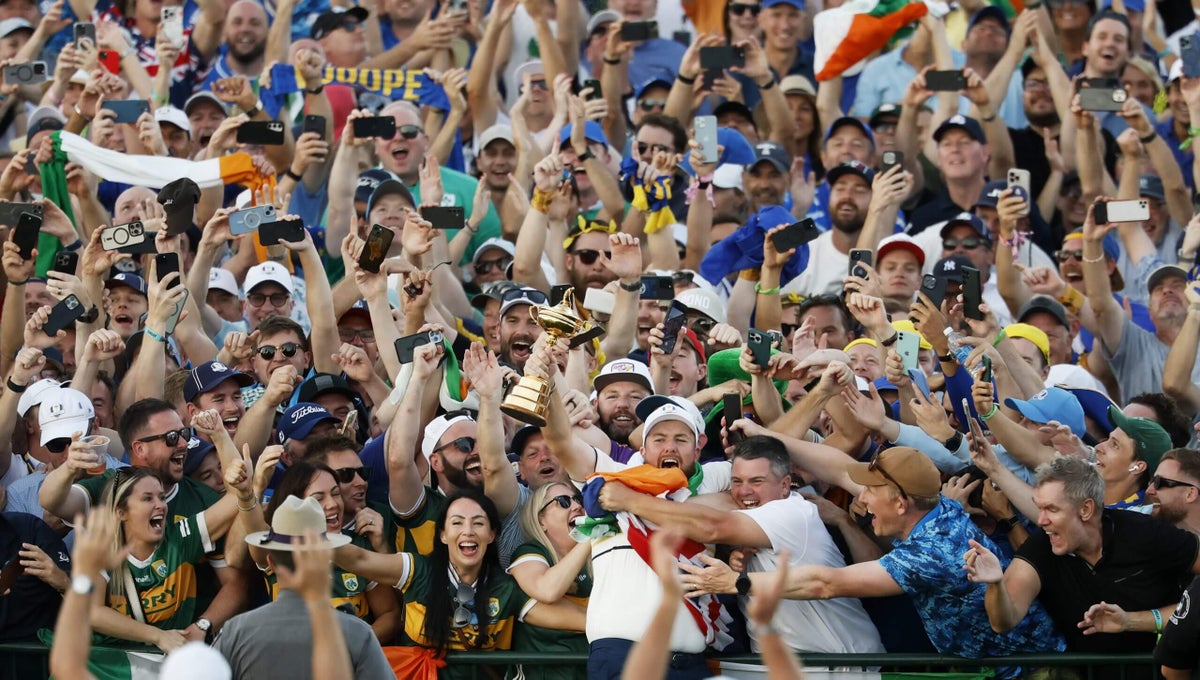
FARMINGDALE, N.Y. — This is the way it had to end, with an Irish heavyweight who had absorbed so much punishment from the American crowd landing the final punch.
Laughing the last laugh.
Shane Lowry was the right man to make the decisive Ryder Cup putt under a fading sun, the right man to dance the funniest and most liberating jig you have ever seen on the 18th green at Bethpage Black. Finished with what he called “the worst two hours of my life,” Lowry hopped around and flailed about and cut loose primal screams from his toes. At one point, he patted his chest, doubled over, and looked like he was about to pass out.
Lowry lifted a small bag of food from the green and fired it back into the stands, then grabbed his country’s flag and held it above his head. The fans who had mocked him and playing partner Rory McIlroy for three days were already halfway to the parking lot.
It was a great, great scene. The Europeans won fairly and squarely, 15-13, claiming the Ryder Cup for the 14th time in their last 20 attempts. The Americans were outplayed, outcoached, out-everythinged for two days, then made a breathless Sunday charge from a seven-point hole that reminded everyone why this particular edition was expected to be an all-time classic sporting event, and why the Ryder Cup is as good as it gets in the business of human competition.
But at the same time, the unexpected drama exposed all the problems buried beneath those truths. The Europeans won by the rules, no doubt about it.
Now those rules need to change. Today, not tomorrow. If the game’s elders on both sides of the Atlantic want to maximize the Ryder Cup’s still untapped upside, they need to fix the divots in the system that prevented the singles matches from being more OMG-I-can’t-believe-this-is-happening than they were.
For starters, the absurd rule that sends a half-point to each side if a player is too injured to compete should be the last thing ripped up and thrown in the trash before everyone says goodbye to Bethpage Black. Viktor Hovland had a bum neck and couldn’t go in singles, so before the U.S. even started trying to pull off its Miracle on Grass, the score suddenly changed.
Europe was upgraded to 12 points, only two away from the total required to retain the Cup, while Team USA was upgraded to five points. At the time, I thought the scoreboard had it wrong. I mean, there were no golf balls in the air yet. What the heck happened???
Substitution rule 3.d) of the Ryder Cup Captains’ Agreement happened, requiring Europe’s Luke Donald and Team USA’s Keegan Bradley to slide into a sealed envelope one name of a player who will sit out singles in case an opponent is unable to compete. In other words, each side’s weakest link — by his own captain’s estimation — would be one tweaked ligament or muscle away from being identified to the world.
Harris English was Bradley’s choice, a fact that wouldn’t have been revealed had Hovland been fit to play; the envelope containing that secret would’ve been burned in a firepit. The fact that Bradley and English probably won’t be making dinner plans any time soon is hardly the most relevant issue at hand.
The fact that Europe benefited from its inability to field a complete team is something that can’t be lost in the noise of an NFL Sunday. As it turned out, the Europeans won only one of the 11 matches played. One. “You think about the odds of something like that happening,” Bradley said.
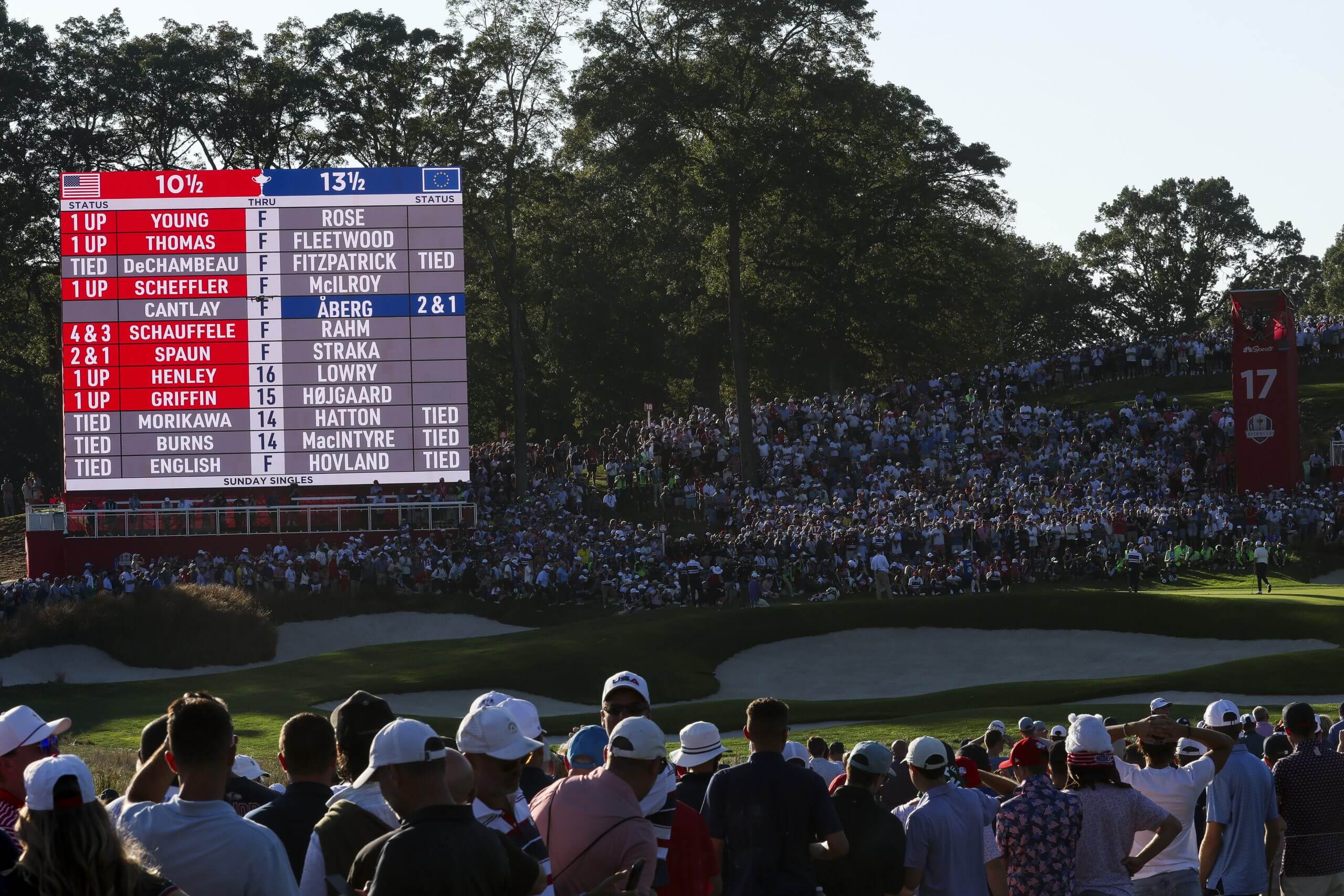
Tens of thousands studied the scoreboard all day at Bethpage as the Ryder Cup tightened. (Jamie Squire / Getty Images)
As the afternoon unfolded, the impossible dream was getting closer and closer to reality. The eventual winners were almost out of gas. The huge lead was cut to three, the closing four matches either tied or slightly favoring the U.S., and none of Team Europe’s titans (McIlroy, Tommy Fleetwood, Jon Rahm) were still on the course. The whole fragile thing was in the hands of Lowry, Rasmus Højgaard, Tyrrell Hatton and Robert MacIntyre.
As the trailing team all day, the Americans would’ve much rather had English-Hovland out there with a full point on the line. The half-point awarded both teams before the battle began allowed the Europeans to play a little prevent defense. It gave them a small measure of comfort as everything else was falling apart near the finish line.
“The rule has to change,” Bradley said. “I think it’s obvious to everybody in the sports world. … Nothing against Viktor. But that rule needs to change by the next Ryder Cup.”
Amen to that.
Donald brought up the controversial application of the same rule during tight American victories in 1991 and 1993, and added, “We have contracts for a reason.” That’s fair. No side of the Ryder Cup divide should ever gain a competitive edge through injury.
It’s simple: If your player can’t answer the bell, your team forfeits his match and the full point at stake. A dumb rule shouldn’t survive merely because it’s been in place a long time.
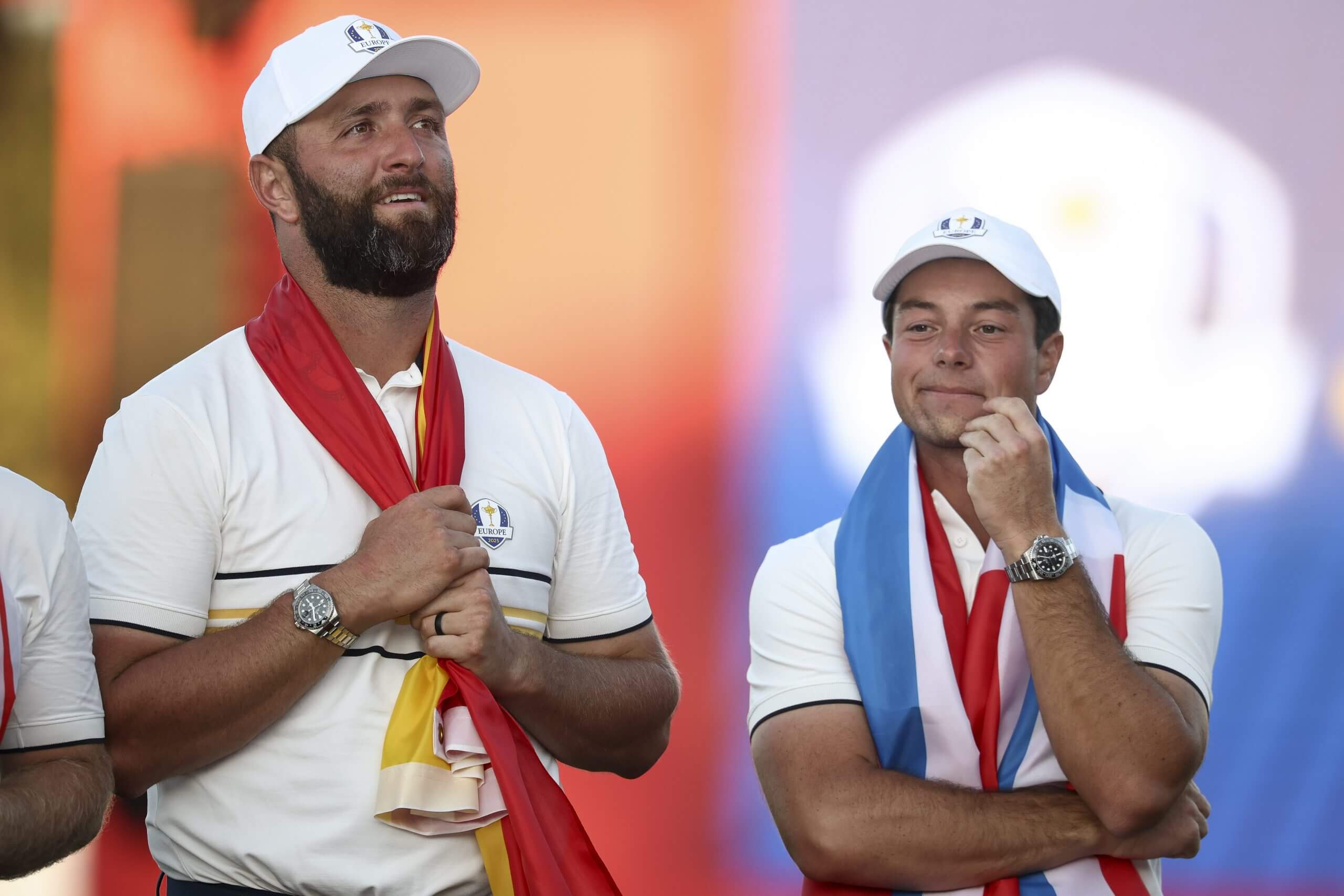
Viktor Hovland, right, was not able to participate Sunday because of a neck injury. (Jared C. Tilton / Getty Images)
This leads us to another old-school corner of Ryder Cup regulations — the ordinance decreeing a victory total of 14 points for the defending champ, and 14 1/2 points to the returning loser. If the American comeback had made it 14-14 on the big board, the Europeans would’ve kept the Cup and partied like they didn’t in 1999.
Where else in sports does a tie award the trophy to the winner of a past competition that has nothing to do with the current competition?
Again, tradition should never get in the way of common-sense evolution. Imagine if Hovland’s injury had granted the Americans a full point and, with a fortunate bounce in another match, allowed them to make it a 14-14 ballgame?
Imagine if those envelopes contained the names of Scottie Scheffler and Rory McIlroy as the juggernauts chosen for a three-hole playoff to decide the 2025 Ryder Cup on a public course in New York.
Now that really would have been a Sunday to remember forever.
(Photo of Shane Lowry of Team Europe celebrating with fans: Harry How / Getty Images)