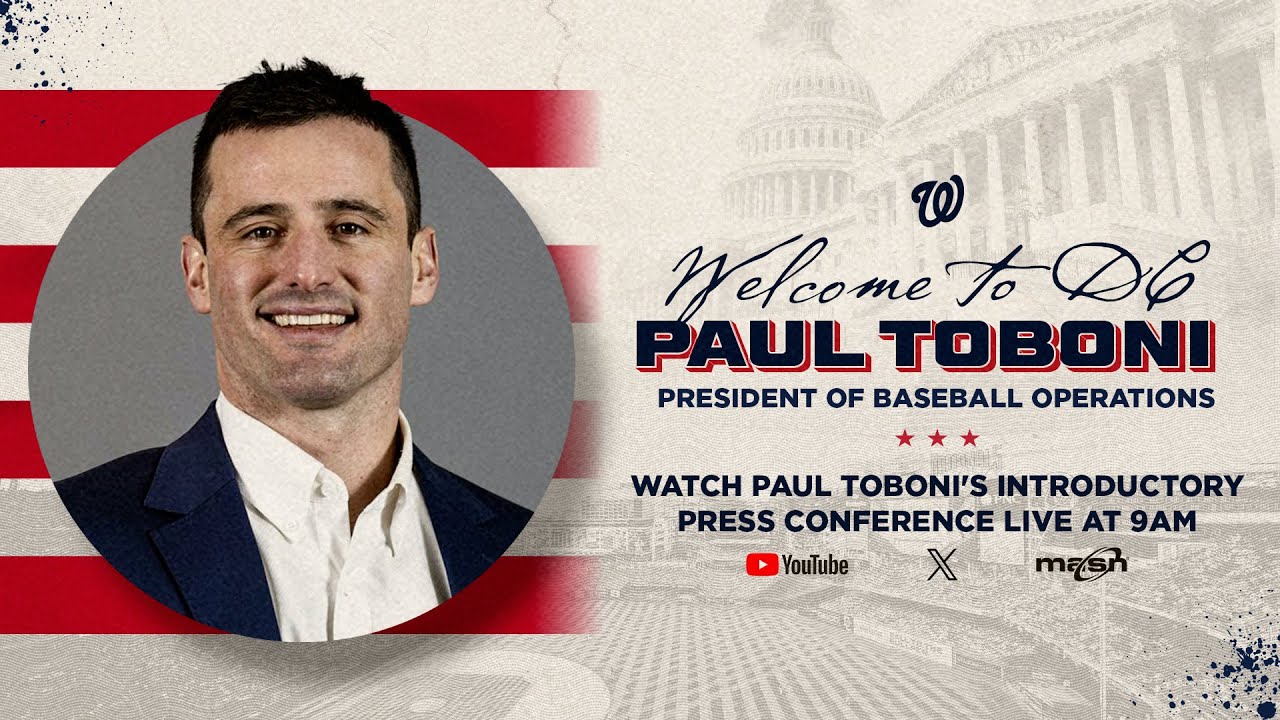
Paul Toboni Introductory Press Conference | Washington Nationals | President of Baseball Operations
I’m honored to be here on this very exciting day. I’d like to welcome everyone who’s here with us at Nationals Park as well as those watching on nationals.com, Massen, and MLB Network. Earlier this morning, the Washington Nationals officially announced that Paul Taboni has been named the club’s president of baseball operations. Paul, welcome to Washington DC. It’s a privilege to have you, your wife Danielle, your four boys who already have their national jerseys and a chain as well already decked out. I love it. And other members of your family here today. Also here with us today on the deis are Washington Nationals principal owners Mark Learner, Ed Cohen, and Bob Tannen. Welcome gentlemen. We’re pleased to be joined as well by other members of the Learner Cohen and Tannon families. as well as other Washington Nationals founding partners. I’d like to extend a special welcome to Angie Gates, president and chief executive officer of Events DC. Thank you so much for joining us today, Angie. And now it’s my pleasure to turn things over to Washington Nationals managing principal owner, Mark Learner. Mark, thank you, Dan. Good morning, everyone. Exciting day. Uh my family and I are thrilled to officially introduce Paul as our president of baseball operations. He is truly impressive. You’ll find that out for yourselves pretty soon. And we are excited about the fresh voice he brings to our organization. We are all energized and optimistic about where the team is headed. When we set out to find a new leader for our baseball operations, our goal was to find someone who could build a world-class department that the that will attract and develop some of the t top talent in the sport. With Paul, we found not only that, but someone who leads through communication and collaboration and who has the ability to connect with our staff and the players on our roster. Paul already has the respect of his colleagues and peers across baseball. That isn’t surprising given how he modernized the draft process in just a few short years in Boston and played a crucial role in turning that franchise around. All of us here are so excited to work with Paul and support the vision he has for the Nets. We’re confident that He’s the person that we need to build a winning culture here in DC. Paul, we’re so thrilled to welcome you and your family into our family. Who’s next? Thank you, Mark. Good. And Paul’s next. Paul, at this time, I’ll open it up to you. Thank you. Uh good morning, everyone. I’d like to start out with a few thank yous. Uh first of all, thank you to the learner, uh Cohen and Tannon Bomb families. Uh thank you for entrusting me with overseeing this baseball operation. Uh it’s a a responsibility that I do not take lightly. And um you know, it’s my goal to make you all proud of of what we build here. Um I’d like to thank the Boston Red Sox organization. Uh specifically, I’d like to thank uh John, Tom, Mike, Sam, uh Brez. Thank you for allowing me to pursue this opportunity. Um, but also thank you for all your support over the last 10 plus years. Um, I’d like to thank all the heads of baseball operations I’ve worked under. Uh, Ben Sherington, Dave Dumbousski, uh, Him Bloom and Brian O’Halerin, and Craig Brezlo. Um, I’ve learned a lot from all of their leadership styles, and I’m grateful to have had the opportunity to work for all of them. Uh, and I’d like to also thank everyone else in the Red Sox organization. You know, those that I worked really closely with. Um, but also, you know, the the coaches, the scouts, the analysts, uh, the parking lot attendants. I’m going to miss the custodians. I’m going to miss. Uh, I’m going to miss seeing all of them every day. So, um, thank you to all of you as well. I’d like to thank my family who’s here today. U, my folks and my siblings. Um, you know, I’d like to say I hit the lottery at birth. Um, I had, you know, no control over the circumstances that I was born into, but they have all struck a great balance of loving me, but challenging me. And, uh, I’m forever in debt to all of you. Uh, to my wife, Danielle, and our four boys, uh, JC, Patrick, Sunny, and, and Mickey. Uh, all of you make life so fun. It can be crazy at times, but, uh, I’m lucky to have all of you in my life. So, uh, thank you to to everyone. Uh I’m stepping into this role with a clear vision and that vision is to be the highest performing organization in all sports. Uh I want to help build something that becomes the envy of all of sports, right? Where we get, you know, x amount of of months and years down the line and people are looking at this organization like shoot I want to I want to be part of that organization. Um we have a lot of work to do. Uh that’s okay. We’re going to embrace it and uh while it’s going to be challenging, uh it’s going to be really rewarding uh when we get to where we uh where we want to go. Uh to me, you know, one of the simplest ways of doing that is creating a scouting and player development monster, right? And to do that in the current game that means uh integrating analytics and R&D um really tightly within um those spaces where we are uh ultimately uh graduating young talented players to the major leagues. Okay. Um but more so than that we can talk about you know driving great process or building great systems uh creating a winning culture right uh in my mind you do that with people and uh I’ve said it uh time and time again but you win with people right and if we are going to achieve that we want people that carry themselves with joy um that through the ups and the downs they they uh maintain a really optimistic attitude right uh folks that are humble and as as Greg Papovich likes to say have gotten over themselves. Um, we want folks of high integrity, right? And that doesn’t mean just, you know, not stealing or not cheating or not lying. Uh, that means folks that are dependable. Um, that are accountable. Um, folks that when they say they’re going to do something, they do it, right? And folks that are going to work, right? Those those are all traits that we, uh, very much are going to hold sacred. And then last but not least, uh, we want folks that are competitive, right? I talk about uh you know making the scoreboard visible and thriving in that environment. Um we want there to be winners and losers, right? And like I said, we want to thrive in that environment, right? So um I’m a big hoops fan and uh I can’t I couldn’t imagine playing a game of one-on-one and not keeping score, right? So that’s going to be central to who we are as well. Uh I think if we build a group in baseball operations that carry uh those attributes, uh you know, it’s like the great uh Bill Walsh says, right, the score will take care of itself. And so that’s the mindset we’re going to keep every day. Uh we’re going to uh stack good decisions on top of each other day after day after day and let the score take care of itself. Uh so in closing, you know, once again, thank you to the Learner Cohen and Tanibon families. Um thank you so much for entrusting me. uh with this responsibility and I can’t wait to get going. [Applause] Thank you, Paul. At this point, we will take questions from the media. We have Daniel and Jacob with microphones around the room. Um please raise your hand, introduce yourself to uh Paul, and we’ll get going. Hi, Paul. Mark Zuckermanman with Mass. Congrats. Um I’m sure as you went through the interview process. There’s a lot of selling of yourself to them. I’m curious what you tried to outline in that regard, but I’m also curious what they told you, how they sold themselves to you that made you believe this was the place you wanted to be. Yeah. So, to the first part of your question, I think more than anything, I just wanted to be myself, right? And if I was myself and it was something that they liked, great. Uh, and if they didn’t like it, also fine, right? I was uh very happy in the in the Boston Red Sox organization. Um, you know, to the second part of your question, uh, listen, when I first took, uh, started the process of interviewing, um, I didn’t know if this was the place I wanted to be. I loved the city. My wife loved the city, our family loved the city. Um, knew that it was a great franchise, right? But ownership was an unknown to us. And what we came to find out, uh, during that interview process was this is an incredibly warm uh, humble uh, grounded set of people. um that love baseball and uh you know we were going to hold a pretty high bar if we were going to leave the Boston Red Sox organization and uh this cleared it because of of of that really um ownership’s love for baseball, how competitive they are and really how great a people they are. Like that’s what I really bought into which uh you know made my wife and I think that this was the jump we were we were going to make. Hey Paul, Andrew Golden, Washington Post. um for you given there’s a lot of responsibilities to hire general manager manager there’s a lot of different roles to fill how do you prioritize what you’re what you’re supposed to be working what doing at this current point in time and how do you kind of assess what needs to be done as you look at the organization as a whole yeah I think uh you know someone gave me some advice a while back and it’s move the big rocks first right and then you can kind of pick up the pebbles at a at a later date so uh right now you know I’ve only been in the organization for a couple days um but um what I’m I’ve started to try to prior prioritize and what I’m going to continue to to prioritize is getting to know people, right? Like I what I said I really meant, right? Like you win with people and figuring out um not just what type of people we have um but how they think through creating a really good department or a really good scouting process or a really good um you know strategy in the dugout, whatever it might be. like um that’s where I’m going to spend my time initially and then uh you know there’s a lot to uh that’s going to be coming our way right as the offseason starts and um so it’s going to feel at times like I think all of us are drinking out of a fire hose and and that’s all right. Uh I think it goes back to the first point I made which is we’ll just prioritize on on moving the big rocks first. Hey Paul Spencer Nesp from the Washington Post. I’m curious what sort of assurances you’ve gotten in terms of latitude for spending, hiring, um all those kind of processes, what sort of um asurances you’ve been given and how that influenced um your decision to take the job here. Yeah, more than anything like what I can point to is that I’m in this seat right now for a reason, right? and throughout the interview process and uh you know even after accepting the job uh I felt incredibly supported and um you know that’s the main thing I just I continue to feel that support and uh you know that will allow us to build a world-class organization uh which is what the goal for for all of us will be Paul Howard Fendrich with the Associated Press you mentioned the um heads of baseball operations worked under in the past. I’m curious, what would you say was the single best piece of advice you got from one of those people about constructing a team? Oh gosh, that’s a great question. Um, you know, I think I think maybe when you initially get into the game and you’re part of this younger demographic, right, like you think about just uh chasing players that uh maybe fit great on a spreadsheet, right? But there’s so much more to it, right? And having played like I’ve experienced it as well and felt it as well, right? And as the game has continued to modernize, right? Like uh placing a uh incredible amount of focus on uh creating a winning culture is uh you know is front of mind for me and something I learned from a few of those folks. And uh more than anything I think like what that means is and I see Derek back here. It’s like, you know, we we want to create an environment where our players are not just holding themselves accountable, um, but holding each other accountable. And I think if we do that, um, you know, we’ll we’ll make a lot of headway, uh, in terms of of, uh, building that winning culture that that we want to be proud of. Hey Paul, Jess Camado from MLB.com. When you look at this nationals team, what strikes you the most about this roster? You know, I think more than anything, we have some uh, young, exciting players, right? Um, I’ve been in touch with a number of them uh to date and uh they’re fun to watch and uh I’ve told, you know, many of them uh while I haven’t had the chance to reach out to everyone, I’ I’ve told many of them like uh and I really believe it. I think there’s another gear uh to tap into uh with many of them and and uh so it’s not just that they’re already really talented players, right? It’s that uh it’s easy for me to see a world a year or two down the line where uh we’re seeing a different caliber of player in a good way. Hey Paul, it’s Barry Sperugo with Washington Post. My my question is actually for Mark. Um Mark, what in your conversations with Paul, what assurances did you give him from ownership that he would have the resources to build a modern front office and pay a competitive payroll like you paid when you were in the playoffs all the time? Uh the we all gave him assurances. I have to say that the family is determined to get back to where we were a few years ago. We’re going to do what it takes. We’re going to do that in conjunction with sitting down with Paul when he’s ready and saying, “I didn’t need to do this and need to do that.” And we’ll take it from there. This is not a decision has to be made today. But we we will be there and we’re going to get back to where we we know we should be. Uh good morning, David Aldridge with The Athletic. Um Paul um you were in an organization that won big and one consistently big for a long time and I just wonder what were some of the hallmarks of that organization that you think are transferable to this one? Uh you know honestly the thing I think about most is what I was I think I explained to uh was it Howard? Um you know especially this year um there is such an accountability piece uh on uh not just the major league staff but amongst the player group. Um, that’s a a big thing for me. But also, you know, what I think about is like summers in Boston, right? Kids are, you know, they’re having fun during the day and uh they’re they’re um maybe going to summer school or playing sports, whatever it is, and then they’re showing up to Fenway at night, right? And Fenway is like their their safe place where they’re having a blast. And um you just you know it’s funny actually between um you know ending my time with the Red Sox and fully hopping on board with the Nationals. I went to a game at Fenway just as a fan with two of my kids and I looked around and I was like gosh there are a lot of young kids here right? So when I think about that uh as it relates to DC and I see my kids right here, it’s hey, you want them, you know, playing sports or having fun during the day. You want them going to the museums, but then we want to create an environment where not just my kids, but kids around DC, around the greater region are filling up the park. Uh just because that’s what it should be about. It’s a great sport. It’s the best sport uh in my opinion. And um I love it so much. And one of the reasons why I love it so much is I grew up in San Francisco going to Candlestick and Pack Bell or AT&T or, you know, SBC or Oracle, whatever they uh but I I went to hundreds of games, right? And I think that’s where I really fell in love with the game. And uh you know, I just I I want kids in the DC area to to fall in love with the game the same way I did. Hey, Paul Toby Alizer 1067, the fan. You mentioned a scouting and development monster. How do you go about building that development system? And on the scouting side, how do you ma marry your background as a scout with the analytics? Yeah. Uh, great question. Uh, you know, I’ll put my hand up. I’m a I’m a huge believer in analytics, right? Um, I’m also a a strong strong advocate and believe in the power of area scouting and uh I believe in the power of great coaching, right? So, uh, what we want to do is um, you know, have folks that have mutual respect for both, right? But um also they understand how uh their responsibilities contribute to the greater goals of the department, right? And then we can clearly outline what’s expected of of everyone in their roles, right? And then it’s up to them to really get after it and do a great job, right? So, um you know, I think that’s the main thing. I’ I’ve been around a lot of coaches that uh are very technically sound, right, but don’t quite understand the art of coaching. Um and they’re not as effective influencing players, right? And I’ve been around coaches that really get the art of coaching but are behind technically, right? And they’re not as good as they can be um impacting players, right? So, ideally, we are, you know, outfitted in our group with scouts, coaches, whoever might be, right? Um, with both those traits, they they really get how to connect with players and build trust and those type things, but also uh they’re really wellversed technically how to get players better, right? And you know, once players start to see that like, wow, this coach uh is really getting me better and I’m getting the feedback that I’m getting better, it just creates this cascading buy in where um they’re they’re realizing that that they are becoming the best versions of themselves, right? So, the more we can do that over and over and over again, uh I think the word will get out around the league amongst the players like the Washington Nationals is the place where I want to be because uh I know I’m going to develop most as a player there. Hey Bob, Bobby Blanco, massports.com. Um, you just talked about the young Red Sox fans, and the Red Sox obviously have a much older tradition than the Nationals do right now. Uh, what would your message be to the young DC baseball fans that you kind of want to give back to Nationals Park? First and foremost, I think we have a ton of young players, right, that are exciting young talents on our uh, Major League team. Um, and I think we’re going to have more, right, um, as time goes on. But, uh, almost separating that for a second, right? Like, let’s forget the players we have. Let’s forget, you know, me in this role or the front office, the coaches, the scouts, like, uh, baseball is is such a great game, right? And, uh, you know, to those kids, like come to the park over and over and over again, I think you’ll realize that, uh, there’s a good chance that you’re going to fall in love with this game, right? Um, just because of how great it is. So, um, you know, that’s the main thing. And uh you know, sports is in my opinion like so deeply woven into the fabric of this area. Um not just baseball, but uh I mentioned I’m a big hoops fan. I think about Georgetown Hoops. I think about Howard Hoops. Like I think about Tamatha and Coach Wooden and and Wooten and and you know all the great players that have come through there, right? It’s not just at the pro level, not just the college level or the high school level. like this is a great area for sports and uh it’s my hope that kids just dive into it because sports has been such a positive influence on my life. Um I hope that that kids around the area can experience the same. Hey Ryan, hey Paul Ryan from uh 1067 a fan there. So looking around baseball, obviously a lot of teams have identities. Like you look at the Rays, they’re a draft and developed organization. Like what do you believe the Nationals kind of how will people perceive the Washington Nationals under your leadership? Yeah. So uh how I think about this is I want to dominate both the big things and and the small things, right? So um when I think about the big things like uh yeah, do we want guys that throw hard? Yeah, we want guys that throw hard, right? Do we want guys that hit the ball hard? Yeah, we want guys that hit the ball hard, right? At the same time, we want to be best in the league at, you know, uh, first, third, right? Or cuts and relays, being really efficient with our footwork, those small things, right? Like I think about the tag play, uh, all the time. I look around the big league still and like guys aren’t, uh, dropping tags the way they should be, right? And, uh, so those small things, right? I think about, uh, the contact play at third base, right? Like those type small things. Um, I think we have to dominate. And um yeah, we might not be bunning, you know, every inning, right? But when you’re called upon to bunt, like you got to get it down, right? And so uh I think there’s uh you know, there’s for whatever reason kind of a narrative that’s been built throughout the game, like you either care about the big things or you care about the small things. And uh my approach on that is we should dominate both. Um for Mark and if Ed and Bob want to share their thoughts as well, that that’d be great. Um it was a little over four years ago that the organization started the rebuilding process and I know the results are not so far what you would have hoped you wouldn’t make this kind of change if you felt that way. Do you view this as a start over of that process is another long-term issue or do you believe that there are pieces in place that winning is more a short-term goal than a long-term goal right now? Well, I first of all I don’t believe that we’ve gone backwards. I think we have a a lot of great talent. A lot of a lot of these young men you haven’t even seen yet. You’re down at Rochester or Wilmington, Fredericksburg. So, I I think that we’re giving um Paul a great pallet of young young players. There’s more to more we need to do obviously and we’re not happy where we are right now. That’s why we we brought in Paul and we’re going to get back to where we where we’re supposed to be. That’s that’s the commitment that we’re all making to our fans and don’t give up on us. We’re gonna we’re going to be there again, guaranteed. Well, you mentioned um the coaching and how you can have different types of coaches maybe are technically sound but not vice versa and the same goes the other way. Um how do you kind of assess the current coaching staff and whether to bring them back and also the minor leagues and then also like how do you judge somebody based off the same down the border when you can’t see what they’re doing in the season? Sorry, I I missed the last part of that question. I guess how do how do you assess the coaches and what they can do from a technical perspective, those sort of things when like they’re in a you’re sitting down with them in a boardroom and they’re not coaching on the field, you can’t see it, I guess. How do you kind of assess where somebody’s at and what what they can do? Yeah, I think it’s it’s challenging, right? Um because you want to balance two things like you want to balance uh being quick and decisive like it’s really competitive industry and folks are after the same people, right? uh while at the same time um you know like I said it’s my second or third day on the job right like you you want to try and get to know people and figure out what they’re about. So, I talk about the values that uh I hold sacred. Like I think it starts there, right? And then it gets into kind of some of the nuance like, hey, uh how do you think about hitting or how do you think about pitching, right? And then from there, I think um you we’re going to make a decision that’s really based in, you know, the the well-being of the organization uh as it relates to to all those positions, right? So, um it’s going to be a process, but um one that hopefully we can move on sooner around later out of respect to to everyone. for a few more. Yeah. Question for Paul. When you think about stepping into that larger player development role in Boston, um what were some of the I guess bigger changes you made in terms of modernization there and how does that inform what you plan to do here? Uh so when I first hopped into that role, um you know, one thing I did was I just uh I went around baseball, right? Like I working on the scouting side for a long period of time. you develop great relationships with college coaches around the country, right? Um, and you also develop relationships with, uh, all these facilities that many major leaguers work out in the offseason, right? So, uh, the approach that I took was honestly just visiting a lot of those places and having a lot of really good conversations with, uh, coaches and trainers and whoever it might be. And then you think about, um, you know, what you want to, uh, build within, in this case, the Red Sox organization at that point in time, right? I think the thing that screams out to me most uh regarding my visits and ultimately what we tried to achieve in Boston was just complete alignment throughout the organization. Right? I can empathize with the player that is in a ball and then gets promoted to high A and they’re getting different messages from a pitching coach, right? Or they go from double A to AAA and you know the catching coach is is teaching technique way different, right? So, um, we want to create really great alignment throughout the organization and, um, you know, I think more than anything, too, like we want whatever we value, um, to, um, basically be what drives value in the major leagues, right? So, um, we’re going to work backwards from there and and, uh, and pour ourselves into educating, uh, staff and players as to why we are doing things, right? Because I, you know, I strongly believe that’s really important, too, right? Like if if I’m just going up to uh one of our hitters and saying you should do this, right? He’s probably going to be like, “The hell with you, man.” Right? But uh if I say like, “Hey, um let’s talk through what uh where your deficiencies are, right? Let’s be really honest with with the assessment of of yourself as a player, right? And then let’s work together and I’m going to support the heck out of you as you address these deficiencies.” And we lay out the reasons why. Like I just found that hey, it’s not going to work every time, but um players are content with the process because they’re looped into it, right? So um that’s what we aim to achieve here. I think honestly that’s what the best organizations in in baseball and around sports do. Well, finish up with Howard. Do you um do you know already uh what sort of a front office structure you want? Do you plan to hire a GM right away? And do you have a sense of what Mike Devartello whether he might have a role saying with the franch? Yeah. So to the first part of your question like I uh you know the perspective I have right is coming from the Red Sox organization what the structure looked like there right obviously having some understanding of what the structures looked like uh around baseball right um so that informs you know how I think through this but am I like completely tied to that? No, not at all. Right. I think like we can be stubborn on the vision that we have but flexible on the on the details of of achieving it. Right. Um as it relates to the general manager position, um these folks have been great in their support with me where if it’s something that I think is in the best interest of the organization, uh we can do it right. At the same time, like you know, I don’t think it’s a definite yes or or no at this point in time. Um, what I would say about Mike, and I’ve told Mike this, um, prior to um, me accepting this job, I had about 10 people reach out uh, just saying unbelievable things about him as a as a person and as a baseball mind. I told him he was shooting 10 for 10 from the line. This is before I even met him. Um, and I think, uh, you know, in my early interactions with them, I once again, it’s just been two or three days. I see a lot of that. Um, I think the world of him. So, um, so yeah, excited to to work alongside him. All right, that is all the time we have for questions right now. I’d like to thank Paul, Mark, Ed, and Bob for their time. And thank you all for watching at home. Uh, at this point, we’ll have do a group photo with the gentleman up here, and then we’ll call everybody up for family photos. And we will bring uh Paul back in the room after he does a live radio uh interview here in a little bit. So, thanks again, everybody. [Applause]
The Washington Nationals introduce new President of Baseball Operations Paul Toboni.

3 comments
Your professional baseball team, not Roaring Kitty in his basement, please have better audio next time.
The Nationals will never see long term success until ownership is willing to spend. Sell the team to Ted Leonsis.
The Commanders got rid of one incompetent owner and saw immediate success. Nats should be next.
holdup