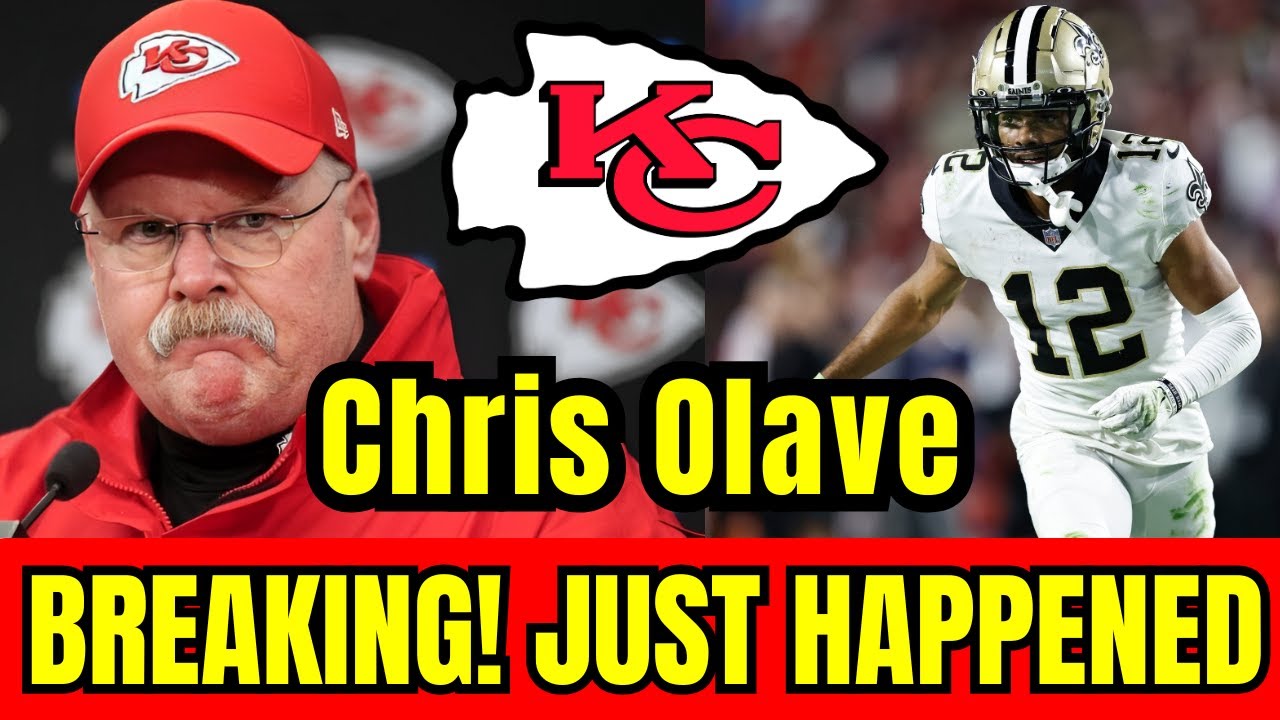
🚨 BREAKING NEWS! NOBODY EXPECTED THAT! KANSAS CITY CHIEFS NEWS TODAY! NFL NEWS TODAY – CHRIS OLAVE
Sarra Cho. Could the Kansas City Chiefs make a bold move for Chris Olav? The Kansas City Chiefs have built a dynasty on strategic decision-making, championship pedigree, and an ability to adapt when circumstances demand change. As the 2025 season unfolds, the reigning AFC champions find themselves at a crossroads that has become all too familiar in recent years, addressing concerns at the wide receiver position. While the Chiefs have proven time and again that they can win with a committee approach and creative offensive scheming, the early weeks of this season have exposed vulnerabilities that cannot be ignored by a team with Super Bowl aspiration. The offensive struggles that have plagued Kansas City through the opening weeks have sparked intense speculation throughout the NFL community. Analysts, reporters, and fans alike are dissecting every snap, every route, and every incompletion, searching for answers to what has become an increasingly pressing question. How will the Chiefs solve their receiver problem this time around? The answer, according to some industry insiders, might involve a blockbuster trade that would send shock waves through the league and demonstrate Kansas City’s unwavering commitment to maintaining their championship window. Enter Chris Olav, the New Orleans Saints dynamic wide receiver who has emerged as one of the most talented pass catchers in the NFL over recent season. The former Ohio State standout has transformed himself from a promising rookie into a genuine star in the Big Easy, consistently delivering highlight reel per performances and establishing himself as a cornerstone of the Saints offensive attack. His combination of root running precision, reliable hands, and explosive playmaking ability has made him one of the most coveted receivers in the league. And now his name is being linked to the Chiefs in trade speculation that has captured the attention of football fans across the nation. Thikuri, the speculation that has everyone talking. John Sigler of Saints Wire recently published an in-depth analysis of NFL trade rumors and buried within his comprehensive examination was a particularly intriguing nugget of information. According to Sigler’s sources and his own expert analysis, the Kansas City Chiefs might be seriously considering a trade proposal that would bring Chris Olive to Arrowhead Stadium. This isn’t just idle speculation or clickbait fodder. This is informed analysis from someone who follows the Saints closely and understands the dynamics that could make such a deal feasible, albeit unlikely. The proposed trade framework that has emerged from these discussions is both ambitious and eyeopening. According to the speculation, the Chiefs would need to part with their first round draft pick to convince the Saints to part ways with their star receiver. This would represent a significant departure from Kansas City’s traditional approach to roster construction, which has historically emphasized draft capital accumulation and development of young talent. However, as the Chiefs have demonstrated in recent years, winning championships sometimes requires deviating from conventional wisdom and making bold moves that other teams might shy away from. The timing of this speculation is particularly noteworthy. The Chief’s receiving CP has struggled mightily in the early going of the 2025 campaign, failing to generate the kind of explosive plays and consistent production that championship caliber offenses demand. While Patrick Mahomes remains one of the most talented quarterbacks in NFL history, even his other worldly abilities cannot fully compensate for a receiving room that lacks the star power and reliability that the Chiefs have enjoyed in previous championship season. This reality has created a sense of urgency within the organization and has fueled speculation that general manager Brett Vich might be preparing to make another aggressive move to bolster his team’s chances at another Super Bowl run. Dr. understanding the Chief’s offensive struggles. To fully appreciate why the Chrysolv trade speculation has gained traction, we must first examine the challenges that have plagued the Chief’s passing attack through the opening weeks of the season. The numbers tell a sobering story for a team accustomed to offensive fireworks and record-breaking performance. Kansas City’s receivers have struggled to create separation, dropped catchable passes, and failed to make the kind of contested catches that can turn drives around and keep opposing defenses honest. The absence of a true number one receiver has been particularly glaring. While the Chiefs have assembled a collection of talented players at the position, none have emerged as the kind of dominant force that can command double teams and create opportunities for teammates. This has allowed opposing defenses to employ more aggressive coverage scheme, bring additional pressure on Mahomes, and generally make life more difficult for the entire Kansas City offense. The result has been an uncharacteristic struggle to move the ball consistently and score points at the pace that Chief’s kingdom has come to expect. Patrick Mahomes, to his credit, has done everything in his power to elevate the performance of those around him. His improvisational brilliance, uncanny pocket awareness, and ability to make throws that seem physically impossible have kept the Chiefs competitive even when the passing game has sputtered. However, even Mahomes cannot single-handedly overcome systematic issues at the receiver position, and the strain of carrying such a heavy burden is beginning to show. While he would never publicly criticize his teammates or complain about the weapons at his disposal, those close to the situation understand that providing him with more dynamic options in the passing game would significantly enhance Kansas City’s offensive potential. The coaching staff, led by head coach Andy Reid and offensive coordinator Matt Ngi has worked tirelessly to scheme receivers open and create favorable matchups. Reed’s offensive genius is well documented, and his ability to maximize the talent on his roster is legendary throughout the NFL. However, even the most brilliant play calling cannot fully compensate for a talent deficit at the most important offensive skill position. The Chiefs need players who can win one-on-one matchups, make plays after the catch, and provide the kind of big play threat that keeps defenses from focusing all their attention on Travis Kelce and the running game. Who is Chris Olav? For those unfamiliar with Chris Olav’s journey to NFL stardom, his story is one of steady development, unwavering work ethic, and natural talent refined through countless hours of practice and film study. Olaf burst onto the national scene during his time at Ohio State where he formed a devastating receiving duo with fellow Buckeye standout Garrett Wilson. His performances in the college ranks showcased all the attributes that would eventually make him a firstround draft selection. Precise route running, excellent hands, the ability to create separation at all three levels of the field, and a competitive fire that burned bright in the biggest moment. The New Orleans Saints selected Olive in the first round of the 2022 NFL draft, recognizing his potential to develop into a franchise cornerstone at the receiver position. From the moment he stepped onto an NFL field, Olave demonstrated that the Saints faith in him was wellplaced. His rookie season exceeded expectations as he quickly developed chemistry with his quarterbacks and established himself as a reliable target in the Saints passing attack. Rather than experiencing the typical rookie wall or struggling with the adjustment to NFL speed and physicality, Olave seemed to thrive under the increased competition and elevated his game accordingly. As Olav’s career has progressed, he has continued to refine his craft and add new dimensions to his game. His route tree has expanded. His understanding of defensive coverages has deepened and his ability to make plays in crucial situations has become increasingly apparent. Saints fans have watched with growing appreciation as their young receiver has transformed from a promising prospect into a genuine star. The kind of player that offensive coordinators build their game plans around and opposing defenses lose sleep over. Olav’s skill set would translate seamlessly to the Chief’s offensive system. His ability to run the full root tree would give Mahomes a versatile weapon who could attack defenses at all level. His reliability as a target would provide the kind of safety valve that becomes crucial in third down situations and tight games. His speed and explosiveness would create the big play threat that the Chief’s offense has been missing. Perhaps most importantly, his presence would fundamentally alter how defenses approach the Kansas City offense, forcing coordinators to make difficult decisions about coverage allocations and opening up opportunities for other players to thrive. Dakshwam the chief’s history with bold trade the speculation about a potential Olive trade must be understood within the context of Kansas City’s recent history of making aggressive moves to strengthen their roster. While the Chiefs have traditionally been conservative with their draft capital, preferring to build through the draft and develop homegrown talent, recent years have seen a willingness to deviate from this philosophy when the right opportunity presents itself. This evolution in strategy reflects both the Chiefs championship aspirations and their recognition that the window for sustained success in the NFL is often narrower than teams would like to believe. John Sigler’s analysis specifically referenced two previous trades that demonstrate Kansas City’s willingness to acquire proven veterans when the situation demands it. Last season, the Chiefs traded for linebacker Josh Uch, adding a pass rushing specialist who could provide an immediate impact on their defensive front. This move came at a time when Kansas City’s defense needed reinforcement, and the front office recognized that waiting for a draft pick to develop, would not align with their championship timeline. Uch’s contributions, while perhaps not transformative, validated the decision to be aggressive in addressing a position of need. Even more relevant to the current Olav speculation is the Chief’s mid-season acquisition of wide receiver DeAndre Hopkins. That trade sent shock waves through the NFL when it was announced as many observers had assumed that Kansas City would address their receiver issues through other means. However, Brett Vch recognized an opportunity to add a proven veteran with championship pedigree and playoff experience, and he pulled the trigger on a deal that brought Hopkins to Arrowhead Stadium. While the trade required the Chiefs to surrender draft capital, the potential reward of another Super Bowl run made the investment worthwhile in the eyes of the front office. The Hopkins trade is particularly instructive when considering the possibility of a move for Olaf. Both situations involve the Chiefs addressing concerns at wide receiver through a trade for an established veteran. Both would require significant draft compensation to complete, and both would represent a calculated gamble that the immediate benefits of adding elite talent outweigh the long-term costs of surrendering future assets. The success of the Hopkins acquisition, whatever form that success ultimately took, would logically influence the front office’s thinking as they contemplate whether to pursue a similar path with Olaf. However, there are important differences between the Hopkins situation and the current Olav speculation that must be acknowledged. Hopkins was older with more years in the league and potentially less long-term value remaining in his career. Olav is younger, still ascending toward his prime, and theoretically capable of providing impact for many years to come. This age difference would likely be reflected in the asking price with the Saints presumably demanding more significant compensation for a player who represents a cornerstone of their future plans rather than a veteran in the twilight of his career. Su the draft capital question. At the heart of the Olaf trade speculation lies a fundamental question that will ultimately determine whether such a deal can be consumated. Would the Kansas City Chiefs be willing to part with their first round draft pick to acquire the Saints star receiver? This question cuts to the core of how NFL teams evaluate present versus future. How they balance the pressure to win now against the need to maintain sustainable success and how they assess the true value of draft picks versus proven commodities. First round draft picks are among the most valuable assets in professional sports. They represent hope, potential, and the opportunity to add young talent on costcontrolled contracts that can provide surplus value for years to come. For teams building toward contention, first round picks are essential building blocks that form the foundation of championship roster. For teams already competing at the highest level, first round picks represent the opportunity to reload while maintaining a competitive window, adding young players who can contribute immediately while learning from established veterans and growing into larger roles over time. The Chiefs, despite their recent championship success, have historically valued their draft capital highly. Brett Vich has built a reputation as a shrewd evaluator of talent who can identify players in the middle and late rounds of the draft who develop into key contributors. This approach has allowed Kansas City to maintain their roster despite the salary cap constraints that inevitably accompany sustained success and the need to pay market setting contracts to franchise cornerstones like Patrick Mahomes. Trading away first round picks in this context represents a departure from the blueprint that has served the organization so well. However, the Chief’s championship window while perhaps longer than most teams due to the presence of Mahomes is not infinite. Opportunities to win Super Bowls must be seized when they present themselves as the margin between championship glory and playoff disappointment can be razor thin. If the front office believes that adding Chris Olav would significantly enhance their chances of winning another title, the cost of a firstround pick might be viewed as acceptable, even prudent. After all, championship rings last forever. While draft picks are merely opportunities that may or may not pan out, the specific value of Kansas City’s first round pick must also be considered in this equation. Assuming the Chiefs continue to win at their accustomed rate, their first round selection will likely fall in the late 20s or early 30s of the draft order, picks in this range, while valuable, have a significantly lower hit rate than selections in the top 15 or 20. The probability of finding a player with Olav’s talent and proven production at pick 28 or later is relatively low, which might make the trade more palatable from a value perspective. In essence, the Chiefs would be trading the possibility of finding a star for the certainty of acquiring one. The Saints perspective. While much of the speculation has focused on Kansas City’s potential interest in Chris Olav, any trade would require the New Orleans Saints to be willing sellers, understanding the Saints perspective is crucial to evaluating whether such a deal could actually materialize. New Orleans finds itself in a complex situation, balancing present competitiveness against future planning, dealing with salary cap constraints, and making difficult decisions about which players represent long-term building blocks versus potential trade assets. Chris Olive has been one of the few bright spots for a Saints team that has struggled with consistency in recent seasons. His production and development into a starc caliber receiver has provided hope for the future and given offensive coordinators a weapon around which they can build their attack. Trading him would create an immediate hole in the roster and remove one of the team’s most marketable and exciting young players. From a pure football perspective, moving Olive would seem counterproductive for a team trying to return to contention in a competitive NFC South division. However, NFL business realities sometimes force teams to make uncomfortable decision. The Saints have been plagued by salary cap issues for years, constantly pushing money into future seasons and engaging in creative accounting to maintain their roster. If trading Olav could provide significant draft capital while also creating cap relief, it might represent an opportunity to address multiple needs simultaneously and reset the team’s financial situation. Additionally, if the Saints front office has concluded that their current roster is not positioned for a championship run in the near term, trading a valuable asset at peak value might make strategic sense. The return package would obviously be crucial to New Orleans decision-making process. A first round pick from Kansas City would provide the Saints with a valuable asset to address other roster needs or potentially package in a larger deal for a different player. The ability to select early in the draft process, which a Chief’s firstrounder would allow given the late position such a pick would likely hold, could provide New Orleans with options to add talent at positions of greater need. However, whether a single firstround pick would be sufficient compensation for a player of Olav’s caliber and age remains an open question. The Saints would also need to consider the message that trading Olav would send to their locker room, fan base, and the broader NFL community. Moving a young star receiver could be interpreted as waving a white flag on the current season and potentially the near-term future. This could impact team morale, season ticket sales, and the organization’s ability to attract free agents in future season. These intangible factors, while difficult to quantify, must be weighed against the tangible benefits of acquiring draft capital and creating financial flexibility. Xavier Worthy’s return and its impact. One crucial factor that could influence the Chief’s decision-making regarding a potential Chris Olav trade is the expected return of rookie receiver Xavier Worthy. The Speedster has been sidelined but is anticipated to return to action in week four, providing Kansas City with another weapon in their passing attack. Worthy’s impending return introduces a new variable into the equation and could potentially reduce the urgency the Chiefs feel to address their receiver concerns through a blockbuster trade. Xavier Worthy arrived in Kansas City amid considerable fanfare. Touted as one of the most explosive athletes in the entire draft class. His blazing speed and big play ability made him an intriguing prospect for a Chief’s offense that values versatility and the ability to attack defenses vertically. While his absence from the early part of the season has prevented him from making an immediate impact, his return could provide the kind of spark that the passing game desperately needs. The mere threat of Worthy’s speed could force defenses to adjust their coverage schemes, potentially creating opportunities for other receivers to operate in more favorable situation. However, banking on a rookie receiver to solve the Chief’s offensive struggles represents a significant gamble. The transition from college to professional football is notoriously difficult for receivers who must adjust to more complex defensive schemes, more physical coverage, and higher expectations for route precision. While Worthy possesses elite physical traits, expecting him to immediately produce at a level that would negate the need for additional reinforcement might be unrealistic. The learning curve for rookie receivers in the NFL is steep, and few firstear players make consistent game-changing contributions. The front office must weigh worthy’s potential against the proven production that someone like Chris Olav would bring. Olav is an established commodity who has already demonstrated his ability to perform at a high level in the NFL. His experience, refined technique, and track record of success provide a level of certainty that no rookie, regardless of talent, can match if the Chief’s primary goal is maximizing their championship odds in the current season. Relying on a rookie to be the solution, might represent an unnecessary risk when a proven alternative could be acquired via trade. That said, Worthy’s presence on the roster does provide the Chiefs with more flexibility in their decision-making. If he returns and shows immediate promise, the urgency to make a splashy trade might diminish. The front office could opt to see how the offense performs with Worthy in the lineup before committing significant resources to another receiver. This wait and see approach would preserve draft capital and allow the team to make a more informed decision based on actual performance rather than speculation about how various players might fit into the offense. The tur were the Rashi Rice factor. Another complicating factor in the Chris Olav trade speculation is the situation surrounding Rashi Rice who is currently on the commissioner’s exempt list. Rice’s eventual return to the lineup would provide the Chiefs with another receiving option and could significantly alter the calculus regarding the need for external reinforcement. Understanding Rice’s situation and projecting his potential impact upon his return is essential to evaluating whether the Chiefs should pursue an aggressive trade for a player like Olav. Rashi Rice showed considerable promise during his time on the field before being placed on the exempt list. His combination of size, root running ability, and competitive mentality made him an intriguing developmental prospect who appeared to be growing more comfortable within the Chief’s offensive system. His absence has deprived Kansas City of a player who was beginning to earn the trust of Patrick Mahomes and the coaching staff, further depleting a receiving core that was already lacking in proven commodity. The uncertainty surrounding Rice’s return timeline creates a challenging planning scenario for the Chief’s front office. If he is reinstated quickly and picks up where he left off, the receiving core would suddenly look considerably deeper and more talented. The combination of Rice, Worthy, and the other receivers already on the roster might be sufficient to support the kind of offensive production Kansas City needs to compete for championships. In this scenario, trading a firstround pick for Chris Olive could be viewed as an unnecessary expenditure of resources when the existing roster at full strength might be adequate. However, the Chiefs cannot afford to simply hope that Rice returns soon and immediately regains his previous form. Players returning from extended absences often require time to shake off rust, regain conditioning, and reestablish chemistry with their quarterbacks. Additionally, there is no guarantee regarding Rice’s return timeline, meaning the Chiefs could find themselves deep into the season without one of their most promising young receivers. Waiting for Rice’s return while passing on opportunities to upgrade the position through trade could result in a missed championship opportunity if the receiving core continues to struggle. The prudent approach might involve planning as if rice will not be available for the foreseeable future while remaining flexible enough to adjust if circumstances change. This would mean exploring trade options like the Olav deal while also developing contingency plans and maximizing the potential of the current roster. If Rice returns earlier than expected and performs well, the Chiefs could simply choose not to pull the trigger on a trade. However, having done the groundwork to make a deal would position them to act quickly if the situation demands it. Dashui financial consideration. Beyond the onfield factors, any potential trade for Chris Olav would need to account for significant financial considerations. NFL trades are not merely about exchanging players and draft picks. They involve complex salary cap management and long-term financial planning that can impact a team’s ability to build and maintain a competitive roster. The Chiefs, like all successful organizations, must balance their desire to win now against the need to maintain financial flexibility for future season. Chris Olive is currently playing under his rookie contract, which provides relatively team-friendly compensation given his level of production. However, this also means he is approaching the point where he will be eligible for a lucrative contract extension either from the Saints or any team that acquires him via trade. Any organization considering a trade for Olav must factor in not just the immediate cost of acquiring him, but also the long-term financial commitment required to keep him beyond his current contract. For the Chiefs, this financial consideration is particularly relevant given their existing salary cap obligations. Patrick Mahomes’s massive contract, while structured creatively to provide annual flexibility, still represents a significant allocation of resources to the quarterback position. Travis Kelce, Chris Jones, and other key players also command substantial salaries, leaving the Chiefs with less flexibility than some other organizations when it comes to adding expensive pieces, trading for Olav, and then extending him with a market setting contract, could create cap constraints that limit the team’s ability to address other roster needs in future season. The timing of a potential Olav extension would also be a crucial factor. If the Chiefs could acquire him and have him play out the remainder of his rookie deal before negotiating a long-term extension, it would provide more time to plan for the cap implications and potentially restructure other contracts to create necessary space. However, Olave and his representatives might demand assurances about a long-term commitment as a condition of approving any trade, particularly if the Saints would be willing to extend him to keep him in New Orleans. Navigating these negotiations while also working out the trade parameters with the Saints would require deaf maneuvering from Brett Vch and his front office staff. The broader salary cap landscape in the NFL also merits consideration. With cap figures continuing to rise as television revenue and other income streams grow, today’s expensive contracts often become more manageable in future years as the cap expands. The chiefs might calculate that while a extension would be costly in absolute terms, the percentage of the cap it would consume might be acceptable given the expected growth in overall cap space. This forward-thinking approach to cap management has allowed other teams to maintain competitive rosters despite having high-priced stars and the Chiefs could employ similar strategies to make the financial aspects of an Olaf acquisition work. Dashimir alternative options for the Chiefs while Chris Olav represents an intriguing trade target. The Chiefs would be remissed not to explore alternative options for addressing their receiver concerns. The NFL trade market typically offers multiple paths to improvement, and the front office would be wise to evaluate all available options before committing to any particular course of action. Understanding what other players might be available and at what cost would provide valuable context for determining whether the Olave trade makes sense from both a football and business perspective. The trade market for receivers tends to heat up as teams approach mid-season and have a clearer understanding of their championship prospects. Franchises that have fallen out of contention often look to trade veteran receivers for draft picks, viewing the remainder of the season as a lost cause and preferring to stockpile assets for future roster building efforts. This dynamic could present the Chiefs with opportunities to acquire quality receivers at prices lower than what the Saints might demand for Olav. While such players might not possess Olav’s upside or long-term potential, they could provide adequate production to support a championship run. Free agency represents another avenue for improvement. Though the options available at this point in the season are typically limited to players who were not signed during the off season for various reasons. While diamonds in the rough can occasionally be found in the free agent market, relying on this approach to solve a significant roster weakness would be risky. Free agents available this late are usually available for good reason. Whether due to declining skills, injury concerns, or scheme fit issues, the Chiefs would need to carefully evaluate any free agent options to avoid bringing in players who would ultimately prove to be more liability than asset. Internal development remains another possibility, though perhaps the least exciting from a fan perspective. The Chiefs could choose to maximize the potential of their current roster through creative scheming. Enhanced practice reps for younger players and role adjustments that better suit each receivers’s skill set. Andy Reed’s offensive genius has often allowed him to manufacture production from unexpected sources. And there is always the possibility that one of the current receivers could break out and provide the kind of impact that would negate the need for external reinforcement. However, several weeks into the season with limited production from the receiver room, this optimistic scenario appears increasingly unlikely. The Chiefs might also explore trades for receivers who would cost less than Olive, perhaps younger players who have not yet developed into stars, but show promising traits that could be unlocked in Kansas City’s system. This approach would require less significant draft capital and financial commitment while still potentially providing an upgrade over the current roster. However, it would also involve more risk as there would be less certainty about the players ability to contribute at a high level. The front office would need to weigh this risk against the reward of preserving more draft capital for future use. What do you think about these potential moves for the Chiefs? Could trading a firstround pick for Chris Olav be the missing piece for another championship run? Drop your thoughts in the comments below. Smash that like button and subscribe to stay updated on all the latest Chiefs news and analysis as we chase another Super
🚨 BREAKING NEWS! NOBODY EXPECTED THAT! KANSAS CITY CHIEFS NEWS TODAY! NFL NEWS TODAY – CHRIS OLAVE