
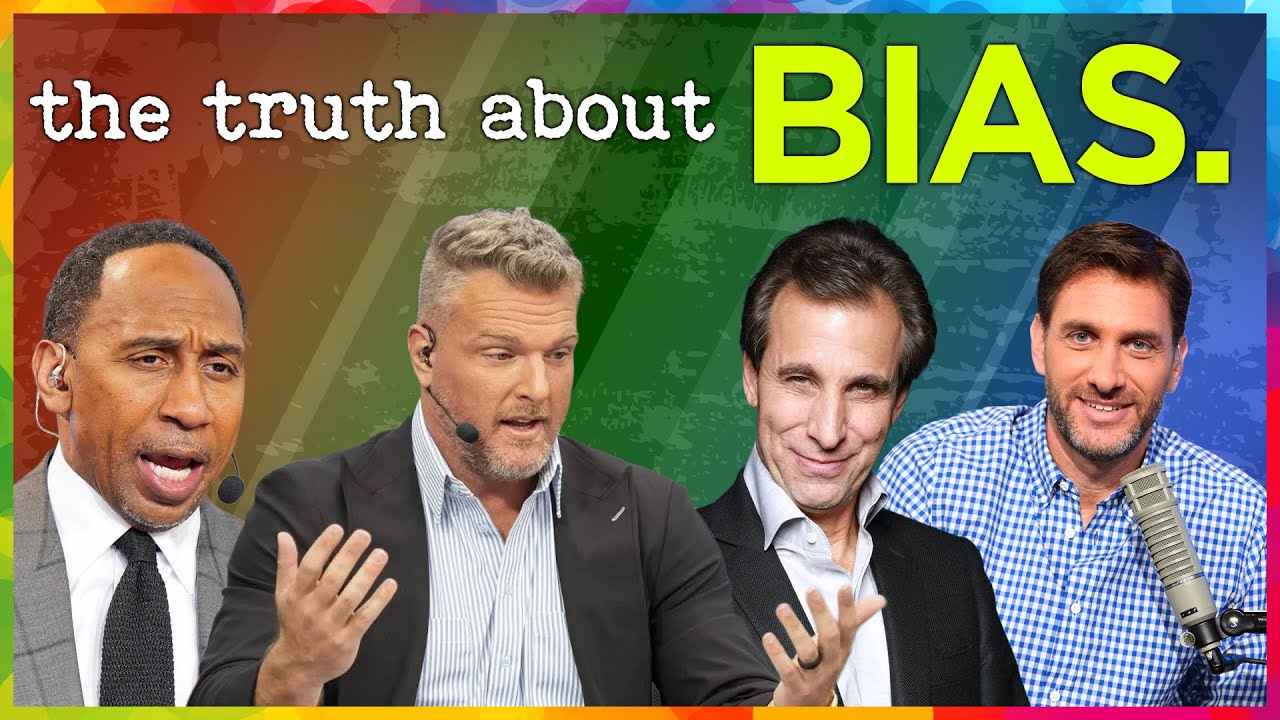
The TRUTH about Sports Media Bias
Here’s Prody Brazil. You know, honestly, the voicemail line has become one of the best features here on the YouTube channel. I’m so glad we implemented it here in 2025. You already know the number 8334 Brody. And this reminder, no, I do not get to use every single call and voicemail you leave, but I literally do listen to every single one. Hey Brody, this is Ben from Boyisey again. Hey, I was just wondering if you could speak to uh the bias that either media members or just people in sports have towards their favorite team. I know some of them try to keep them quiet, but there’s people like Steve Nay Smith who love the Knicks or Mike Greenberg who loves the Jets. And so I’m just wondering if you could speak to this and like how stuff like this impacts. So anyways, love your content. Bye. Hey Ben, thanks for the call. Thanks for the compliments. you say from Boise again. That’s right. I think you’ve left a message before that I made a video about. So, you might be the first two-timer, two calls, two videos. I’m not sure that anybody else has reached that level yet, but everybody keep trying. I really do appreciate the voicemails. Let me start addressing this conversation by throwing myself right in the middle of inherent media bias because what what are we talking about here? presenters of sports news or insights or information or opinions. These are all human beings and it doesn’t matter if it’s a network sports show or a YouTube channel or a social media platform or a radio program. Whatever the medium is, it’s still a human being talking into a microphone sitting in front of a camera. Human beings are not robots breaking news. They’ve got backgrounds. They’ve got experience. They come with inherent bias and preferences. And all of this could be the the product of history like how they were raised, where they were raised, what team they started following, who are their favorite players, traditions that were passed down from one generation to the next. Maybe it’s because of who they work for. Oh well, my employer is connected to this team or this person or this entity. So, of course, they’re going to approach every single thing a little bit differently with that bias in the background. Look, I think there’s a reason we all got into sports. Those of us who present news and information and opinion and insights because we loved something at one point. How do you ever take that away? How do you ever try and reprogram, retune yourself to be this, I don’t know, person with sterile preferences and have no opinions and you’re a journalist. I know people always think that there should be no bias in journalism and there’s minimal. But again, we are still talking about human beings here. So, it’s impossible to rid every single person of their backgrounds and who they are and what they believe and how they’re presenting something. Again, to think that as soon as I sit down and there’s a mic and a camera that I’m going to be perfect and level about every single thing every single time, that is impossible. We could be talking about individuals with bias. We could be talking about an entire network or company or group of people, a media entity that has a general bias. I’m watching this channel. I know they they cover a certain team or person or subject a certain way. Well, that’s just who they are. I think the biggest part of this that’s hard to explain, but it’s really important to understand is media literacy. And actually, I’ll name drop here. In fact, I’ll play a clip. I’ll go back and find this clip. When I chatted with Bob Kostas, you like that one? Friend of the friend of the channel, by the way. When I chatted with Bob Kostas earlier this year, we were actually talking about the different places and people that uh sports fans get their news from. And basically what he was saying is whether it was a traditional outlet or a non-traditional outlet like old media or new media, the most important thing for the consumer of that product would be to have good media literacy. Here’s how he put it. What’s critical here is media literacy. When I speak to classes at my alma moater at Syracuse, which has always had a a tremendous communications and journalism department and others around the country, the point I make is or among the points I make is the technology doesn’t matter. It’s only generational that I prefer to hold a newspaper in my hand when I can get a newspaper as opposed to scrolling, which I do because you can’t always get a newspaper. That’s generational. But what should be timeless is that credibility and quality should count. And I think that in much of the new media, if you’re not discerning about how you consume it, whether it’s something as relatively unimportant as most of what happens in sports or whether it’s news, if you can’t differentiate the credible from the not credible, um then you’re less well off. And I think that what’s also happened um and I’m certainly not alone in this observation uh this thing which we hold in our hands. No, no matter you could be 90 years old, it’s still to a certain extent rewired your brain. Yes. And your and your attention span. Um, I don’t think that everything needs to be geared towards someone with the attention span of a gnat. And what you do flies in the face of what is, I think, a troubling trend, which is, hey, that’s good, but can you cut it down? You know, a lot of stuff that now happens even in what used to be called mainstream media that they almost give you a merit badge if you take something that’s 3 minutes long and make it a minute and 47. Even if a lot of the context went out, even if a lot of the antecedent on which the laugh is predicated upon went away, um you know, I don’t think that it’s the equivalent of reading war and peace aloud to say I need three minutes for this instead of 48 seconds to make a point or to speak in paragraphs rather than in sound bites. And I don’t think necessarily that personality is measured in decibel levels. I think we can talk to each other as adults and still have a sense of humor and a sense of irony. I think there’s a difference between irreverence and snark. And the coin of the realm in a lot of places on the internet is snark. And it’s it’s obvious that Twitter and now X and whatever else and the comment sections after uh perfectly credible articles uh can sometimes resemble a hellscape. Uh it’s disproportionately populated. There’s a lot of valid stuff that goes on there, but disproportionately populated by people who are who have no there’s no bar of entry in terms of credibility, knowledge of the subject, honesty, and not there’s no accountability. Um, even even the least even the person at a a newspaper magazine or at a a television station who has the least allegiance to quality and credibility is held accountable by somebody. But on the internet, you’re not. It’s it’s the it’s the wild west. And it is what it is. But someone, no matter what age they are, no matter what stage of life, ought to be able to discern what’s credible and worthwhile from what’s not. Something that bothers me is when a newspaper publishes an opinion column by someone that may have won a Puliter Prize, letters to the editor. The key word is editor. You could disagree with the person, agree with them, and maybe they’ll even print a crackpot letter or two just for the the humor of it. But once they open the gates and there’s 500 comments, a lot of those comments are fact averse and they’re ad homum nonsense. And you would think that that newspaper would take its its standards, the standard that it had for many years, just take it to the new technology. I know I’ve gone on a while here, but that’s what podcast or YouTube allows you to do. It doesn’t make any difference whether someone carved it on the wall of a cave with a jagged rock or it came off Gutenberg’s printing press or it came off something they’ll invent tomorrow and they’ll put a chip in the palm of your hand so you don’t even have to carry the phone. What matters is credibility and quality. And as long as there’s an enduring standard for that, I’m okay with it. And yeah, so I think the biggest takeaway of of all of this in media literacy is just for you, the consumer of the product. And Ben, you point out some names you already know and you can kind of get hints of who their teams are. It’s important to just start identifying the pattern of who this person is and the approaches they take on certain things. Maybe you like them, maybe you don’t like them. Maybe sometimes it’s actually important to listen to some people that you’re not 100% fond of just to see what a different opinion is out there. Again, you don’t have to agree with that. You don’t have to buy into that 100%. But just to know the entire scope of everything that’s out there. I also think it’s super important not to just listen to one person and you only get all of your everything from one place. That’s not great. The diversity of of voices and opinions and backgrounds and perspectives, all of that is super valuable. So, this isn’t a perfect science. There’s no one perfect person to listen to. Everybody, if you dig deep enough, has a little bit of a background and a little bit of a favoritism like baked in to their personality and absolutely who they are. It’s also less about frequency and how much somebody talks about a certain team and if if it’s their favorite. It’s less about that. It’s more about the positions they take and the presentation they have when they bring it up. So, I know sometimes there’s the thought that, well, Stephen A. Smith might talk about the Knicks a lot. Well, yeah, that is true, but how does he bring them up? Does he back them? Does he counter them? Does he go against them? Does he give them a free pass when he shouldn’t? Does he build them up when that shouldn’t be happening? Is he is he not talking about something? And I think that’s the biggest point I’ll leave you with here. As much as we normally are tipped off by the frequency of of how much somebody talks about a certain topic or player or individual, silence is even the bigger indicator of something going on. If there’s a big news story and it’s controversial and it involves a certain team and somebody’s not talking about it, there might be more there than you initially anticipated. So, those are my thoughts on media bias. I think the biggest concept to understand here is that of course it exists. It’s never going away. I mean, unless AI is the one presenting to you, but even then, I don’t know who coded AI, so I don’t know what’s baked in to that. Everybody’s a human. Everybody’s got history. Everybody’s got a backstory. Some of that is naturally going to bleed through. We just have to appreciate that almost in the same way that an umpire isn’t perfect in calling balls and strikes and there is just the human element of the game. This is the human element of media. There’s always going to be just a little bit of somebody who has their opinions that shine through. And for me, honestly, what’s wrong with that? Again, we treat it like that’s a problem. We treat it with the expectation that everything is going to be neutral, level, and flat as can be. It will never actually be that way. Let me know what you think about all this in the comments section below. Also, thumbs up while you’re down there. Helps me the video and the channel. And don’t forget to also hit that subscribe button. I would love to see you back here next time.
Join channel, access perks ✅ http://brodie.bz/join
LEAVE ME A VOICEMAIL 📞 (833) 4-BRODIE
*Subscribe now, get more* 📺 http://brodie.bz/YouTube
[[ *MY PLAYLISTS* ]]
San Jose Sharks: https://brodie.bz/sharks
San Francisco 49ers: https://brodie.bz/49ers
San Francisco Giants: https://brodie.bz/giants
Golden State Warriors: https://brodie.bz/warriors
Howard Terminal Ballpark: https://brodie.bz/HowardTerminal
Oakland Athletics: https://brodie.bz/athletics
[[ *MY OTHER CHANNELS* ]]
*HOME STUDIO PRO* 🎥 http://brodie.bz/HomeStudio
*NEXTFLIGHT AVIATION* ✈️ http://brodie.bz/Aviation
📸 *Instagram* ➡️ http://brodie.bz/IG
🐦 *X /Twitter* ➡️ http://brodie.bz/X
👍 *Facebook* ➡️ http://brodie.bz/FB
*Support this channel* 🎉 https://brodie.bz/PayPal
#sports #media #vlog
12 comments
ESPN is bias towards NFL teams that are on the east coast, Midwest and south.
That’s me again!
The bias is real. ESPN never covers MLB regardless of what is going on.
Clear in-game announcer/commentary bias towards the Toronto Blue Jays.
Speaking in terms of individuals, I'm fine with media members showcasing their biases, as long as they're honest about it. Particularly for you, Brodie, it's no secret that you have biases toward the Bay Area teams. Perfectly fine, because then I have full context on where your opinions are coming from. To me, the only thing worse than a pundit talking ad nauseam about [insert team] is if that same pundit turns around and says they don't have any bias.
There are places in media where biases need to be left out, but once the cat's out of the bag, the best thing to do is embrace it. (Even so, I'm still avoiding most traditional media since I don't want to hear about New York teams and the Cowboys 24/7)
i dont care for that , but i do care and dont want to see teams on again and again . Myself i don't want to see the N Y area and Los Angeles area teams on. I dont live there .
Keep up the good work, Brodie. Nice to revisit this chat you had with Bob.
Bob Costas is a national treasure. Thank you for this video. Good stuff.
Bias is very clear in sports. It has been very bad against the Blue Jays
It’s mostly East coast bias. Sports “journalism” is only a step above video game “journalism”, so my expectations are low.
It’s not just certain sports anchors, it’s whole networks with bias. Over the weekend one the ESPN anchors admitted live on TV that they wish they could show more Big Ten-Julian Sayin highlights, but do to business things behind doors they weren’t allowed to speak about it.
ABC should start broadcasting other teams besides the lakers, Celtics, warriors and Knicks.