
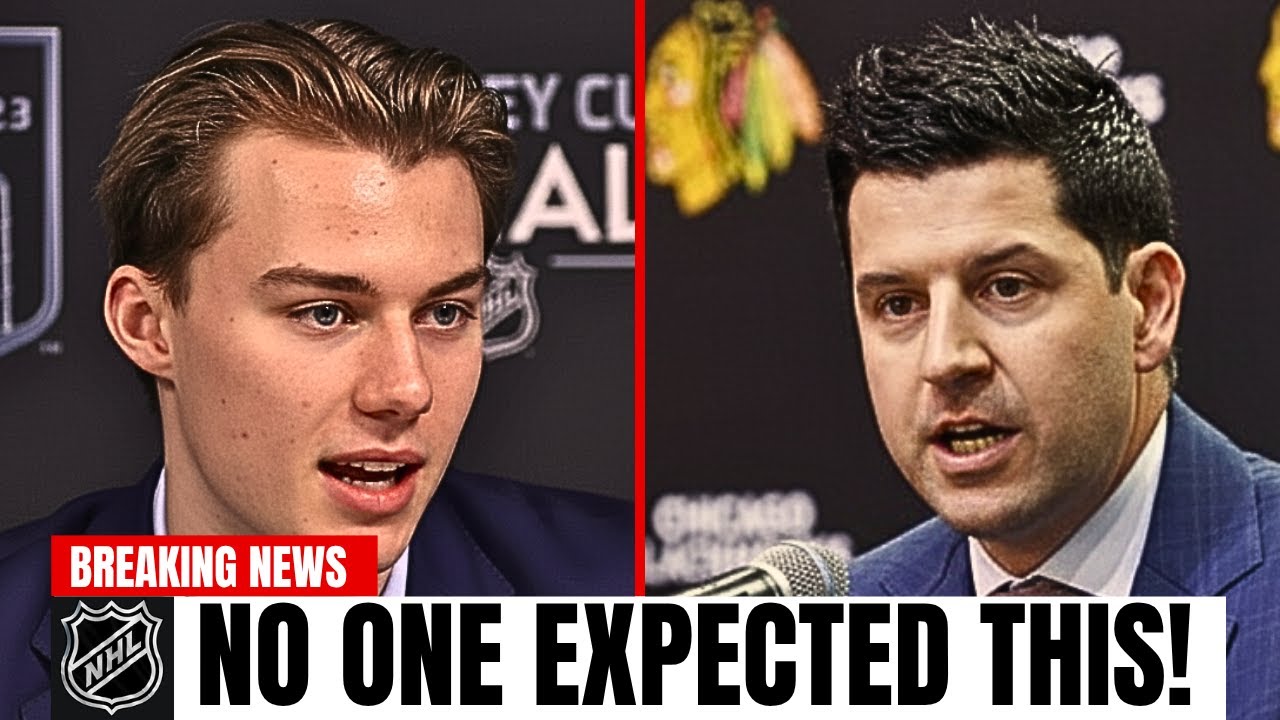
BREAKING: Connor Bedard DROPS a Hammer on His Future With the Blackhawks!
you just know what to expect. You know the guys. Um, you know, been been in it for a couple years. I got to, you know, play the 82 last year, which is nice. You know, what to expect on a day-to-day basis, and, uh, it just gives you, um, you know, more opportunity in the way you prepare, the way you train, and, um, you know, I’m grateful for that. Connor Baddard just dropped a quiet message that’s louder than any goal. No arguments, no drama, just one decision that changed everything about his future with Chicago. Fans can feel it. Insiders can’t explain it. What made Baddard step back when the deal was in reach? The Chicago Blackhawks selected Connor Baddard with the first overall pick in the 2023 NHL entry draft. He signed a three-year entry-level contract that summer, laying the foundation for his professional career. In his rookie season, Bard recorded 22 goals and 39 assists for 61 points in 68 games. The following year, he led the Blackhawks in scoring with 23 goals and 44 assists over 82 games. After just two seasons, he totaled 45 goals and 83 assists in 150 games. Elite production for a player his age. With his entry-level deal nearing its end, quiet discussions have begun about his next contract. General manager Kyle Davidson confirmed that early talks with Baddard’s camp are underway, but said there is no urgency. Both sides have delivered the same message. Patience. Badard echoed that tone when asked about his future. They know I want to be there. I know they want me, he said. So, it’s really not on my mind that much. His calm, confident response showed he’s not worried about timelines or pressure. During training camp, Chicago extended defenseman Wyatt Kaiser for two years and acknowledged informal conversations with Baddard’s representative. The tone around those talks was steady and respectful. No tension, no surprise. League insiders confirm neither Baddard nor the Blackhawks are rushing a long-term deal. Analysts describe the situation as professional and patient. The organization knows it holds the centerpiece of its rebuild, and Bedard understands the power of timing. From Baddard’s side, the delay seems strategic. A shorter bridge deal could allow him to build his resume, raise his market value, and take advantage of a rising salary cap later. It’s a modern move used by top players seeking both flexibility and control. For the Blackhawks, waiting is also part of the plan. The team is fully committed to building around Baddard, but must manage its cap space carefully while adding new talent. A huge contract too early could limit their ability to strengthen the roster. Chicago’s front office continues to emphasize that keeping Baddard long-term is the top priority, but at the right moment. Their vision is to grow a team alongside him, not just around him. That patience now shapes every move from free agent signings to development strategy. Baddard’s own comments show he’s aligned with that plan. It’s nothing crazy, he said. We’re both comfortable with where we’re at. He hinted a deal could come before the season starts, but ended simply, “We’ll see.” Experts project his next contract could mirror other young superstars about 7 years at roughly $9 million per season. But for now, both sides are content to wait. The tone is cooperative, not confrontational. The team trusts its star and the star trusts the plan. For now, the focus is performance, not paperwork. Bard keeps producing while management builds the supporting cast. Chicago’s roster is growing stronger, blending youth and experience around its cornerstone player. Every move points back to him, the foundation of the rebuild. This delay in contract talks isn’t hesitation, it’s precision. Bard knows timing equals power, and Chicago knows patience protects its core. In the modern NHL, both understand that control is everything. The facts are clear. Bedard’s current contract runs through the 2025 to 2026 season. Extension discussions are active but informal. Both sides want a long-term partnership. Yet neither feels pressure to sign immediately. The final decision will depend on performance, cap growth, and the evolving market for elite young forwards. His choice to wait has already reshaped how the Blackhawks plan their future. A bridge deal would let him renegotiate in his prime. A long-term commitment would signal Chicago’s readiness to chase contention. Either way, the message is unmistakable. Connor Baddard controls his own timeline. His patience isn’t doubt. It’s power. And for a franchise rebuilding its identity, that power might be exactly what Chicago needs most. Demov gets to it. Up. Ivan Demidov lid. He’s there. He scores. Power takes over back of the goal. Court checking forces a turnover. New hook. Hudson. He scores. Lane Hudson. Suzuki on the off wing. The trailer. Doson in front. Slapsky. Shut down by Alex Lion. The scramble. Suzuki back door. Dobson right in. A stop chance. He scores. out. The Montreal Canadians have done something that no one saw coming. They’re not rebuilding. They’re destroying that story. In less than 10 days, this young team has knocked off top opponents, pulled off lategame miracles, and signed one of the biggest contracts in franchise history. Montreal’s rising stars are not waiting for the future. They’re changing the game right now. The Canadians began this strong run with a high-scoring battle against the Seattle Kraken. On October 15th, 2025, Montreal won 5 to4 in overtime. Cole Cawfield scored twice, including the gamewinner just 1 minute and 35 seconds into overtime. The winning play came off a drop pass from Lane Hudson. That win marked Montreal’s third straight victory. Two nights later, the Canadians did it again. On October 17th, they faced the Nashville Predators and won 3 to2 in overtime. Caulfield tied the game with just 20 seconds left in regulation, then scored again 3 seconds into overtime. Hudson blocked a key shot and assisted on the tying goal. Goalie Jacob Dobies stopped 17 shots to secure the win. By October 21st, Montreal had completed another comeback win against the Buffalo Sabres. They scored three goals in the third period to win 4-2. The goals came from Juraj Slavovski, Lane Hudson, and Jake Evans, while veterans Nick Suzuki and Alex New Hook each recorded two assists. DOEs stopped 30 shots in net. Montreal improved to 5 and two and zero on the season. The results tell a clear story. Montreal isn’t rebuilding for later. They’re winning now and doing it with their youngest players. Lane Hudson, just 21 years old, signed a massive 8-year contract extension worth $70.8 8 million that begins in 2026 to 2027. The deal averages $8.85 million per year and makes him one of the franchis’s core players for the next decade. Hudson’s performance backs up the investment. In the 2024 to25 season, he recorded 66 points, six goals, 60 assists, breaking the Canadians rookie defenseman record. His 60 assists tied the NHL rookie defenseman record, and he won the Calder Memorial Trophy as the league’s top rookie. Meanwhile, Ivan Demidof, drafted fifth overall in the 2024 NHL draft, is already making an impression. In the KHL before joining Montreal, Demidov posted 49 points in 65 games as a teenager and won the Alexi Cherupanov award for KHL Rookie of the Year. His offensive skill and quick hands now give Montreal even more scoring options. The Canadians pattern in games also shows something different. They don’t fade late, they attack late. In the win over Buffalo, Montreal outshot the Sabres 14 to6 in the first period, kept steady through the second and then broke the game open in the final 20 minutes. The third period featured quick transitions and aggressive forchecking. Let’s look at where the numbers stand now. Early in the 2025-26 season, the Canadians hold a 4-1 and zero record with 18 goals scored and 14 allowed. Cole Cawfield leads the team with five goals. Nick Suzuki has seven assists and both sit tied for the team points lead. These early results build on the 2024 to 25 campaign when Montreal finished 40 and 31 and 11, showing major progress from prior season. Ger Slafkovski, just 21, continues to build on his development curve. Hudson anchors the defense while adding scoring. Caulfield is emerging as a consistent closer, scoring goals with seconds left in regulation and in overtime. And Demidov still new to the NHL pace is already influencing offensive plays. Montreal’s approach on defense has improved as well. Even with Kaden Ghoul missing time due to a lower body injury, out four to 6 weeks as of midocctober, the team’s defensive structure has held steady. The young pairings led by Hudson have filled gaps and maintained strong shot control. On offense, the Canadians have focused on quick zone entries and second chance scoring. They’ve also been consistent on special team, holding opponents to limited power play goals across their first few games. All these facts point to one conclusion in numbers, not opinion. The Canadians are performing at a playoff level pace. Their overtime wins show composure. Their defensive improvements show structure. Their new contract shows long-term planning. And their young scoring leaders show readiness. Teams once viewed as rebuilding don’t usually win three consecutive overtime games in one week, outshoot opponents, and extend a 21-year-old defenseman to a contract exceeding $70 million. That’s why the idea of the rebuild no longer matches what’s happening in Montreal. When Cole Cawfield scores with seconds left, when Lane Hudson turns a defensive block into an assist, when Slavovsky converts pressure into goals, these are not signs of a team still growing. These are signs of a team already competing. Opponents are starting to recognize it. The Canadians have gone from being overlooked to being a serious threat to veteran teams in the Eastern Conference. For a franchise once measured by its rebuild timeline, the numbers and winds are saying something louder. Montreal’s rising stars have destroyed every rebuild narrative that surrounded them. They’re not waiting for the next era. They are the era and they’re already winning. Conor McDavid and Jud Moldover, his agent, he signed a two-year extension. So, basically what he has, he’s got three years left on his deal this year plus two more uh at 12.5 million. McDavid’s agent just announced the real reason behind his short deal, and the hockey world is stunned. After months of silence and endless speculation, the truth has finally come out. What Jud Moldver just revealed about McDavid’s decision isn’t about money or fame. It’s about something much bigger inside the Oilers locker room. Conor McDavid signed a 2-year $25 million extension with the Edmonton Oilers days before the season began, continuing his average annual value at $12.5 million. The deal keeps him under contract through 2028. This short-term contract drew widespread attention. Many expected McDavid to seek a long record setting extension after back-to-back Stanley Cup final appearances. His agent, Jud Mulaver, addressed questions in an appearance on the 32 thoughts podcast. Mulaver said the process was intentionally extended over the summer to allow McDavid to take his time with the decision. Mulaver stated that from the start of negotiations, McDavid’s intention, both publicly and privately, was to stay in Edmonton and pursue a Stanley Cup as an Oiler. He emphasized that this was never about a predetermined deadline. It was never about a date circled on a calendar. He said the timeline had to be McDavid’s alone. Mulaver also addressed the salary terms. He said that while there may have been permutations he could have suggested a higher cap hit, ultimately he always works to protect his clients interests. He noted that $25 million over two years is itself rare for a short deal. According to Moldaver, the choice of two years gave flexibility to both McDavid and the team. He framed the agreement as balancing McDavid’s ability to win in Edmonton and preserving his individual value. Some observers viewed this contract as a team-friendly move, raising speculation that it could suppress future elite deal. Mulaver rejected that narrative. He called the idea that McDavid’s contract hurts other players value as bogus and disingenuous. He explained that different players sign at different times. The salary cap system is fixed. deals cannot be reopened once locked. He also cited previous examples of his clients taking shorter terms. He noted that Austin Matthews signed a 4-year deal in 2023 with a $13.25 million cap hit rather than maximized term. Mulaver said there were parallels in that approach, though the timing and market conditions differ. From Moldaver’s view, McDavid’s approach is a bet on himself. Short-term deals carry elasticity and flexibility. The Oilers organization also backed this messaging. General manager Stan Bowman commented that management allowed McDavid to take his time in negotiation. Reports say that Edmonton was never approached with an official trade offer for McDavid during the off season. CEO Jeff Jackson confirmed no team made a formal proposal. Jackson further said McDavid’s new deal doesn’t force the Oilers into immediate decision. Jackson maintained that while you’re always on the clock in contract context, this deal doesn’t transform Edmonton’s strategy overnight. Before the extension, McDavid had stated he would not rush contract talks. In August, he told media that he would take his time with input from his family, his agent, and those around him. At that time, he reaffirmed his commitment to winning in Edmonton and his desire to proceed deliberately. McDavid entered the 2025-26 season with 1,082 points in 712 NHL games. He had posted 100 points in 67 games in 2024 to 2025. In two straight seasons, the Oilers reached the Stanley Cup final only to lose to the Florida Panthers both times. Given those outcomes, McDavid’s decision to accept a short-term non-increasing cap hit surprised many analysts. Mulaver’s statement clarified that McDavid’s priority was to stay in Edmonton and give the franchise a chance to compete under favorable roster flexibility. He insisted that this was not about market setting or comparisons, but the best decision for McDavid at this moment. In rejecting the precedent argument, Moldaver asserted that McDavid’s contract should not be used as a template for other elite players. Mulver’s framing suggests this short deal gives McDavid and Edmonton options to reassess in two years if the market shifts or objectives change. By emphasizing process, timing, flexibility, and alignment with team goals, Mulaver cast McDavid’s short commitment as a strategic choice, not a limitation. Moldver’s revelation adds depth to the headline. The real reason behind McDavid’s short deal was not a lack of leverage, but a deliberate plan built over months, aiming to balance competitiveness and future options. Um, Marty, you uh you have an experience of people doubting you. And I think when Mark Andre just mentioned that you coached at a junior level, you corrected him and said, “Pewee, there’s a lot of people out there that are doubting you right now.” What do you have to say to those people? They were written off, but now they’re coming for everything. Under Martin St. Louis, the Canadians have turned from a rebuilding roster into a relentless, hungry force that refuses to quit. From grueling practices to last second goals, this team isn’t just playing hockey anymore. They’re proving that Montreal matters again. All that stuff, you know, as as an athlete, as a human, all that stuff that people want to uh doubt or talk and say and comment, to me, it’s all noise. It always been noise. And I’ve never I’ve always been a guy that blocked the noise and gets after it. And that’s what I intend to do. Since Martin St. Louis became head coach, the Canadians have changed. He took charge in June 2022 after a long playing career. He was the 32nd coach in team history. In his first full year, Montreal finished near the bottom. But under his plan, that changed quickly. By the 2024 to25 season, the Canadians jumped to a record of 40 wins, 31 losses, and 11 overtime losses. That gave them 91 points, 15 more than the year before, and their first playoff trip in four seasons. These are not small steps, they are proof of change. In May 2025, the National Hockey League named Martin St. Louis one of three finalists for the Jack Adams Award. That award goes to the best coach in the league. He was honored for helping Montreal move from a rebuild into real competition again. His work caught the eye of analysts, players, and other teams. Now, at the start of the 2025 to 26 season, the Canadians are working harder than ever. Training camp opened with a clear message. St. Louis told his players that every day mattered. Every shift had to mean something. Team captain Nick Suzuki backed that up. He said the group had to come hungry every day. That message stuck. In their recent games, Montreal’s new style is showing. They beat the Chicago Blackhawks with a goal in the last seconds, 15.7 seconds before the horn to be exact. Defenseman Kaden Goully scored that winning goal. It showed that the team doesn’t stop pushing even when the clock is almost gone. That type of finish is what St. Louis has been asking for. In that same game, Montreal had 10 power plays. Chicago collected 39 penalty minutes. The Canadians fired 12 shots on those chances. Those numbers are a sign of control and also a sign that their special teams still have room to improve. St. Louis said that execution under pressure is part of what separates good teams from great ones. He is also testing new lineups. Reports from Sportsnet say St. Louis may move rookie Ivan Demidov into the top power play unit. Demidov, who joined Montreal from Russia, is already drawing notice. In one game, he stopped a breakaway chance by skating hard back on defense, something St. Louis wants from all his players. Global News reported that this kind of two-way effort is exactly what the coach expects from young talent. It’s not just about scoring, it’s about playing the whole game. Another player showing progress is Zack Bulduk. Montreal traded for him this fall. In his first three games, Buluk scored in every match. His ice time jumped from just over 13 minutes to almost 17. He earned that through hard play. He also changed the way players train. In recent interviews, he said he wanted practice to feel like real game. He didn’t want slow warm-ups or lazy drills. He told players that every shift in practice should mirror how they play when the puck drops for real. He said, “Do what the game demands.” That line has become something of a motto inside the locker room. The Canadians improvement isn’t only on paper. The team looks more organized, more confident. They still make mistakes. Every young team does, but now those mistakes come from trying, not from hesitating. St. Louis said that once players learn his system, he can demand more from them. That’s what’s happening this season. The change also shows in leadership. Nick Suzuki continues to grow as captain. The coach has made clear that every player must understand his role. In Montreal’s system, the defensemen are expected to help the attack.
Connor Bedard just dropped a quiet message that’s louder than any goal.
No arguments. No drama. Just one decision that changed everything about his future with Chicago. Fans can feel it, insiders can’t explain it. What made Bedard step back when the deal was in reach?
The Chicago Blackhawks selected Connor Bedard with the first overall pick in the 2023 NHL Entry Draft. He signed a three-year entry-level contract that summer, laying the foundation for his professional career.
In his rookie season, Bedard recorded 22 goals and 39 assists for 61 points in 68 games. The following year, he led the Blackhawks in scoring with 23 goals and 44 assists over 82 games. After just two seasons, he totaled 45 goals and 83 assists in 150 games — elite production for a player his age.
👉 Subscribe for more NHL insights, trade breakdowns, and player-contract updates!
#ConnorBedard #ChicagoBlackhawks #NHL #HockeyNews #BedardContract