
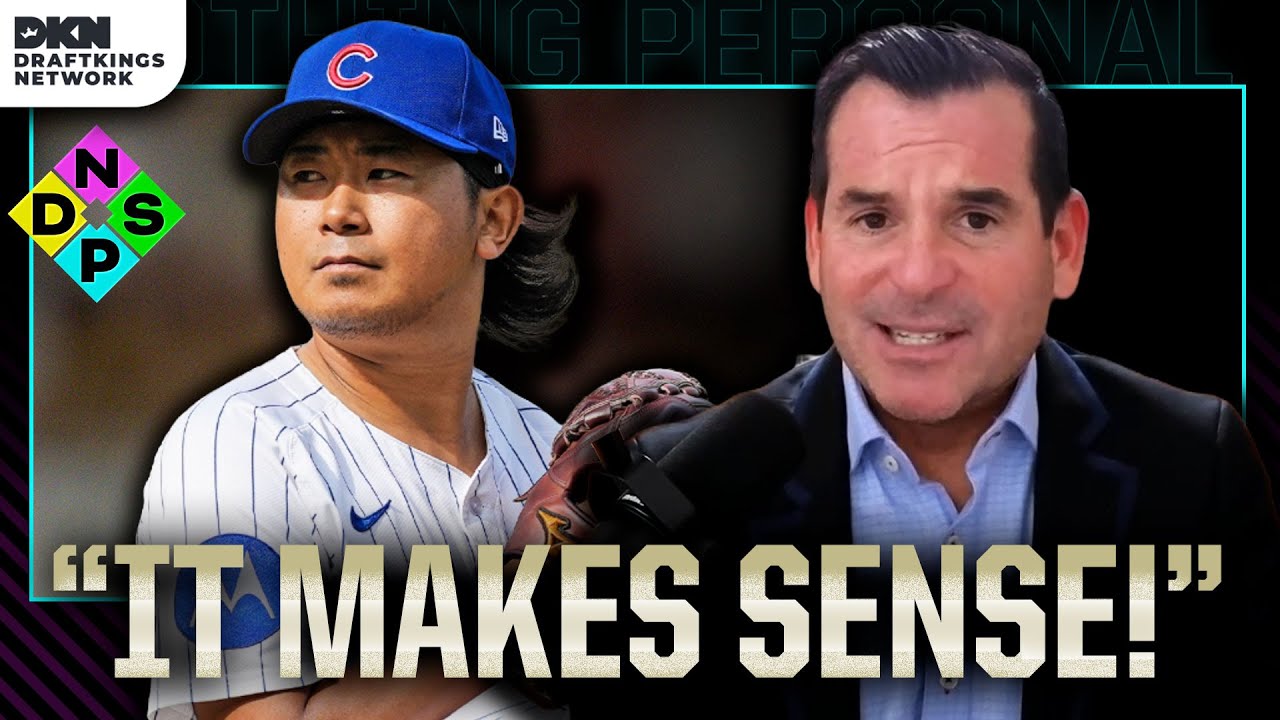
Breaking down what happened with Shota Imanaga and the Chicago Cubs!
Now, we can certainly talk about one more thing for my friends in Chicago. I just want to mention it. I don’t know if you guys are upset about Ianaga, the Japanese pitcher who started off so well. I would tell you that he was less than effective later in the season. But let’s talk about what happened there. When he first signed, there was an opportunity where one of the ways you can have an interesting contract is that at a point during a long-term deal, the team gets the opportunity to decide whether they as a team option, not whether they’ll pick up one year, but whether they will decide to pick up multiple years. We negotiated that with players before. It makes you make a decision at a certain point in time about what you think the future of that player is and what you think that player is worth at that moment in the open market. his deal with the Cubs had a provision where the Cubs either had to extend his contract out to 2028, which as you know is 3 years from now, or his contract would revert into a one-year player option. And if the team chose to decline to give him 3 years 57 million which he’s not worth then he would have an opportunity to take one year$15 million from the team. That is a way for think about what happened here. 57 divided by three it’s sort of easy math. You could just say it’s $19 million if you so choose. When you sign a player to a deal that allows you to give him three years 57 and if you don’t then he will take if he wants one year 15 that means when you’ve negotiated you’ve said that the player wants you to value him at $19 million. you believe that his value may be closer to $15 million and so you negotiate that provision. In the Cubs situation, they didn’t value Imanaga as a $19 million player, but he valued himself as more than a $15 million player. So what happens? The Cubs decline the extension. Then I imanaga declines the player option and now he’s a free agent. The next thing you have to negotiate in that scenario where the team doesn’t do the team option, the extension, the player doesn’t do the player option, but the player then is a free agent. you can negotiate whether that player will or will not be eligible to receive a qualifying offer. A qualifying offer is a concept that we talk about every year and this year it’s up to $22 million. It’s when you make an offer to a pending free agent that you have on your team and you say, “We’ll take you back for a year. We’re going to give you an offer of a one-year deal at 22 million. You can accept it, you can reject it. It’s totally up to the player. If the team makes an offer, a qualifying offer to a player and the player rejects it, Kyle Tucker will not accept a qualifying offer from the Cubs because he’s going to go into the market and get more than one year, get more than $22 million a year. If you make an offer and it gets rejected by the player, you get an extra draft pick. That’s too many signs. If you make a qualifying offer to a player, there’s always a risk the player’s going to take it. When the Cubs decide what they’re going to do with Imanaga, if they offer him a qualifying offer of $22 million, that is more in one year than what the team was going to pay him if they extended him out for three years on an average annual basis. It’s more than he would have made on a one-year deal if he had accepted what the Cubs contractually would have to have paid him, which is 15. So, it’s a fascinating thought that Imanaga may have not been offered 3 years 57. He may not have accepted 1 year 15 and instead could end up with one year 22 from the Cubs. The other little known secret here is that all these players that you read about Chris Sale and he got his club option extended etc etc. Right now and two weeks ago and four weeks ago every player agent is calling the teams to figure out what is the opportunity for their player in the wide openen market. It’s all against the rules, but we fielded calls from agents starting in August about what we thought about players on other teams, what we thought about where our payroll was going to be, what we thought our team needed. The reason why agents do that on a consistent basis is they need information to give to the player so the player can decide whether to opt out, whether to exercise this player option. Teams, we don’t need to talk to agents. We don’t need to talk to other teams. We mark our players to market. Agents and players don’t do it that way.
#cubs #baseball #MLB
MERCH:
– Visit: davidsamsonpodcast.com
AUDIO
‘Nothing Personal’ is available on Apple Podcasts, Spotify, Google Podcasts, Audacy app, and wherever else you listen to podcasts.
-LEAVE a 5-star review on Apple Podcasts: https://podcasts.apple.com/us/podcast/nothing-personal-with-david-samson/id1483011704
-STREAM on Spotify: https://open.spotify.com/show/15gYsXoV81ySg2kBCzamC0?si=5o2-ofBoSG2Uw7ycnFep3Q
SOCIAL MEDIA
-FOLLOW NPDS on TikTok: https://www.tiktok.com/@nothingpersonal.npds
-FOLLOW NPDS on Twitter: https://twitter.com/DavidPSamson
-FOLLOW NPDS on Instagram: https://instagram.com/DavidPSamson
-JOIN DISCORD: https://discord.gg/FjGAjYxcQx
Tracking Document: https://docs.google.com/spreadsheets/d/1jl_qRYCA04IqNp-pmcfGQoaF6rA_7f4RigR1ZPY7dQo/edit?usp=sharing
7 comments
I’ve become a big fan of yours, Mr. Samson
If I was Imanaga I would opt out just to get out of Wrigley field. As a fly ball pitcher he should take his talents to San Fran or Seattle where the stadium can keep some of those fly balls.
I still remember the press conference last year where he won over the Cubs fans. I know his performance suffered after he came back from his hamstring injury – possibly he came back too soon – and it probably was a rational decision by the team, but…it felt rather cold.
I learned a lot from Samson with regard to such contractual terminologies as "team option" and "player option." The business aspect of running an MLB team is very complicated for a lay person like me. This video clip is very informative!
Imanaga had a WHIP of .988 so should have had a better ERA, but his HR/9 was 1.9. Put him in a pitcher's park with good outfielders and he'll be an all star.
Future dodgers
Watch him go to the dodgers