
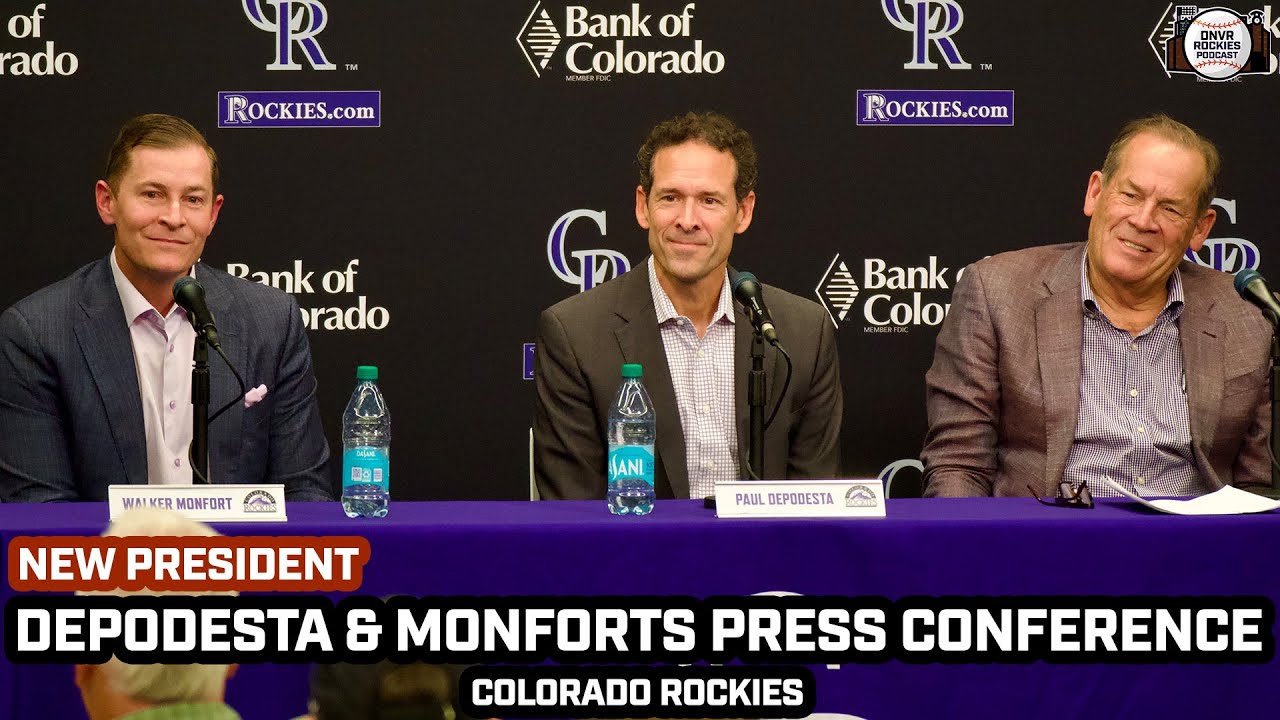
Paul DePodesta & Monforts on Rockies FUTURE, New Front Office Hires & More
[Applause] Paul, we’re thrilled to have you and your family, some of whom, like I said, are along or along the wall here, joining the Rocky’s family here in Colorado. Welcome. Up on the stage with Paul are Rocky’s owner, chairman, and CEO, Dick Montford, and Rocky’s executive vice president, Walker Montford. Before taking questions, we’ll get started with opening remarks. And with that, it’s my pleasure to turn it over to Dick. Yeah, thank you, Corey, and thank you all for being here. I was going to get up and talk up there, but the I I have this fear that one of these days I’m going to fall off this thing, so I’m going to just stay seated. Um, but I do thank you all for being here. Uh, it’s nice to see some excitement in this room. Um, I’m going to pretty much let Walker and Paul do this. I will uh hang around for questions, but uh uh I’ll let Walker introduce and then Paul do whatever you’re going to do. All right. Awesome. Well, first of all, like he mentioned, thank you all for being here today. Um you know, I think a few of you may actually know Paul a little bit better than uh than we do um after a couple days in Vegas and uh grilling him. He got a good taste of uh what it’s going to be like here in Denver. Um, but we do appreciate those of you that made the trip um getting out there and and uh certainly just, you know, helping us tell the story um even just a weekend. So, um appreciate that. Uh Paul, it’s great to finally have you here in Denver. Uh, it’s been a whirlwind since everything became public last Thursday, and we’re thrilled to officially welcome you, your wife Karen, and your sons Alex, Evan, and Trevor here today in their Rocky’s gear over here, um, with with their York Space Systems patch. Um, you know, we also look forward to meeting your daughter, Talia, here in short order. When this process began just over a month ago, someone asked me what we’re looking for in this role. Coming off of the difficult season, my answer was simple. We needed someone who could transcend. Someone who could take us beyond where we are today and help us reach new heights as an organization. We began the search by reaching out to trusted voices around the game. People who know what it takes to do the job and who understand both our market and our mission to win. Through those conversations, one name quickly rose to the top. The gentleman sitting right here next to us. Of course, it was a name we recognized, but as we learned more, we realized there was far more to his story than met the eye. Throughout our conversations, Paul impressed all of us, me, Dick, and Charlie, with his leadership style, his deep experience building not just teams on the field, but a culture within the front office and his unique perspective on how the game should be played and led. From our very first call, his track record of success, his resilience through challenges, and his constant drive to evolve and improve stood out. It became clear that that Paul isn’t just a problem solver. He’s a visionary leader. He’s a visionary leader who inspires collaboration and conviction in everyone around him. After several more discussions, we unanimously agreed Paul is the kind of leader that can make an immediate and lasting impact with our staff, our players, and throughout the organization. Now, we all know it’s been a tough stretch here for the Rockies, um, to say the least. There are no excuses for that. Um, but today marks something new. Today is the first day of our future, and from here on, we will not accept anything other than progress. To our fans, we know you’re frustrated. You have every right to be. We are, too. And I can’t express how grateful we are for your continued passion and support. I know you’re tired of hearing words. You want to see action. Bringing Paul on board to lead our baseball team is our first move, and there will be many more to come. It’s the first move towards getting this team back to where we know it can be and where you, our fans, deserve it to be. We hear you. We feel your passion. and we share your belief in what Rocky’s baseball can be and should be. Our mission is to get there and we couldn’t be more confident that Paul is the right person to help restore pride in our brand, re re-energize this organization, and build something truly special here in Denver. Most of us in this room have witnessed the electricity of the city when the Rockies are full steam, and is our goal to get back to that as soon as possible. We have our work ahead, but we couldn’t be more excited to begin that journey with Paul today. With that said, it is my pleasure to officially introduce our new president of baseball operations, Paul D. Podesta. Take it away. [Applause] Thanks very much. Um, it’s really hard to express just how excited I am, you know, to be here. Um, and I I can’t wait to get started, especially over the course of the past week. I feel like they’ve been trying to start and then not actually being able to do it. So, I’m glad to finally get here in in Denver and get going. Um, first of all, I I want to thank the Mforts really for entrusting me with this responsibility. Um, it’s been a great process over the course of the past four or five weeks and getting to know them and uh getting to know this market. Um, I also want to thank the the Hasslam family uh and the Cleveland Browns. Um, just for the the trust they uh they gave me over the course of the past 10 years and then even, you know, their willingness to allow me to entertain this in in sort of an awkward time in the middle of our our season. Uh, not everybody would do that and uh so it it means a lot to me and they’ve meant a lot to me over the course of, you know, the last 10 years. Um, and also my family, my my wife Karen, uh, my kids Trevor, Tally, uh, Evan, and Alex. They they’ve been unbelievably supportive, you know, through all these years. They’ve been great fans. Uh, even when they stacked their fantasy teams with Joe Burrow and Jamar Chase and other players in the AFC North, it’s okay. Uh, um, look, I I’ve been I’ve been incredibly fortunate over the course of the past 30 years, right? I was with a CFL team, five different Major League Baseball teams, an NFL team. I’ve gotten to see a lot. I’ve been on both coasts. I’ve been in the Midwest. I’ve been in big market teams, small market teams, mid-market teams. I’ve sort of seen it all. And once you go through all that, uh you really start understanding what it is that’s important to you uh in an organization. And it it really for me begins with ownership. And you know, it’s one of the reasons it was so hard to leave Cleveland is I thought we had terrific ownership there. you know, with with the HLMS and the the foundation of that ownership when you’re when you’re looking at it, at least from my perspective, is, you know, is there a really high care factor, you know, for the organization, um, and for the city. Um, is there patience, you know, because these things don’t always happen overnight. Um, and is it is it a partnership, you know, or are you just an employee that if you don’t get it done in year one, then they’re just going to move to the next person where there’s, you know, there there’s loyalty. There truly is a partnership. And uh while I had that all those things in Cleveland, uh you know, over the course of the past month that I I got a chance to spend time with with Dick and Charlie and Walker and everyone here, uh I absolutely felt that that they checked every one of those boxes and I felt great about the potential of of moving here. Um the second thing, you know, I always looked for is the challenge. Um you know, 30 different Major League Baseball teams, they all have their own challenges and they’re all interesting challenges. Uh but let’s be honest, there’s uh there’s no challenge as compelling as this one. Um you know, this is a unique environment and there’s a reason it’s it’s interesting to so many people, not just in baseball, but even in sports. So to take that on, you know, that was uh really exciting for me. The other part of it, you know, you start thinking about is is the venue and the geography. And look, there’s, you know, for the last 30 years, this has consistently been one of the best venues in all of baseball. It’s a great place to watch a game. Uh probably better as a home fan than as a visitor, but it’s a it’s a terrific place to be. And then again, geographically, you know, this isn’t just a city’s team. This is a this is a region’s team. Um it’s a you know, a huge part of the United States that are Rockies fans. Um so all of that was intriguing. Um and then it really comes down to, you know, the last piece, which really is the fans, right? you if you’re going to pour yourself into something, you know, ideally you do it in a place where it matters to somebody or hopefully matters to a lot of people. And while I know it it has been a difficult, you know, few years here, um the fan support has been remarkable. I mean, still lots of fans, you know, at every one of these games the last few years. I think everybody sort of dying for this organization to get back to where it was. Um, and I can tell you, you know, in from 2004 to 2010, I was in this division as an opposition. And in 2007, in game 163, I was here. I was in this building, right? And so, I know what it’s like uh when the Rockies are really good. And like you said, when they’re when they’re rolling, I know what the electricity is like in this building. and and that night um while I probably have a very different uh feeling and memory of that night than most of the people in this room um it made a mark like it made a mark on me and I just thought geez you know if you ever have the opportunity I mean this is a this is a special place so I’m very anxious to get started and get back to that point you know where the Rockies are winning every year uh and we can create that kind of electricity in this ballpark because it’s uh you know it’s special so thanks again for having me again I I can’t wait to get started and um excited to be here. Awesome. All right. Well, thank you, Paul. Thank you for Walker. Uh thank you, Dick. At this point, we’ll go ahead and take questions from those in the room. Uh if you have a question, please raise your hand. And Kevin or Edwin from the Rocky’s communication staff will pass you a mic. Just please make sure to introduce yourself and state your affiliation before your question. We’ll go ahead and get started with Thomas Harding first over here. Thomas Harding, MLB.com. Welcome to Denver. Okay. when you you’ve talked about uh Dick and Charlie and Walker, but at what point in the interview process did you feel like, hey, I’m going to have that um I don’t know if the word is autonomy, but I’m going to be able to put my vision in here and they’re going to trust me with it and maybe, you know, just kind of defer to my thoughts and and uh beliefs in this. Sure. I thanks, Thomas. I think very early on to be honest with you. Um look, let’s let’s be candid. I mean, for them to connect with me, you know, this wasn’t going to be the most traditional hire. I mean, it showed me right away that um there was a real open-mindedness here. There was a willingness to, you know, to do things differently uh and to try some things. So, you know, from the beginning, I think in our very first conversations, I got that sense that, hey, we uh we know we’ve done, you know, we know we’ve done things a certain way for a while. Um they haven’t worked the way we wanted to. we’re ready for a change and uh we’re ready to bring someone in here to affect that change. So I felt that right away and then throughout the whole process. Hey uh Paul I guess this is for you Pat Graham Associated Press. Um you know Korsfield is a unique venue as you know it’s you know the splits there are different. How do you how do you turn Korsfield into an advantage? I mean what are some of the ways you can make that an actual advantage for for the Rockies? Well you know that’s certainly the goal. I mean, I can tell you again as as an opposing team here a number of times through those years. Um, I mean, we’d look at the schedule in March and you’d circle these dates, you know, and you’d dread them. You’d think, geez, we got to go in there for three days. Um, no lead is safe. We don’t know how we’re going to get through this with our pitching. We’re going to need to be thinking about how we’re going to set up our pitching for the series after this. That’s what I want this to be. like this has a chance to be, I think, the, you know, the the best home field advantage in all of baseball. So, um, that’s our goal and that’s what we that’s what we want. I’m not going to get into the details of exactly how we plan on doing that. Um, but that’s certainly the goal here. I I see it as a, you know, potentially huge advantage. Uh, quest Patrick Saunders, Denver Post Walker, I have a question for you. Can you in a nutshell explain to us how the hierarchy now is going to work from your dad to you to Paul to who he hires underneath and just just your hierarchy of how this is going to work? Yeah, of course. Um, so obviously everyone reports upward to our our chairman and CEO, my father Dick. Um, and basically from there I’ll still be responsible for oversight of the of the entire organization. Um, so Paul will report to me. um those that he hires will report to him. And um like I told Paul um when we were going through this process, I mean um I’m I’m very much behind him as it relates to his experience in the sport. Um I think my goal is to learn from Paul and others that he brings in um on a daily basis. But uh you know, above and beyond that, it’s it’s partnering with him and um you know, really being part of the same team. But that’s how it’ll be organized. Paul, welcome to Denver. Uh Troy Rank from the Denver Post. When the Rockies have had issues through the years, part of it has been identified as the infrastructure. It’s not just at this level here. Do you feel confident you’ll be able to hire enough people to change how you do things in inherently because you were a data guy at the forefront of it 20 years ago to where you can create a philosophy that runs through the organization with people where it’s consistent. In other words, do you feel you’ll be empowered to create that infrastructure? And and Walker, can you speak to that? Will he will be have will he have a chance to bring in x number of people to you know create the change you guys are looking for? I’ll let you start. Sure. Uh yeah, absolutely. I I feel really good about the possibilities in terms of what we can do here as we continue to sort of build out the baseball operation. You know, that being said, the first thing I want to do is really get to know everybody here that’s already here and understand the capabilities that are already in place. Um I think it’s probably beyond what maybe some people think. Um, but I want to do that before I start thinking exactly about how we maybe want to supplement that with with additional people uh or additional skills. But, um, but no, I I’ve been given assurances that that there there’s actually a there’s not just an appetite, there’s like a thirst to to build this out and uh, you know, to make it a real strength for the organization. How would you articulate that on a walk in regards to that? Yeah, I mean one of the things that we talked about through uh through the conversations with Paul was we do have resources, right? Um I think we did we did a study where we looked at um a number of other teams that are, you know, sort of our size, mid-market type teams, um center of the country type teams. And what we found is, you know, it’s it’s not necessarily that we’re not spending enough money. um we do have resources. We have comparable resources to those other clubs, but um one of the things that I think Paul will be tasked with is figuring out how to allocate the dollars, right? Where are we missing? Um where do we need to add? Um what can be done different with those dollars to provide, you know, long-term a greater return on investment. Um so we’re going to be supportive of that. Um we look forward to having his thoughts on on what needs to be done. And um again, I I think there’s going to be plenty of flexibility. I I want to just add one more thing to that. I think it’s also not always just about the sheer volume of people or volume of information. It’s how you’re actually utilizing it and is it is it impacting your decision-m is it impacting your player development, you know, etc. So there there is a point um we’re not there, but there’s a point where there’s diminishing returns of just adding more and more people or more and more data. Um, but I think we we need to figure out exactly what that right line is for us so that the things that we’re doing can really move the needle, you know, for the major league team. Paul, congratulations and welcome to Denver. Ed Henderson with Crawford Media Group. I wanted to ask you, I’m sure right now you’re drinking from the fire hose and will be for some time, but if you can identify maybe one or two of your top priorities as you move through this process. Well, I think you know the first is just to get to know everybody here like I said before and understand the capabilities that are already in the building. Um but then there’s some real decisions we have to make. Certainly the manager um is a is a you know first and foremost I think in my mind and then from there it’s setting the entire major league staff. Um we also have you know some uh some pitching jobs that we need to we need to fill including sort of the top pitching jobs. And that that’s not just hiring a person, that’s actually establishing a pitching philosophy for the entire organization. Um, so those are I think those are sort of front and center in my mind. Clearly, we there will be probably some front office transactions and then obviously this is our offseason. We got to go sign some players and you know, fortunately that’s already been happening. We’ve had some waiver claims. There are some uh some free agents we’ve been out there trying to sign. So that’ll be happening uh at the same time or concurrently. But um but yeah, I think you know the the personnel here within the building um you know starting with the manager is probably the first order of business. Hey Paul, uh Mark Kizler, Denver Gazette. Uh like you uh two decades ago in ‘ 07 I was in the building. So I have two questions for you. Number one, did Matt Holiday touch home plate? And number two, how long does it take to go from last place to first place? So, I actually was going to purposely try to avoid this question, but I’m not sure he’s ever touched home plate, but hey, just my perspective, you know, um I actually got a chance to connect with with Matt uh late last week, so I’m sure it’ll be a topic for us, you know, at some point. But, um you know, in terms of timing, you know, I’ve I’ve talked about this before. I as I’ve moved to different organizations, oftentimes when you go to an organization, um there’s a need for some change, right? Things haven’t been going great. That’s why these jobs are available. So, I I’ve been through this now a handful of times. Um I still don’t know exactly, you know, the time frame because I think each situation is a little different. Uh and I don’t know enough at this point to tell you exactly when that would be. But I will tell you this. I think what we’re actually trying to achieve is this like fundamental change of state right within the organization and that’s both the talent on the field it’s also the the culture in the clubhouse the culture in the building um and even as I’ve gone through these different organizations and experienced that I still have never been able to say oh yeah that was perfectly predictable like three years ago it was you know I remember even when I first got to Oakland for instance my first spring training there It just felt different than had when I’d come from Cleveland. Like Cleveland, it was a situation where they just expected to win every single day. And in Oakland, they that was lacking for sure, you know, that first spring training. And then it sort of evolved to um hey, we think we can compete with these guys. And then it evolved to um hey, we think we can, you know, compete with anybody, like even the best teams. And then it evolved to we know we can win. It doesn’t matter who’s in the other dugout. And that’s a process, right? And it does take time. I’d love to speed it up like as quickly as we could. Um, but I do think you have to sort of hit each stage in that process. And not each one is a year. You know, sometimes those things happen over the course uh uh of an individual season. But um, look, I I don’t want this to take, you know, a bunch of years. I’m I’m anxious to get going and and you know, as Walker said at the beginning, you know, start showing some progress right away and and move to where we want to be. Um, but I I think we’ll I think we’ll start to feel it before it necessarily shows up and uh we’ll start feeling that that progress toward that fundamental change of state. You’ve worked for the evil blue empire working against it. How big a challenge is that? Yeah, I mean, you know, when I left the Dodgers, I went to the Padres’s, so it was, you know, I’ve been in the I’ve been in this boat before. Um, I’ve also been in, you know, New York when I was the Mets and they were the Yankees like right across the street. Even with the A’s, the the Giants were right across the street and had some great teams. I just don’t get caught up in those things. I think we have to worry about ourselves um and not worry about what anyone else when anyone else in the division is doing. There are some great teams. There are some really, really competitive teams in this division. Uh, that’s okay. We plan to, you know, hopefully be one of them uh at some point here relatively soon. Um, you know, I also started back in the day where they were eight playoff teams. Like they’re now 12. There’s room for all of us. So, I I think for uh you know, my goal is we got to be playing in October and uh I’ll take my chances against anybody once you get there. Christian Lionel first and we’ll go to you. Uh Lionel Benu, Denver 7. This question is for Dick. Uh Dick, with the Walker as executive vice president and now Paul as president of baseball operations, what were you what specifically will your role be on the baseball side of the operation moving forward? I think they’re sort of pushing me out. Doesn’t it feel that way? No, I mean, hey, uh, much has been said about what I do and don’t do. Uh, I’m here to support Walker. I’m here to support Paul. I’m here to support everybody in this building. And, uh, you know, we we have to have the the resources to make all this work. And that sort of always has been part of my responsibility, too. But I I’m here to support people. I’m I’m not as bad as anyone thinks I am. Uh I I do care. I think that’s where it sort of gets foggy. I care about, you know, winning. I care about our players. I care about our, you know, the entire staff that work here. They work extremely hard. And so, you know, I defend them and I support them. And but, you know, really, it’s Paul’s job. It’s Walker’s job. and and I’m there to support them and like I tell people I’m the overhead around here. Christian uh Paul Christian size DNVR sports you talked about one of the biggest decisions facing you being a managerial decision. What are some of the qualities you’re looking for in a manager? What are you hoping to get from a successful manager in this hiring search? You know, I’ I’ve always believed that I think the most important job a manager has is just being a great relationship manager. um relationships with the players, relationships with the rest of their staff, relationships with the front office, etc. Um look, it’s a hard job. I mean, it’s it’s unbelievable everything that they have to deal with on a daily basis. Um but I I think that’s at the core of it. Um are are there other things that are important? Sure. I mean, you know, game strategy and whatnot. And um but I I think there are a lot of people that are capable of doing some of those types of things, but I think the people that are exceptional relationship managers, they’re they’re harder to find. Uh Paul, I’m Owen Perkins from the Telluride Times. Um do you as there’s a lot of concern about 2027 and labor um and as you’re putting together, you know, a rebuild of the organization? How much do you look to that? How much does that come into your thinking on putting things in place now with that looming in your mind? Or do you have to kind of ignore that aspect? You know, I’d say this, at least as we sit here today, um there’s so much right in front of us, you know, that we need to tackle between now and the middle of February that that that’s really what’s on my mind more so than anything that’s, you know, a year away or more than a season away. Um obviously at some point, you know, from a strategic standpoint, we need to be, you know, thinking through possibilities, but right now it’s not really not really part of the the calculus. John, John Tree, 9 News. Dick, in order to make big changes, you have to take big swings. How much do you want Paul to take those big swings and risks? Yeah, I mean, we’ve taken big swings before. Uh Paul’s taken big swings before. Uh, you know, you calculate those risks and you know, if if the worst possible thing could happen, are we all right? And so, you know, you just have to weigh those risks. Um, you know, we all, you know, we understand where we’re at. As Walker said, we we fit in a group of about 15 teams that, you know, are not as resourceful, let’s say, as you know, the top five or eight teams. So, you know, we know where we live, but risk, you know, we’re up for risk just like anybody else. Paul, Scotty Gains, 9 News. Welcome to Denver. In your last position in Cleveland, you received a lot of blame for the Deshun Watson trade that objectively was a failure with that organization. Is that fair? And if so, how can you be assured that you won’t do something like that again here now in Colorado? The previous question was about big swings, huh? Uh yeah. Risk. Yeah. You know, I I was also calling plays for the Browns, you know, and uh No. Um, look, I and I’ve said this before. I think whenever you have a significant player decision, whether it’s trade, bring free agent signing, number one draft pick, whatever it is, like those are organizational decisions, right? Um, those are done collaboratively like a lot of people on board and and if you’re a senior leader of that organization at that time, u then, then you own that decision. I mean, you do. We we all do. Um, so that’s the way I feel about that and I and it’s the way I feel about sort of almost all the decisions we made there in Cleveland. I absolutely, you know, own them all. And look, I I’ve said this now for probably 25 plus years. Like um I lost my no hitter a long time ago. Like a long long time ago. Like I’m not perfect. I haven’t been perfect. I won’t be perfect going forward. Like we are definitely going to miss again. Um, but hopefully we learn from that and we learn from both the successes and the failures and you know we get better the next time we need to make uh a significant decision and I do feel like I’ve been able to do that through the course of my career. I feel confident that I’m a lot better today than I was 5 years ago or 10 years ago or 20 years ago and I hope five years from now I’m a lot better than I am sitting here today. Hey Paul, right in front of you Brandon Crystal Gorilla Sports now that Scotty asked a football question. Uh, I think a lot of people want to hear about Shador Sanders and if he’s ever going to get on the field, but we can do that another time. Um, I’m curious because you Pat started to talk about the uniqueness of Korsfield. What are your thoughts on the dimensions and potentially changing them to not make it the biggest outfield so that singles become doubles and doubles become triples and the wall that was added in right field that Jeff Brightage put up? Any thoughts to changes to the dimensions? No, not immediately. Right. Right. I mean, I think I have certainly have a sense for how the ballpark plays because I’ve obviously been here a bunch as um as a part of the visiting team. Uh but no, I don’t have sort of immediate thoughts on that. There are look, I’ve been a part of parks that have changed. Petco changed when I was there. Uh City Field changed while I was there. Um so I think you need to be open-minded about that as you get data and sort of understand how everything plays. And I know there have been some changes here, you know, over over the time. But um my my sort of more immediate concern is how um how we’re going to play given the current situation, right? And at some point if it makes sense to change something, I’m sure we’ll we’ll look at that. But um but right now I’m just focused on what it’s like today. Hi Paul. Susie Hunter, Guerilla Sports. You’ve mentioned you’re excited to tackle the very unique challenges here in Colorado. Is there any one aspect of that that was most exciting to you when approaching this role? Um, I don’t know that, you know, playing at altitude obviously is a is a huge deal. I’m not sure that it’s like this for any other sport. Um, forget about baseball, like just any other sport. The the impact that the environment has on the actual play of the game, you know, not necessarily just the condition of the players, but actually the way the game is played, the way the ball moves, you know, etc. Um, so I just think, you know, intellectually I think it’s fascinating. Um, it’s a real challenge, you know, for our players. Um, but, you know, I’m again sort of excited to learn even more about it. I have a lot of theories, but I’m afraid some of them are probably naive because I’ve been on the outside looking in, and I know there are a lot of things that have been tried here over the course of the past 30 years, and I’m anxious to learn about those, too. I don’t want to uh I don’t want to try something that someone already tried and it didn’t work, right? But I so I want to learn from those things. But um but I do think there are probably some things that we um we will have to do differently than everybody else. Um when I left Oakland and I went to the Dodgers, look, I was really young and I and I was, you know, pretty naive at the time. I was we were we were so successful in Oakland that I thought, okay, I’ll be able to forklift out what we were do doing in Oakland and drop it in Los Angeles and we’ll be even more successful because we have more money and more resources, etc. Well, I quickly learned that that’s actually not the way things work. You know, every organization is different. Every environment is different. It has its own strengths. It has its own obstacles. Um, and again, this is unique in that sense. Um, so I I’m under no illusion that you can build a team the same way here that you would anywhere else. Um, but again, that’s part of the um that’s part of the intrigue that I’m really looking forward to. Uh, this is kind of a question for both Walker and Paul. U, there’s been a lot of discussion about a possibility of there being a lockout in 2027 from both hiring a personnel perspective and also, you know, signing players. Does that change your approach to hiring people, the possibility of there being a lockout in 2027? You know, from our standpoint, and this this really comes from from Dick here, but um you know, we we look at it as something that could potentially happen down the road. Um it’s not something that’s that’s uh going to be a roadblock. It’s going to be a you know, a speed bump potentially at some point. But um really I mean we’re not looking at it with the lens of holding back anything right now. We’re we’re looking at it um with a lens of efficiency, right? I wouldn’t say we’re trying to bring on too many people, but if we can um you know evolve our operation in a way that uh provides again a great return in the form of wins, um we’re open to anything. Yeah. Yeah. And I would say, you know, it just um like it is what it is in terms of the time frame, but it’s a bit of an artificial time frame. I think my time frame is much longer than just, you know, 2027. I think we we want to build something that’s uh robust and lasting and and uh that’ll certainly extend well beyond 2027 one way or the other. Paul Mark Kudson, Mile High Sports. The one job that hasn’t been mentioned today is general manager. Can you tell me what kind of person you’re looking for? Is it somebody you’ve worked with previously? somebody with some new ideas exactly when that job might get filled. Sure. Um, so, uh, I’m not sure exactly how it’s going to like how it’s going to evolve. And the reason I say that is because I’m I’m a huge believer in building teams as opposed to just, you know, picking individuals. And, you know, I I want to find someone who can help fill in some of my gaps, but also maybe help fill in some of the gaps in the rest of the organization as well. Um, and even as we look to build out sort of the, you know, the senior leadership team with people that are already here, maybe people that I bring in, um, it truly is a team. So, um, if if there’s someone that we hire in one spot or if there’s some capabilities that are already here in the building, that may impact how I look at what we’ll need out of a general manager. So, um, I’m not dead set on anything right now in terms of the actual person or exactly what their background might be. Um because it’ll I think it’ll really depend on how that piece fits into sort of a larger whole of our you’ll call it senior leadership team. Sean Sean Keeler, Denver Post for for Walker and Paul. Uh Paul, you’ve addressed this a little in the last couple days, but with the Chris Bryant contract, when you talk about big swings and about resources and allocation of those resources, how does that affect your ability to kind of reshuffle things and just for both you guys and to get a clean slate and to build something going forward with that contract there and the financial obligations on the table? First, sure. I mean, I I think it’s it’s, you know, it’s an obligation that we have, right? But I think what um we’ve done leading into the end of last season, um whether it be at the trade deadline um or, you know, since then over the past month, um what we what we’ve tried to do is is free up additional resources, right? And so, um you know, he’ll have a he’ll have an opportunity to allocate what we do have available, right? And I think you’ll have an opportunity to, you know, convince us that there needs to be more available. Um, so it’s really about just, um, you know, you work within what you can and uh, we feel like we have opportunity to to change things up and and to do things a lot different in in a variety of areas. Yeah, I don’t I don’t have too much to add other than to say that, you know, there are always some guaranteed contracts on the books that, you know, again, when you take over one of these spots that um, that’s just what it is. you it’s not an expansion team. You don’t start from zero, right? So, um you know, I I think that’s that’s fine. And like I said, I think we feel like we’ve got uh we’ve got plenty of room to do some things, not just this year, but over the you know, over the coming years. We have a lot of flexibility. All right, I think that’s all the questions we have. So, that’ll uh conclude today’s press conference. Uh thank you again for everyone for being here and Paul, congratulations and welcome to Colorado. Yeah, thanks very much. Thanks everyone.
Paul DePodesta, Dick Monfort, & Walker Monfort Press Conference As Colorado Rockies Introduce Paul DePodesta as NEW Colorado Rockies President of Baseball & the Future of the Colorado Rockies
#mlb #baseball #coloradorockies #rockies #mlbbaseball
6 comments
This is such a Monfort thing to do. Pathetic owners. SELL THE TEAM!!
Is this guy responsible for bringing Deshaun Watson to Cleveland? No wonder the Monforts love him, they brought Kris Bryant here. Birds of a feather…
😂😢😮😅
9:05 shocking isn’t it?
What has he done that's successful???
9:39 look at Dick, chomping his gum and sipping from a straw. What an embarrassment.