Blake Butera Introductory Press Conference | Washington Nationals | Manager
Mark, big day for Paul Daboni and the entire staff here introducing first major move of the Paul Tabone era. As we know, it’s been a little while, 18 days since the actual contract was signed. Why has it taken this long? Well, because his wife just had a baby on the same day that uh they hired and that he signed the contract. So, priorities here time to get ready. What came first, the baby or the the signing the hiring? We got to find that out. That’s a big thing today. It was close. I heard it was very close between the two. for Nationals fans, for baseball fans all around. Blake Peter, 33 years old. Such a huge, huge day for the entire organization as we send it to Dan Koko. Good afternoon everyone and thank you for joining us here today. I’m Nationals broadcaster Dan Kolko and I’m honored to be here on yet another exciting day for this Nationals franchise. We’ve had a couple of these lately. I’d like to wake welcome everyone who’s with us here at Nationals Park as well as those watching on nationals.com Massen and MLB network. Earlier this month, Blake Butra was officially named the eighth manager in Washington Nationals history. The day before the announcement, Blake and his wife Caroline welcomed their first child, Blair. They say the birth of your child marks the best day of your life. Imagine finding out you’re getting a big league managerial job that very same week. That’ll do, huh? Needless to say, there’s been a lot going on lately for the Butra family, and we’re so glad to have all three of them here in Washington today for Blake’s formal introduction. Joining Blake, Caroline, and Blair, I’d also like to extend a special welcome to several other members of Blake and Caroline’s families. We’re so happy to have you all here as part of the Nationals family. Congratulations. We’re also joined today by several members of the Learner, Cohen, and Tannon Bomb families, as well as several Washington Nationals founding partners. And joining Blake at the Deis is Nationals President of Baseball Operations Paul Taboni. So Paul, it’s my pleasure to turn it over to you. Thanks, Dan. Uh, good afternoon everyone. Thank you all for being here. Uh when we set out to find our manager, our goal was to find not only a great ambitious baseball mind, but an even better person. We wanted someone whose character and values aligned with ours and whose experiences fit our organizational goals. As you’ve heard me say many times over the course of the last six weeks, I’m a strong believer that you win with people. And Blake’s character and ability to connect with everyone across the baseball spectrum is second to none. I’m excited to welcome him, his wife Caroline, their baby Blair, and the rest of their family to Washington DC. And I look forward to executing our vision together. With that, I’d like to officially introduce you to the next manager of the Washington Nationals, Blake Butra. [Applause] [Applause] Thank you, gentlemen. And Blake, now I’d like to turn it over to you. Thank you, Paul. Thanks for the great words. Um, I’m incredibly honored, humbled, excited to be the next manager of the Washington Nationals. Um it was clear um during this process that this organization, this city are really special. Um this was somewhere my family and I immediately felt like we can make home. I want to thank the learner Cohen and Tannon families as well as well as Paul Tabone and the rest of the uh baseball ops group. From my very first conversations, it was evident that their values align with mine, that this is a place built around people, trust, and doing things the right way. I really enjoyed the process over the last few weeks of getting to know everybody um in this entire organization. I know I wouldn’t be sitting here today without the support of a lot of people. Um first and foremost, uh my wife Caroline and our baby Blair. Um, Caroline knows how demanding this game can be and how much time we’ve spent away from each other um during it and I can’t thank her enough and I couldn’t do this without her. So, thank you to my parents and siblings. Um, my mom driving all of us around to all the games at different towns and my dad coaching at least one of us at all times. Don’t know how they did it. Um, but just want to say thank you to my siblings. um you know from the countless backyard games we played whiffle ball and basketball and football that somehow never never felt fair. Um thanks for continuing to challenge me but also supporting me along the way. Um the fact that you’re all here today um on a Monday a work day with several kids um leaving work and kids behind to be here is just another example of how supportive you’ve been every step along the way. So, thank you to my wife’s family who made the long drive up and back to make sure Blair could be here today for the special day. Thank you. It means the world. I also want to take a moment to thank Eric Neander um and the entire Tampa Bay Rays organization. Um I was there for 11 years. Um and couldn’t say thank you enough to to them for for what they’ve done for me and and my growth and and also our family. Um it’s a special place. Um, you’ll hear me say the word culture a lot and I I don’t want to use it lightly. The culture there is real. It’s special. Um, it’s what make that makes that place great. And my family and I knew that if we were going to leave, it would have to be for somewhere that was special as well. Um, and getting to know Paul, the ownership group here, as well as the rest of our baseball operations group. This place is on the way to building something special. And I I felt that from day one. As we move forward, our identity is going to start with character. I believe true leadership is built on real relationships. Relationships that create unity, clarity, and a shared purpose. And all that begins with accountability for myself, for our staff, for every player that wears this Nationals jersey. We’re going to hold each other to a standard every single day. We’re going to be committed to our process and a daily standard of performance. That means focusing on improvement and excellence one day at a time, trusting that consistency is going to help us build something sustainable, not just for one year, but for several years ahead. We’re going to be committed to our process on the field. You can expect a team that plays with intent. We’re going to be fundamentally strong. We’re going to do things the right way. We’re going to play the game the right way and handle all the small details. We want our fans to feel connected to the way we play and to take pride in the identity that we show every night. DC is an incredible sports city. It’s passionate. It’s knowledgeable. And they’re hungry for a winner. We’re in this together. And our commitment as a staff is to represent this city with pride. We want to play a brand of baseball that reflects the toughness, competitiveness, and the spirit of the people who support us. We’re currently building an elite coaching staff. In my opinion, the best coaches are teachers, mentors, and leaders that are able to get the most out of every single player in this organization. We want to create an environment where every player feels challenged yet supported. And that’s what we’re building right now. I’m so excited to get to work. The group of players in this clubhouse are special. I’ve had the chance to get to know a lot of them over the past few weeks, and I’ve been blown away by their character and their hunger to be great. I can’t wait for our fans to see how special this team’s going to be. and we’re going to do everything we can to make them proud. Thank you. Thank you, Blake. All right, at this time we’ll take questions from the media. We have Mauricio and Claire on each side of the room with microphones. So, please raise your hand. Uh mention the outlet you’re from and your name and we’ll get started. Will Jessica go first? Hi, Blake. Jessica Camarado from MLB.com. Welcome and congratulations. Obviously, the day you were hired was a very big day for you and your family. Can you take us through that day, where you were when you got the phone call and what you were thinking? There was a lot that happened that day. Um, uh, first and foremost, I mean, my my wife, she’s a she’s a trooper. Um, we had our first baby on the same day. um had the chance to be named the manager of the nationals the same day of course and it was a whirlwind and I don’t think it was anything that we could have planned or predicted. Um but it was also such a special day and my parents were there as well and it was we were very fortunate just to have our loved ones around us and be able to celebrate it together. Hey Blake Andrew Golden Post. um you were in a senior senior director of player development with the Rays. Um did you always desire to want to get back into managing? How did you know that this was the right fit and the right opportunity for you? Yeah, it’s a good question. Um I obviously enjoyed my time managing with Rays and then when they, you know, brought this next opportunity up to me, it was something that was um obviously on a broader spectrum with a lot more players, a lot more staff members to oversee. Um, I think it was something that gave me a much better perspective of how to build an organization from the ground up and what goes into creating a winning culture, creating a winning team, creating a winning organization. Um, and you know, I think when this next opportunity came about, I always love being on the field. I love the competition. I love being with the guys every day. So, this was a no-brainer. Hey, Blake Spencer Nusam from the Washington Post. Can you walk us through what the interview process looked like and if you expected to get a managerial job this season? Yeah. Um to the second part of that question, I I wasn’t I didn’t have a timeline set on when I expected or wanted to be a manager by. Um to the first part, Eric Neander gave me a call. Um I think it was a Tuesday morning and said that Paul asked to to interview me or talk to me for the managing position. Um, and it was a a few weeks um, of a process and I had a chance to talk with Paul. I’ve had a chance to talk with a lot of people in in the ops group. Um, and then it was kind of throughout that process where I realized that this is somewhere that I I could see myself and and my family. Um, based off of the values that they have and they align with mine. Um, and that was first and foremost most important to to me and my family before the actual position. Um, and with that, yeah, I think it was another thing that stood out to me was that instead of coming up here, one thing that was struck home for Carolina and myself was just that Paul did not want me to miss the birth of our first child. Um, so he came to the city where we live um, in Raleigh and, um, that was just super special to us, the fact that he was able to put aside the traditional process of interviewing and wanted to make sure we put our family first. Hey Blake, Bobby Blanca, massports.com. Um, to piggy back off of the, uh, player developmental side, I know you were a manager in the minor leagues for a little bit with the Rays. What did your experience working in player development uh, do to kind of enforce or maybe enhance um, your thought process as a manager? Yeah, I think when you look at the whole player development process, right, there’s a lot that goes into it from the acquisition of players to creating plans for for players to improve and what their timeline looks like to get to the major leagues. So, I think just the whole broad and global um outlook of of a player’s process and a player’s journey um kind of helped make it a little bit um easier transitioning. Thank you. Yeah, I think the best advice I’ve gotten is just to be yourself, right? It’s like um at the end of the day when you when you talk with players, when you work with players, um I think the last thing they look at is how old or young somebody might be. Um I think what’s most important to them is do you care about them as as a person first? are you going to do everything you can to help them become the best version of themselves both on and off the field? Um, and I think people can can accomplish that in in different ages and different experiences. And I think that’s most important in my opinion. Hey Blake, David Aldridge with the Athletic. Welcome. Um, Tampa has consistently been able to stay competitive, do more with less maybe over the years and I just wonder what is transferable from that organization to here in your view? Yeah, I think I mentioned earlier just the culture is the biggest thing, right? I think when you create an environment where players feel challenged at all times but also supported, um, is something that’s really important and something that Tampa Bay does a great job of. uh they’re always going to be upfront with their players in terms of what their deficiencies might be. Um but there’s also an art to it where you don’t just tell a player what they need to get better at. You tell them where we view them, where we think they can get to, and then make sure we support the heck out of them to get them there. Uh Jake Mintz with Yahoo Sports. How’s it going, Blake? What’s up, Jake? Um I’m just piggybacking off of the question about your your age. In what ways do you see that being a potential asset for you in a big league clubhouse and and what challenges might that present as you, you know, start this new opportunity? Yeah, I think along the same lines, just like building relationships, relationships first, right, where make sure to get to know each one of these players. Um, you know, I I didn’t play in the major leagues, but I I was in their position not too long ago. Um, so I think understanding that just the pressures that go into playing this sport and playing it at a high level. Um, whether it’s family, um, there’s a lot of stuff off the field that players are going through that that can add to the stress of of succeeding and and playing this game. And I think just understanding what they’re going through and meeting them where they’re at and making sure they know they have someone they can always go to is is really important. Over here, Blake. Uh, hi Mark Zuckermanman from Mass. And Jake actually stole my question, so I’ll ask you about the coaching staff instead. Um, I know we have two names that are out there already, and I know you’re working to to hire more. For you, what’s the balance between wanting to bring in experience that you don’t have personally uh versus finding others who might have the same kind of youthful and minorly experience in teaching kind of experience? Yeah, I don’t think we really set out to um to either hire for or not for experience. I think what was first and foremost was we wanted to make sure we brought in people that aligned with our values. We wanted people that would help hold each other accountable would come in with a a tremendous amount of a work ethic um and make sure they were in this thing for the right reasons. At the end of the day, our job is to help these players get better and create something that’s sustainable for a really long time and successful. um regardless of of of age. I think that was most important to me when we were building out a staff is to make sure there’s people in here that are going to help our players reach their ultimate potential. Uh hey Blake, congratulations. My name is Eric Flack. I work with the local CBS here at Channel 9. One more on the age thing. Um I I I wonder first and foremost, do you think about it as much as people like me do? And do you approach a conversation holding somebody accountable, not playing the game that you want it to be played with somebody who is three years your senior as opposed to three years you’re a junior? Yeah. To your to your point about the tough conversations, I think going looking at it from that lens, you create you create the relationship first. I know I’ve said that a few times, but it’s really important to me. create the relationship, create the trust to where player, regardless of age, experience, understands um where you’re coming from with a certain message. Um and I think, you know, one thing for me as well is I’ve I’ve tried to put myself in in positions and situations where I’ve coached or worked with players that were, you know, future Hall of Famers or players that had played one day professionally, right? Right. And I think some experiences in winter ball and then also the World Baseball Classic with players like Vinnie Pascantino and Matt Harvey and then, you know, working alongside Mike Piaza, like gaining their respect was really important to me. So, I think looking back at that, it’s, you know, you create the relationships first and make sure they understand you care about them and are going to do whatever you can to help them succeed. Hey Blake, it’s Byron Kerr from Associated Press. Welcome to DC. You mentioned a lot about your dad being your coach uh when you were younger. Can you talk about some of your mentors and coaches that kind of influenced you to become a manager? Maybe a story or a moment that you’re like, “Oh boy, I really want to do that.” Yeah, I mean, my dad definitely coached me for a long time when I was a kid and instill a lot of the the work habits and values that I have today. Um, as I get older, and I think part of the reason why I didn’t start listing them in my intro is because I know I’m going to forget somebody. Um, but there’s a long list. Um, I think the ones that come to mind right away, um, you know, Bill Evers with the Rays, Mitch Lucich with the Rays, the late Jim Jim Hoff with the Rays. Um, and then you look at, you know, Craig Alberz, who’s just hired as the Baltimore Orioles manager. Um, he’s made a lasting impact on my life and taught me a lot. Um, he he’s very transparent and honest with his players and with his staff. And I think that’s a lesson that I’ve probably learned that that’s stuck with me the most is just at the end of the day, players and staff around you want you to be transparent. They want to know where they stand. And sometimes those conversations can be difficult and those messages can be tough, but I think it’s important. Hi, Heather Mcdana over here. Heather Mcdana, uh, NBC4 Local NBC. Welcome to Washington. Blake Paul looks a little bored over there, so I’m just kidding. Um, this is for honestly both of you. um when you guys initially and maybe we’ll start with Paul and then Blake. Um when you guys met and started this process, was there kind of an aha moment where the both of you were saying to yourselves, “Okay, I think this is a partnership that could work.” What was it and what stuck out about those conversations? Um okay, let me start with maybe like the the first aha moment, which was uh we had Blake’s name circled. I don’t even think I had called Eric Neander to ask permission to interview him. Uh, and I got a call from Mike Piaza and uh, he basically said like, “Hey, I have no idea what you guys are doing with your search, but like there’s this guy that you got to interview.” And he mentioned Blake’s name, which I was thinking to myself like, “Okay, if Mike Pio is thinking that to himself given his background and his experiences, everything like we are kind of thinking it a little bit.” And then the more we dug on Blake, like, and I’ve said this before, but it doesn’t matter whether whether it was the the first year analyst or the person that’s been in baseball for 50 years. Um, they all have a tremendous amount of respect and trust for for Blake. Um, which is something I just I thought a lot about, we thought a lot uh about over the course of of the whole process. Um, and then I think just uh Blake mentioned visiting him down in Raleigh. Like I think there’s something to be said for spending a whole day together, right? And like you’re kind of like towards the end of the day and we’re sitting in the car together and I was thinking to myself like I could probably spend another two hours in this car, you know, and it’s like 11 p.m. or whatever it was. Uh, it’s a small thing, but in my opinion, it’s actually a really big thing because we’re going to be spending so much time around each other, right? like if you’re itching to get out of that car, like there’s probably something up, right? So, um you know, that was and I’m sure there were probably 10 aha moments in between that first one and maybe the last one as part of the process, but those are two that stick out. Yeah, I think for me, um I know I mentioned the part about coming to Raleigh and making sure that I didn’t miss the birth of of Blair. Um, but also with that, I mean, from the first step, like his his Paul’s press conference, right? Like when he talked about his vision, his values, what he wants to to help create and build here. Um, from the jump before they even asked permission, I mean, just being a baseball fan, watching the press conference was something where I was like, I can work alongside that guy. Blake Scott Abraham, ABC7. First of all, congratulations on the new job. Uh, you’ll learn this is one of the more passionate and loyal fan bases in Major League Baseball. They’ve been very patient. This the reality is this team has not been in the playoffs since 2019. So, as you come into this situation, do you view this as a rebuild situation or can you see as a win now mode type deal? Yeah, I think going back to to Paul’s vision, right, and believing in his process as we as we build this thing out and start it um with the foundation, there’s already a really a really impressive group of of young talent in the building right now. Um, you know, as I mentioned, I think they’re really good right now, but there’s also another gear they can get to. And part of our job as we build out this staff is to make sure we surround them with people that are going to help them hit that second gear. And I think it’s a really good group already. And I I’m pretty excited about what’s already in this clubhouse. Blake, what does it mean to you to be a major league manager, both on a personal level and then what it means with your responsibility within the organization? I think when you when you get into coaching and you get into this industry, I think, you know, a major league manager, if you’re a field staff member is like the ultimate goal you want to get to. Um, and I understand it’s it’s a big responsibility and there’s a lot on your plate. Um, but the end of the day, it’s it’s something, you know, you feel like you kind of you work towards your entire career. And I think when are you ever going to be quote unquote ready for something? I don’t know. But I feel pretty prepared based off of a lot of previous experiences and a variety of different backgrounds where I ready for this opportunity. Um, this one’s for both of you. Uh, I know it’s been only two weeks and a lot’s happened, but um, how has your relationship grown since the hiring and as you guys look at the coaching staff and and the roster as a whole moving forward into this offseason? Uh I think this is the first time we’ve been together live since uh since the interview stage. So we actually haven’t spent that much time around each other. Um but we’ve been talking every day and uh more than anything like I think I’ve just come to realize like hey what you what you think you’re getting in the interview process um in my opinion like it’s been however long it’s been but um we’re getting right which is uh Blake is an unbelievable teammate. uh he’s he hit on it I think in his opening remarks but like the importance of uh relationships is such a huge part of all of this and uh it’s one thing to talk about our relationship but it’s also another thing to observe Blake creating relationships with everyone else in the group which to me is like kind of um you know a strong indicator of like how it’s going to take place for the rest of the organization that he’s yet to spend time with right so and that that was a huge reason why we we liked Blake in the first place is because we trusted that he was going to be able to do that. Yeah, same here. I mean, I I think just um Paul mentioned we haven’t spent a ton of time together in person just because he’s given us some time to kind of get our family started, which is really, you know, appreciative from our end. Um but spent a lot of time on the phone together and especially as we’re building out the staff together and I think just his vision and believing in kind of what we’re trying to create here is is has been it’s been awesome. All right, time for two more with Spencer and then Jake. Uh yeah, this is for Blake. In Paul’s introductory presser, he had mentioned melding the art of coaching with uh data and analytics. What is the role of data in a Blake Buta managed club? Um fully believe and buy into data and information analytics. Um it’s it’s a huge part of going to be of our decision-m process, right? Like there’s a really good group here in place that’s going to help us come up with processes in terms of what we’re going to do. uh leading into games. Um and then also building a staff around us that’s going to do a good job making sure we’re all on the same page and prepared um each night to help kind of carry those things out. You haven’t been in a dugout now for three seasons. Um I’m curious just for you, what excites you about getting back into that specific role? I think there’s two things. One, I think the competition, right? when you’re in it, when you’re in the dugout every night, you feel the competition and and the desire to win. Um, I think secondly, one thing that I missed the most was when you’re with this group every day for six, seven, eight months, it’s it’s never a smooth ride. There’s always going to be ups and downs and highs and lows for every player in that clubhouse. and building those relationships and seeing players at their lowest of lows and then helping them through some of those things and and seeing them ultimately get back to the top throughout the end of the year. There’s no more rewarding feeling than that. All right. Well, thank you guys. We’re going to call up ownership, take a couple photos with Paul and Blake. TVs, if you could go please set up in the Terra Club. We’ll bring the guys over for some standups. Uh and then Beat Writers will we’ll bring the guys over to you guys as well um after the photos. So, thank you guys for your time and thank you [Applause] So there you have it. Blake Buter, the eighth manager in Washington Nationals history. Kevin Franen, what are your takeaways from hearing Blake talk, from hearing Paul Tabone talk about his new manager? Both are prepared. I think that’s what one thing that we’ve noticed from the beginning with Paul, right, is the hiring is he’s prepared. Alignment, being in align. And you I I don’t know when you think about the Rays, you think about the Brewers, you think about teams like that, there’s alignment from top to bottom. And it doesn’t mean about, you know, pinching dollars. It’s just about how can we get the most out of something, right? and and doing it.
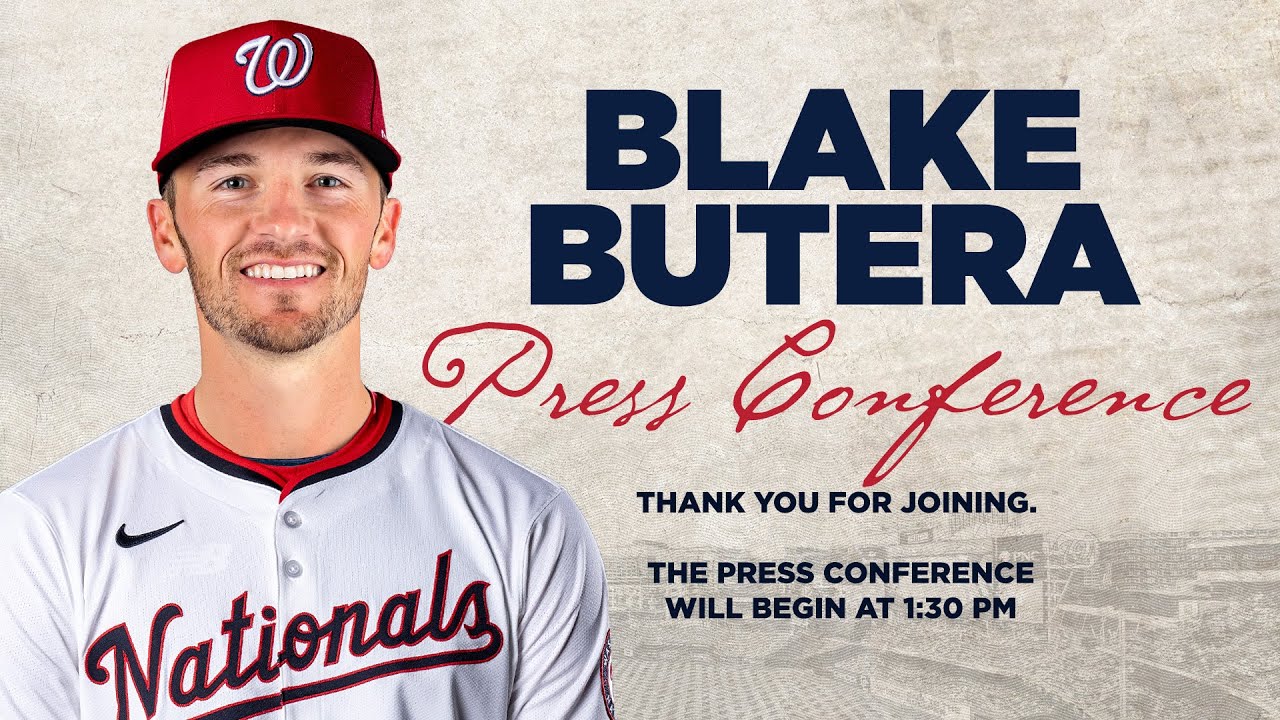
The Washington Nationals introduce new manager Blake Butera.

5 comments
Yay!
Young is good.. need someone player relate to plus he is a smart guy
Let’s Go Nats!!!!
Ridiculous hire. Lerner going cheap. As usual. I wish him the best tho
Well…I…hmm. congratulations and good luck.