
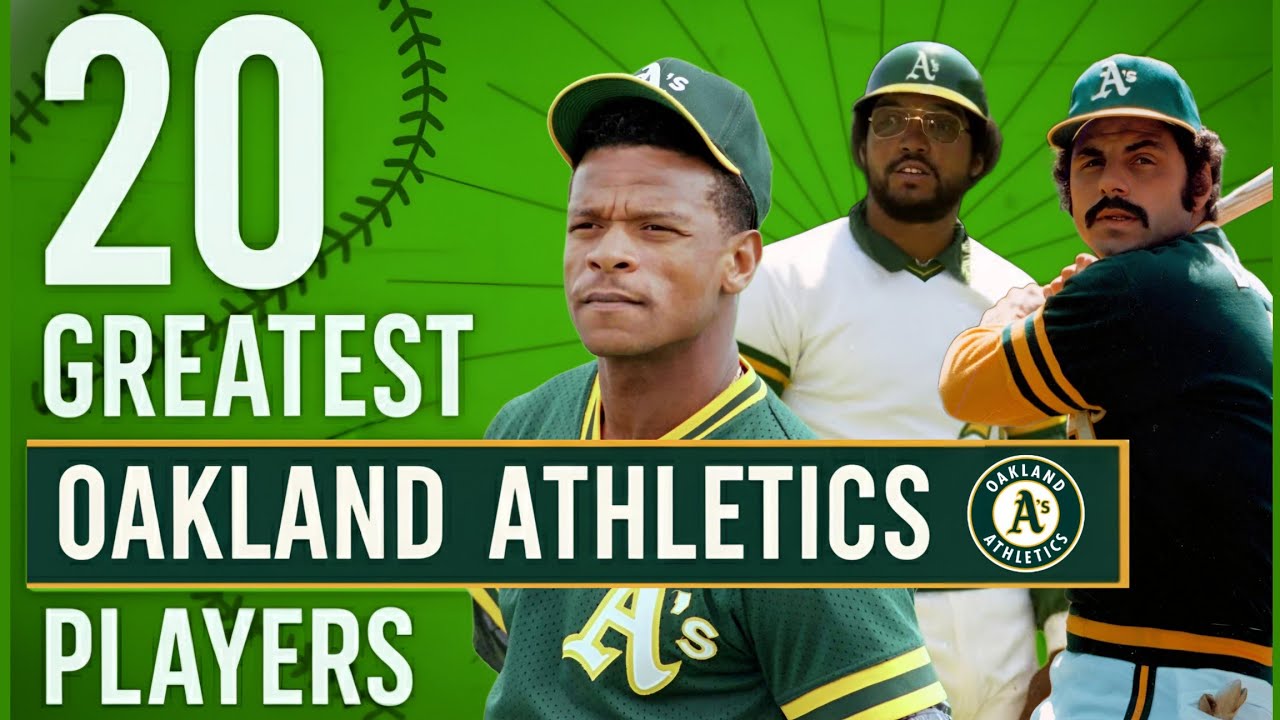
20 GREATEST Oakland Athletics Players of All Time
From Philadelphia to Kansas City and finally to Oakland, few franchises in baseball have lived as many lives as the Athletics. They were born in the dead ball era, survived the Great Depression, witnessed the rise of superstars who became American myths, produced one of the greatest dynasties ever assembled, moved across the country twice, and built yet another dynasty on the West Coast. The colors changed, the cities changed, but the heart of the franchise stayed the same. Grit, swagger, talent that rewrote baseball itself. This is the story of 20 men whose name shaped more than just box scores. They shaped baseball history. This is the journey through the 20 greatest Oakland athletics players of all time. Number 20, Eric Chavez. Our story begins in the early 2000s in an era defined by pitching, defense, and the rise of analytics. And on the hot corner stood a player who made the impossible look easy. Eric Chavez, the quiet superstar, a six-time gold glover with hands soft as silk and a bat that could crush balls deep into the right field seats at the Coliseum. For years, he was the anchor of the A’s infield, one of the most polished third baseman of his generation. Injuries kept him from reaching Hall of Fame numbers, but for nearly a decade, he was the A’s signature star, the face of the Moneyball era without ever needing the spotlight. He played for the team, not for the fame, and that alone earns him a place on this list. Number 19, Danny Murphy. Before the lights, before the West Coast, before television, there was Danny Murphy. One of the earliest stars to ever wear an athletics uniform. Long before the franchise moved west, before legends like Reggie Jackson or Ricky Henderson, Murphy was out there patrolling the field for Connie Max Philadelphia A’s in the early 1900s, back when baseball was raw, gritty, and unforgiving. Murphy was everything a dead ball era star needed to be. Versatile, fast, disciplined, and baseball smart. He played both outfield and second base, hit for average year after year, and was constantly putting pressure on defenses with his base running. He became a core piece of the A’s first great dynasty, helping lead Philadelphia to back-to-back World Series championships in 1910 and 1911. In an era when baseball demanded toughness and resilience, Danny Murphy shined brighter than most. Number 18, Harry Davis. The first true power hitter in A’s history. Before the long ball became the heartbeat of baseball, Harry Davis was already launching them. He led the American League in home runs four straight years from 1904 to 1907. A feat almost unheard of in the dead ball era when even one home run could discide a season. But the numbers only tell part of the story. He wasn’t flashy and he didn’t need to be. He brought leadership, reliability, and a professional presence that helped shape the culture of the franchise. With Davis anchoring the lineup, the A’s captured the 1910 and 1911 World Series championships, marking the birth of the club’s first great dynasty. He gave the athletics their earliest identity of excellence, power when power was rare, poise when pressure was high, and leadership that set the standard for all the legends who followed. Number 17, Max Bishop. If you wanted to understand discipline at the plate, you studied Max Bishop. They didn’t call him camera eye for nothing. Bishop saw pitches clearer than almost anyone in baseball history. He didn’t chase junk. He didn’t get fooled. And he didn’t give pitchers anything for free. During his years with the Philadelphia A’s, Bishop became one of the greatest onbase machines the sport had ever seen. With his performance, he set the table for the sluggers behind him, guys like Jimmy Fox and Al Simmons. During Connie Mack’s late 1,920s dynasty, Bishop wasn’t the one launching towering home runs. He wasn’t the one who stole headlines. He wasn’t the superstar everyone talked about, but he was the quiet engine, the man who made the entire offense go. Pitchers hated facing him because he forced long at bats, wore them down, and got on base over and over again. Max Bishop didn’t play for glory. He played for victory. Number 16, Mickey Cochran. Picture a field general, not with a helmet and stripes, but with a mask, shinuards, and a mind that worked like a battlefield commander. Mickey Cochran Diggy Kiki Calvin wasn’t just a catcher. He was the heartbeat of every team he played on. Tough, brilliant, fearless. One of the greatest catchers in baseball history, Cochran won two MVP awards and became the emotional center of the athletics’s legendary 1929 1930 dynasty. When the A’s were at their most dominant, he was the steady voice guiding them through every inning. He hit for a high average, controlled the running game, handled pressure like it was nothing, and commanded a pitching staff with an authority rare even today. And when Connie Mack began assembling the iconic late 1,920 SAS, Mickey Cochran was the very first cornerstone. Because before the home runs, before the championships, before the dynasty, the A’s needed a leader and Mickey Cochran was born to lead. Number 15, Frank Homerun Baker. His nickname tells you everything. Frank Baker wasn’t just a power hitter. He was the power hitter of his era. Before Babe Ruth turned home runs into the sport’s greatest attraction, Baker was already doing it. He was baseball’s first true slugger. The man who showed the world that one mighty swing could change everything. He led the American League in home runs four straight years. Not in a time when balls were flying out of parks, but in an era when the game was built on bunts, steals, and singles. Yet Baker stood out. He swung with purpose, with confidence, with the kind of strength players of his era simply weren’t supposed to have. And when the lights shone brightest, he didn’t shrink, he rose. That’s how he powered the A’s to three World Series titles in four years. That’s how he became Home Run Baker. Not just a nickname, but a legacy. A name that defined the birth of baseball’s power era. Number 14, Mark Maguire. Long before the home run races of the9s, long before every swing he took became national news, Mark Maguire was simply Big Mac, the young Oakland slugger who changed the way people thought about power. He exploded into baseball with 49 home runs as a rookie, a record that stood untouched for decades. Every ball he hit seemed to have its own orbit. He didn’t just clear fences at the Coliseum. He launched baseballs into parts of the ballpark no one had ever seen reached before. With Big Mac anchoring the lineup, the A’s became a powerhouse. Three straight American League pennants and the 1989 World Series Championship. And even in an era full of great sluggers, Mark Maguire stood apart. Few hitters in the history of the game have ever hit baseballs as far as hard, and as fearlessly as he did in his Oakland prime. He wasn’t just a home run hitter, he was a phenomenon. Number 13, Bob Johnson. One of the most underrated stars in MLB history. That’s Bob Johnson. He played during the toughest era for recognition, the Great Depression, and World War II. Ballparks were half empty, sports pages were shorter, and teams like the Philadelphia A’s didn’t get national love. But if you look at the numbers, the real story, Bob Johnson was nothing short of elite. Nine straight seasons with 20 or more home runs, seven seasons with over 100 RBI’s. And he wasn’t just a hitter. He was a dependable defender who played the outfield with intelligence and consistency. Year after year, he showed up, performed, and carried a struggling franchise on his back. The steady force who kept the A’s competitive when everything around them was collapsing. Bob Johnson didn’t chase fame, he earned respect the hard way. Number 12, Rube Wadell. Then comes the eccentric genius. Rube Wadell didn’t just pitch, he performed. Every time he stepped onto the mound, it felt like a show, a spectacle, something baseball had never seen before. He was a strikeout machine long before strikeouts became a weapon. Six straight seasons leading the league. Hitters walked up to the plate already knowing what was coming and still couldn’t touch it. Wadel fired shutouts. He went the distance almost every time he pitched. And his curveball hitters said it moved like it was alive. But what made him unforgettable wasn’t just the stats. It was the personality. The wild, unpredictable, larger than life energy. He chased fire trucks just for fun. He once wrestled an alligator at a circus. He’d disappear for days, then return and strike out 15 like nothing happened. Rub Wadell was one of baseball’s first true pitching legends. A man who brought magic to the early athletics and became one of the brightest stars in franchise history. Number 11, Chief Bender. A master of the big moment, Chief Bender was calm, composed, and brilliant when the pressure rose. A pitcher who never flinched, never panicked, never hurried. Armed with a wicked fastball and his legendary fadeaway pitch, the forerunner of the modern slider, Bender became one of Connie Mack’s most trusted weapons. He helped lead the A’s to three championships, anchoring a dynasty built on pitching excellence. But it was in October where he truly separated himself. Seven complete games in the World Series, seven times he took the mound, and refused to hand the ball to anyone else. unshakable, dependable, elite when it mattered most. Whenever the stakes were highest and the season hung in the balance, Connie Mack always turned to the same man, Chief Bender, the postseason assassin, the pitcher who delivered championships. Number 10, Reggie Jackson. This is where the story enters the era of swagger, power, personality, electric showmanship. Reggie Jackson didn’t arrive quietly. He exploded onto the Oakland stage. Before the world knew him as Mr. October, he was the beating heart of the A’s 1970s dynasty. The young superstar who turned every atbat into a spectacle. Reggie launched baseballs into the third deck of the coliseum. Shots so massive they felt mythical even as they happened. From 1972 to 1974, he didn’t just contribute. He carried the offense through three straight World Series championships. Fearless at the plate, explosive in the batters box, loved by fans, feared by pitchers, envied by every team that couldn’t contain him. Reggie had charisma, swagger, and a presence that filled the entire stadium. He didn’t just play for the A’s. He changed the entire vibe of the franchise. He made Oakland bold. He made them loud. He made them champions. Number nine, Bert Campanerys. If you needed speed, defense, or a spark, you turned to Bert Campanerys. Before analytics, before highlight reels, before the modern obsession with versatility, Campy lived it. He once played all nine positions in a single game. A stunt that perfectly captured who he was. Fearless, adaptable, and always ready to do whatever the team needed. He led the league in stolen bases six times, terrorizing pitchers with pure explosive speed. And at shortstop, he was the anchor. Quick, reliable, and unshakable in the biggest moments. Campanys wasn’t just a piece of the swinging A’s dynasty. He was the catalyst, the spark, the tone setter, the engine that kept the machine running. Without Bert Campanerys, the A’s don’t win three championships in the 70s. It’s that simple. Number eight, Eddie Raml. The master of the knuckle ball before the knuckle ball ever became famous. Eddie Raml wasn’t just a pitcher. He was a pioneer. While other pitchers relied on fast balls and curves, Raml perfected a fluttering, unpredictable knuckle ball decades before the pitch became a baseball phenomenon. For two decades, he baffled hitters in Philadelphia. He twice led the American League in wins. He logged more than 1,900 innings with a pitch that danced, dipped, and moved in ways hitters couldn’t understand. And he did it in an era with rough baseballs, bad lighting, and almost no pitching science. Raml didn’t overpower you. He confused you. He frustrated you. He made some of the best hitters of the 1920s look helpless. Durable, crafty, and completely unique. Eddie Raml became the A’s most reliable arm of the decade. A true original in franchise history. Number seven, Al Simmons. Elegance in cleats. Al Simmons didn’t just hit baseballs. He crafted them into art. Every swing looked smooth, controlled, almost effortless. Yet, the ball exploded off his bat. a career.334 hitter, an RBI machine who drove in runs season after season, a two-time World Series champion, and the offensive engine of the A’s legendary 1929, 1930 dynasty. Simmons was the kind of hitter pitchers dreaded seeing in the on deck circle. He sprayed line drives to every part of the park, hit for average, hit for power, and delivered in the biggest moments. Connie Mack adored him for his reliability. Pitchers respected him because they had no choice. Fans worshiped him because he made hitting look like ballet. One of the greatest hitters of his entire era and one of the purest right-handed swings baseball has ever seen. Number six, Sal Bando. The captain of the swinging A’s, Salando wasn’t flashy, he wasn’t loud. He didn’t chase headlines or spotlight. But he was the glue, the heartbeat of one of baseball’s greatest dynasties. A powerful third baseman with instincts sharper than most players ever develop, Bondo was the emotional anchor of the A’s three straight World Series titles from 1972 to 1974. When the A’s needed a big hit, he delivered. When they needed calm, he provided it. When they needed leadership, all eyes turned to him. He played the hot corner with confidence and precision. Always in control, always steady, always reliable. His presence in the clubhouse was just as important as his bat in the lineup. And that’s what made him a true captain. Championship teams need that one figure who holds everything together. For the Oakland A’s of the 1970s, that figure was Salando. Number five, Eddie Collins. Before analytics measured everything, Eddie Collins already mastered everything long before WPS Plus and Advanced Scouting Reports. There was a second baseman who played the game as if he knew every outcome before it happened. Eddie Collins, a 333 career hitter, a terror on the bases, a defensive mastermind, a strategist whose baseball IQ was decades ahead of his time. Collins didn’t just play the game, he elevated it. He ran with precision. He hit with consistency. He defended with elegance. And he outsmarted opponents so thoroughly that even the great managers of the era couldn’t solve him. With Collins anchoring their infield, the Athletics captured the 1910, 1911, and 1913 World Series titles. He was the engine of Connie Mack’s first dynasty. The complete player before baseball even had a word for it. One of the finest players in MLB history, not just for the A’s, for the entire sport. Number four, Jimmy Fox. Raw power, country strength, a legend built like a steel beam. The man who hit baseballs farther than almost anyone who ever lived. Jimmy Fox, Double X. The first true superstar slugger of the athletics franchise. In an era when most hitters were just trying to slap singles, Fox was rewriting what was possible. Two MVP awards, four home run titles, and offensive seasons so explosive that they barely seemed believable for the early 1930s. 58 home runs in 1932, one of the greatest power seasons in baseball history. Towering shots that disappeared into the horizon. an intimidating stance, a violent yet beautiful swing, and a presence that made pitchers tremble. Jimmy Fox wasn’t just strong, he was a baseball titan, a force of nature, a generational power hitter, and one of the most feared sluggers the game has ever seen. Number three, Lefty Grove. The greatest left-handed pitcher in MLB history. Yes, many still believe that today. Lefty Grove wasn’t just dominant. He was inevitable. A force of nature on the mound. Combining a scorching fastball with pinpoint command and a confidence that broke hitters long before the ball even reached the plate. He won 300 games, captured two World Series titles, and led the league in ERA an unbelievable nine times, a record that still feels untouchable. When Grove took the mound, it wasn’t a contest. It was a countdown to when the other team would finally fold. In the late 1920s and early 30s, during the heart of the A’s greatest dynasty, there was no pitcher alive who could stand beside him. Not Walter Johnson, not Carl Hubble, not anybody. Lefty Grove didn’t just pitch, he attacked, he intimidated, he conquered. And more than 90 years later, baseball historians still look at his numbers and shake their heads in disbelief. Number two, Ricky Henderson. There is fast, and then there is Ricky Henderson, the greatest leadoff hitter in baseball history. The greatest base steeler the game has ever seen. One of the most electrifying athletes to ever lace up cleats. Ricky wasn’t just playing baseball, he was redefining it. From the moment he stepped onto the field in an A’s uniform, chaos followed him. Pitchers shook when he got on base. Defenses shifted, strategies crumbled, and every stolen base felt like a masterclass in audacity. MVP, all-time stolen base record, World Series champion, a career that spanned decades, yet never lost its excitement or edge. And the swagger unmatched. The grin, the stride, the way he owned every moment. Ricky didn’t just play the game, he dominated it on his own terms. There will never be another like him. Because in baseball, legends are made. And then there’s Ricky Henderson. Number one, Eddie Plank. At the top stands a man often forgotten by the modern fan, but never forgotten by those who truly understand the history of this game. Eddie Plank. The first great ace in athletics history and one of the finest left-handed pitchers to ever touch a baseball. He wasn’t overpowering. He didn’t need to be. Plank was crafty, methodical, and unshakably smart. A pitcher who lived on the corners, who changed speeds with the calm of a surgeon, and who could outthink hitters long before analytics or scouting reports existed. Across his years in Philadelphia, he won 284 games, more than any pitcher the franchise has ever had. He pitched in four World Series, helping Connie Mack build the first great dynasty of the 20th century. When the A’s needed stability, when they needed someone who wouldn’t crack under pressure, Mack always turned to Plank. Because he knew exactly what he’d get. Control, poise, and a chance to win every single time. Plank wasn’t loud. He wasn’t flashy. He didn’t seek fame. He just won over and over and over again. That’s why he stands at number one. From dead ball legends to West Coast icons. From the genius of Connie Max dynasties to the swagger of the swinging A’s. From Plank to Ricky, from Bando to Maguire, the Athletics have lived many different lives. But one thing has never changed. They produce superstars who shaped baseball itself. These 20 players didn’t just help build the A’s. They built baseball history. And their stories live forever. [Music]
Batflix – Bringing you the best Baseball and MLB content about your favorite baseballplayers on Youtube.
Throw us a comment on what you’d like to see and run to the subscribe button for support!
20 GREATEST Oakland Athletics Players of All Time
⚾ The **Oakland Athletics** are one of MLB’s most historic and iconic franchises — known for legendary players, unforgettable postseason moments, dominant pitching staffs, and the revolutionary **Moneyball era**. From the speed and swagger of **Rickey Henderson** to the power of **Reggie Jackson**, the A’s have produced some of the **greatest players in baseball history**.
In this video, we count down the **Greatest Oakland Athletics Players of All Time**, breaking down the legends who shaped the franchise across different eras — from Philadelphia to Oakland.
We’ll explore:
* ⚾ **Hall of Fame A’s legends** who changed baseball forever
* 💥 Power hitters like **Reggie Jackson, Mark McGwire, and Jason Giambi**
* 🔥 Dominant pitchers including **Catfish Hunter, Vida Blue, Dennis Eckersley, and Rollie Fingers**
* ⚡ Speed, steals, and leadoff greatness from **Rickey Henderson**
* 🧢 The stars who defined the **1972–1974 A’s dynasty** and later postseason teams
* 📈 Key players from the **Moneyball era**: **Miguel Tejada, Eric Chavez, Barry Zito, Tim Hudson, Mark Mulder**
From **Rickey Henderson’s stolen-base records**, to **Reggie Jackson’s MVP power**, to the **dominant trio of Zito–Hudson–Mulder**, the A’s have built a legacy filled with greatness and innovation.
📺 Watch until the end to see who ranks as the **#1 greatest Athletics player of all time**, and relive the iconic moments that made the A’s one of baseball’s most influential franchises.
👉 Don’t forget to **LIKE**, **COMMENT your favorite A’s legend**, and **SUBSCRIBE** for more **MLB history, player rankings, and baseball documentaries!**
#athletics #mlb #oaklandathletics #athleticsnation #baseballhistory #baseball #baseballplayers #sports #baseballhighlights
keywords:
oakland athletics,athletics,MLB Greatest Players,baseball,mlb,greatest oakland athletics,best athletics players,best athletics players of all time,top athletics players,athletics greatest players,athletics hall of famers,greatest athletics of all time,best hitters in athletics history,best pitchers in athletics history,best athletics players ever,Jimmie Foxx,Rickey Henderson,Lefty Grove,Oakland Athletics,Sports,Homerun,athleticsnation,oakland athletics players
9 comments
Rickey Henderson was such a superstar
As always, good content.
Eddie Plank the old forgotten hero
I'm only going to name players who played in from the 1960s to the present. #1 Rickey Henderson, #2 Reggie Jackson, #3 Mark McGwire, #4 Catfish Hunter #5 Jose Canseco.
Zack Hample should be on the list.
Ok! Looks like the pre-Oakland A's are included! In that case (haven't watched yet):
1 Rickey Henderson
2 Lefty Grove
3 Eddie Collins
4 Jimmie Foxx
5 Reggie Jackson
6. Al Simmons
7 Mickey Cochrane
8 Home Run Baker
9 Mark McGwire
10 Dennis Eckersley
11 Catfish Hunter
12 Sal Bando
13 Bert Campaneris
14. Rube Waddell
15 Eddie Plank
16 Miguel Tejada (he's higher than this, actually)
17 Jose Canseco
18 Dave Stewart
19 Barry Zito
20 Josh Donaldson
100% off the top of my head, no references used. Will watch now and see how I ( we) did. I'm certain I omitted an obvious one. Thanks!
What about Vida Blue, Dave Stewart and Joe Rudi?????
Not to mention Dennis Eckersley!!!
Kudos for a bold list. I think McGwire, Jackson and Cochrane are too low and Bando, Campaneris and Rommel too high, but definitely outside the box thinking.