
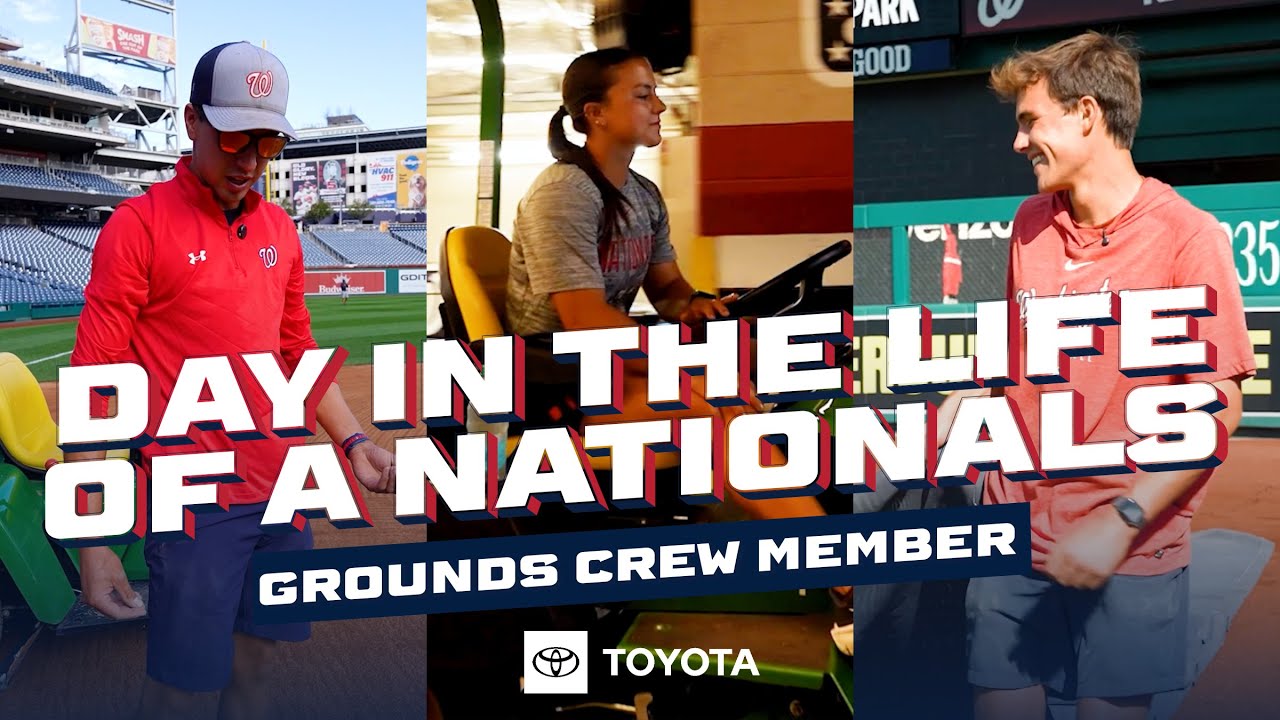
Grounds Crew For The Washington Nationals | Day In The Life
So, these are all the bases. That’s our clay surface. We have 10 nails total. Switch out the bases. [Applause] Hey, knife fans. I’m Amanda. I’m Bryce. And I’m Cam. And we’re your Ground Screw managers. Come follow along with us today. So, the tarp is out today. We didn’t really want to take a risk on uh us getting rain without the tarp being out. So, right now we’re just taking the tarp off, getting the stakes um out of the ground, taking all the equipment off. Um we do this just to dry the underside. Did you hear what Thomas said? He said, “How many times do you think we’re going to tarp this weekend?” A cam. Good or female? No, let’s just do the intro. Now, welcome to our shop, guys. This is where we keep all of our equipment that we use on a daily basis. Got everything from our little skit steer to all of our different gators that we have that we use for various occasions. Some of my favorite things, we’ve got the watering tank that we use to water our flowers, and we’ve got the roller. We’ve got the 648 and the AVI back there, and our tractor. Some of our bases for ingame. So, these are all the bases that we’ll put in. We have three sets of each cuz we switch them out during the game. And then we’ve got all of our different walkbehind mowers. All of our irrigation stuff is back in that corner. And then we’ve got all our extra conditioner and whatnot up on these shelves. And then all of our little tools. And then if you walk in through that door, that is our break room. Right now, we’re fixing a a mow out there. So, normally with this pattern that we have in um we use both mowers. We both will be mowing the same pass. One of us will go first and then the other one will be right behind following. And then the pattern out there. So the the light stripe, the white that’s going with the grain. So you’re pushing the leaf blade over. It looks white if you’re coming back, but if you look against it, it’ll look dark cuz you’re seeing the other side of the blade. [Music] [Music] So the mount gets covered every night. It’s primarily for moisture purposes to keep moisture in, keep it from drying out. This is a daily process. Um, we do this on the mound and home plate every day. I’ll use my Floyd rake. I’ll scratch up all of our patch areas from the night before. So, the landing spot on the rubber, the landing spot on the mound, and I’ll run our plate compactor all over our our whole pitching surface. So, during the home stands, we’re pretty much fixing the pitching surface. on road trips, we’ll come in and like that’s when we do a really detailed, thorough fix on everything. There are certain measurements at the mount we have to meet. So the top of the rubber has to be exactly 10 in taller than the top of the plate. And then the slope of the surface, pretend there’s a 6 in line here, starting at the 6 in line going down. For every foot that we go down, it has to drop an inch. Aside from that, like the size of the table, so the square that’s around the rubber, that’s kind of up to us how we want to shape that and and what the size can be. The rubber, it’s a big rectangle. So before next season, we’ll dig it out and flip it upside down and use the other side. So generally last two years. And then as far as the rest of the infield goes, we pretty much have to follow the book on that too. The bases obviously have to be 90 ft. As far as cutouts go at first, second, third, those can be adjusted. Every team has different shaped cutouts and different size cutouts. The distance between the mound and the or the rubber and the plate 60 ft 6 in. So that’s that’s also like a non-negotiable. This is our nail board. We have a a nailing routine that we do every morning. That’s our clay surface that we’re that we’re working with. The conditioner, which is this stuff, which is on top. This is just a mulch. This helps keep moisture in. So ultimately the nailboard will smooth the clay surface, but it’s also mixing around and drumming up more conditioner that’s on the top too. This is our infield drag. It drags out all the chunks that are left, all the clay chunks, and it really just kind of gives it a finishing smooth look to it. [Music] So, I’m going to drag out the base pass and get water on those. [Music] The drag sometimes leaves a ridge. So, we’ll take this broom, we’ll put it backwards, and we’ll just very lightly float it along the edge. And that’s generally enough to flatten the edge out. So, when if a player steps on it or if a ball hits there, it’s a it’s a smooth transition. This roller, we use this primarily on all of our clay surfaces. So, generally, we try to get a roll on all of our infield clay once prior to each homestand. And what that does is it helps improve compaction. So, it it tightens the infield clay up. The infield clay generally feels like a corkboard. So, it’s firm but soft on your feet. Being that today’s day one of the home stand, um I actually rolled everything yesterday, so we’re not worrying about the entire dirt. But today, I’m gonna go along and roll all the edges. And then we’ll do what we call 50/50 at the end. And I’ll roll with this roller half on the grass and half on the dirt. After you roll the infield clay, because it’s tighter, it generally holds up to water better. So, if if it looks like we’re going to play through rain, generally we’ll try to get a roll on it beforehand. So tonight we have a postgame concert and so right now we are having a sound check for it and basically our jobs is just to make sure that these stages get driven out and that when they come out nothing messes up the fields. Right now for the sound check we just have them on the infield dirt and that’s mostly so that um it doesn’t ruin the grass cuz later tonight they’ll be pushed back a little bit. Now that we have our sound check over, we have just redragged the infield just to kind of smooth it out again and get all the tire tracks out. I’m just going to take this broom and go over some of the little spots just to smooth everything over and then we’ll water it and we’ll be ready for the afternoon. So, right now, um, we are doing a full batting practice setup to basically give the grass a little bit of extra cushion and some protection so that when they come out and hit the balls, it doesn’t cause any destruction to the grass. And since we have a postgame concert tonight, we have Riley Green taking BP. So, that is what we’re setting up for right now. So, this mat that I’m pulling out is called Inca Mat. And this blue mat goes on top. And everything is kind of folded in a routine way so that it all rolls up and rolls out the same so we know how to place it and where it all goes. Good work. Oh, thanks Cam. This is the mound board. So, they’ll use it to throw off of for batting practice. So, we’re just setting this up right in front of the mound. Um, this is one of our worst wear spots is like in front of behind the mound where the pitchers walk on and off all the time. Square mat to go on top of the Inca mat. You got them. Put these on the ground. Step on them. Do all four corners and pull the mat tight. You like it? Yeah, it looks good. Okay. I’m just nailing the hitting mats in so that they don’t slide. Whenever someone hits or throws off of them, sometimes they shift a little bit. For the pitchers mats, we have three different sizes. So, right here is one size on the ground and then the bigger size that we’re putting out today is already out here. Just try to limit the same area getting worn every day. Uh it depends on the day when we put these out. But generally when we see them walk out here, we’ll start heading this way. Got any more questions, Thomas? Yeah. Why uh why don’t we just put these out in the morning and that way we’re ready no matter what. The grass would just get burned. We left them out here all day. We have 10 nails total. Um we’re going to put five on each side. So this is our second base position mat. And basically, we just put this about where the second basement would stand in the grass just to protect this edge and the grass mostly from wear and tear from them during uh ground balls. It’s about 4:00 now. Ground balls just finished up. So, we went out, we broommed the infields just to provide them with a smooth surface. We got the rest of our screens in position and we put another white water on the dirt. So, that’ll go here. here. Then you guys will jump to over here and do the same thing. So, identical to the previous four that we’ve done this year. And we can keep this probably 3 ft or so off the grass edge. And then there’s going to be a second loop. Can we just have the station group start out as traffic traffic cops? So, I know M you’ve done that a handful of times, but if you guys could just station yourselves, especially around home plate. So, BP just ended. Right now, we’re focused on getting all the BP mats rolled up and taken off the field. So the BP cage, the BP screens all come off and then all of our staff, they all get together and everything gets rolled up and taken off the field. Our focus now is to get the field game ready. So Bryce is out nailing the infield again. Amanda’s starting our our finish drag that she’s doing. And then we’re about to get everything watered and get foul lines down. Obviously, we’ll run our line from the line in the grass to home plate. We’ll put our first base in just to make sure that it’s perfectly on the base. And when we set our runner’s lane, we measure three feet behind the base and then we measure three feet over. So the width of the runner’s lane is three feet. So once we paint this foul line, the line will get bumped over and we’ll paint the runner’s lane after that. [Music] Generally about a half hour prior to game time, we’ll open the mound up and we’ll get conditioner on the mound. Joe’s out there. He adds conditioner and his goal is just to spread it out, make a smooth surface. So, we just wrapped up with all of our pregame preparations. The only thing left is we’ll wait for Anthem to be over and we’ll bring the on deck circles out and we’ll be ready for baseball. [Music] The game started. One of us normally sits out here. Weather room is where we typically sit in case something happens on the field. We have to go out there. We have a core group of guys in here. Um we have a couple TVs in here just so we can watch the game and stay up to date on the field. Josh is going to watch one. See you later. Mezzanine. [Applause] So it is the end of the third inning and we’re getting ready to go out on the field and drag right now. [Music] switch out the bases. And then we drag certain parts of the field to smooth it all out. [Music] Just like that. That’s it. Grab the base. And now we run back. Thank you, Leslie. And that is our in-game drag. So, we are taking the bases into the clubhouse right now. Um, they get authenticated. They have a little authentication sticker on them. Here’s one right here. And so every base has this and you can look it up online and you can know what base it was in what game and like who was playing and everything. And yeah, they basically just sell these and the fans can purchase them. This ball roasted out to left center by Garcia. CU opposite bullpen later. Abrams will blast one to right. Oh, he might park another one. Luis car. See you later. Oh my god. [Applause] [Music] And this one high in the air to right. See you later. [Applause] Garcia deep right. CU first career three homer game later. All right, the game’s almost over. We’re getting ready for the postgame concert. Um we have some flooring in this Pro Gator right here with some Incamat. Incomat goes under the flooring, protect the grass. These two gas gators right here, um we use those to pull the stages on the field. I think there’s a total of five stages. Once the game’s over, we take those out one by one and get ready for the concert. [Music] The postgame concert just finished and so we are waiting for them to break apart the stages and to take all of the different cords they have hooked in for lighting and music and everything. Once they get those apart, we’ll drive down and we’ll hook up to the stage and we will drive them all off and get them all back in the loading dock. Our regular postgame routine consists of basically just uh cleaning up the field and getting it back to normal for the next day. Patch the mound and patch on plate. Just fix all of the holes that the players have created in the clay. And then we will clean up the infield and the baselines. We will rake them out, get all of basically the clay chunks and seeds and whatever not that have come up. And we’ll sweep all that up. And then we will just drag them and get them cleaned up and ready to go for the next day. [Music] Thank you guys for spending the day with us. The field is all ready and prepped to go and we will be doing the same thing tomorrow.
Take a look behind the scenes and see what a day on the Washington Nationals grounds crew is like for Assistant Field Manager Amanda Gibson, Field Supervisor Bryce Garrett, and Field Manager Cam Basila as they prep Nationals Park for a Major League Baseball game AND Riley Green’s postgame concert.
@ExploreSEToyota
#mlb #washingtonnationals #baseball #ditl #dayinthelife
_____________________________________________________________________
Make sure you don’t miss any of your favorite videos from the Washington Nationals and subscribe now!
Make your way to Nationals Park to see all your favorite Nats live at nats.com/tickets.
Follow us to keep track of everything happening on the field, and off:
Twitter: http://twitter.com/nationals
Facebook: http://facebook.com/nationals
Instagram: http://instagram.com/nationals