
The Detroit Red Wings are now just past the one-third mark of their season, and they’ve been a roller coaster.
Some nights, they look like they’re putting the pieces together. Other nights (and too often over the last few weeks) they’ve looked like they still have a long way to go. That all means they’re rarely boring, but I daresay this group would benefit from fewer dramatic swings along the way.
Regardless, it’s made for plenty of intrigue through the season’s first two months, and that meant there was plenty of good fodder in this month’s mailbag.
Let’s dive right in, starting with the big topic of the moment at the most important position on the ice.
Note: Questions have been lightly edited for clarity and length.
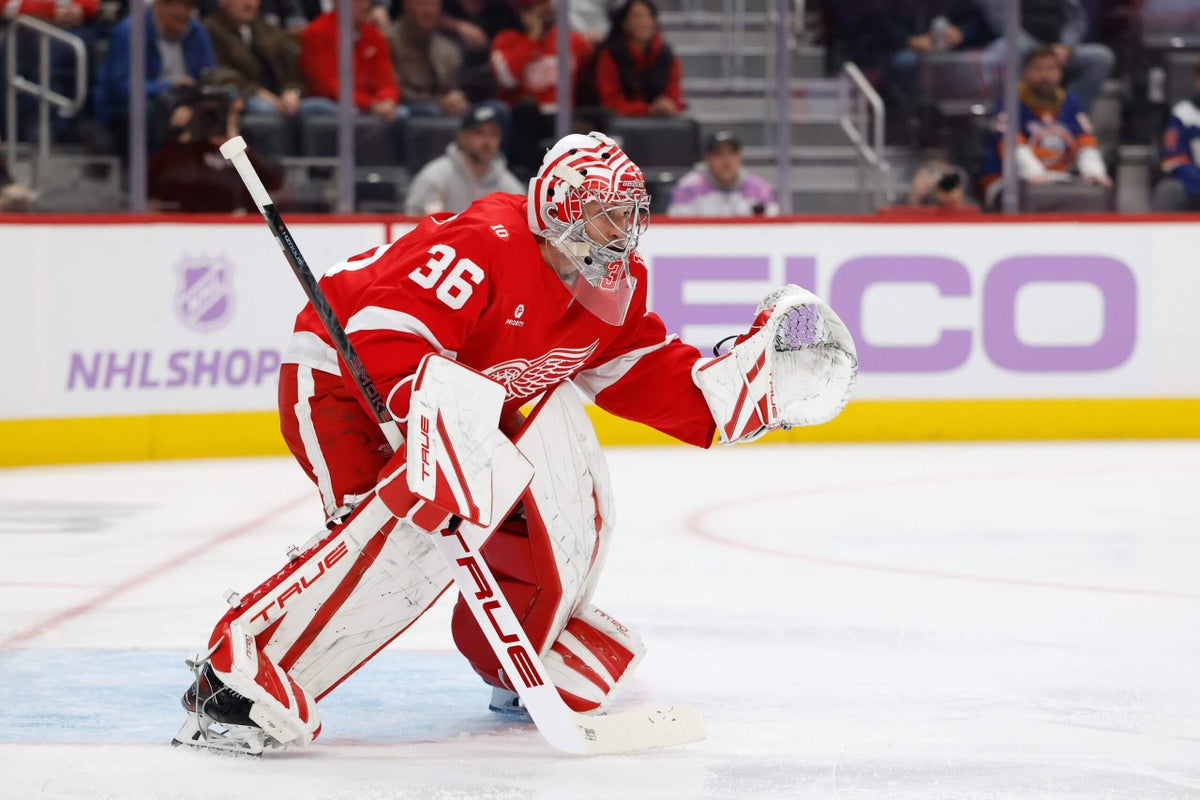
At what point do you bring up Sebastian Cossa? John Gibson just isn’t getting it done. — Jordan A.
Gibson is off to a rough start, there’s no doubt. Entering Thursday, he had allowed four or more goals in four straight starts, and in nine of his 14 this season. His .868 save percentage was the fourth-lowest among goalies with at least four starts, and his minus-6.2 goals saved above expected was the third-worst mark in the league.
None of that is good enough, no matter how bad the defense has been in front of him on some nights.
That defense is still a factor, of course, and it makes the assessment a bit more complicated. A goalie can’t be expected to thrive against odd-man rushes or in-tight deflections, and the Red Wings have allowed their opponents too many chances of both varieties this season. But whatever a reasonable expectation for a goaltender might be in such situations, it’s fair to say Gibson has been below it so far.
Meanwhile, Cossa has been outstanding in Grand Rapids. The Red Wings’ No. 15 pick in 2021 was recently named the American Hockey League’s goaltender of the month for November as well as Player of the Week. He leads the AHL with a .945 save percentage and 1.51 goals against average in 10 starts this season. That’s all compelling.
But I do think the Red Wings need to give Gibson at least a little more time to try and figure this out. He was their marquee offseason addition, and as bad as it’s gone so far, there have still been some flashes (albeit not enough) of the goaltender Detroit traded for. The third period of the win against the Tampa Bay Lightning early this season was the clearest example.
Gibson finding that form more regularly remains the clearest path to the playoffs, and that puts the Red Wings in a tough spot where they almost have to give him more runway. I’ll also point out the Red Wings are not alone in navigating this kind of dynamic. The Ottawa Senators’ Linus Ullmark is right there with Gibson in most major statistical categories, struggling early for a team that’s going to need to rely on him.
That being said, Detroit also can’t wait forever if those results don’t come, and Cossa does loom as an ever-more-enticing option as long as he keeps this up. You look at what Spencer Knight, Jesper Wallstedt and Yaroslav Askarov — all goalies of a similar pedigree — are doing with their respective teams right now, and the temptation to see if Cossa can do the same is real.
I certainly think Cossa will get his chance in the NHL this season. I just don’t see Detroit rushing to get there quite yet. The NHL remains a big step up from the AHL, and as good as Cossa has been, he is likely to have some growing pains in the world’s toughest league.
The Red Wings will have to deal with those growing pains at some point, of course. But trying to help Gibson find his game, rather than just giving up on him, feels like it has to be the first option.
The Red Wings’ goaltending is fourth-quartile. Realistically, what are the chances of making the playoffs, given that? — Kevin B.
It certainly doesn’t help.
Entering Thursday, the Red Wings had the fourth-worst team save percentage in the league between Gibson and Cam Talbot — though with how slim the margins are on save percentage (we’re talking tenths of a percent) going with fourth-quartile (or bottom eight) makes more sense.
If we look at the last five seasons, only four teams with bottom-eight save percentages made the playoffs: the 2023-24 Tampa Bay Lightning (.890), the 2022-23 Seattle Kraken (.886) and Los Angeles Kings (.889), and the 2020-21 Montreal Canadiens (.896).
There are some other playoff teams just outside the bottom eight — the Carolina Hurricanes were ninth-worst in 2024-25, and the Toronto Maple Leafs and Washington Capitals were 10th worst in 2023-24 and 2021-22, respectively — but that tells a pretty compelling story. Especially when you consider that the Red Wings’ .872 falls well below all of those teams.
Team defense still plays a significant role in save percentage, of course, and I think that’s gotten papered over a little too much in the discussion on goaltending. But between the goaltenders and the team in front of them, history says any path to the playoffs has to include getting that number up considerably.
Thoughts on putting Marco Kasper on the top line to get his game going? He was great on Dylan Larkin’s wing last year until Andrew Copp got hurt and forced him into 2C duty (where he was also outstanding). More ice time, less responsibility, let him play his game. — Steven B.
I share your feeling on this as a way to spark Kasper, and asked Red Wings head coach Todd McLellan about it earlier this week. Here’s what he said.
“I like Marco’s game over the last four or five. I like the line that he’s playing on (with Nate Danielson and Elmer Söderblom). I think they’ve been productive. They’ve had multiple scoring chances. Emmitt (Finnie)’s done a good job with the other two. There is a lot of hockey left. That opportunity may come to the forefront. But the last — for the most part — the last six periods, give or take a few minutes here or there, we’ve liked how our lines have looked. And we haven’t been real consistent with them since early in the year.”
So it’s not off the table by any means, but right now it sounds like McLellan likes the trend in Kasper’s game and the arrangement of the lineup as a whole recently. As we’ve all seen, though, that can change in a hurry.
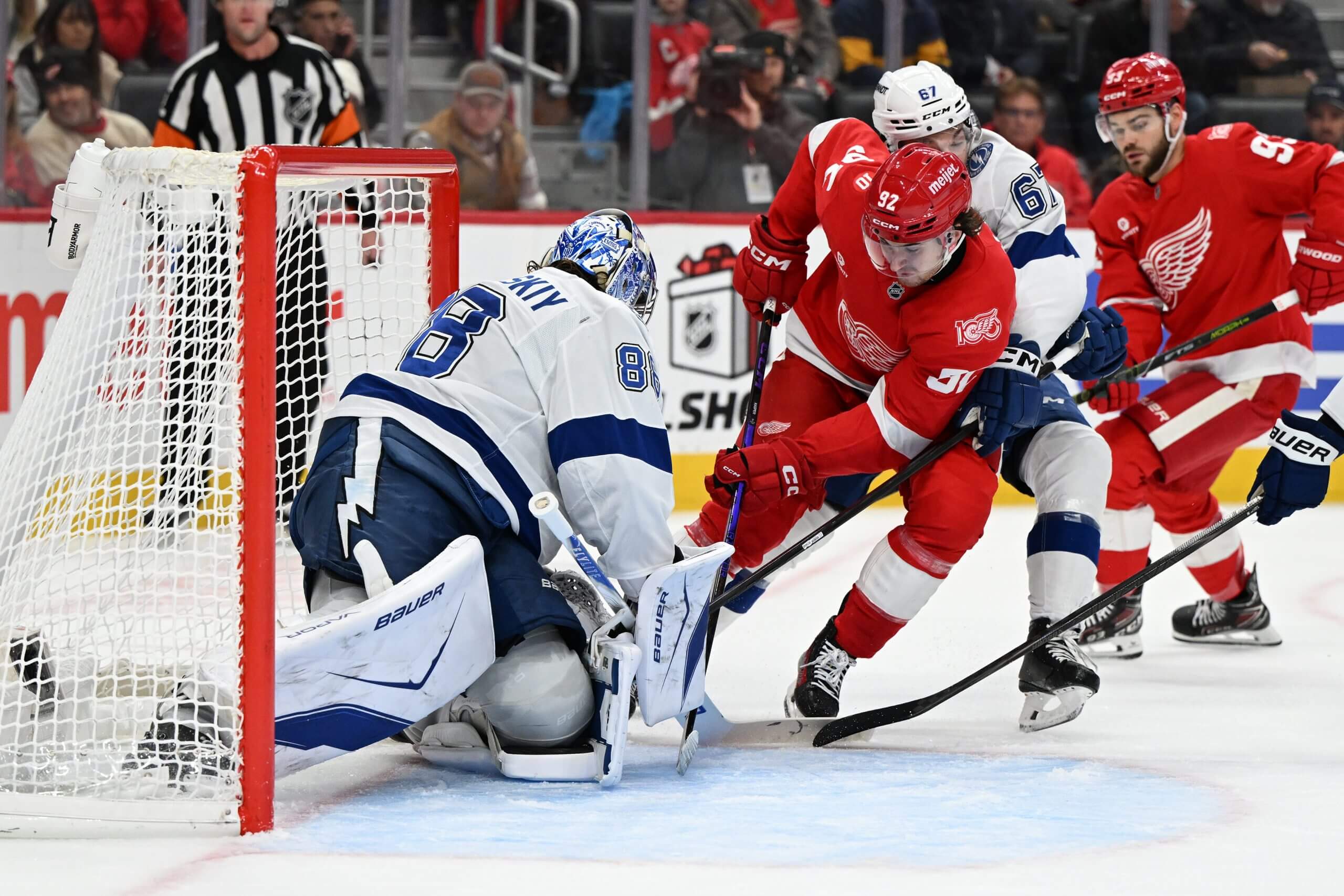
Coach Todd McLellan has liked Marco Kasper’s past few games. ( Lon Horwedel / Imagn Images)
Max, with the bottom 3 defense pairing challenge they have, and with Travis Hamonic in and out of the lineup and not being effective at all … How does William Wallinder not get a chance? Huge guy with great skating, and he can’t be a number six or seven at the big club? — Rich G.
I think Wallinder will get a chance at some point. But despite his size and skating, I will caution you by saying I also don’t think another young defenseman is really the solution to the Red Wings’ problems. Detroit’s issues mainly stem from being mistake-prone and not doing a good enough job clearing the front of the net.
Despite his size, Wallinder doesn’t have as much meanness as you’d like to see from him, and like any young defenseman he will likely make his fair share of mistakes. That doesn’t mean he shouldn’t or won’t get a look at some point, and the veterans (like Hamonic) are clearly are making the same kinds of mistakes on that pair. But it’s just a reminder that rookie defensemen seldom are a path to stabilization.
Who would you trade to get Quinn Hughes? — George M.
Well, it’s Quinn Hughes. He’s a Norris Trophy-winning defenseman who is just 26, squarely in his prime and right in line with the age of Detroit’s top players. So the real question — after whether he will indeed be traded, of course — is: who wouldn’t you trade for him?
For me, I’d take Dylan Larkin, Lucas Raymond, Alex DeBrincat, Moritz Seider and Simon Edvinsson off the table. That’s Detroit’s long-term core, and dipping into it doesn’t make much sense for the Red Wings.
Detroit still has a lot of strong prospects and draft capital beyond that, though — more than enough to make a compelling offer for Hughes. They have young centers, which are hard to find. They have young winger prospects with some edge in their game, an increasingly valuable commodity. They have young goalie prospects. They have young defensemen. And they have players with serious pedigree at all of those positions.
You never want to get too carried away, and the fact Hughes can’t extend anywhere until July 1 has to factor into any negotiation. An acquiring team can’t have that certainty of having him signed, which affects the price.
But it’s still Quinn Hughes, and with fewer and fewer stars making it to free agency with the rising cap, the chance to acquire him would represent a rare opportunity to add a proven superstar.
The 2018 Erik Karlsson trade isn’t a perfect comparable, as Karlsson was slightly older (28) and only one year from free agency instead of one and a half, but it’s as close as I could find in recent years. That deal cost San Jose a recent first-round pick center (Josh Norris), a first-round pick, a second-round pick, 24-year-old center Chris Tierney, prospect winger Rūdolfs Balcers, 25-year-old defenseman Dylan DeMelo and two conditional picks.
I have to think the cost for Hughes would be in that same ballpark — and I’d be willing to pay it.
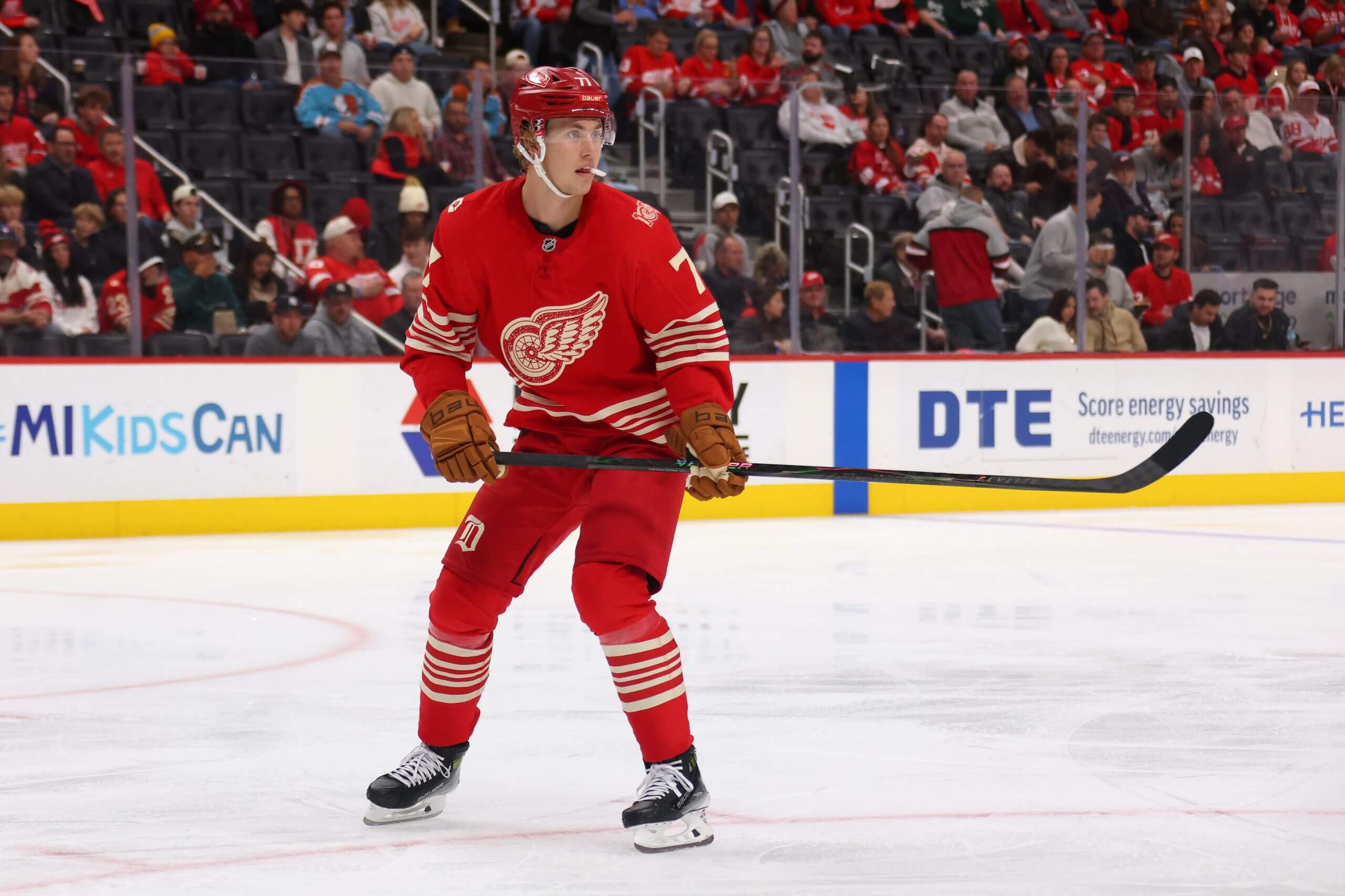
What will Simon Edvinsson’s next contract command? (Gregory Shamus / Getty Images)
What is your perspective on a new contract for Simon Edvinsson? Any idea of what either side might use as a comp or justification? If his camp wants anything close to Moritz Seider money because of the rising cap, do the Wings opt for a shorter deal to see if he can develop more offense? — Jordan R.
The recent long-term contracts signed by young defensemen suggest it’s very possible Edvinsson lands close to Moritz Seider’s $8.55 million AAV.
Anaheim’s Jackson LaCombe was slightly closer to unrestricted free agency than Edvinsson will be this summer, but he got a $9 million AAV for eight years while having 60 points in 148 games. New Jersey’s Luke Hughes got the same $9 million AAV for seven years with 93 points in 155 games.
Both had higher better production in their platform years than Edvinsson is tracking towards (seven points in his first 24 games) but Edvinsson had a very respectable 31 points in 78 games last year, and has 42 in 127 for his career. He also plays the same huge workload as the other two at 21:38 per night.
The offensive production might keep him from getting to that $9 million number on a long-term deal — but with the cap set to rise again, he might be able to get there anyway. Edvinsson looks set to be a pillar of this blue line for years to come, and with few top players coming available in free agency, locking in your key players is increasingly important (and viable).
Both sides could certainly opt to go short-term if they want more data points before locking in. But with the cap continuing to go up, the likeliest outcome of that scenario, in my view, is that Edvinsson only becomes even more expensive on the next contract, which would be that much closer to UFA.
For that reason, putting Edvinsson in the Seider range salary-wise wouldn’t scare me. It’s the way of the new world in the NHL.
Seider, Axel Sandin-Pellikka, and Albert Johansson are the only defensemen signed beyond this year. Assuming Yzerman gets Edvinsson signed, who can fill those final two or three spots on the blue line? — Andrew C.
This goes back to the question about Wallinder, who could be an answer. The Red Wings have some young defenders in the system (Shai Buium and Anton Johansson being two more) who they will need a look at in the next year or two. And hey, maybe it goes back to the Hughes question, too.
I also think the Red Wings need to make sure they don’t get too young back there, though. That’s not to say seek veterans just for the sake of being veterans. Fans have seen plenty of examples of veterans who are still mistake-prone the last few years. But experience is valuable on the blue line, where learning curves can be steep.
That may be one reason to consider a short-term extension with Ben Chiarot, who has been an important piece for the Red Wings this season.
Some other names set to be UFAs this year: Jacob Trouba, Radko Gudas, Carson Soucy, Brett Kulak and Connor Murphy.
Those are all older players, and Detroit would do well to avoid giving out too much term, but some veteran presence behind Seider and Edvinsson feels like it will be essential for this blue line as it evolves.