
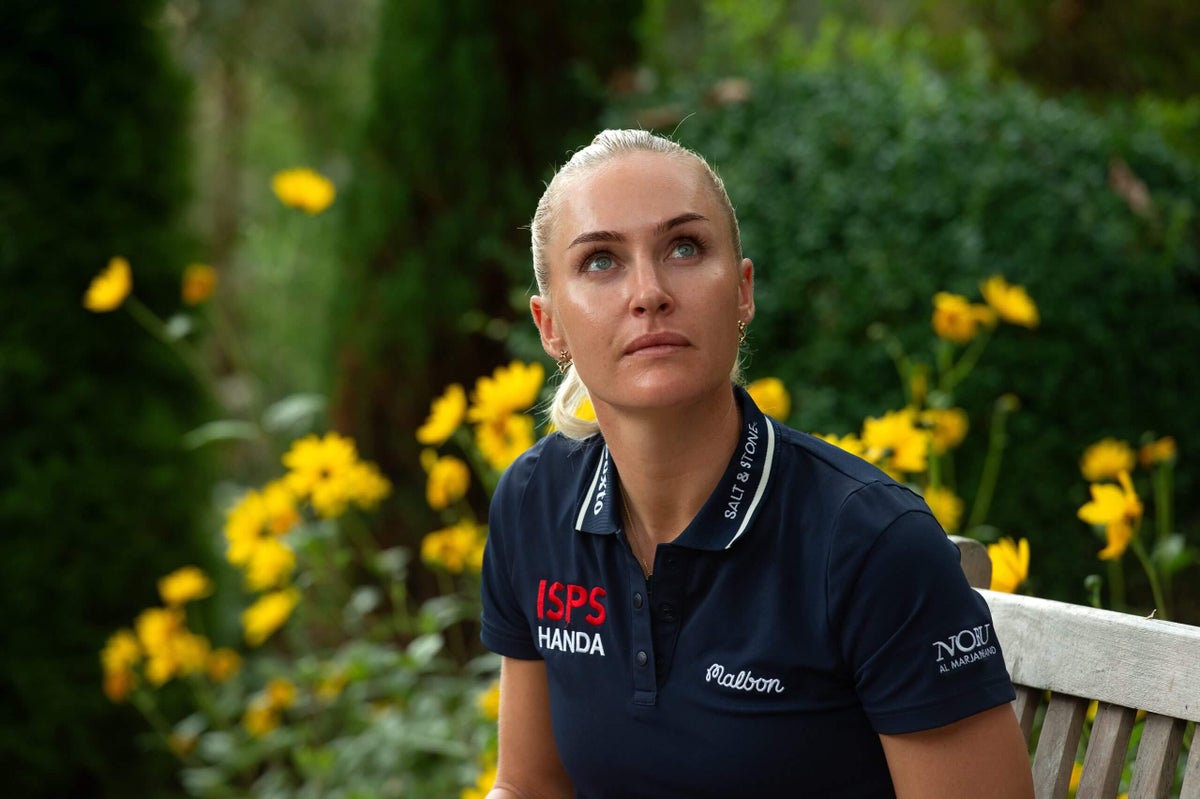
Charley Hull slips through the front door of her stone 17th-century home, her platinum blonde hair slicked into a sweaty ponytail. She started her day with a casual loop around Burton Latimer, a quaint English town in the heart of the East Midlands.
“Before you guys got here, I ran a 5K,” she says. “I needed my mood to be lifted.”
Hull settles down in an armchair in her living room, stroking Esmee, her family’s white German Shepherd. Still catching her breath on this overcast summer day, she crosses her legs and jumps right in.
Hull motors through sentences. Her eyes dart around between her Polish, equally blonde mother, Basienka, and her 4-year-old nephew, who’s scampering around the kitchen on an undisclosed mission. Hull’s father, Dave, passes by the window outside, smoking a cigarette in the garden. It will not be his last of the afternoon.
Charley Hull is 29 and one of the few LPGA players people think they know. No female golfer in this era generates the specific kinds of headlines she does. More than 800,000 follow her Instagram account, which features a healthy mix of designer handbags, mornings at the gym and clips of the swing that made Hull the No. 5-ranked player in the world. Hull lashes at the ball with her driver, and the club recoils off the back of her neck.
But Hull is perhaps best known for one particular photo, in which a cigarette dangled from her lips at the 2024 U.S. Women’s Open. The internet dubbed her the “female John Daly.” But Daly never wore Louis Vuitton sunglasses or had six-pack abs. For better or for worse, this is how people view Hull — they draw assumptions from that image and its iterations. Her mother had the photograph framed. It’s displayed prominently on a mantle in Hull’s trophy room.
“People think I’m a party girl. Maybe it’s because I dress nice off the golf course. I’ve got blonde hair. I’m outspoken,” she says. “But I’m just true to myself. I just say it the way it is.”
Spend a day with Hull, and you’re going to see all the sides of her, because she can only be herself. She’s restless. You can sense it as she buzzes around the town. She speaks in idioms and metaphors, but doesn’t sugarcoat the truth. She is right there in front of you.
But she is not the Charley in that picture.
A church built in 1147 sits adjacent to Hull’s home. The slender grey spire towers over the neighboring buildings and comes into view as you make your way down Hull’s street. Burton Latimer’s roots date to the 12th century, but the arrival of the railway and the shoe factories in the early 1900s brought new life, including those looking for work. There are two primary schools, but no secondary schools. Weetabix was first produced in Burton’s rolling hills.
At 23 — “young and naive,” she admits now — Hull got married in this church.
That day, when Hull walked across the street in her wedding dress, a priest snapped a Polaroid picture of Hull and her husband, as he did for every couple set to be married. Hull never got to see the photograph, because it failed to develop. She was left with a blank print.
She has never publicly acknowledged the reason for the fate of her four-month marriage to a man 14 years older than her, MMA fighter John “Ozzie” Smith. They dated for a year and a half before marrying in September 2019.
In Hull’s version of events, her ex-husband became increasingly controlling and manipulative in their relationship. Hull’s ability to discern her own reality shifted. She asked herself, ‘Is this normal?’ It worsened as the relationship progressed and Hull’s success continued.
“I could go back and say, I wish it never happened, but I actually feel like I’m glad it happened because it makes me the person I am today,” Hull says, crossing the two-way street.
“You’ve got two choices in life, bad things can make you weak, or they can make you stronger. And you definitely want to be stronger.”
Smith could not be reached through fighting promotions he has participated in, and he did not respond to messages left on social media platforms.
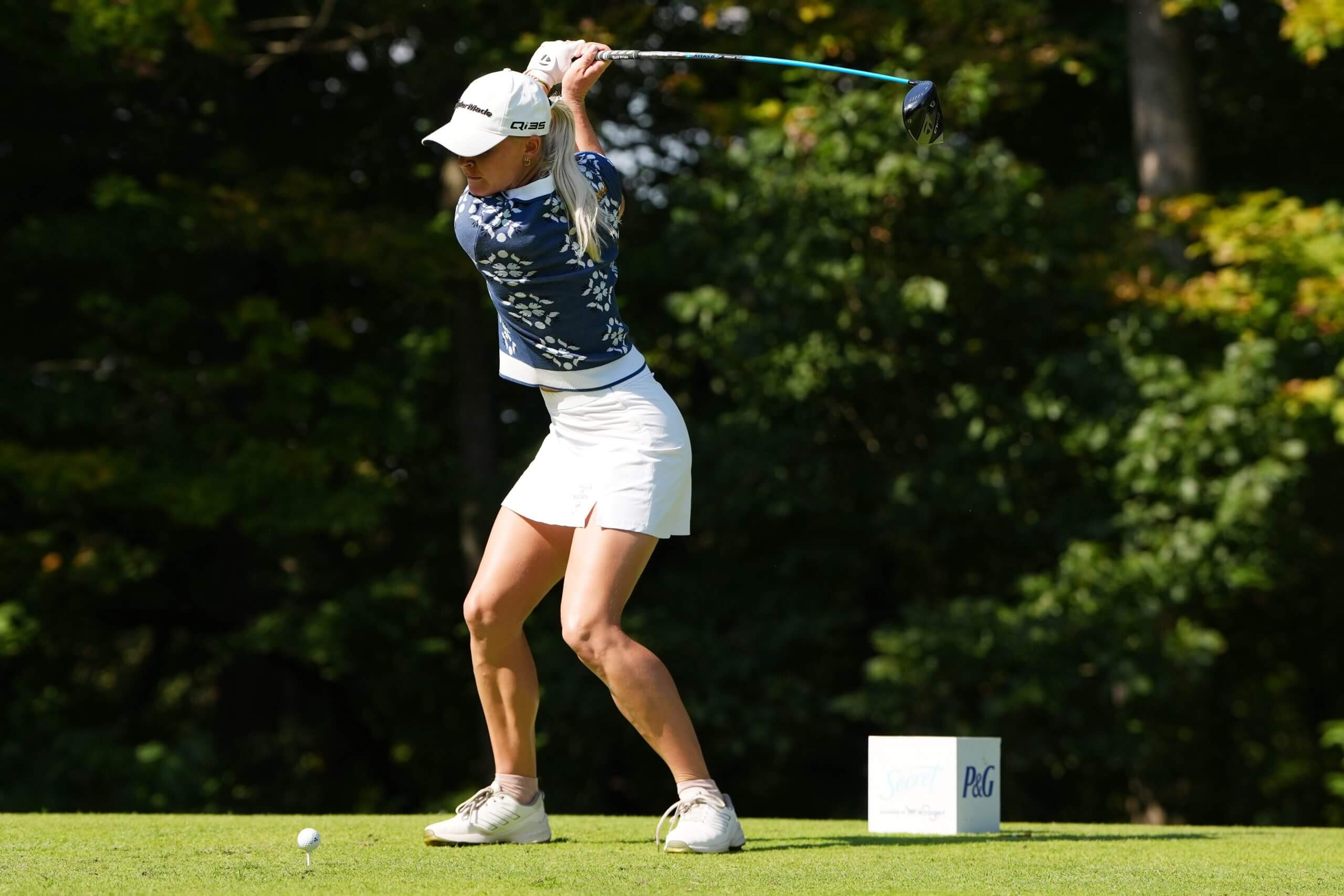
Charley Hull generates significant distance off the tee with a swing that is powerful and efficient. (Dylan Buell / Getty Images)
The fallout from the relationship was as traumatic as the duration of their time together. Hull wanted the divorce to be quick and painless, to move on as fast as possible. The year before she got married, Hull finished in the top 10 at three of the five majors. The following season, she won a Ladies European Tour event in Abu Dhabi and nearly $1 million in earnings on the LPGA Tour. Later that summer, she went undefeated in the Solheim Cup, leading the Europeans to beat the Americans. She was a mainstay in the top 25 in the world, firmly a star in the women’s game. It looked like Hull was living the dream, and she was — on the course.
“My best friend Georgia Hall said to me, ‘Charley, I don’t know how you can go out there and play unbelievable golf with the amount of s— you have going on, anyone else would be a mental wreck.’” Hull says. “And I was like, it’s just normal to me.”
Hull picked up golf as a young girl, whacking balls into her dad’s makeshift net in the back garden, and turned her deep affinity for the sport into a multi-million dollar career. Now the game was much more than a livelihood.
“It was my escape,” she says.
Past the church and further down the street, Dave Hull rests his arms gently on a wooden table at The Olde Victoria pub, exposing a faded tattoo from another life. He’s waiting patiently as his afternoon Guinness is being poured — and for his daughter, still finishing up a photoshoot back at the house. The key to a proper pint is to let it settle.
Dave is 74. A builder by trade. A free spirit by existence. He has wispy steel hair. Crooked, rimless glasses. It’s either the asbestos poisoning in his lungs or the 40 cigarettes a day, perhaps both, but Dave’s voice almost vibrates. His words melt together. If Burton Latimer could talk, it would sound like Dave Hull.
Dave was born into a world that wasn’t sure where to put him. His birth mother had him out of wedlock and didn’t want to care for him. Dave was on his way to Dr. Barnardo’s Homes, an orphanage, when his grandmother, Betty, intervened. She became his guardian. A single mother herself, Betty worked as a teacher, but she also took a job in the shoe factories. She needed two incomes to provide for Dave and her four other children.
Dave stopped attending school at 14 and began working as a plasterer. He also joined a motorcycle gang: The Rockers. “Most lads that grew up in them days, it was a thing, the Mods and the Rockers,” he said. The Rockers liked their hair long. Their jackets leather. Their bikes loud. The Mods were posh. They wore clean suits. Rode “little scooters.”
A sly smile emerges on Dave’s face. The details are hazy, but there were wild parties and there were definitely fights. A hundred Rockers versus a hundred Mods. Arranged in the park. Broken up by the police. Dave Hull was not to be messed with. And everyone knew it.
“I never had nobody to look up to,” he says as his pint arrives. “You didn’t do what your dad done, or what your mum did. It was just me. I never had any interferences in my way.”
That’s what Basienka always wanted. Hull’s parents went to the same primary school, but their paths wouldn’t have crossed. Dave was a self-described ruffian, and Basienkia — “Bash,” for short — kept close to the Polish community. They each lived their 20s, each had a daughter from a previous relationship, and then found themselves in their 30s, still searching.
Then Bash caught wind of Dave. She began to stand outside her home every Sunday. She’d wash her car in the yard, knowing he’d pass by on the way to visit his grandmother, hoping to get his attention.
“Christ, she’s got this fascination with cleaning the car,” Dave would tell himself.
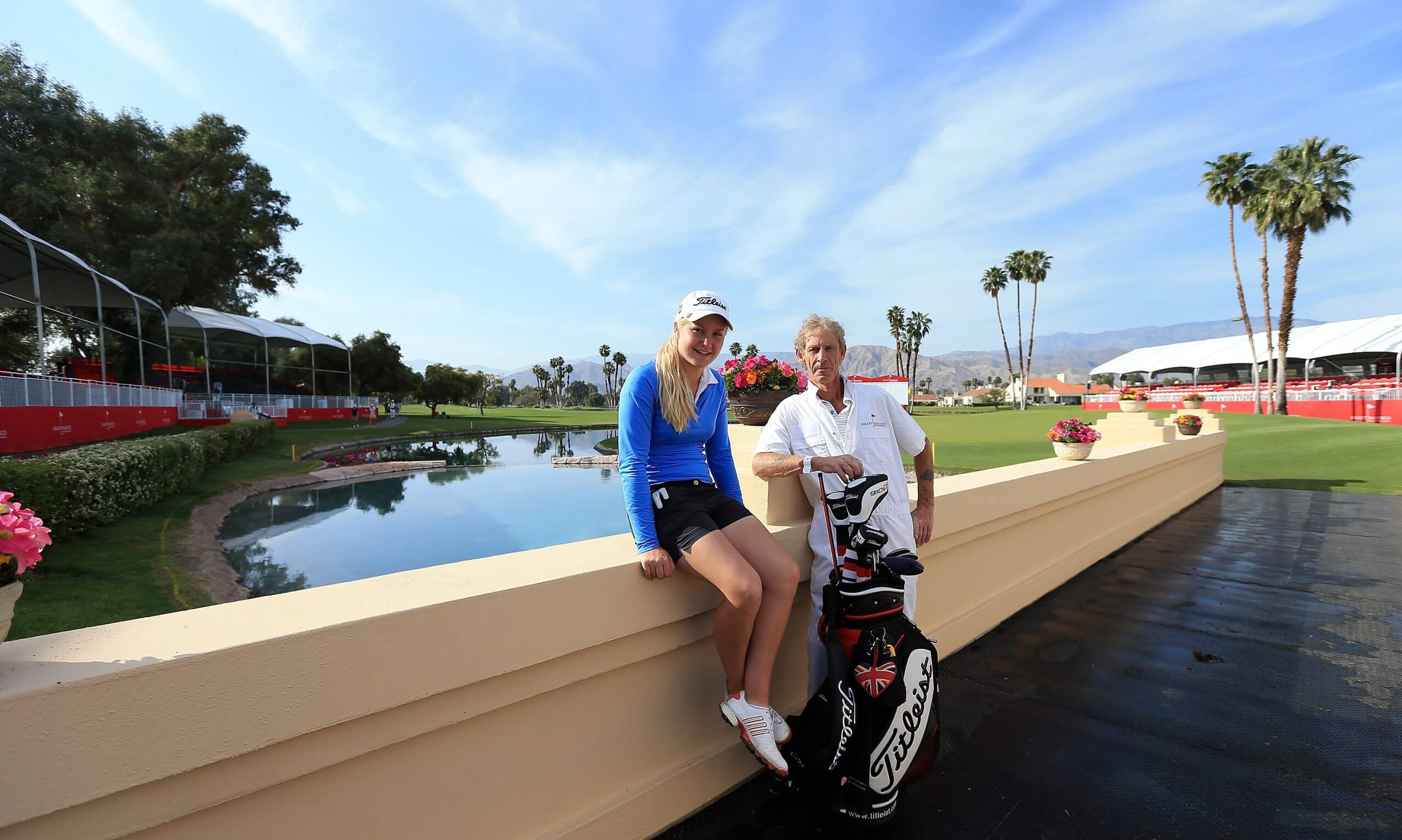
Charley Hull, then 16, with her father, Dave, at the 2012 Kraft Nabisco Championship. (David Cannon / Getty Images)
Bash’s mother, Irena Pernak, was a member of a resistance group in Russian-occupied Poland. But at age 15, in 1940, Irena was captured in the middle of the night in her town, Lvov, loaded onto a truck, and forced into a labor camp in Siberia. She escaped, along with six other women, hiding on trains through Soviet Russia, into Kazakhstan, then Tehran, then Baghdad. There, she worked at a service store for Polish soldiers temporarily stationed in the Middle East.
She wrote it all down in her diary.
“After the prisons, interrogations and camps, the Arctic winters, dysentery, hunger and lice, there was nothing left for us to fear — not me, who had come out of all that hardened, like tempered steel,” Pernak wrote. Her journals were eventually published as a book, “The Red Beads.”
In Baghdad, Pernak met her husband, Joseph, a Polish military captain. Together, after the war, they moved to England, finding their way to an industrial town in the middle of the country, 75 miles north of London. There, they started a family.
Pernak was 92 when she died in Burton Latimer. But she was alive in December 1988 to witness her daughter meet her lifelong partner. That’s when Bash finally got her chance to speak to Dave, face-to-face at a bar. That’s when the concentric circles intersected. All the coincidences and all the absurdities of two unconventional lives led to this. Somehow, everything that had to happen to bring Dave and Bash together, happened.
Then, there was Charley.
It’s time for the house tour.
Dressed in mini shorts and a golf polo, Hull walks around, showcasing her private workout studio situated in the back garden. There’s a custom-built gym, a simulator room, a sauna, a cold plunge — all Dave’s creation. He drew the blueprints. He laid the foundation. He placed the last brick.
Passing by a painting hanging on the wall, Hull laughs, unembarrassed, knowing that you’re looking. It’s an AI-generated rendition of her sitting on a throne, gifted to her by one of her many sponsors.
The conversation moves to Hull’s life playing on the LPGA. She verifies a mind-boggling rumor: Hull is an especially early riser. And sometimes, she even keeps herself synced up with the U.K.’s time zone when traveling to tournaments in the U.S.
“Yeah, I eat dinner at 5 p.m. and go to bed at 6 p.m. I just like to communicate and speak to people at home. I get homesick.”
Unlike most LPGA players, Hull has never established a base in Florida or Arizona, despite the perks of easier travel and tax benefits. She won’t play three tournaments in a row. Only two. She refuses to be away from England for that long.
As a child, Hull was in and out of international competition. She traveled to tournaments in a booster seat. She quit school at 13. Turned pro at 16. There was never a chance to stop.
“I just love being at home so much. I’ve traveled and I’ve been pro since I was a teenager. Do you know what I mean?” she says.
There was a time when Hull more closely resembled the world’s perception of her. She had a wider circle. They had free rein of her in-home bar. She loved a night out. A four-day bender preceded the 2016 CME Tour Championship. No one knew, because she flew to Florida right after and won $500,000 for her first victory on tour.
“I tell these stories and my friends on tour are like, ‘Oh my god, you’ve really done that? I wish I had your life, you’ve got so much going on, my life’s boring.’ And I’m like, ‘Trust me, it’s less stressful that way,’” she says.
We enter the pub in her house — it now doubles as a laundry room. That lifestyle isn’t for Hull anymore. She only drinks a few times a year. She’s a product of habits and routines. Practice rounds with her mates. Mornings with her trainer. Afternoons with her sister.
“You’ve got to have a life outside of golf,” she says. “But now I’m in the gym. Now I can go for a night out with my friends and not drink.”
Hull ran a 10K on the treadmill before defeating world No. 1 Nelly Korda in a Sunday singles match at the 2024 Solheim Cup. No one told her not to. “You just let her be on a certain schedule of her own,” says Mel Reid, a close friend and assistant captain on that team. “Make her feel like she’s in control of what she’s doing, because that’s where she thrives.”
Hull passes by the sauna and settles into a wooden bench, overlooking the garden. A robotic lawnmower hums in the distance. Her plum trees rustle in the late-afternoon breeze. Hull feels at peace outdoors, which helps her slow down. She explains: In 2023, two years after her divorce was finalized, at age 27, Hull was diagnosed with ADHD. She had existed her whole life in a naturally restless state, but it started to escalate. This was different. Bouts of anxiety. Sleepless nights. The chaos of a life as a pro golfer didn’t help.
“They say that when you go through a very stressful situation, it almost triggers my ADHD and anxiety more,” Hull says. “Before, I was never like this. I was twitchy, I was fast. My brain never used to be a demon.”
Doctors prescribed an anti-anxiety medication in response. But a few months in, Hull felt herself developing a dependency. That was the end of that. Still searching for an answer, she picked up a vape. When she realized she was vaping too much, she picked up a pack of cigarettes.
“I’m pretty old school, like my family are. Ok cool, you’ve been through a bad time? Just move on, deal with it, deal with it, deal with it,” Hull says.
Hull hasn’t smoked in months. Now it’s nicotine pouches. And a career-high world ranking. She’s made it — a trio of wins, high-profile sponsorships, even a cameo in “Happy Gilmore 2.” This week, she’s playing in golf’s annual mixed gender event, the Grant Thornton Invitational, alongside PGA Tour rookie Michael Brennan.
Hull’s status is rising and her LPGA earnings total $11 million, but she’s still after her first major championship. She has four runner-up finishes in them, including August’s AIG Women’s Open. That’ll be the next chase.
“I just want to win majors,” Hull says. “But I don’t think about it too much. I’ll just keep practicing and nip away at it.”
The Burton Latimer tour is wrapping up, and so is the day. Hull is back in her living room, reaching for her phone to catch up on notifications. Her social battery is running out, naturally, after six hours of being “on.”
Hull has all the moldings of a highly skilled athlete, but she is also human. And she is slowly figuring out how her gears work. At 29, she’s spent her whole life honing her craft. Always moving on to the next thing. Carrying on. Persisting. Coping. That’s Hull’s nature. It’s woven into her DNA.
So that viral photograph hanging in the trophy room? It’s not a portrait of rebellion. It’s survival.