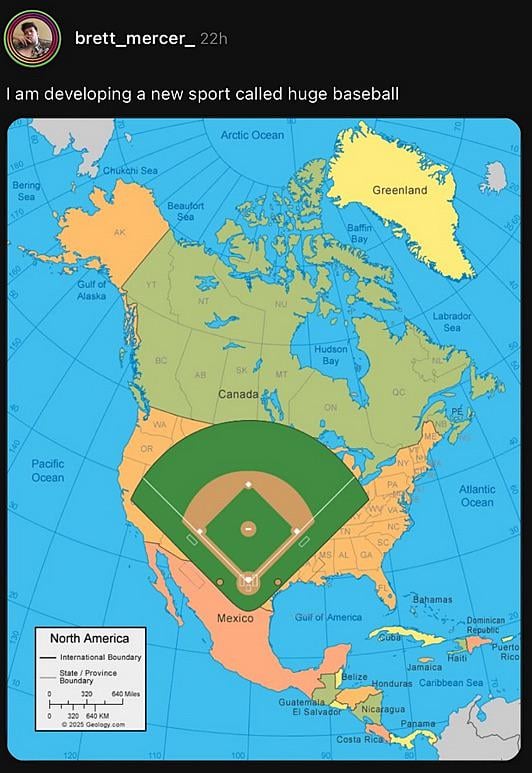
The random chunks of Lake Superior and Lake Michigan in RF are going to be a little bit of a hazard

Will there be a Dumb Starbucks on the premises?
Where’s Jon Bois at?
Reminds me of a Jon Bois project called 17776, but for baseball instead of football
Don’t do that, it opens the door to Gojira playing RF for Japan in the Huge Baseball WBC.
Hitting the first Huge Baseball Home Run by hitting the ball with an ICBM then tragically dying of exhaustion while trying to run the bases
That’s just the field dimensions at Chase Field
Finally, we can turn Aaron Judge into a singles hitter!
So you rob a bank in San Antonio Texas and see if you can make it to Branson Missouri without getting caught… single. If you make it past Branson to Sturgis SD… double. Galllup New Mexico triple. Little fuzzy on how to apply the other rules of baseball…
It’s important to try and hit home runs down the lines because any home run that lands in Canada is only worth 0.8 runs after accounting for retaliatory tariffs.
Centerfielder better have their passport handy.
Somehow, Ernie Clement wouldn’t send a line drive deep enough to win a ballgame.
Thanks to Andy Pages covering Idaho at the last minute.
I bet Vladdy can pop one outta there. Lol
This is gonna look wild when you account for the curvature of the earth.
Tsubasa scale baseball
Not the first time I’ve driven from San Antonio to Little Rock just to get to first base.
so this is what forrest was training for
Now i want someone to do the math. Not accounting for air resistance, at 110 exit velocity and a parabolic flight path, how long would it take a fly ball to dead center to get over the fence?
Probably a lot of opportunities for extra bases on shots to deep center while the centerfielder is delayed going through customs.
I’d love to see Juan Soto cover right field at this ballpark
I’m intrigued, tell me more
Big if true
Jeremy Peña is going to stand in Texas and still manage to hit a homerun that lands in Washington
IKF located in, and not straying far from, the Navajo Nation.
I’m listening…
It’s a 6 hour drive to first base.
Shohei Ohtani would still somehow manage to hit the ball to Alaska
One thing I’ve always love about baseball is that every playing field technically occupies 1/4 of the planet’s surface. That is, you have two foul lines extending away from each other at a 90-degree angle, and any ball hit between those lines–even one that theoretically traveled thousands of miles–would be fair. Those two lines would eventually meet on the other side of the globe.
the Rocky Mountains as the Green Monster
First person to run the bases without dying wins.
the thought of it taking like 4-5 days to drive from home plate to first base is really funny to me for some godawful reason
Huge if true
This is how regular baseball feels for Jose Altuve
The Giants now have an “appropriate” “stadium”.
Stanton could still hit it into the second deck, but I don’t think he could make it off home plate alive.
Holy shit, you guys actually call that the gulf of America? I thought that was one of those silly things like Mexico paying for a wall.
I want season tickets in Detroit
Old news. Albert Pujols was on this very field in 2005. Brad Lidge watched the ball land in Northern Canada and Houston wept.
Still no team in NC smdh
It’s the Gulf of Mexico.
“AND THERE’S A HARD SHOT DOWN THE RIGHT FIELD LINE! DEVERS IS BOARDING AN AMERICAN AIRLINES FLIGHT TO LITTLE ROCK ARKANSAS FROM WHERE HE’LL MAKE A CONNECTING FLIGHT AND CRUUUUISE INTO OMAHA NEBRASKA WITH A STAND UP DOUBLE! HERNANDEZ FISHES THE BALL OUT OF LAKE MICHIGAN AND GUNS IT ALL THE WAY TO ARIZONA, MEANWHILE ADAMES WILL HOP IN A RENTAL CAR AND EASILY MAKE IT HOME TO LUBBOCK TEXAS AS THE GIANTS TAKE A 3-1 LEAD!”
They might be Giants.
I see the Rocky Mountains as being a minor speedbump but otherwise I don’t see why we can’t get this project off the ground by 2030
Ignoring how pitching would work this would just turn into a giant game of manhunt with multiple bases:
Batter slaps a line drive down the left field line. Left fielder scoops it and throws to a cutoff man who launches it to the right fielder that is actively pursuing the batter down the first base line. Problem is the base path is 75 miles wide and the runner avoids the tag and after outrunning the fielder for a quarter mile and is lost into the surrounding area. He cuts through yards and streams like an escaped prisoner being chased by hounds.
After 12 hours the defending team is unsuccessful in locating and tagging the runner. In an effort to mitigate losses the defending team concedes the single and instead sends an expedition of infielders with the live ball to second base, far to the north, in the hope they can arrive at second in time to attempt a tag if the runner stretches for two. They arrive and tarry for over a week as they zealously guard 2B in shifts.
After six weeks the umpires inform the teams that the runner has reached first safely and has called a time out. The expedition defending second base is informed and begins the trek to return the ball to the pitcher.
After 4 months of play the pitcher winds up and pitches to the second batter. Top of the first, 1AB, 1 H. No outs.
The batter leans away from an inside pitch. Simultaneously the runner on first, undefended, starts upon his long journey to steal second.

45 comments
The random chunks of Lake Superior and Lake Michigan in RF are going to be a little bit of a hazard

Will there be a Dumb Starbucks on the premises?
Where’s Jon Bois at?
Reminds me of a Jon Bois project called 17776, but for baseball instead of football
Don’t do that, it opens the door to Gojira playing RF for Japan in the Huge Baseball WBC.
Hitting the first Huge Baseball Home Run by hitting the ball with an ICBM then tragically dying of exhaustion while trying to run the bases
That’s just the field dimensions at Chase Field
Finally, we can turn Aaron Judge into a singles hitter!
So you rob a bank in San Antonio Texas and see if you can make it to Branson Missouri without getting caught… single. If you make it past Branson to Sturgis SD… double. Galllup New Mexico triple. Little fuzzy on how to apply the other rules of baseball…
It’s important to try and hit home runs down the lines because any home run that lands in Canada is only worth 0.8 runs after accounting for retaliatory tariffs.
Centerfielder better have their passport handy.
Somehow, Ernie Clement wouldn’t send a line drive deep enough to win a ballgame.
Thanks to Andy Pages covering Idaho at the last minute.
I bet Vladdy can pop one outta there. Lol
This is gonna look wild when you account for the curvature of the earth.
Tsubasa scale baseball
Not the first time I’ve driven from San Antonio to Little Rock just to get to first base.
so this is what forrest was training for
Now i want someone to do the math. Not accounting for air resistance, at 110 exit velocity and a parabolic flight path, how long would it take a fly ball to dead center to get over the fence?
Probably a lot of opportunities for extra bases on shots to deep center while the centerfielder is delayed going through customs.
I’d love to see Juan Soto cover right field at this ballpark
I’m intrigued, tell me more
Big if true
Jeremy Peña is going to stand in Texas and still manage to hit a homerun that lands in Washington
IKF located in, and not straying far from, the Navajo Nation.
I’m listening…
It’s a 6 hour drive to first base.
Shohei Ohtani would still somehow manage to hit the ball to Alaska
One thing I’ve always love about baseball is that every playing field technically occupies 1/4 of the planet’s surface. That is, you have two foul lines extending away from each other at a 90-degree angle, and any ball hit between those lines–even one that theoretically traveled thousands of miles–would be fair. Those two lines would eventually meet on the other side of the globe.
the Rocky Mountains as the Green Monster
First person to run the bases without dying wins.
the thought of it taking like 4-5 days to drive from home plate to first base is really funny to me for some godawful reason
Huge if true
This is how regular baseball feels for Jose Altuve
The Giants now have an “appropriate” “stadium”.
Stanton could still hit it into the second deck, but I don’t think he could make it off home plate alive.
Holy shit, you guys actually call that the gulf of America? I thought that was one of those silly things like Mexico paying for a wall.
I want season tickets in Detroit
Old news. Albert Pujols was on this very field in 2005. Brad Lidge watched the ball land in Northern Canada and Houston wept.
Still no team in NC smdh
It’s the Gulf of Mexico.
“AND THERE’S A HARD SHOT DOWN THE RIGHT FIELD LINE! DEVERS IS BOARDING AN AMERICAN AIRLINES FLIGHT TO LITTLE ROCK ARKANSAS FROM WHERE HE’LL MAKE A CONNECTING FLIGHT AND CRUUUUISE INTO OMAHA NEBRASKA WITH A STAND UP DOUBLE! HERNANDEZ FISHES THE BALL OUT OF LAKE MICHIGAN AND GUNS IT ALL THE WAY TO ARIZONA, MEANWHILE ADAMES WILL HOP IN A RENTAL CAR AND EASILY MAKE IT HOME TO LUBBOCK TEXAS AS THE GIANTS TAKE A 3-1 LEAD!”
They might be Giants.
I see the Rocky Mountains as being a minor speedbump but otherwise I don’t see why we can’t get this project off the ground by 2030
Ignoring how pitching would work this would just turn into a giant game of manhunt with multiple bases:
Batter slaps a line drive down the left field line. Left fielder scoops it and throws to a cutoff man who launches it to the right fielder that is actively pursuing the batter down the first base line. Problem is the base path is 75 miles wide and the runner avoids the tag and after outrunning the fielder for a quarter mile and is lost into the surrounding area. He cuts through yards and streams like an escaped prisoner being chased by hounds.
After 12 hours the defending team is unsuccessful in locating and tagging the runner. In an effort to mitigate losses the defending team concedes the single and instead sends an expedition of infielders with the live ball to second base, far to the north, in the hope they can arrive at second in time to attempt a tag if the runner stretches for two. They arrive and tarry for over a week as they zealously guard 2B in shifts.
After six weeks the umpires inform the teams that the runner has reached first safely and has called a time out. The expedition defending second base is informed and begins the trek to return the ball to the pitcher.
After 4 months of play the pitcher winds up and pitches to the second batter. Top of the first, 1AB, 1 H. No outs.
The batter leans away from an inside pitch. Simultaneously the runner on first, undefended, starts upon his long journey to steal second.