
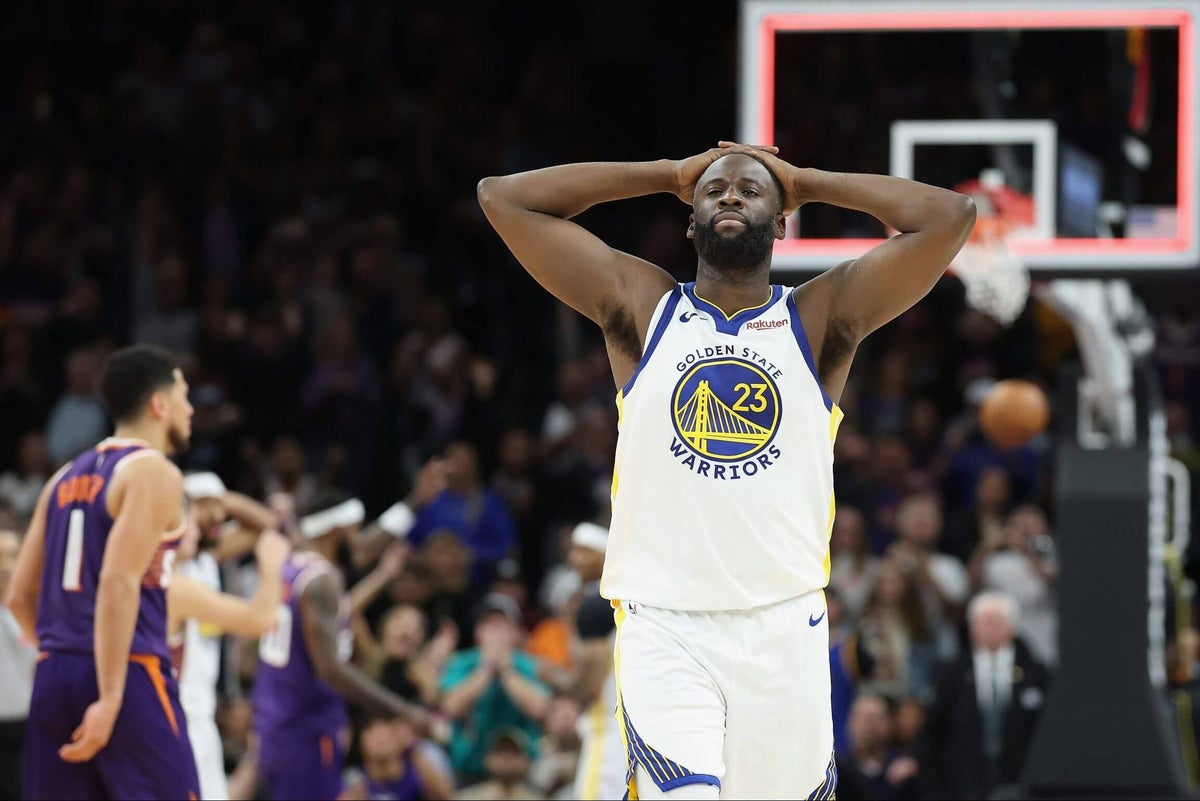
SAN FRANCISCO — The Golden State Warriors have a Draymond problem — but it may not be the one that’s freshest in your mind.
The emotional engine of the proud team ignited a new self-inflicted distraction during Monday’s win over the Orlando Magic when he got into a screaming match with coach Steve Kerr and left the bench in the third quarter. After the game, Green, Kerr and star guard Stephen Curry made it a point to shrug off the latest episode as something the team would all be able to move past quickly — as if they were describing a sprained ankle.
The Warriors have conditioned themselves to these different outbursts over the years because they know that it’s all part of the package that comes with having Green as a figurehead of the team. They also know that Green, for all his public missteps, still offers the group its best chance to win each night because of the skills he provides.
The real issue for the Warriors isn’t that Green created another scene in Monday’s game; it’s that the skills that were once so sharp and consistent every night have started to diminish. The reality is, the Warriors have to accept that Green is not the player he used to be, and they’ve got to find ways to maximize the best areas he can still help them.
In many ways, the variance between the high and low points that Green still provides mirror those of the 15-15 Warriors as a whole. Green can still play at a level that is as high as any player in the game on the defensive end — he just can’t reach that level night after night anymore. It’s what makes his decrease in production on the offensive end even more noticeable.
It’s a fact backed up by the numbers.
On a basic level, Green has fewer field goals made (72) than he does turnovers (75) and personal fouls (80). What’s just as alarming for the Warriors is the drop in Green’s offensive production through the first 30 games of the season. According to Basketball-Reference.com, roughly 59.1 percent of Green’s field goal attempts are 3-pointers. Over the first 13 years of his career, that percentage was 36.8. Green is shooting just 32.7 percent from beyond the arc this season, which is in line with his career 32 percent average from distance, but teams are giving him more space than ever from the outside, daring him to shoot. Green is only getting to the free-throw line on 14.8 percent of his possessions, which is on track for the lowest of his career.
This season, Green is averaging 8.1 points a game, his lowest since averaging 7.5 points a game during the Warriors’ last title run in the 2021-22 season. The fact that Green is only averaging 27 minutes a game this season — his lowest total since he averaged 21.9 minutes a game in the 2013-14 season as a second-year player, when he was mostly coming off the bench — is a recognition from the Warriors of two difficult truths. First, at 35 years old, Green’s body is starting to show more wear and tear. He’s dealt with a lingering foot issue all year that the organization continues to monitor. Second, as reliant as the group is on Green for his defensive prowess, his offensive struggles leave a wider hole than ever. It’s part of the reason Kerr has rotated so many different players in and out of the lineup while searching for combinations that work.
But the Warriors are still reliant on Green’s defense to help set the tone each night. Curry recently said the 2016-17 Defensive Player of the Year is a “cheat code” on that end and is still a key to setting up the Warriors’ offense because of how strong a defender he remains. But Green has been turning the ball over at a higher rate this season. His 3.1 turnovers a game are his highest number since he turned the ball over an average of 3.2 times a game in the 2015-16 season. The difference is that in that year, the same year the Warriors won an NBA-record 73 regular-season games, Green was averaging a career-high 14 points a game in 34.7 minutes a night, which also remains a career high.
The Warriors give up almost a full point less (109.9 points per 100 possessions over his 649 minutes played) compared to when Green is off the floor (110.7 points per 100 possessions over the 796 minutes when he sits). Opponents shoot 45.1 percent from the field when Green plays and 46.6 percent from the field when he doesn’t. Only Warriors big man Quinten Post has more contested shots (227) than Green’s 193. The difference is that Post has played in six more games this season as Green has missed time because of that lingering foot issue and, more recently, a team-excused absence.
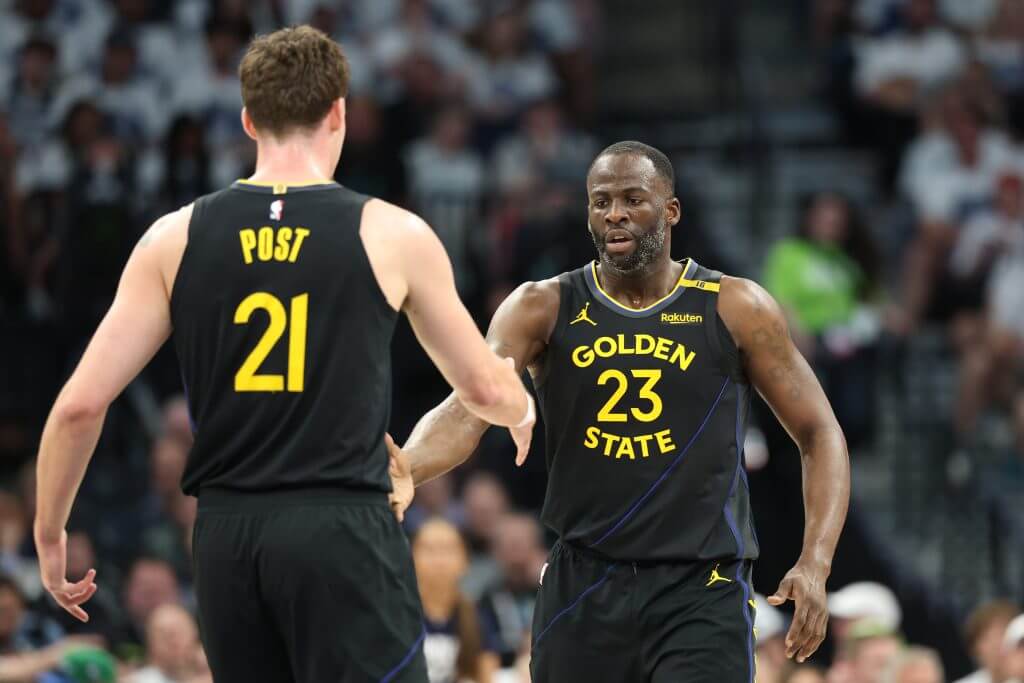
Draymond Green and Quinten Post celebrate a play against the Timberwolves. (David Berding / Getty Images)
Where Green continues to shine the most is when the Warriors play a game with something at stake, a game where Green takes on a personal challenge on the defensive end. In two games against the San Antonio Spurs this season, Green held Spurs big man Victor Wembanyama to 8-for-21 shooting from the field. Green also held Alperen Şengün (5-for-12) and Pascal Siakam (1-for-5) when squared up against those opposing All-Stars.
Given the offensive decline and the foot problem, the safest play for Kerr is perhaps to conserve Green as much as possible for another potential playoff push. It’s a gamble that he can’t afford to make with Curry and Jimmy Butler because of the offensive responsibility each man carries every night.
Both Kerr and Curry mentioned after Saturday’s win over the Phoenix Suns how important Green remains in setting up the offense — the pick-and-rolls, the dribble handoffs he creates. There is a trust the group still feels when he’s out there that he can clean up his teammates’ mistakes, especially on the defensive end. The Warriors average 17.2 second-chance points per 100 possessions when he plays and just 12.9 second-chance points when he sits. But while it’s clear the Warriors are forced to play a different style without Green, a more cautious one, it’s an adjustment that is worth gambling on, given two figures: The Warriors rank third in the league in defensive rating, according to NBA.com, and they rank 21st in offensive rating. The flaws that have crept into Green’s offensive repertoire outweigh the positives that he brings to the floor on defense, at least as the Warriors try to gain ground in the dog days of the regular season.
The intangible part of Green’s game, the one that Kerr and Curry have highlighted through the years and undoubtedly part of the reason they played off Green’s latest transgression Monday, remains clear. Green serves as the big-brother protector for the rest of the group. The Warriors know that for all his fire, some of which can burn them as it did when he left the bench, Green is still the player who can elicit fear into opponents with the way he plays defense. It’s why they have been so willing to look the other way after the laundry list of mistakes Green has made during his tenure in the Bay.
“It makes a dramatic difference,” Kerr said prior to Green’s return to the lineup on Dec. 14 in Portland. “Draymond remains one of the great defenders in the league. One of the very best, if not the best, defender that I’ve ever seen.”
But that’s also the reason Kerr should look for even more breaks for Green throughout the season. Green’s minutes are the lowest they’ve been in over a decade, but maybe part of the solution is for Kerr to lower that number even more in advance of the Warriors making another run later in the year. The problem the team has once again created for itself, however, is that by losing so many early games, they’ve fallen into a hole in the middle of the Western Conference standings that will be more difficult to climb out of later. The difference now is that they can sustain more time without Green in the lineup than at any other point in his tenure because the biggest issues the Warriors have 30 games into the season aren’t defensive issues; they are offensive ones.
In that same answer that night in Portland, Kerr described how Green’s return changed the way the group played offensively and how lineups would be altered as Kerr and the Warriors continue to tinker with combinations. In this case, the numbers reveal what the Warriors have known for several years: They have to find a way to keep Green engaged each night to continue to bring out the best in his game.
Green has been asked several times about playing so much at center and how that may impact his production. If the Warriors could get anything from veteran big man Al Horford in the second half of the season, theoretically, that could also take some of the defensive burden off Green’s shoulders — but that wouldn’t fix the offensive issues that continue to fester.
There’s a section of the Warriors fan base that believes the best course of action would be to trade Green and let the Warriors try to find a new identity behind the offensive greatness of Curry and the offensive stability of Jimmy Butler. But the rest of the league knows that Green, at 35, isn’t the player he once was and wouldn’t yield the same value in return. Green is likely better within the Warriors system than he would be anywhere else because he is part of the fabric that makes the system work at its best.
The challenge for the Warriors as they try to move forward from this latest Green distraction is to find ways to address the real issue at hand: Green’s decision to leave the bench and disengage from his teammates during Monday’s game isn’t the real problem. The real obstacle is that Green has become more of an offensive hindrance than a help on most nights.