
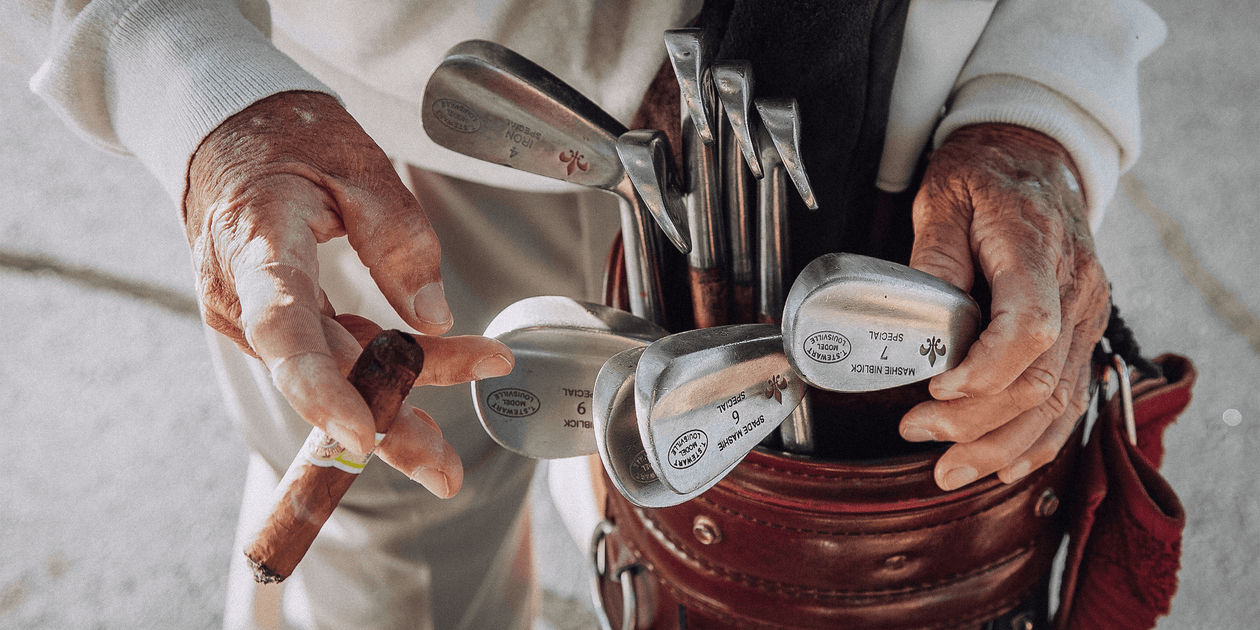
“Swing smooth.” That was Bruce Markwardt’s only advice. I was preparing to compete, so to speak, in the 2025 U.S. Hickory Open, a golf tournament requiring pre-1935 equipment, an arcane version of an already ancient game. I needed a set of clubs and, well, here they were — my hickories. Five irons, a wood, and a putter, all jutting out of a discolored bag with one rusted zipper pocket and a sad, skinny shoulder strap. I looked at Bruce, skeptically. He looked at me, assuredly.
Swing smooth? I pulled out one of the clubs, an AG Spalding & Bros. Kro-Flite Sweet Spot iron stamped with a patent date of Sept. 13, 1927. What a time to be alive. Lindbergh crossing the Atlantic. The Babe hitting 60. My great-grandfather, James A. Flaherty, leading the Knights of Columbus. I wrapped my hands around the grip, extended my arms, and looked down on what appeared to be half a tuna can lid. I tapped the floor a couple times, getting a feel for it. Firm, sturdy. I pulled the club back into a half swing. Hickories are heavier than modern clubs. Their shafts are remnants of trees that stood a century ago, and despite feeling like an heirloom off a wall, that history feels unsentimental once in your hands. The difference between an artifact and an instrument is how you use it.
Yet there’s an entire subculture out there, one that loyally subscribes to hickory golf. They swing their cleeks and their mashies and their niblicks — club names long extinct, replaced by today’s numbered irons and woods. They dress in period-appropriate getups — knickers and flat caps, ties and suspenders, all imaginable argyles. They laugh at your modern vanities. Why worry about spin rates and clubhead speed when you can wear a necktie and hit a drive 180 yards?
Color me curious. Maybe I could learn something about today’s game by pulling back a curtain to the past. Or maybe better understand some universal truths by rejecting modern technology. Or maybe just mock a bunch of men dressed like jockeys, because even by golf’s standards, this was a bit much.
I reached out late in the summer to Gary Krupkin, the tournament director for this year’s U.S. Hickory Open. The 36-hole event was slated for Hot Springs, Ark., an odd town with an odd history. I assumed a qualifying process existed. I was wrong. Krupkin said all I needed was a pulse and a means to travel to central Arkansas. That, and some clubs.
That’s where Bruce came in. Seventy-four years old and long retired after 39 years in purchasing at Ford, Bruce repairs and restores antique golf clubs in his ample free time. This man loves old golf clubs. When I first emailed him, he replied 14 minutes later with mountains of information. I wasn’t sure what I was reading, so I agreed to whatever he was offering. Bruce said it would take a week or two to put together the set. Then he emailed me a couple days later, saying they were ready.
We met in Grosse Ile, Mich., a small island just south of Detroit, where Bruce lives with his wife. A lifelong golfer and collector, he began playing hickory clubs about five years ago, during the pandemic, as a lark. He didn’t realize he was signing himself up for an obsession. Today, Bruce plays about half his rounds with hickories. Alongside the driveway, what should be a guesthouse is instead a shack split between a storage space for thousands of clubs and a small nook filled with tools and clamps and dust. “My dumpy little workshop,” he called it.
“This is where I spend my time now,” Bruce said, moving through a tight hallway. “The plan for the winter is to finally get this stuff cleaned out.”

Century-old hickory golf clubs are restored in Bruce Markwardt’s Grosse Ile, Mich., workshop. (Courtesy of Bruce Markwardt)
Bruce began the restoration process by removing the heads off all the irons and soaking them in rust remover. Then he peeled off the old grips, sanded each shaft, and applied fresh stains. Seeing that a few shafts bowed ever so slightly, he fastened them on a straightener, forcing them to their former glory. Then the iron heads, fresh from a long bath in the rust remover, met the soft steel brush of a lathe. Working on the lone persimmon in the set, Bruce removed layers of claggy varnish and applied three new coats. Then he reset, re-epoxied and re-pinned each club. He added whipping (threading wrapped to reinforce the bond) to the bottom of every shaft. Then he wrapped new elk leather grips atop each.
The result? A wonderful island of misfit toys. The irons included a few Spaldings, a MacGregor and something stamped only with the word “Edgebrook.” Some clubfaces were lined with familiar groove patterns, others with mysterious systems of inverted dimples. The putter looked like an Allen wrench. But the driver — a “brassie,” the equivalent of a modern 2 or 3 wood — was beautiful. Glossy auburn swirls across a brindle grain. No manufacturer’s mark, at least none I could make out.
I wondered where else these clubs have been. Each was, at some point, new. Probably advertised in a catalog as the next big thing. Bought by some guy who thought it would change his game. Handed down to a child. Then sold. Or left in a garage. Forgotten. Then found. Tossed into a bin of other old clubs, or into a storage unit. Found again. Eventually laid upon a shelf in Grosse Ile. Then handed to me. It felt like one long love song.
There was, though, the matter of hitting these things.
“Take your handicap,” Bruce told me, “and add 50 percent to it. That’s your hickory handicap.”
What’s 50 percent of 11?
I paid Bruce $300 for the clubs and laid the bag down gently in my trunk, next to my regular clubs, a modern set of Srixon irons, Callaway woods and Titleist wedges. Driving off, I waved to Bruce, standing outside his dumpy workshop, smiling like a missionary after a baptism.
Swing smooth, I thought.
How hard could it be?

Wearing traditional attire and playing with hickory clubs, golfers compete in the 2025 U.S. Hickory Open in Hot Springs, Ark. (Katie Adkins for The Athletic)
The story of hickory golf is one of evolutionary annihilation. In the game’s early days, when Scots smacked featheries and gutties around sheep pastures, club shafts were made of native Scottish woods like ash and hazel. That was, until the 1800s, when North American hickory — flexible, durable, reliable; the stuff of wagon wheels and tool handles — was deemed ideal by clubmakers. By the early 1900s, as golf rode a wave of popularity shaped by Harry Vardon, Ted Ray and, in time, Bobby Jones, clubs were mass-produced for the first time.
Then came 1924 and the United States Golf Association’s decision to legalize steel shafts. The change was part necessity, part free enterprise. What was once an endless supply of slow-growing hickory trees was coming upon the realities of deforestation. Club manufacturers realized steel was better performing, more durable and less expensive. The transition began gradually. Scores of golfers stubbornly clung to their hickories from the ’20s into the ’30s. Sands shifted when Billy Burke, who began his career juggling practice with a full-time job as a mold caster at a Connecticut iron foundry, won the 1931 U.S. Open with a full set of steel-shafted clubs. Five years later, Johnny Fischer won the 1936 U.S. Amateur in what would be the last major ever won with wooden shafts.
With that, history ate hickories whole. And with that, all those original clubs — millions upon millions of hickories — were immediately irrelevant.
The story of Hot Springs isn’t all too different. About an hour south of Little Rock, the city popped in the 1920s, a swirl of gambling halls and cathouses, racetracks and barrooms. Doors were pushed open by Al Capone, “Bugsy” Siegel and “Lucky” Luciano; by Babe Ruth, Mae West and Jack Dempsey. Walking downtown today, you can see it, but you have to squint. Locals say that, had the state of Arkansas not clamped down on gambling in the ’60s, Hot Springs would be America’s modern freewheeling destination, not Las Vegas.
Three miles from downtown, two 18-hole courses make up Hot Springs Country Club. One was born amid the city’s boom and designed by legendary architect Willie Park Jr.
That’s where I arrived for my pre-tournament practice round, finding a 2025 U.S. Hickory Open banner draped across the front of a two-story clubhouse. Dropping my bag on the range, I feigned confidence, rehearsing a few swings. In reality, I hadn’t yet hit any of the clubs Bruce gave me a day earlier and had no idea what I was doing. All the makings of a nightmare.
Except, then I looked around.
Expecting a lineup of fluid swings striking pure shots, I instead found a row of relatably unexceptional swings swatting relatably average shots. One guy, short and stocky, squatted over the ball as if perched in a porta-john. Another seemed to be doing some kind of Kevin Youkilis impression. What was this? I had anticipated a weekend of stuffed shirts and serious golf, but the U.S. Hickory Open was beginning to look like something else. Eclectic, offbeat. A little weird. I chose to ignore the handful of low-handicappers who clearly knew what they were doing.
In the distance, I saw Krupkin, the ringleader, smiling with his arms folded.
“If someone describes this event to you and asks you to paint a picture, we know the picture that’ll be painted,” he told me later. “But oftentimes the picture in real life isn’t what’s in your mind. Everyone here, there’s got to be something a little off about you to want to play the game this way.”
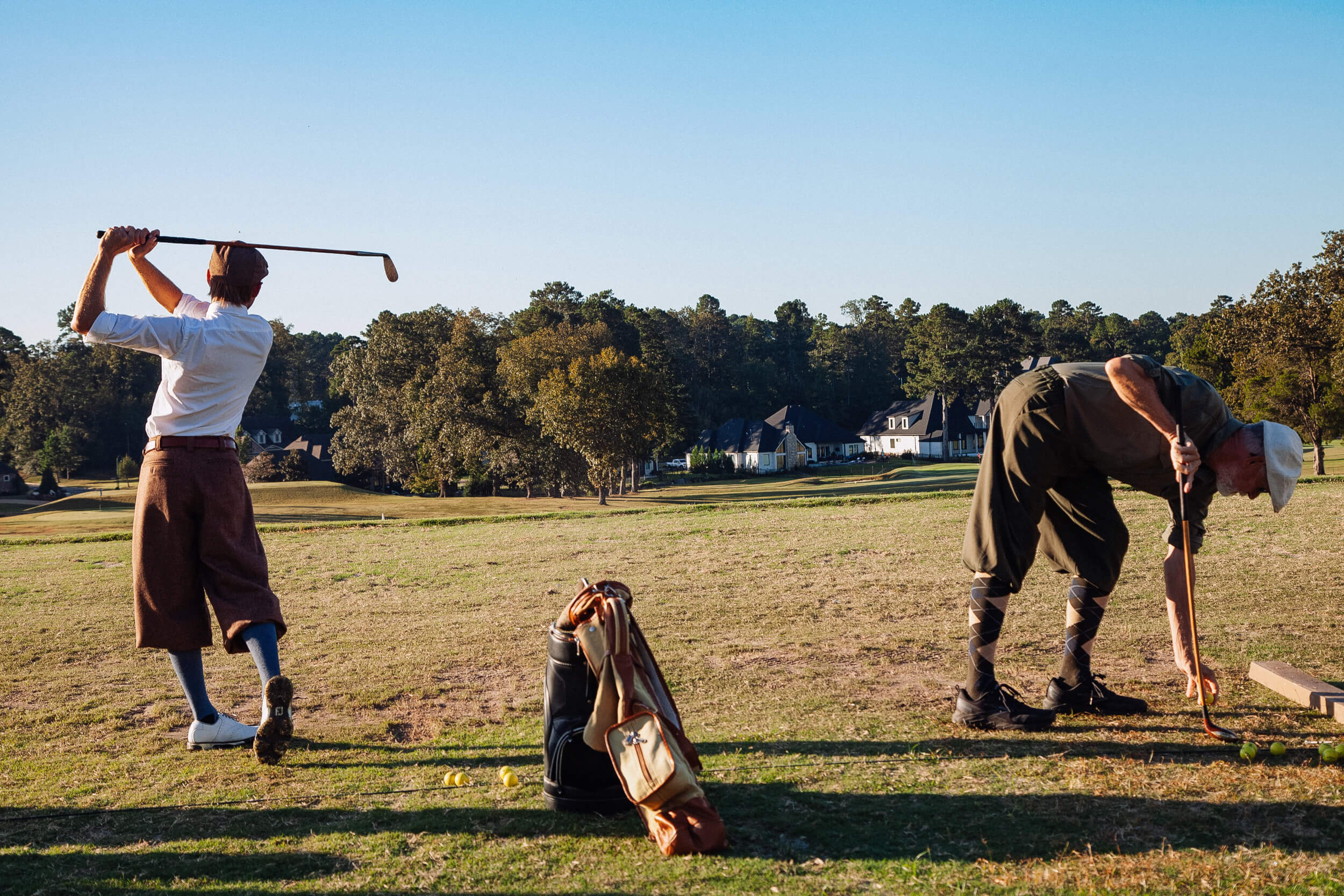
Legendary architect Willie Park Jr. designed one of the courses at Hot Springs Country Club. (Katie Adkins for The Athletic)
Krupkin is a Dallas-based attorney who, on the side, is vice president of Sara’s Secret, a chain of “romance boutiques” with 22 locations across Texas. He uses modern clubs regularly, practices daily, and plays matches against friends for “considerable sums of money.” He got into hickories about six years ago when seeing a man at a Plano public course wearing knickers and asking, as one does, why are you wearing knickers? Next thing Krupkin knew, he was trying hickories. Then he was getting involved with the Society of Hickory Golfers. Then he was somehow a tournament director.
All because of the sticks.
“You can’t build technology into these old clubs. It’s impossible,” Krupkin said. “That’s why it feels pure.”
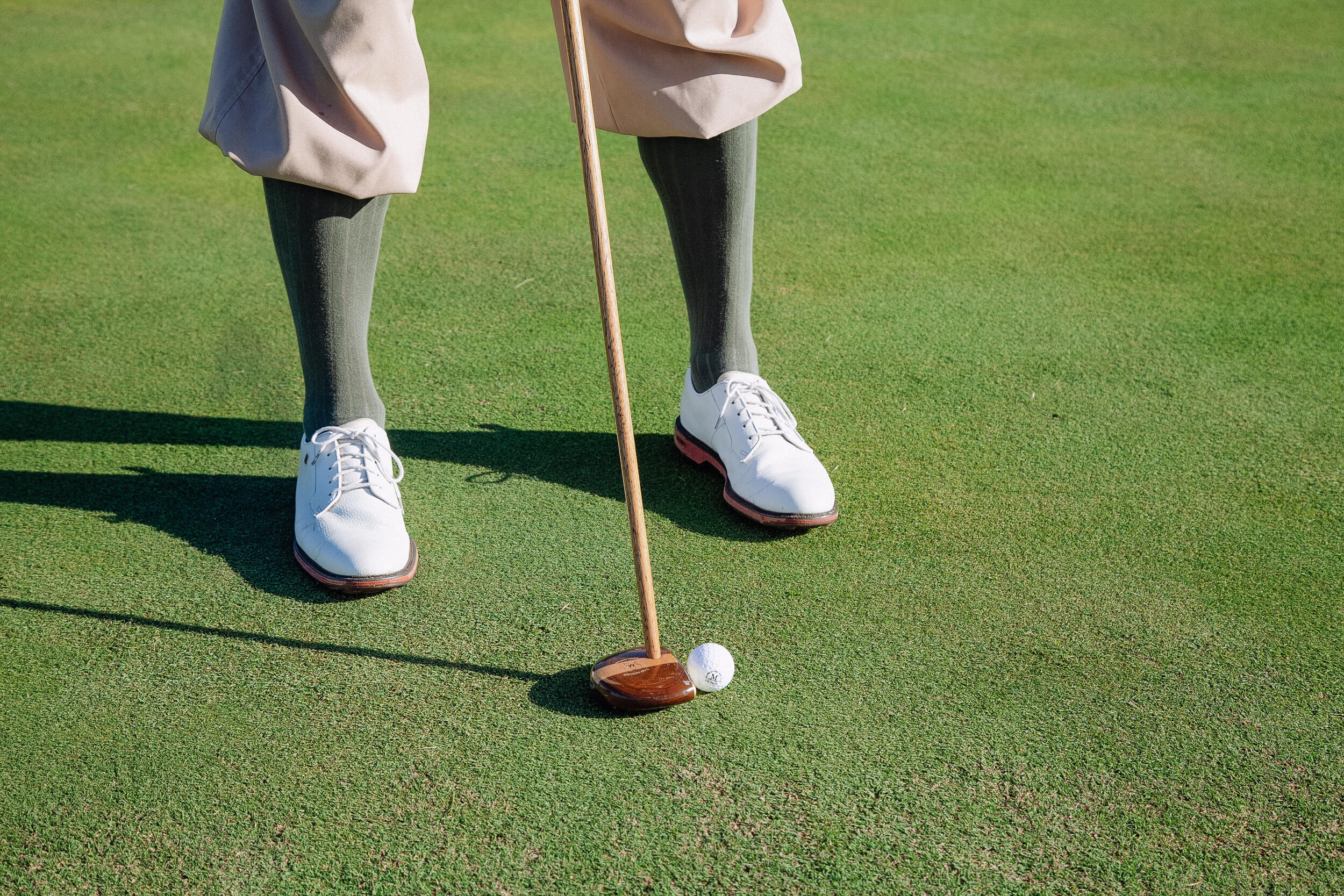
Some clubs felt strangely comfortable to a novice. Others did not. (Katie Adkins for The Athletic)
I was unsure which club to reach for. Bruce wrote large numbers on the back of each iron. The degree of loft. One read, “46,” essentially a pitching wedge. Fully expecting to blister a ball off the hosel, and hoping desperately no one was looking, I muttered to myself, “Swing smooth,” and turned my shoulders.
Flushed.
High and true. About 110 yards.
“Nice!” the guy next to me said, sensing a newbie.
That contact. Oh, man. It’s unlike anything you feel with a modern club, unless your pitching wedge feels like a big bite out of a perfect apple. I wanted to feel it again, immediately. So I raked another ball over, centered it in my stance, and squeezed the grip. I turned my shoulders and …
Thinned the ever-loving s— out of it.
“Happens,” the neighbor said.
I worked my way through the bag. Good swings. Bad swings. Some clubs felt strangely comfortable. Others did not. The club labeled “26” was, in fact, a dull, old butter knife. The brassie felt good, somehow. The key, I had read, was to tee the ball a little lower, only slightly forward in the stance, maybe choke down a tad, and swing with rhythm. One practice shot led to the next and something resembling confidence followed. I hoisted my flimsy bag upon my flimsy shoulder and set out for my practice round. Other than sweating heavily in layers of clothes I would otherwise never wear, things went shockingly well. I learned quickly that if you hit a hickory dead square on the clubface, right on the sweet spot, a symphony of shivers will shoot through your hands, up your arms and into your heart. Hasten that swing, though, and reach back for more, squeeze the grip a little tighter, and your hands will feel like door knockers.
I arrived for the following day’s first round in brown knickers, a white shirt, blue tie, and socks in green and blue criss-crossing argyle. It wasn’t easy leaving that hotel room that morning. I’ve long imagined performing open-mic comedy as the most unbearably humiliating scenario imaginable. That’s only because I had never considered dressing like this in public.

Reporter Brendan Quinn of The Athletic competes in the 2025 U.S. Hickory Open in Hot Springs, Ark. (Courtesy of Greg and Beverly Wise)
My group started on hole 15. A 150-yard par-3 requiring 140 yards of carry. Not exactly daunting, until I looked down at a clubface featuring, ominously, what seemed like only a heel, a toe, and no discernible middle. The previous day’s good vibes were gone. I don’t know why; maybe it was the slightest tinge of competition, maybe it was the fact that I’m not a good golfer, but instincts kicked in and the swing sped up. I sent a squirrelly shot skittering toward the water.
I looked at the club, but knew I needed a mirror.
I tried to remember what Jeffrey Havelock had told me. We’d played together the previous day, and he noticed my preshot routine didn’t include an actual practice swing. Havelock is 65 and plays hickory clubs because they force him to swing slower. After a few holes, he implored me to pause and rehearse the swing. Feel the weight, feel the torque, feel the way it’s meant to be swung. “Every club is different,” he said. “You need to adjust.”
When I listened, things went well. When I didn’t, they did not. Modern golf clubs allow for leeway; a margin of error to save you not only from the occasional wonky swing, but from the inevitable loss of focus that every average golfer knows too well. Hickory clubs? There are no margins. Mishit a hickory, even in the slightest bit, and you question not only why you bothered trying, but why this stupid game was ever invented in the first place.
I spent two days wondering why anyone plays this way by choice.
“People find their way into this community a hundred different ways,” Tracy Joneson replied.
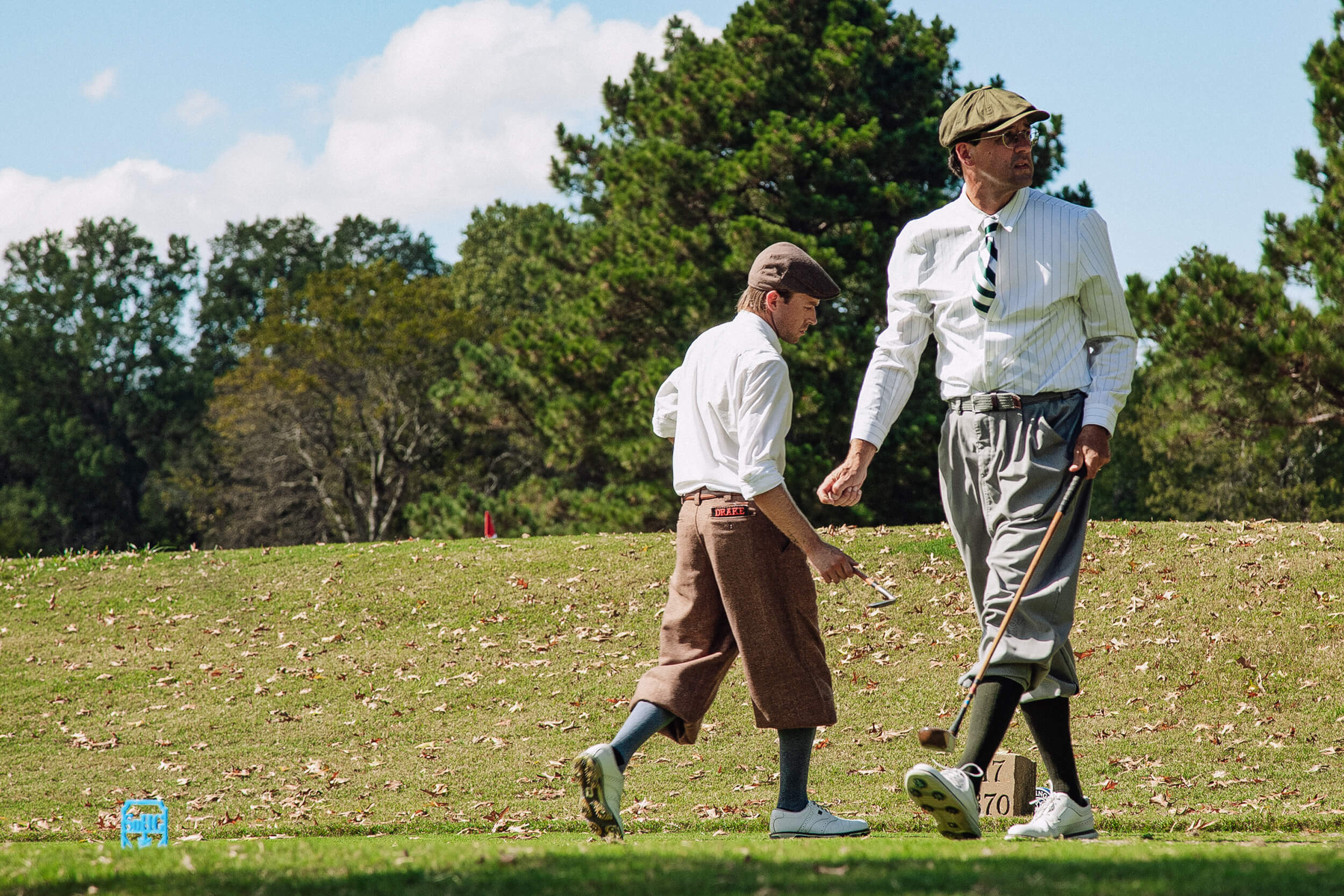
There’s an estimated 10,000 hickory golfers worldwide, and maybe 3,500 in the U.S. (Katie Adkins for The Athletic)
A 62-year-old from nearby Gravette, Ark., Joneson is relatively new to the journey. While helping a local nine-hole course through a bankruptcy two years ago, he was cleaning out the clubhouse and came upon a single, lonely hickory. “Poor thing had a loose head and the grip was falling off,” he recalled. “Looked like Charlie Brown’s Christmas tree.” Joneson gave the course $40 for the club (only to find out it was worth maybe $15 on eBay) and set out to repair it. That prompted Joneson’s wife to buy a full set of weathered clubs, along with a little leather bag, on Etsy. She paid $100, thinking her husband might display them in the office. He instead refurbished those, too, and set out on the course.
I played another round with Dave Koenig, 57, from Des Moines, Iowa. He came upon hickory golf years ago, finding a social outlet he badly needed. Sixteen years sober, he found a like-minded group. They talk about equipment, and course design, and golf, and life.
I played with Chris Hawes, a Canadian. Now 59, he discovered hickories when, while playing as a single, he was paired with three truthers. All the doors of his mind swung open, as did an opportunity. A standup comic in a previous life, Hawes started a company producing inexpensive replica hickory sets and a golf travel agency. A self-described “egalitarian,” he regularly convinces, or cons, people into converting to hickories.
I had a long talk with Nelson Ford from McLean, Va. The 78-year-old served as Under Secretary of the Army, the department’s second-highest-ranking civilian official, from 2007-09. In 2013, Ford went for a walk and found a bench near the 17th hole at Pacific Grove Golf Links, a municipal course five miles north of Pebble Beach known as “Poor Man’s Pebble.” A player passing by soon stopped and chatted. The man asked Ford if he’d ever played with old hickory clubs. Ford, cocking an eyebrow, responded, “Who would do that?” Long story short, that man gave Ford a hickory 5-iron and a putter. He never looked back.
“Once you hit a pure shot with a hickory,” Ford said, “there’s no better feeling.”
There’s no formal number for how many hickory players are out there. The most common estimate is 10,000 or so worldwide, and maybe 3,500 in the U.S. With golf being an export of the aristocracy, I mistakenly assumed these would be the especially polished, the especially uppish. In truth, it’s the opposite. These are the hobbyists, the pack rats, the tinkerers. They play the game the way they imagine it was intended to have been played. They go to trade shows and swap meets. They accumulate collections that grow too big and aren’t worth too much. They try to convince others to give the game a try. Hey, a decent persimmon goes for $60 or $70; good irons are maybe $20 apiece.
There is, of course, some sectarianism. Different associations abide by different qualifications. Some welcome replica clubs. Others allow for only pre-1935 originals. Yet another sect requires 19th-century clubs and modern-made gutta-percha balls. All innovation invites a tug-of-war. I was told the story of what was supposed to be an amiable tournament of hickory players from Ohio against hickory players from Michigan. A disagreement over using range finders turned radioactive. Sides fumed. The Toledo War broke out again. Hands were balled into fists before players were finally separated.
But that’s on the edges.
Most hickory golfers? They just want to find other hickory golfers. And Krupkin was right. They’re all maybe a little off, usually in a good way.
After I posted rounds of 95 and 93 in Hot Springs, finishing 28th place out of 38 in the men’s open division, everyone I’d met asked the same two questions. Did I want a beer? And might I continue playing hickories? My answers were yes and maybe. Heading home, I was still trying to figure out whether I enjoyed myself or not.
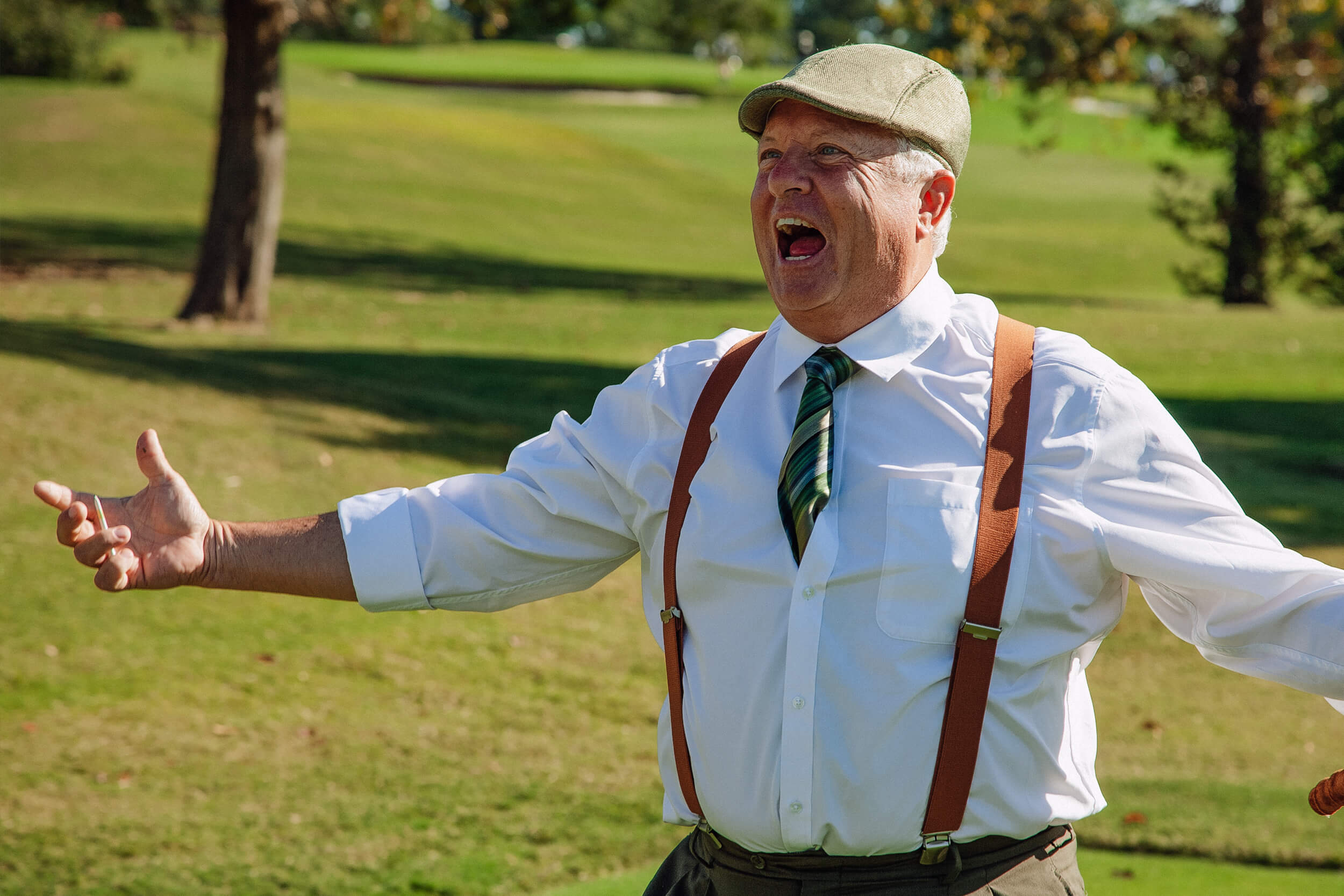
Chris Hawes celebrates during the final round of the U.S. Hickory Open in Hot Springs, Ark., on Oct. 5. (Katie Adkins for The Athletic)
The latest Callaway driver, the Elyte X, features a thermoforged carbon crown that optimizes weight distribution for stability. It relies on “advanced AI” to enhance speed, spin and dispersion across the entire face. The clubhead comes standard with a Mitsubishi Tensei 1K black 65 graphite shaft. It debuted in 2025 for $619.99.
And TaylorMade? The new Qi35 driver is constructed of chromium carbon, steel, aluminum, tungsten and titanium, and features two movable weights to achieve optimal spin and shot shape control. Yours for $599.99.
Modern irons are fitted to your exact specifications — height, swing speed, optimal compression — and can cost upward of two grand for a set.
This is where golf’s eternal obsession with distance has led us. Space-aged clubs constructed from sci-fi materials. Amateurs are hitting the ball longer than ever and pros are rendering historical courses obsolete, so much so that, unable to stop club manufacturers from trying to reach Mars, the USGA and R&A are instead engineering a “rollback” to curb the game’s erosion. Professional players will begin playing a scaled-back golf ball in 2028. Recreational players will begin buying those sleeves in 2030.
Hickory players will be just fine. The best ball to use with antiquated clubs is the soft, low-compression variety, the ones you see stacked in sporting goods stores for $20 a dozen. Those ain’t getting rolled back.
Everyone else will simply find the next best way to get ahead.
It was, you should know, no different a hundred years ago. I found an original advertisement for that Spalding Kro-Flite Sweet Spot iron. It boasted that a matching set of Kro-Flites rendered all other sets obsolete because they allowed for the same swing with each club. (“Every club in the set feels exactly like its fellow!”) Only three years later, in 1927, Spalding’s new “cushion-neck” steel-shafted irons were advertised as “the world’s most perfectly matched golf clubs.”
(I wonder how those who originally read those ads and played those clubs would react if presented with a bizarro time capsule, one opening to reveal players a century later using that same equipment by choice.)
Playing with hickory clubs doesn’t necessarily need to be about rejecting what’s available today. Rather, it can be about deciding that the hard way is OK because it’s all on you. We all know when we get away with a swing — that drive that’s hit dead off the toe, yet, in defiance of all logic, and all forces of nature, and all truths bestowed upon us by the gods, somehow self-corrects, flies back on-line and falls, magically, to a final resting place along the fairway. We look down at the face of the driver, rub a thumb across that ball mark, and insert some lame cliché. “Rather be lucky than good!”
Deep down, though, you know.
You know.
Swinging a hickory, that’s how you play without pretenses. If the swing is off, the shot is off.
There’s no spell check. There’s no auto focus. There’s no lane assist feature.
It’s worth remembering what that’s like every once in a while.
A month after the Hickory Open, Bruce and I got together at the club down the street from his house. I’d shot a solid 83 — with my moderns — the prior day at a public track up north and arrived in Grosse Ile feeling good. I felt a little sentimental as I pulled the hickories back out of the trunk. I recalled picking them up and felt like we’ve all somehow found our way onto the same ancestry report.
Then I proceeded to play four hours of truly atrocious golf. Never came within an inch of the sweet spot. Not once. The brassie? Every swing felt like hitting a hockey puck with another hockey puck. After 16 holes spent writing down big numbers with that tiny pencil, I didn’t even bother keeping track on 17 and 18. Anything to avoid the final tally — a 107? 108? Lord knows.
Back at the car, I dropped my hickories to the trunk and reminded myself who was to blame. I didn’t swing smooth. History caught up with me.