
The most mind-blowing outcome of the College Football Playoff inside the coaching world wasn’t Miami bullying Ohio State; it was the way Indiana dominated Alabama in the Rose Bowl.
Several coaches The Athletic spoke to this weekend weren’t shocked that Indiana handled Alabama. After all, the Hoosiers were almost a double-digit favorite. It was how the game unfolded. They mauled the Tide 38-3, outrushing them, 215-23.
“That ain’t an Alabama defense,” said a Power 4 offensive coordinator, who used one of the most damning words a coach can evoke about another football team: soft.
“Ultimately,” the coach continued, “and this is y’all’s job, not my job, but there needs to be an evaluation of this narrative of the SEC is these big, bad m————, because they’re getting their asses whipped in these games.”
Is that true?
Yes. The Playoff semifinals on Jan. 8 and Jan. 9 feature two Big Ten teams (Indiana and Oregon), one ACC team (Miami) and one SEC team (Ole Miss). More broadly across bowl games, the “It Just Means More” conference is at the bottom of the Power 4 leagues in records, trailing the Big Ten (9-4), the ACC (8-4) and the Big 12 (4-4). In bowl games through this weekend, the SEC is 2-7 against teams from other conferences. The SEC team was favored in seven of those nine games. The SEC is 4-9 overall.
Five years ago, when Alabama blew out Ohio State 52-24 in the national title game, the SEC went 7-2, while the Big Ten went 3-2. The ACC was 0-6, the Big 12 5-0. The year before, when LSU beat Clemson to win the title, the SEC was 8-2, the Big Ten was 4-5, the Big 12 was 1-5, and the ACC was 4-7.
It wasn’t surprising to see the SEC consistently winning when it faced teams from other leagues, when it had a run of winning 13 of 17 national titles from 2006 to 2022. But a seismic shift had begun to take place in the sport as Georgia was winning back-to-back national titles in 2021 and 2022.
Bret Bielema knew what life was like in the meat grinder that was the SEC. He led Wisconsin to three top-10 finishes in seven years in the Big Ten before taking over at Arkansas, where he struggled in five seasons, going 29-34. After three seasons coaching in the NFL, he came back to the Big Ten as Illinois’ head coach in 2021. Even though the Illini hadn’t had a winning season in nine years, Bielema’s timing was ideal.
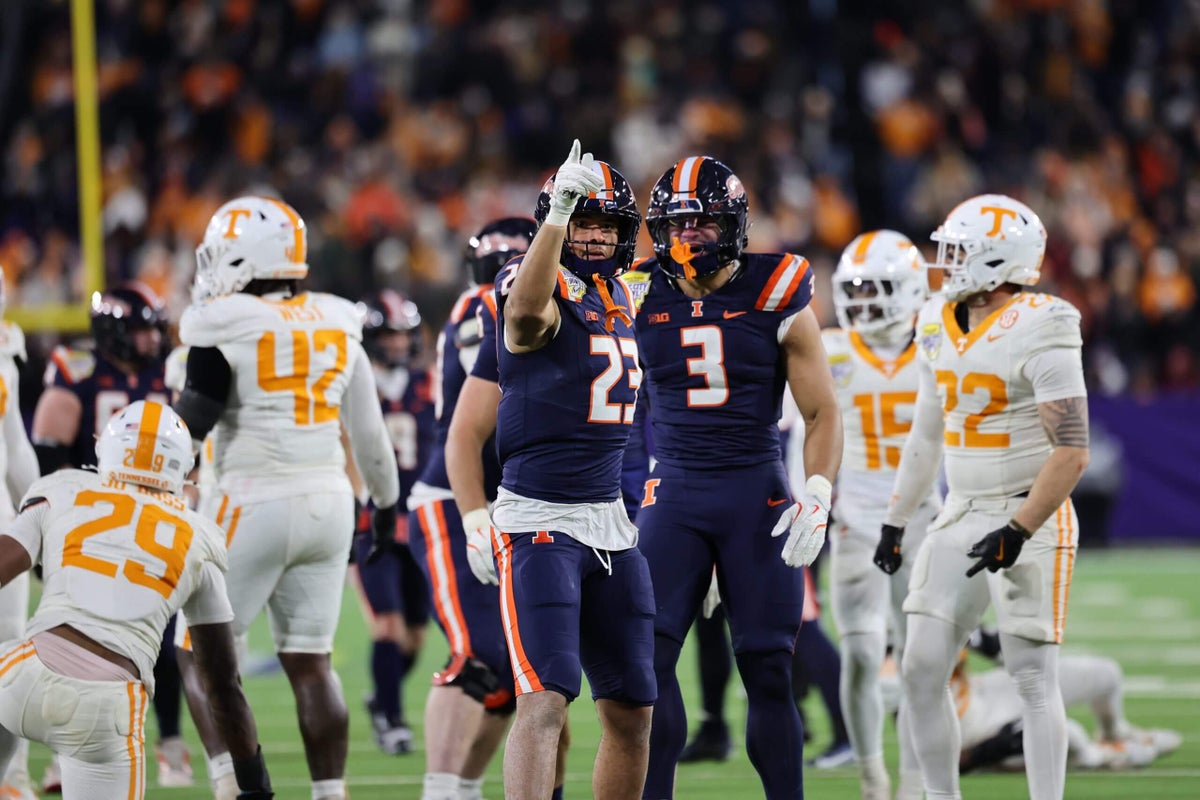
“The world that has been created through NIL, revenue share and the portal that we operate in now has erased the limitations to a certain level,” Bielema told The Athletic on Saturday, a few days after his Illini defeated Tennessee in the Music City Bowl. “I know this: Before I came here, we’d never beaten an SEC team in our history, and we’ve now beaten two back-to-back (in bowl games).”
Name, image and likeness began in the summer of 2021. That, coupled with the ramping up of the transfer portal (established in 2018) as NCAA rules changed to allow players more flexibility to move without sitting out a year, has been a game changer.
The retirement of arguably college football’s greatest coach, Alabama’s Nick Saban, was a gut punch to the gold standard of the sport in Tuscaloosa. Saban said the changing climate around the sport prompted him to step down when he did.
“The reality is this, there were some very famous, very successful coaches that were having a lot of success when the NIL was illegal,” said the Power 4 offensive coordinator. “Well, now NIL is legal. I saw what (former LSU head coach Ed) Orgeron said about how now you can walk through the front door with the money. Well, now the players are going everywhere.”
Said one Big Ten assistant coach this weekend: “Hard to ignore the fact that when everyone got to pay players, it leveled the playing field immediately. They can deny all they want, but that’s a fact.”
Before NIL and the portal became so prolific, Alabama and Georgia — the SEC’s two biggest heavyweights — stockpiled talent. That is much harder to do now.
“I definitely don’t think this is a one-off,” said SEC Network analyst Cole Cubelic, a former Auburn offensive lineman.
“They’re just not as stacked,” Cubelic continued. “Georgia has players that are as good as those guys were on those (national championship) teams, but the second and third waves aren’t nearly as good as what was on those teams. I used to want to watch blowouts with Saban’s teams because I wanted to watch that next wave of guys. I have a vivid memory of watching the film of them playing in Knoxville. This lighter defensive tackle, No. 93, was chasing a screen 30 yards downfield. I’m like, who is this guy? It’s (future first-rounder) Jonathan Allen. When Georgia lost (standout offensive lineman) Tate Ratledge (to an ankle injury) last year, their team really suffered. They didn’t have another guy to plug in, whereas in normal circumstances they would have.”
The talent drain is also apparent to NFL draft analysts.
“I’ve been doing this for over 15 years. It has always been the SEC clearly at the top, the Big Ten second and then the other conferences taking turns for third,” said Dane Brugler, The Athletic’s NFL draft analyst. “But there is no question that the Big Ten has closed the gap, at least in terms of producing NFL talent. The SEC had more top-50 draft picks last year (21), but the Big Ten was only three shy (18). And the margins might be even closer in the 2026 draft class.”
One Group of 5 head coach who has also been an SEC assistant pushed back on reading too much into the postseason league records.
“I would pay zero attention to the bowls,” he said. “I think they’re essentially exhibition games, but the Playoff does matter. I think there are two reasons why things have changed. Number one: The season is an extreme grind in that league. Other teams get to the Playoff a lot fresher. Now, Ohio State didn’t get tested enough. But I think other teams are getting tested three or four times during the season, whereas the SEC teams are having to really play six or seven. The physicality of it all, over the course of (the season), wears on guys. Injuries and fatigue set in, and it’s only gonna get worse because now you’re going from eight league games to nine.
“The second reason: The SEC is hurting itself because everyone in that league is resourced well now. Kentucky is like 13th or 14th best among those 16 teams. In the ACC, they might be third or fourth. In the Big 12, they’d probably be right behind BYU. When everybody’s spending $25 million in the SEC, there’s more parity. Now, there’s not as much depth. But to me, it’s really spread out on the O-line and D-line. All the top teams now also have a weak link somewhere, and that didn’t used to be the case.
“There’s no question to me. (The SEC) is still the best league, but I don’t think there’s one or two programs that are just dominant. I think they’re hurting themselves.”
A Group of 5 defensive coordinator who used to coach in the SEC took a long view of the conference’s successes.
“The SEC became really relevant when USC and Miami got into trouble back in the day,” he said. “Then the SEC was really able to get into Florida and was able get into the West and Texas, able to get kids in. Now, with the NIL world coming in, that kid in Florida or someplace else doesn’t have to go to the SEC to have a better lifestyle. Miami, all of a sudden, has become relevant again because the amount of money the school is paying is now up with everybody else. … Nick Saban’s the greatest coach of all time, but Nick knew what was coming down the pipe.”
Asked about other coaches’ contention that NIL being legal is a big factor for the shift, the Group of 5 head coach said, “Now, there’s some truth to that too. I think that’s accurate.”
Illinois, which last winter beat a 9-3 South Carolina squad in the Citrus Bowl, has posted 19 wins the past two seasons — the most it has over any two-season stretch in school history.
“I’ve always said this: Sometimes these coaches that are in scrapping and clawing to win seven, eight, nine games and occasionally can win 10, well, if they ever got their opportunity in one of the worlds where it was truly skewed the other way, you could see life change in a hurry,” Bielema said. “Now, things have become more balanced and they can do some things that no one ever thought possible.
“The people who are having a hard time believing it still think it’s 2020. Forget 2000 or 2005-10. It’s a completely different world now. The world has flipped, and for all those who want to live in the past, they were the ones who were great in the past. The people who want to live in the future and the world we’re in now are the ones who are embracing success.”
A few weeks before Bielema’s Illini beat Tennessee, his program also pulled off another win away from the field, landing three-star running back Javari Barnett, who had been committed to Alabama.
“We flipped a kid from Alabama on signing day,” said Bielema. “When has that happened? When it’s equal, it’s everybody’s game, man.”