
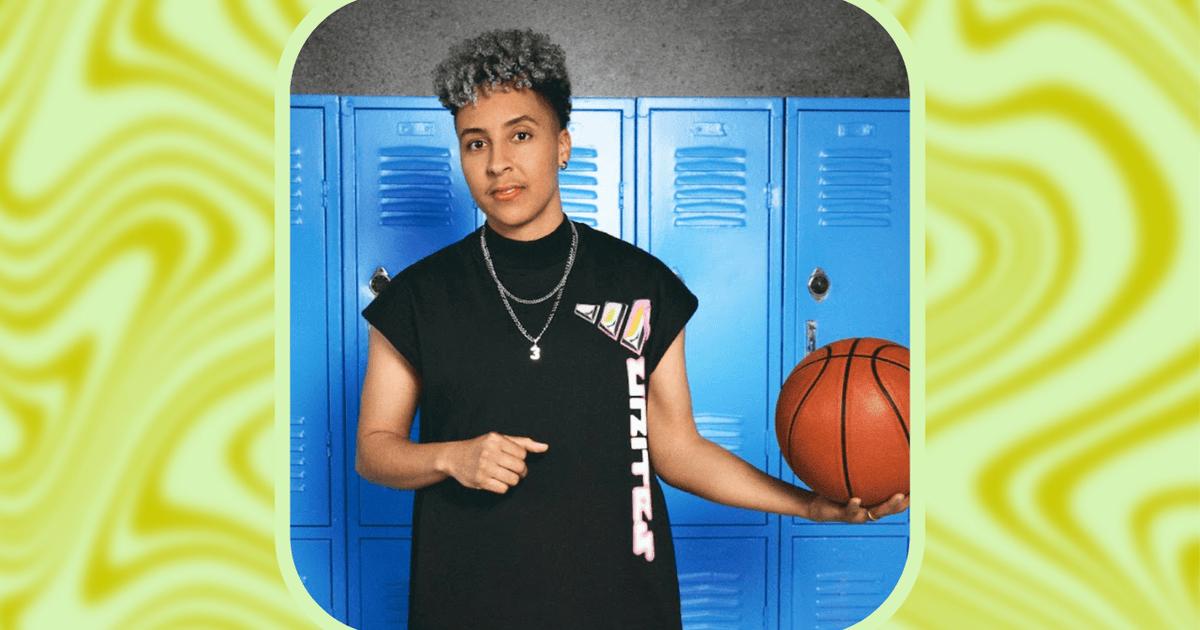
For Layshia Clarendon, it was never just about basketball. Over the course of a career that has spanned grade school gyms, college arenas, the WNBA, and the international stage of the FIBA World Cup, sport is bigger than any of that. “[Sports have been] everything from a therapist, to a best friend, to a worst enemy,” Clarendon tells Her Campus in an exclusive interview. “[It’s my] security blanket, my identity, and everything in between.”
That sense of belonging in sports — in what’s “a Black space, a really queer space,” as Clarendon says — has shaped not only how they moved through the WNBA as the league’s first openly nonbinary and trans player, but how they continue to show up for others now. “Queer athletes have been around forever and ever and ever, and we’re not going anywhere,” Clarendon says. “No matter what people try to tell you, no matter what these bills try and tell you.”
After their final buzzer in the WNBA in 2024, Clarendon is still making an impact. As a point guard, Clarendon controlled the basketball court and served as a leader on their teams. Now, through the Layshia Clarendon Foundation and other game-changing partnerships, they are working to ensure that other trans people of color can experience the same life-changing affirmation they found in sports — proving that the community basketball gave them is something they’re determined to pass forward.
For Clarendon, who spent over a decade on five different teams in the WNBA — plus gold medals with the USA Women’s U19 Team in 2009 and on the senior roster for the FIBA Women’s Basketball World Cup in 2018 — being a space of belonging is one of the most important things sports can do for people. “A lot of times you interact with folks you probably wouldn’t be friends with normally,” they say. “There were a lot of people I played with where it was like ‘I wouldn’t actually be your friend, but we’re teammates, so I’ve gotten to know you more than I would have,’ So, I learned a different side of them and learned how to work together with them.”
Through my own experience of having top surgery and just realizing how good it felt, how it literally saved my life to feel good in my body, and [I wanted] other people to have that experience as well.
Layshia Clarendon
Working together didn’t just happen on the court. Clarendon notes the variety of support they got during their journey as the first trans player, the first openly nonbinary player, and the first player to undergo top surgery while in the WNBA. “One of my teammates, before I had my little mustache, she helped me fill it in one day for media day with her eyebrow pen,” they say. “She was like, ‘Oh, try this!’ So, that was such a sweet, tender moment of a teammate just seeing you and affirming you in the same way someone will be filling in their eyebrows or mascara on their eyelashes.”
Others in the league — even those Clarendon had never played on the same team as — showed up for them, too. “I never actually played with Brianna Turner,” Clarendon says of the current forward for the Indiana Fever and advocate for LGBTQ+ inclusion in sports. “She’s supported me as just a WNBA colleague.”
From asking questions to educating themselves to continuing to tease in the locker room, Clarendon’s experience with getting gender-affirming care was a critical one: In 2021, it inspired them to start the Layshia Clarendon Foundation — which supports the trans community through education, advocacy, and direct financial assistance. “Through my own experience of having top surgery and just realizing how good it felt, how it literally saved my life to feel good in my body, and [I wanted] other people to have that experience as well,” Clarendon says.
When asked about the most rewarding experience since the launch of the Layshia Clarendon Foundation, Clarendon didn’t hesitate. “Definitely when I got the report [showing] the actual people [the foundation] impacted by giving them access to surgeries,” they say. “We directly have a surgery fund partnered with the Oakland LGBT Center, and so folks who didn’t have the means, quite literally, to have the thousands of dollars they needed to get their gender affirming surgery, and then they got to have that because of our direct funds to them. That’s the moment I really teared up.”
Helping people get access to health care is super important, especially with a sweeping number of bills introduced across the U.S. to try to ban it. According to the Trans Legislation Tracker, over 1,000 anti-trans bills have been introduced in the United States at the federal and local levels. Over a hundred of those focus on prohibiting trans athletes from participating in sports in line with their gender identity, and over 200 look to restrict or ban access to gender-affirming care.
But just as Clarendon had a roster of teammates in the WNBA, they have a team at their foundation, and it may be slightly unexpected: Adidas. On Dec. 2, also known as #GivingTuesday, Adidas released its limited-edition Community Archives zine to honor cultural changemakers partnering with the brand. Featured as part of a multi-page Words of Wisdom spread is Clarendon, who partnered with Adidas to start their foundation.
The Three Stripes are about more than sneakers and athletic wear. Through an arm called Athletes For Impact, Adidas has partnered with hundreds of athletes to help change the world. Clarendon explains that there was never any question about what they wanted their foundation to do. “I directly wanted to impact trans people of color,” Clarendon says. “Adidas was like, ‘Great, say the word, what are we doing?’ They were just on board from the first moment I said I wanted to start the foundation and get the money directly, so it’s really cool to see [Adidas] putting their money and their ethics and their values where their mouth is. And that’s something Adidas has stood by me from day one through my entire journey.”
Remember your why. Why are you doing it? What’s the point? Why are you stepping out there? Know your anchor and then remember that
Layshia Clarendon
When asked what they want young, queer athletes to remember, Clarendon has three pieces of advice. The first? “Always know: you belong in sports.” Even if you’re the first out, you’re not the first to exist, and you won’t be the last. “This is a place for you to belong, in sports, and that’s the beauty of sport,” Clarendon says.
The second reminder is about happiness. “Remember the joy of why you first stepped on the court or the field or the track, and don’t lose sight of enjoying to play,” Clarendon says. “There are a lot of things that can bog you down in the grand scheme of playing, whether it’s competitiveness, the coaches, the teammates, the parents, all the drama that comes with it.”
They explain, “That’s what kept me going for over a decade: I enjoyed it, and I always come back to that, even through the hardships: Once I step on the court, whether it’s practice or a game, I have a tremendous amount of joy, just playing the game of basketball.”
Finally, Clarendon’s last piece of advice: “Remember your why. Why are you doing it? What’s the point? Why are you stepping out there? Know your anchor and then remember that.”