
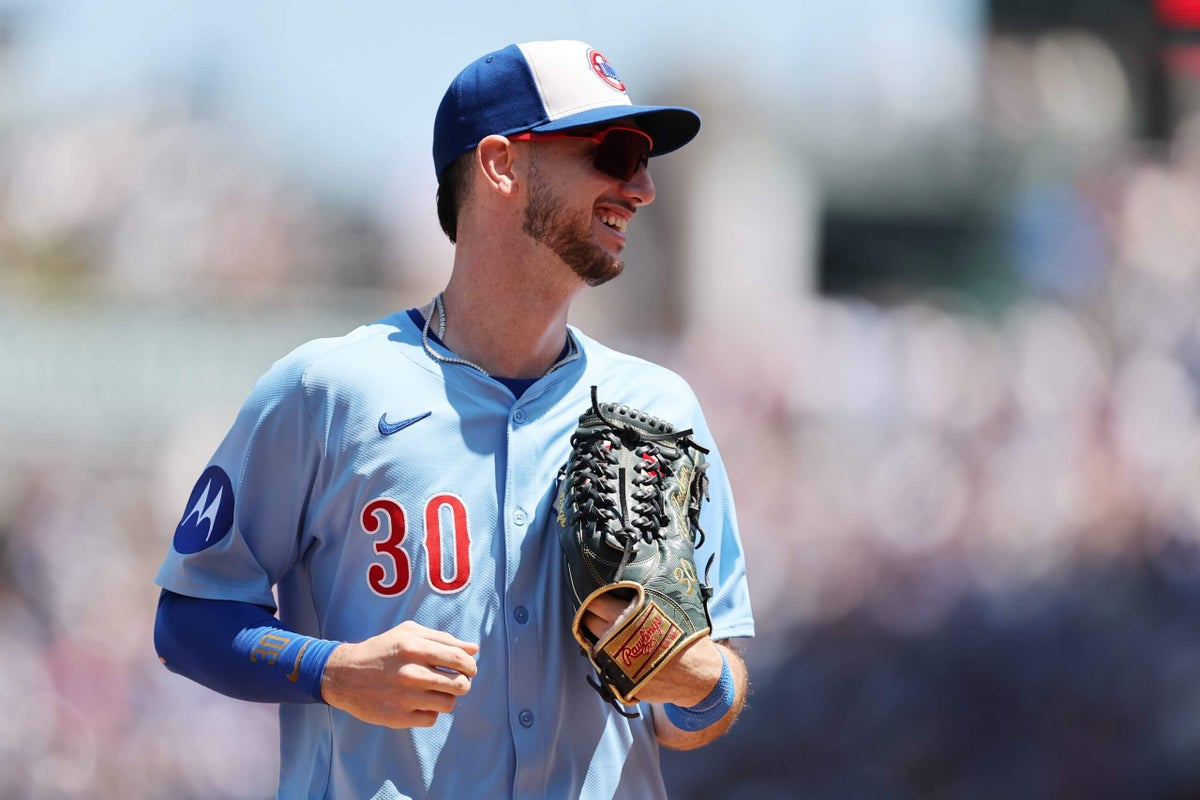
Now that star free-agent outfielder Kyle Tucker has reached an agreement on a four-year, $240 million contract with the Los Angeles Dodgers, here’s what it means for the back-to-back World Series champions and the two other known bidders, the New York Mets and Toronto Blue Jays.
Los Angeles Dodgers
Think the Dodgers didn’t particularly need Tucker? Think again.
If Tommy Edman was unable to play center field coming off right ankle surgery, the Dodgers were looking at opening the season with Andy Pages in center, Teoscar Hernández in one corner and Ryan Ward and Alex Call platooning in the other.
Now, a previous weakness — Dodgers left fielders ranked 17th last season in OPS — looks like a potential strength.
Tucker will play right field, with Hernández likely moving to left. Pages figures to remain in center, with Edman serving as a possible alternative. And Tucker’s short-term deal, which includes opt-outs after two and three years, still leaves flexibility for the Dodgers to eventually mix in four top outfield prospects, two of whom (Josue DePaula and Zyhir Hope) ended last season at Double A.
Hope and a highly regarded young pitcher, left-hander Jackson Ferris, were the return for Michael Busch and reliever Yency Almonte. Mike Sirota, another of the outfield prospects, came from the Cincinnati Reds in a trade for Gavin Lux. Critics of the Dodgers give them too little credit for such under-the-radar moves. But that’s because they keep bullying the rest of the league by signing free agents such as Tucker.
The Dodgers paid a record luxury tax last season of $169.4 million. They already were $35 million over the highest threshold. Tucker’s agreement contains $30 million in deferrals, with $10 million in each of his final three seasons, bringing the net present value of his deal to $57 million per season. Not that the Dodgers are worried. If they had missed on Tucker, their options would have been limited. They might have simply seen how the first half went and regrouped at the deadline.
A reunion with Cody Bellinger would have been unlikely. Maybe the Dodgers would have signed Harrison Bader, whom they pursued at last year’s deadline. Maybe they would have renewed their quest for another deadline target, the Cleveland Guardians’ Steven Kwan. Maybe they would have traded for the Boston Red Sox’s Jarren Duran or Wilyer Abreu, tried for the St. Louis Cardinals’ Brendan Donovan or signed free agent Bo Bichette to play second.
Tucker is a better answer.
New York Mets
While the idea of carrying two $50 million corner outfielders seemed ill-conceived, particularly when neither is an above-average defender, what the heck will the Mets do now that they’ve failed to land Tucker?
To sign Bellinger, the next-best free-agent outfielder, they would need to beat the Yankees’ five-year offer for between $155 million and $160 million, without deferrals. That seems unlikely, given the Mets’ preference for shorter deals. But to a degree, they have backed themselves into a corner. Which is why Tucker was practically a must-have.
Bader, the best of the other free-agent outfielders, could fit short term, even with the Mets wanting to keep center field or left field open for rookie Carson Benge. A trade for one of the Red Sox’s outfielders is another possibility, though the Mets do not appear positioned to fill the Sox’s need at second or third base. Trading third baseman Brett Baty, another young player the Mets are eager to make a regular, would only create another hole.
Had the Mets signed Tucker, they would have moved forward with a revamped lineup that included two other offseason additions in second baseman Marcus Semien and first baseman/DH Jorge Polanco. But now they still might be operating at an offensive deficit following the departures of first baseman Pete Alonso, left fielder Brandon Nimmo and infielder/outfielder Jeff McNeil.
President of baseball operations David Stearns remains under intense pressure to salvage the team’s offseason.
After losing closer Edwin Díaz, the Mets supplemented their bullpen by signing free agents Devin Williams and Luke Weaver. They still need to add a starting pitcher, perhaps by trading for Freddy Peralta or MacKenzie Gore, or perhaps by signing free-agent lefty Framber Valdez or righty Zac Gallen.
But the offense remains a major question mark.
Toronto Blue Jays
The Jays are a strong bet to repeat as American League champions even after striking out on Tucker. They have spent more than any other team in free agency, with a combined $337 million on right-hander Dylan Cease, infielder Kazuma Okamoto, reliever Tyler Rogers and right-hander Cody Ponce. And their outfield already is in good shape, at least for 2026.
Tucker, though, would have been an upgrade not only for this season, but also a fixture in 2027 and beyond. That was no small consideration for the Jays with Daulton Varsho and George Springer entering their walk years. The free-agent class of outfielders next offseason also lacks a cornerstone-type player.
With Tucker in right, the Jays would have stayed with Varsho in center, perhaps platooned Addison Barger with Okamoto at third and either played Anthony Santander in left or made him available in a trade. The odd man out could have been left fielder Nathan Lukes, a league-average hitter and strong defender who turns 32 in July. But probably not now.
Lukes should continue to play a valuable role, and Barger should continue to get at-bats in right field. If Bellinger goes back to the Yankees and Bichette signs with the Phillies, the rest of the Jays’ offseason likely will include only minor alterations.
Per Fangraphs, the Jays’ luxury-tax payroll is beyond the highest threshold at $304 million, meaning they would have paid a 90 percent tax for every dollar they awarded Tucker in 2026. The Dodgers will pay a 110 percent tax on every dollar they are above. (They will be penalized at a higher rate than the Jays would have been for exceeding the base threshold three or more consecutive years; the Jays have done it two straight.)
The signing of Tucker would have capped a remarkable shift in perception for the Jays, demonstrating once and for all that free agents are more than willing to go to Toronto. But the Jays already were in a better place, as evidenced by the rest of their offseason. And even without Tucker, they should remain a force.