
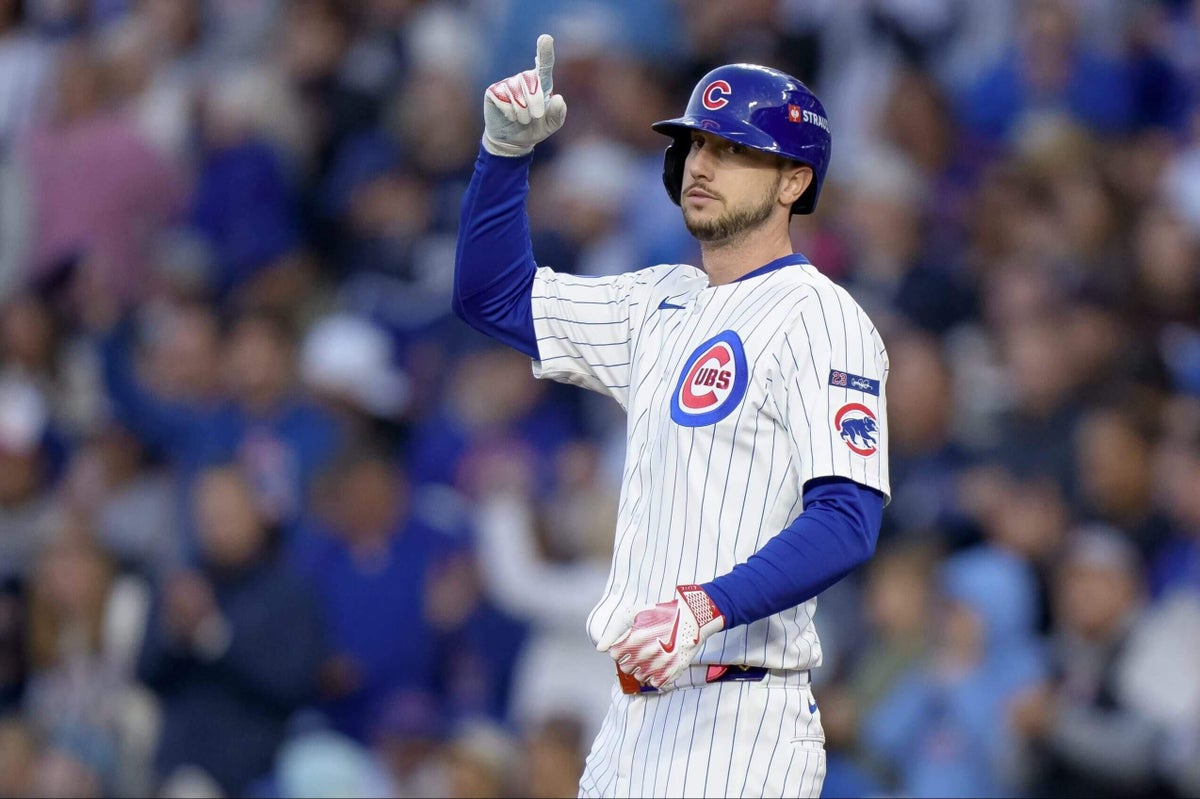
Shortly after the Kyle Tucker news broke, a major-league coach called me, unaware of what had just transpired. When I informed him of Tucker’s four-year, $240 million agreement with the Los Angeles Dodgers, the coach blurted out, “We’re going to have a lockout!”
True enough, but a lockout was always inevitable when the collective-bargaining agreement expires on Dec. 1. The Tucker deal, which, even after deferrals, includes a record average annual value of $57.1 million, will further embolden commissioner Rob Manfred and all of the owners who want to push for a salary cap. But the coming labor hysteria also will obscure realities Manfred and Co. would prefer to ignore.
The Dodgers not only outspend every team by a wide margin, but also outsmart and outperform them. In the current system, their success prevents them from picking high enough in the draft to access future stars like Paul Skenes, Bobby Witt Jr. and Tucker, who went fifth overall in 2015. Thus, the Dodgers are denied the best avenue to the most precious resource in the sport: young, controllable star talent. The only way for them to access such players is through trades and free agency. Now that they are awash in money thanks to Shohei Ohtani, they’re supposed to stop trying their hardest to get good players?
Too many clubs, large- and small-market alike, take a defeatist approach, preferring to lament, “baseball is broken,” rather than figure out how to prove it isn’t. No one can dispute that vast revenue differences exist in the sport, even between the Dodgers and other large-market teams. Those differences can be addressed in ways other than a cap. And if the owners try to force one upon the players’ union, it might shut down the industry for a full season at a time when the game is in the midst of a renaissance. Doesn’t seem like a great idea.
The Dodgers are convenient bogeymen, but the sport derives an intangible benefit from a David vs. Goliath dynamic, with 29 teams trying to slay the giant. And all those who find the Dodgers’ gorging offensive also tend to overlook that their spending provides real benefits as well.
Not only did the Dodgers’ star power help them lead the majors in road attendance the past two seasons, but in that time they also paid $272.4 million in luxury tax, including a record $169.4 million in 2025. That’s on top of the estimated $150 million per season they contribute in revenue sharing. Per The Athletic’s Evan Drellich, that money is essentially split between the league and players, with half going to the clubs in some form, the other half to player retirement funds.
Rest assured, the Dodgers’ payout will be even greater this season. With Tucker, their luxury tax payroll according to FanGraphs stands at $396 million, more than $90 million over the highest threshold.
If the league can’t get a cap, it surely will seek higher luxury tax penalties in the next CBA. The likelihood of increased restrictions on spending, in one form or another, perhaps gave the Dodgers additional motivation to go nuts for Tucker, whose AAV beat Juan Soto’s record by more than $6 million. The high rollers in Hollywood wanted one last whiskey before the bar closed.
No other team can win under such circumstances, you say? Consider the facts, starting with this: The Dodgers did not carry the game’s highest payroll last season. The New York Mets did, and failed to even make the playoffs.
Now look back on the past two postseasons, which ended with the Dodgers winning the World Series.
The San Diego Padres, who operated as a small-market franchise until late owner Peter Seidler decided to run the club with a more grandiose vision, needed one win to eliminate the Dodgers in the 2024 Division Series. The Padres were at home, playing before their raucous fans and with the advantage of the Dodgers throwing a bullpen game. They could have put the Dodgers away, ended this dynasty before it started. Instead, they were shut out in the final two games.
Last year, more of the same. The Toronto Blue Jays, carrying the game’s fifth-highest payroll, were still more than $80 million below the Dodgers in the World Series. Didn’t stop them from taking a three-games-to-two lead heading back to Toronto. Or getting within two outs of winning Game 7. But they, too, could not put the Dodgers away.
Both on and off the field, Ohtani is a major part of the Dodgers’ success. People forget, Ohtani reportedly offered his incredibly club-friendly 10-year contract — $70 million annually, with all but $2 million deferred — to at least three other teams. The Blue Jays and San Francisco Giants accepted. The Los Angeles Angels declined. Ohtani chose the Dodgers, thinking they gave him the best chance to win. Smart move.
Ohtani created the payroll flexibility for the Dodgers to keep buying talent, generated millions in additional revenue to make them even more of a financial behemoth and served as a beacon for other players to follow, including his Japanese countrymen, pitchers Yoshinobu Yamamoto and Roki Sasaki.
That short-term, high-dollar structure that Tucker just accepted, with opt outs after years two and three? The Dodgers for years have offered free agents that type of deal. Some initially balked, including Bryce Harper, who in February 2019 turned down a four-year, $180 million free-agent proposal. Now players like Tucker and closer Edwin Díaz jump at such offers, eager to partake in the Dodgers’ culture and perhaps a championship parade. Following Ohtani’s lead, they’re often willing to take deferrals, too.
Success builds upon success, and yes, money is a big part of it. But the Mets under owner Steve Cohen want to be the Dodgers, and can’t figure out how to do it. And what prevents other large-market clubs, in particular, from standing up to the bully?
The Dodgers entered the offseason not necessarily intending to sign Díaz, the best closer on the market, and Tucker, the best hitter. But they “hung around the backboard” in their usual fashion, prepared to pounce.
Díaz and Tucker preferred to go short with them rather than do it with the Mets, who lack the Dodgers’ recent history of success and in both cases made lower offers. The Blue Jays offered Tucker a higher guarantee than the Dodgers over a longer term but a lower AAV. The Boston Red Sox pulled off a Dodgers-type deal last offseason when they signed third baseman Alex Bregman, then wilted this offseason trying to keep him. And with both Tucker and Díaz, the New York Yankees, among others, were nowhere to be found.
Signing free agents who reject qualifying offers comes with an additional price, one many teams often balk at paying. The Dodgers, because they exceeded the luxury tax last season, forfeited their second- and fifth-highest draft picks plus $1 million in their international bonus pool for Díaz, their third- and sixth-highest picks for Tucker.
This isn’t the first time in recent years the Dodgers forfeited picks — they also sacrificed their second- and fifth-highest to sign first baseman Freddie Freeman prior to 2022 and Ohtani prior to ‘24. Yet, The Athletic’s Keith Law last year rated the Dodgers’ farm system the third-best in the game. Not bad, considering they haven’t had a top-10 pick since 2006 and a top-five choice since 1993.
Money is part of that, too. The Dodgers spend heavily on scouting and R&D. But the domestic draft and international markets are capped, and still the Dodgers keep the young talent flowing, mostly through opportunistic selections at lower draft positions and forward-looking trades.
Again, baseball’s playing field needs to be more level. But as other leagues have shown, a cap is not necessarily a panacea for competitive balance, even with an accompanying salary floor. Owners who salivate over the idea of such a system increasing their franchise values seem to forget that a prolonged work stoppage would set those values back. And the owners almost certainly are not getting a cap without losing a chunk or all of the 2027 season.
So, stiffen the luxury tax penalties for the Dodgers and the other big spenders. Increase revenue sharing for the small-market teams, give them additional draft picks, come up with other creative solutions to help them better compete.
The Dodgers hold big advantages, sure. But they’re hellbent on winning, and their success does not stem solely from spending. Let’s see other teams compete as fervently, to the best their resources will allow. Then let’s have a conversation about the future of the sport.