
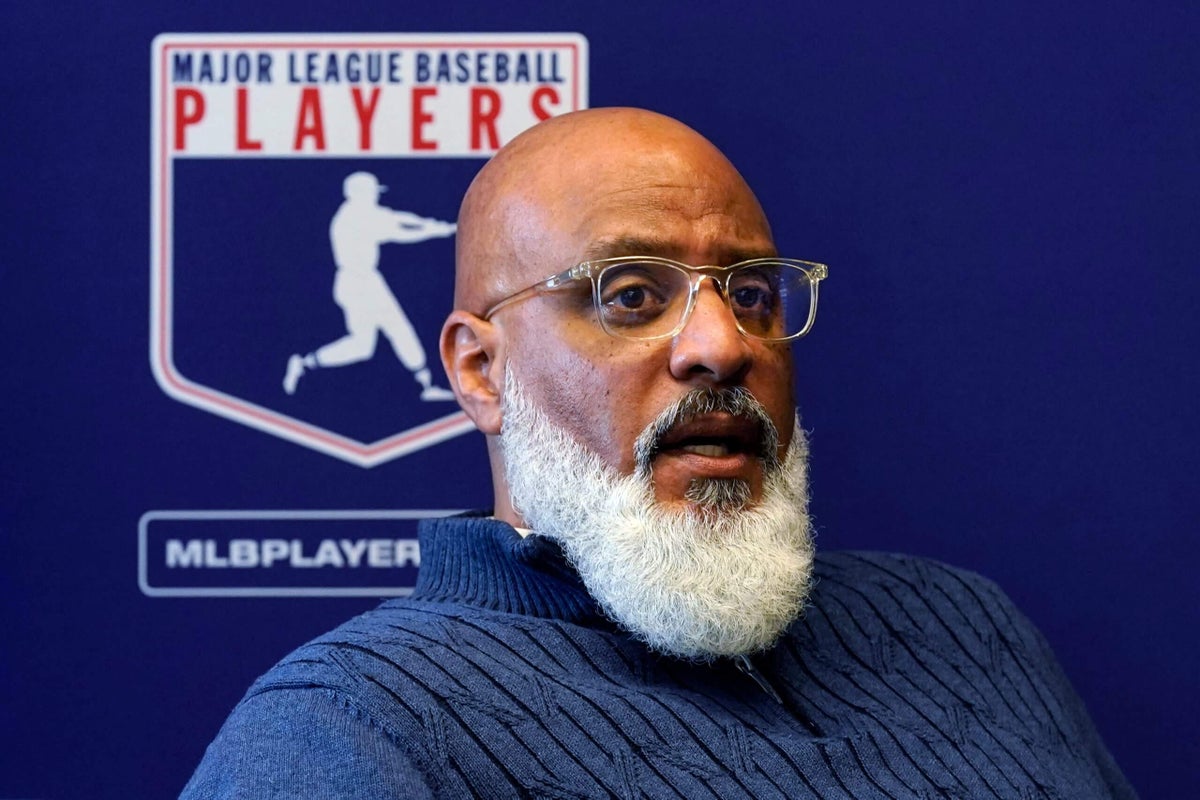
Facing growing concerns from players in the wake of a federal investigation, Tony Clark is expected to resign from his position as executive director of the Major League Baseball Players Association, leaving the union scrambling to find a leader heading into what’s expected to be a lengthy labor dispute this winter, people briefed on the decision who were not authorized to speak publicly told The Athletic.
Members of the MLBPA’s eight-player executive subcommittee have been in contact with federal officials in recent months since the Eastern District of New York opened an investigation into Clark and the MLBPA last year regarding using licensing money or equity to enrich themselves, according to a person with knowledge of the situation.The Department of Justice expanded its inquiry into Clark in October.
Clark, his attorney and the MLBPA did not immediately respond to requests for comment.
Clark and the MLBPA were supposed to start their annual tour of spring training camps in Arizona on Tuesday. The first stop, a meeting with the Cleveland Guardians, was canceled, which the team found out from the union at 6 a.m. local time.
The union plans to announce an interim replacement, said Los Angeles Angels pitcher Brent Suter, a member of the executive subcommittee. Suter cited the upcoming bargaining sessions, which are expected to begin this summer, as the union’s priority. The MLBPA hopes to “keep everything as stable as we can this year,” Suter said. The most obvious candidate would be deputy director Bruce Meyer, who was already set to be the union’s lead negotiator.
Meyer spent time calling agents on Tuesday to firm up his support among players, according to people familiar with the situation.
The Athletic broke the news of Clark’s departure on Tuesday morning just as players were arriving for workouts in Arizona and Florida, with the MLBPA’s leadership council not yet able to convene player representatives from all 30 clubs to explain the decision. The union leaders plan to meet at 4:30 p.m ET on Tuesday. New York Mets infielder and executive subcommittee member Marcus Semien told reporters that Clark’s decision stemmed from the federal probe.
“There has been an investigation going on,” Semien said. “We still need to discuss with players why. You definitely don’t want things to be a distraction going into December.”
Players like Suter and San Diego Padres infielder Jake Cronenworth took pains to downplay the upheaval at the union. Cronenworth, another subcommittee member, described the state of the group as “strong.” Suter hit a similar note.
“Let me tell you, the ship is strong,” Suter said. “We just need to make the right decisions today and moving forward, and we’ll be just fine.”
Yet the resignation occurs at a time of heightened rhetoric as the owners are expected to lock out the players at the conclusion of this season when the current collective bargaining agreement expires. The owners executed the same tactic after the 2021 season, shutting down the sport for 99 days. The upcoming negotiation could last longer, as owners have become vocal about the necessity for a salary cap, used by leagues like the NFL, NBA and NHL, in the wake of rampant spending by teams like the Los Angeles Dodgers and New York Mets.
Clark oversaw the negotiations for this current CBA alongside Meyer. Both are strongly opposed to a cap, which the union believes would not help competitive balance in the sport. Earlier this month, Meyer delivered the rebuttal in Detroit Tigers ace Tarik Skubal’s landmark arbitration case in which Skubal was awarded a $32 million salary for 2026. Skubal vouched for Meyer on Tuesday.
“I don’t think it has any impact on negotiating,” said Skubal, another member of the subcommittee. “Bruce has been our lead negotiator. He’s done it in the past. Although Tony has been the face of the PA in terms of negotiating, I’m still as confident as ever in Bruce and everyone else that we’ve got behind him.”
Clark joined the union in 2010 at the conclusion of a 15-year playing career. He worked in player relations before becoming the deputy executive director. After the death of MLBPA chief Michael Weiner in December of 2013, Clark took over the head position. In 2018, Clark brought in Meyer, who had advised former MLBPA chief Don Fehr with the NHL Players’ Association, to aid CBA negotiations.
Discord between the owners and the players emerged before the 2017-21 agreement expired when the sport shut down to protect against the Covid-19 pandemic in 2020. Those contentious talks foreshadowed the extended lockout in the winter before the 2022 season. The two sides struck an agreement on March 10 and managed to avoid cutting games from the schedule. But the specter of a work stoppage has loomed over the sport ever since.
Clark and Meyer faced criticism from within the union even before the federal probe. The tension culminated in a push for new leadership by some players, agents and a former MLBPA attorney.
With a lockout on the horizon and unrest among some of his constituents, Clark became the subject of an expanded focus in October related to Players Way, a for-profit MLBPA arm focused on youth baseball. After its founding in 2019, Players Way spent close to $10 million despite holding few events, ESPN reported last year. That expenditure was more than twice the $3.9 million the union told the outlet it had spent.
“Any suggestion that Players Way has not been supported by our elected player representatives and broader membership is patently false,” Clark said in a statement last year. “Players Way has been front and center at every annual meeting of the MLBPA Executive Board in recent memory, and our dialogue with players regarding youth development continues throughout the calendar.”
Despite the pushback at the time, the investigation proved consequential enough to lead to Clark’s departure.
“There’s people that like Tony, there are people that don’t like Tony, but as a whole, where we are now comparatively to where we were 10 years ago, is a much better spot,” said Miami Marlins reliever and executive subcommittee member Pete Fairbanks. “Dealing with this will be its own separate entity in terms of where it goes and what it does for Tony Clark in people’s estimations, but he’s been a steadfast voice that’s been fighting for players for some time now, and I don’t think we should discount that.”
Additional reporting contributed by Sam Blum, Tim Britton, Dennis Lin, Cody Stavenhagen and Katie Woo