
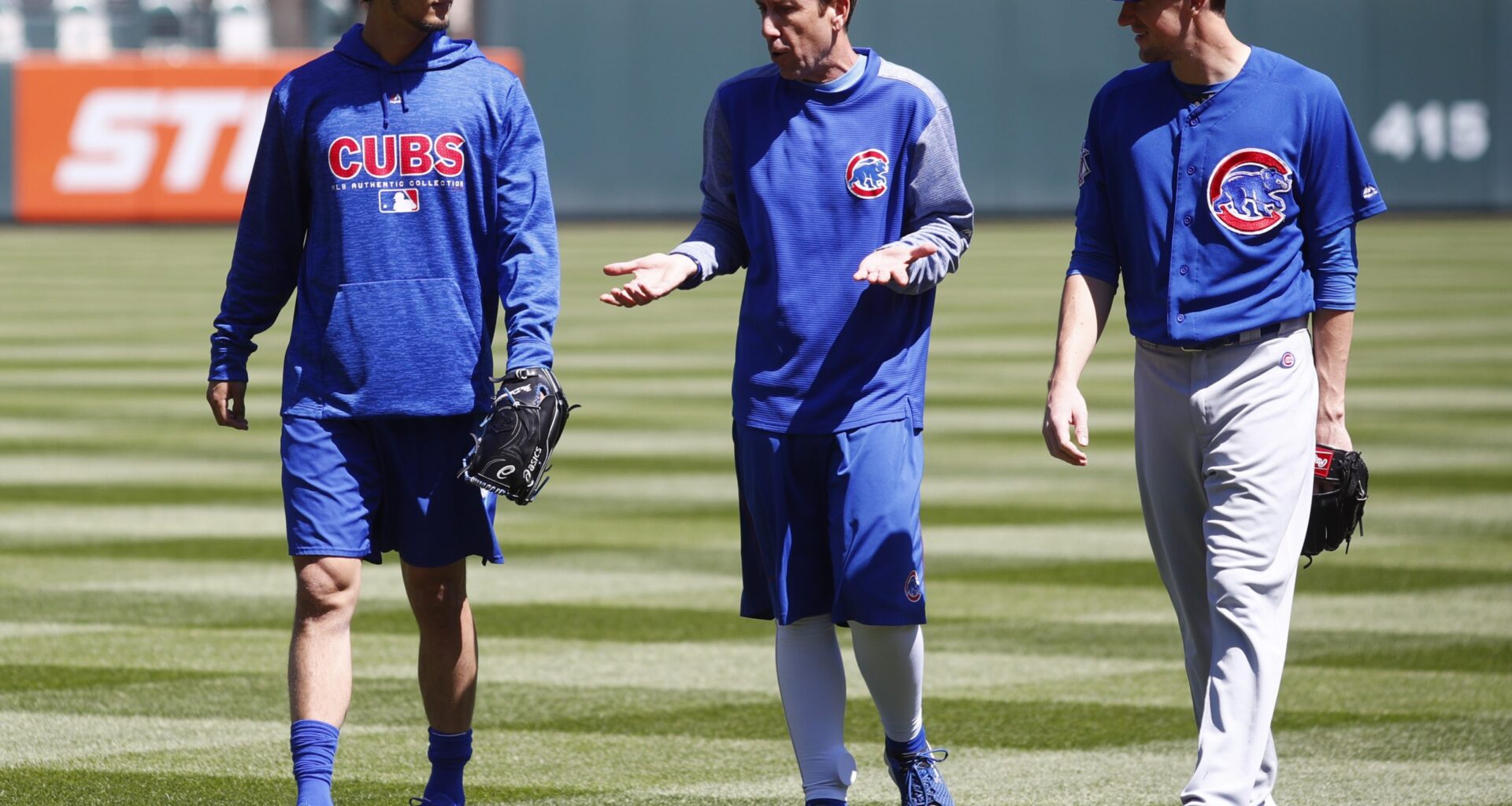
PHOENIX – Mike Borzello is an advance scout in every sense of the word.
Before a single player stretches on the grass or a group of fans trickles into the ballpark for a Cactus League game, Borzello is logging notes – evaluating roster battles, studying defensive positioning and identifying trends that might not show up in a box score.
Spring training is often viewed as exhibition baseball – a warmup for the 162-game grind ahead. Inside a front office, however, it functions as evaluation season.
“You want a perspective that’s not your own, and you want to value that,” Padres manager Craig Stammen said of advance scouts. “They’re looking at the game from a different perspective; we’re looking at it from the dugout.”
Scouts are not watching the game emotionally. They are watching it analytically – tracking pitch sequences, defensive alignments and player decisions.
“I think they’re probably specific in what they’re looking for,” Stammen said. “Their eyes and ears are open for something that they may not have seen that piques their eyes and their ears, that could give the team an advantage to win a ball game or win a series.”
That perspective is especially critical in March, when roster spots are still unsettled. For many players in camp, the difference between making the Opening Day roster and heading to Triple-A can hinge on those evaluations.
“We’re analyzing our own, watching our own players, making decisions on certain guys and who we want when we start condensing the roster,” Borzello said. “As spring training goes later, then I’ll start advancing the opposition.”
Early in camp, Borzello’s focus is internal. He is helping determine which young players are ready and which roles remain up for grabs, tracking pitch selection, defensive positioning, and how players respond when game situations speed up.
“For what I’m doing now is we’re trying and evaluating; we already know the tools that each guy has for the most part,” Borzello said. “We’re watching to see if the young guys that are in camp are ready.”
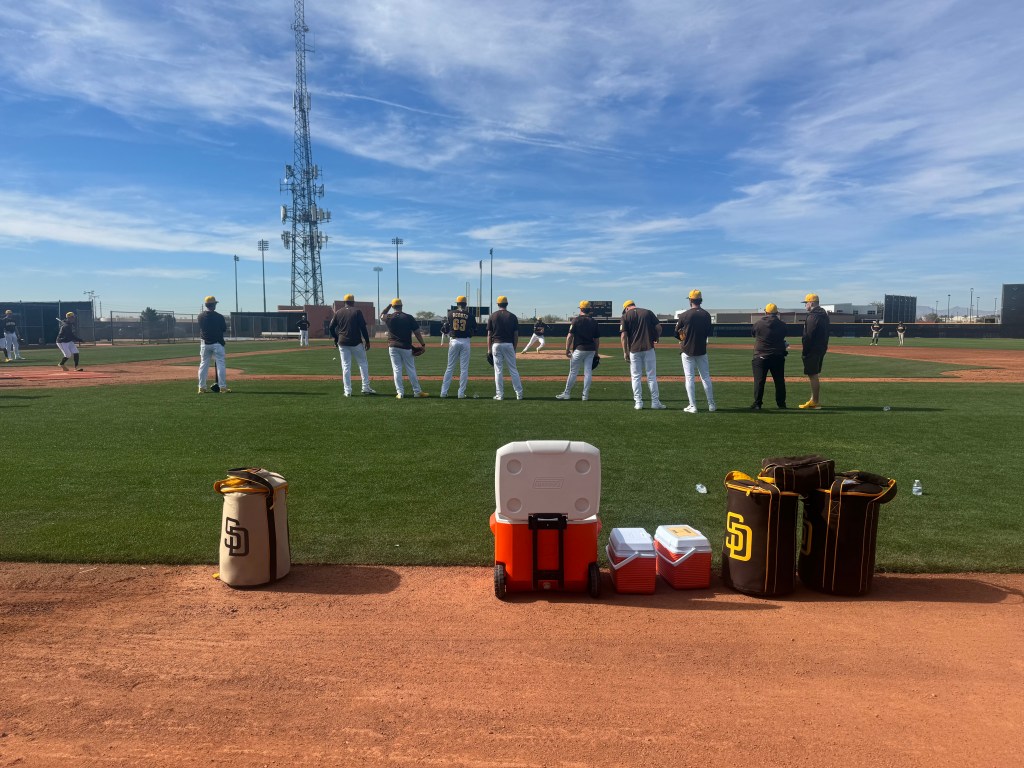 Coaches and scouts are always analyzing the moves and actions of players, including at this San Diego Padres workout. (Photo by Riley Reisner/Cronkite News)
Borzello said that most of the Opening Day roster is largely established. Spring is about the margins. This is a time where, if you are a scout, you hope to see breakouts in young talent that could blend the roster without having to deal with that on the fly when a star player may go down.
“I think it’s a ‘You got to see it a couple times to believe it,’” Borzello said. “Especially if it’s someone that’s kind of a dark horse.”
Scouts are looking for consistency — whether a pitcher can command the strike zone multiple outings in a row, whether a bench bat can consistently execute situational at-bats, whether a defender’s instincts hold up over time.
For A.J. Preller, general manager and president of baseball operations for the Padres, perspective matters at this time of year, and evaluation must be handled carefully.
“I think we’ve all seen over the years, you can get fooled in spring training pretty easily,” Preller said. “You’ve got to put it all in context.”
Spring statistics can be misleading. Competition levels vary. Pitchers are often experimenting with grips or building arm strength. Hitters may be focused on timing rather than results. The games are different. The stakes are different. But the information still matters.
As camp progresses, Borzello’s responsibilities expand beyond internal evaluation. With Opening Day approaching, preparation for opponents begins.
“So we open the MLB season with the Detroit Tigers, and then we play the Giants,” Borzello said. “So I’ll go watch the Giants play a lot of games and make my notes and see how their roster is shaping up.”
That work becomes the foundation of advanced reports — detailed breakdowns of opponent tendencies, bullpen usage, defensive alignments, and lineup construction that coaches use when game-planning the first couple of series of the regular season.
Then comes the part fans never see.
After games, Borzello heads into the clubhouse, asking questions about pitch selection or positioning to clarify what he observed in real time. Later, at home, the video review begins again.
“By the time I get home, they’ll usually have the video uploaded, and I can re-watch the game pitch by pitch to see if what I saw matches,” he said.
He studies pitch sequencing, defensive alignments, and execution on cutoff and relay plays — details that can swing close games over a 162-game season.
“I still look at certain pitch locations or pitch selections,” Borzello said. “I want to see how they sequence, see where our position players were lined up, how we did, or how we ran, a cutoff and relay.”
The day does not end with the final out.
During the regular season, Borzello’s schedule shifts to later arrivals and night-game preparation.
“Regular season, most of the time you’re dealing with night games, so I’ll go to the ballpark for batting practice,” he said. “I’ll get there around 3 p.m. … watch batting practice … usually go up into the press box and write some notes.”
For Borzello, the payoff for the early mornings and late-night video sessions comes months later. It comes in a tight September series, when a lineup adjustment or defensive alignment matches something he noted weeks earlier in spring camp.
“Make the postseason,” he said. “When you win a big series, and you feel a part of it, or something happened in a game that you put in a report that made a difference.”
Ultimately, he simplifies it.
“Winning,” Borzello said. “Just winning and more winning, the better you feel about the job you’re doing.”
Before the first pitch of Opening Day is thrown, the reports are written, the video is reviewed, and the final roster spots are decided.
And when the sun rises over the complex the next morning?
“It’s rinse and repeat.”
This <a target=”_blank” href=”https://cronkitenews.azpbs.org/2026/03/03/mlb-scouts-spring-training/”>article</a> first appeared on <a target=”_blank” href=”https://cronkitenews.azpbs.org”>Cronkite News</a> and is republished here under a <a target=”_blank” href=”https://creativecommons.org/licenses/by-nd/4.0/”>Creative Commons Attribution-NoDerivatives 4.0 International License</a>.<img src=”https://i0.wp.com/cronkitenews.azpbs.org/wp-content/uploads/2026/02/favicon1.png?resize=85%2C85&ssl=1″ style=”width:1em;height:1em;margin-left:10px;”>
<img id=”republication-tracker-tool-source” src=”https://cronkitenews.azpbs.org/?republication-pixel=true&post=100387″ style=”width:1px;height:1px;”><script> PARSELY = { autotrack: false, onload: function() { PARSELY.beacon.trackPageView({ url: “https://cronkitenews.azpbs.org/2026/03/03/mlb-scouts-spring-training/”, urlref: window.location.href }); } } </script> <script id=”parsely-cfg” src=”//cdn.parsely.com/keys/cronkitenews.azpbs.org/p.js”></script>
Canonical Tag:
Copy Tag
Article Content:
A day in the life: inside an MLB scout’s world during spring training
Riley Reisner, Cronkite News
March 3, 2026
PHOENIX – Mike Borzello is an advance scout in every sense of the word.
Before a single player stretches on the grass or a group of fans trickles into the ballpark for a Cactus League game, Borzello is logging notes – evaluating roster battles, studying defensive positioning and identifying trends that might not show up in a box score.
Spring training is often viewed as exhibition baseball – a warmup for the 162-game grind ahead. Inside a front office, however, it functions as evaluation season.
“You want a perspective that’s not your own, and you want to value that,” Padres manager Craig Stammen said of advance scouts. “They’re looking at the game from a different perspective; we’re looking at it from the dugout.”
Scouts are not watching the game emotionally. They are watching it analytically – tracking pitch sequences, defensive alignments and player decisions.
“I think they’re probably specific in what they’re looking for,” Stammen said. “Their eyes and ears are open for something that they may not have seen that piques their eyes and their ears, that could give the team an advantage to win a ball game or win a series.”
That perspective is especially critical in March, when roster spots are still unsettled. For many players in camp, the difference between making the Opening Day roster and heading to Triple-A can hinge on those evaluations.
“We’re analyzing our own, watching our own players, making decisions on certain guys and who we want when we start condensing the roster,” Borzello said. “As spring training goes later, then I’ll start advancing the opposition.”
Early in camp, Borzello’s focus is internal. He is helping determine which young players are ready and which roles remain up for grabs, tracking pitch selection, defensive positioning, and how players respond when game situations speed up.
“For what I’m doing now is we’re trying and evaluating; we already know the tools that each guy has for the most part,” Borzello said. “We’re watching to see if the young guys that are in camp are ready.”
Borzello said that most of the Opening Day roster is largely established. Spring is about the margins. This is a time where, if you are a scout, you hope to see breakouts in young talent that could blend the roster without having to deal with that on the fly when a star player may go down.
“I think it’s a ‘You got to see it a couple times to believe it,’” Borzello said. “Especially if it’s someone that’s kind of a dark horse.”
Scouts are looking for consistency — whether a pitcher can command the strike zone multiple outings in a row, whether a bench bat can consistently execute situational at-bats, whether a defender’s instincts hold up over time.
For A.J. Preller, general manager and president of baseball operations for the Padres, perspective matters at this time of year, and evaluation must be handled carefully.
“I think we’ve all seen over the years, you can get fooled in spring training pretty easily,” Preller said. “You’ve got to put it all in context.”
Spring statistics can be misleading. Competition levels vary. Pitchers are often experimenting with grips or building arm strength. Hitters may be focused on timing rather than results. The games are different. The stakes are different. But the information still matters.
As camp progresses, Borzello’s responsibilities expand beyond internal evaluation. With Opening Day approaching, preparation for opponents begins.
“So we open the MLB season with the Detroit Tigers, and then we play the Giants,” Borzello said. “So I’ll go watch the Giants play a lot of games and make my notes and see how their roster is shaping up.”
That work becomes the foundation of advanced reports — detailed breakdowns of opponent tendencies, bullpen usage, defensive alignments, and lineup construction that coaches use when game-planning the first couple of series of the regular season.
Then comes the part fans never see.
After games, Borzello heads into the clubhouse, asking questions about pitch selection or positioning to clarify what he observed in real time. Later, at home, the video review begins again.
“By the time I get home, they’ll usually have the video uploaded, and I can re-watch the game pitch by pitch to see if what I saw matches,” he said.
He studies pitch sequencing, defensive alignments, and execution on cutoff and relay plays — details that can swing close games over a 162-game season.
“I still look at certain pitch locations or pitch selections,” Borzello said. “I want to see how they sequence, see where our position players were lined up, how we did, or how we ran, a cutoff and relay.”
The day does not end with the final out.
During the regular season, Borzello’s schedule shifts to later arrivals and night-game preparation.
“Regular season, most of the time you’re dealing with night games, so I’ll go to the ballpark for batting practice,” he said. “I’ll get there around 3 p.m. … watch batting practice … usually go up into the press box and write some notes.”
For Borzello, the payoff for the early mornings and late-night video sessions comes months later. It comes in a tight September series, when a lineup adjustment or defensive alignment matches something he noted weeks earlier in spring camp.
“Make the postseason,” he said. “When you win a big series, and you feel a part of it, or something happened in a game that you put in a report that made a difference.”
Ultimately, he simplifies it.
“Winning,” Borzello said. “Just winning and more winning, the better you feel about the job you’re doing.”
Before the first pitch of Opening Day is thrown, the reports are written, the video is reviewed, and the final roster spots are decided.
And when the sun rises over the complex the next morning?
“It’s rinse and repeat.”
This article first appeared on Cronkite News and is republished here under a Creative Commons Attribution-NoDerivatives 4.0 International License.
Copy Content
Tracking snippet:
Copy Snippet