
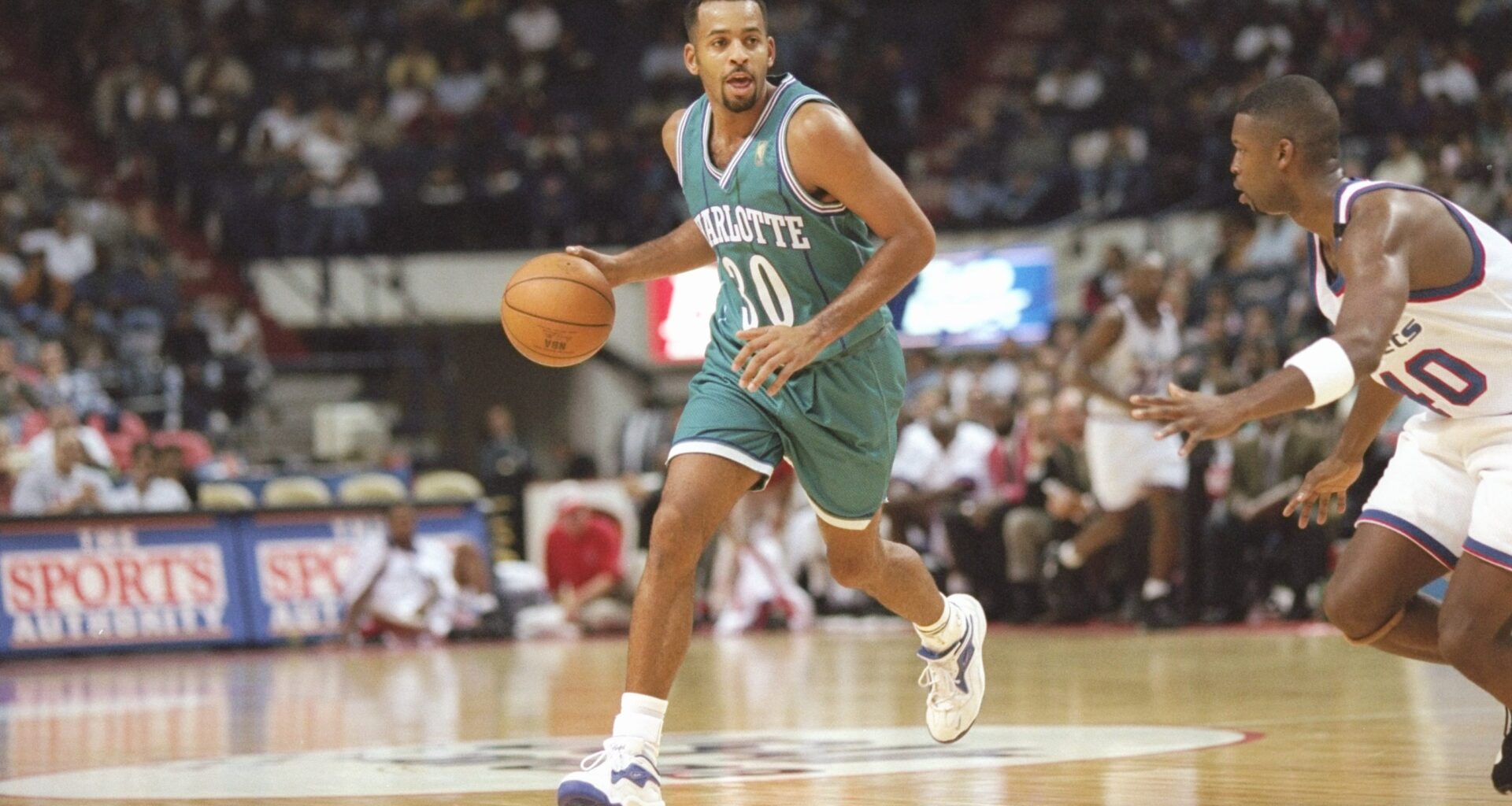
NBA fans and players all over the world wear the No. 30 in honor of Stephen Curry, the greatest shooter in basketball history. Seth Curry, Stephen’s brother, has also worn the No. 30 for most of his NBA career and was the last to don it for the Charlotte Hornets.
For the Golden State Warriors star and his now teammate brother, the No. 30 is a second-generation jersey number that they have worn in honor of their father, Dell, who “set the foundation.”
The No. 30 will be immortalized by the Hornets when they retire Dell Curry’s number in Charlotte during a special on-court ceremony at tonight’s game against the Orlando Magic. Both Stephen and Seth told Andscape they will be in attendance to salute the Hornets’ all-time leader in games played and the first player to join the franchise.
Beyond his accomplishments in Charlotte as a player, Dell Curry is a television analyst with the Hornets and Amazon Prime, and he has been an ambassador and special adviser for the franchise.
“It means the world because the Hornets’ No. 30, pinstripes, Charlotte and Dell Curry are pretty synonymous in terms of what he did as the original Hornet,” Stephen Curry told Andscape. “Ten years playing there, what he’s done as a broadcaster, in the community and all that. Charlotte is our home. I was there in 2016 and they honored him. And then 10 years later, he was going into rafters.
“It’s special for our whole family. We call him the originator. And me and Seth are able to do this because of him. He set the foundation. So, one, to have it happen and, two, to be able to be there and see it in person, I’m so excited.”
Said Seth Curry, Warriors and former Hornets guard, to Andscape: “It’s a big deal. He and the Hornets and the city of Charlotte are kind of synonymous when it comes to basketball. Obviously, with him being the first Hornet, it just represents all he has done for that organization being a part of it for so long. And then obviously, this even makes it even cool that I was actually the last person to wear No. 30 for the Hornets [2024-25 season]. So, it’s huge for that to live up in the rafters forever.”
Dell Curry was selected by the then-expansion Hornets from the Cleveland Cavaliers in the 1988 NBA expansion draft, becoming the franchise’s first player. The sharpshooter played for the Hornets from 1988-98 and retired as the team’s all-time leader in games (701), points (9,839), field goals made (3,951) and 3-point field goals made (929).
Curry, who was the 1994 NBA Sixth Man of the Year, still ranks in the Hornets’ top 10 in games (first), seasons (first), points (second), field goals made (second), field goals attempted (second), 3-point field goals made (second), 3-point field goal percentage (third), steals (fourth), free throw percentage (sixth) and free throws made (eighth).
The Hornets previously retired the late Bobby Phills’ No. 13 jersey weeks after his tragic death in a car accident in 2000, the only other number retired in Charlotte.
Dell Curry found out his No. 30 jersey would be retired when he was surprised on Jan. 14 during a staged sitdown interview on the court at Spectrum Center with Hornets play-by-play announcer Eric Collins.
Dell Curry also has his jersey retired at Virginia Tech and Fort Defiance High School (Va.).
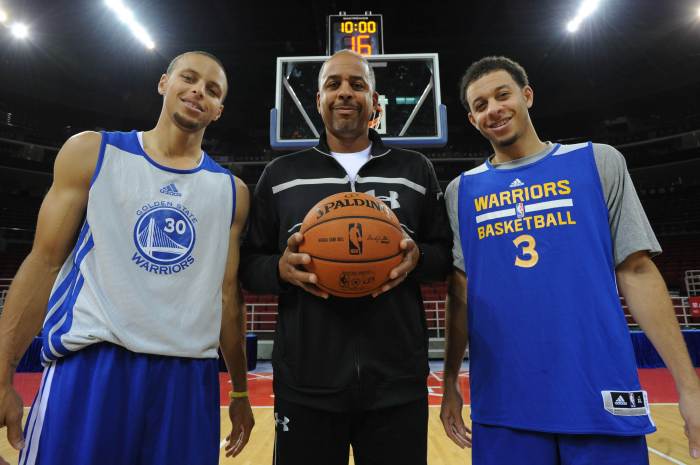 Both Stephen Curry (left) and Seth Curry (right) will be in attendance to honor their dad, Dell (center).
Andrew D. Bernstein/NBAE via Getty Images
“I had no idea. No idea,” Dell Curry told Andscape. “Eric and I spend so much time together. We had talked about it when he got here [in 2015]. He’s like, ‘Your number is not retired?’ I was like, ‘Nah, man.’ So, we had talked about it. I’m like, ‘Just let it go. It’s whatever. I’m going to do what I do.’ That’s not going to change who I am or what I mean to franchise because my number is not up there.
“So, we had that conversation, and then for him to go through this elaborate scheme … the way they just totally hid it from me. He still had been working on it for over a month. The look I must have gave him when he said it was like, ‘Dude, we talked about this, man.’ So, he was like, ‘No, no, I’m not kidding.’ And I had no idea. All the raw emotions came out.”
The following is a Q&A with Andscape in which Dell Curry talks more about his No. 30 jersey being retired; the highs and lows of his playing career with the Hornets; how he became a television play-by-play analyst; his thoughts on the success of his sons in the NBA; what the city of Charlotte means to him and his family; his lifetime devotion to the Hornets; and much more.
For people who don’t remember, what kind of impact do you think you had as a player there?
Being the first guy from the expansion team and the last guy to leave off of that expansion team, I’ve seen it all. I saw the team get better and how the city grew, the franchise grew. So, I was the one guy that was the constant on every team for 10 seasons. I was the one guy that was there every year. So, the fans, they appreciated that. Also, being in the community, they felt like I was a part of them, and I felt the same way from the first time there.
So, I look at this not only as for what I did on the court, but also in the community and now as an ambassador of the team and the broadcaster, being with the team for over 25 years. All of that encompasses this. It’s just not what I did on the court.
You didn’t have to live in Charlotte. But you raised your family there. Why?
Well, one, it was close to home — four, four-and-a-half hours from home — which meant family could come visit as long as they called first. And Charlotte’s a great place to raise kids. You got the mountains, beach, airport. It’s a city, but you can live outside of it and have a quiet community. So, it just felt like home.
I’m from a small town and it felt like a big city, but small-town living. And I knew my kids loved it. So, for me to play 10 years — not being an All-Star, not be a superstar — to be able to park my kids in one spot for 10 years meant a lot.
What did growing up in Charlotte do for them?
Stability. It gave them stability, and it gave them the foundation. That’s why they’re all still [Carolina] Panthers fans. My daughter just moved back from Phoenix. Family is still there. [Seth’s] house is a mile from me now. It’s always been home for them. They’ve got plenty of family, friends that they’ve had for a lifetime there. So, it’s just that foundation and that stability.
What do you remember about being selected by the then-expansion Hornets in the 1988 NBA expansion draft and your emotions at the time?
I was a little disappointed. I knew the Cavs were going to be good. Brad Daugherty was a great friend of mine, Ron Harper, “Hot Rod” Williams, Phil Hubbard. We had [Mark] Price, Craig Ehlo. It was a good team. I knew that I needed to go somewhere where I could get playing time and really showcase my skills. And I remember [then-Cavaliers general manager] Wayne Embry telling me it was a hard decision between me and Craig Ehlo on who not to protect.
But he thought Craig Ehlo would have a better chance of holding [Michael] Jordan down. I was like, ‘OK, good. That makes me feel better.’ That makes me feel better that that was your decision, because I know that’s not going to work.
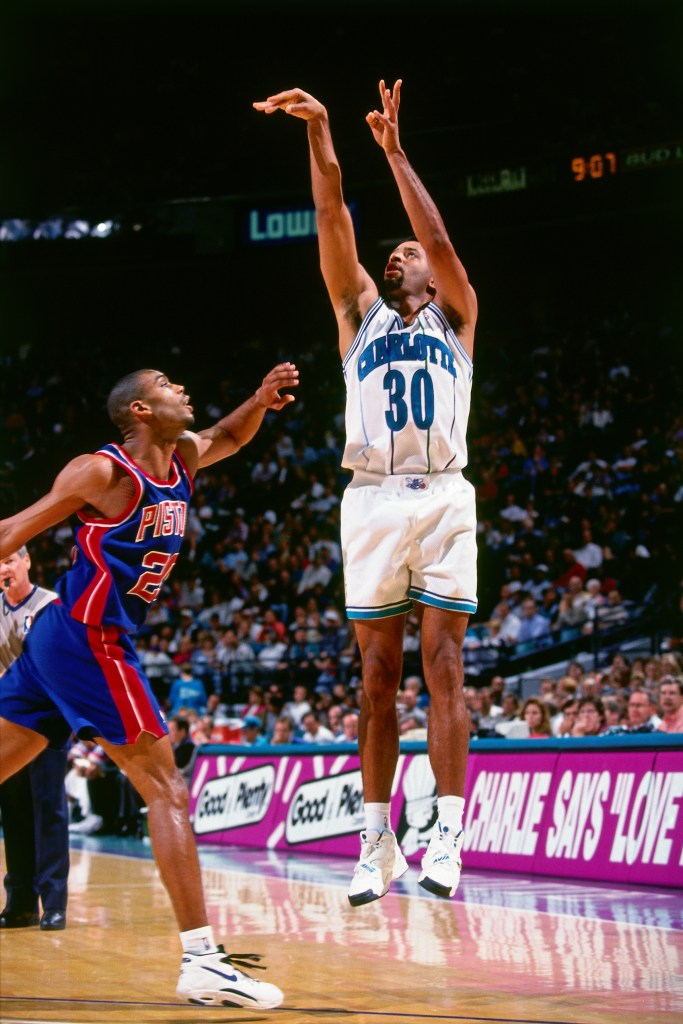 Dell Curry (right) on what the Charlotte franchise means to him: “It’s done so much for me and my family. … I won’t be involved in any other franchise other than this one.”
Greg Forwerck/NBAE via Getty Images
Do you remember the early days with the Hornets when you first got to Charlotte?
Oh, it was great. We were the only show in town. The city was on fire. It was electric. I often said I don’t remember paying for a meal that entire first year, and maybe two. It was a great place to play. Regardless of who we played, everybody came out, sold out the building. We led the league in attendance [seven] straight years.
It was just a fun time to play. And we didn’t win a lot of games, but it didn’t matter. They were happy that we were there doing our best.
In 1998, you were the last original member of the Hornets when you went to the Milwaukee Bucks. Why did you leave?
I actually had a contract on the table to re-sign [with Charlotte]. I had a three-year deal on the table. And before I could sign it, I pulled my calf muscle and they took it off the table. So, I was a little upset when I left. And the owner put it on [then-Hornets coach] Dave Cowens. Dave Cowens put it on the [then] owner [George Shinn]. So, I really remember when I left. But I had a hard time when Muggsy [Bogues] got traded as well [to Golden State in 1997]. Him and I were best of friends. That was an emotional time. I remember we were in D.C. at a hotel and he got traded. So, I remember those two things.
How’d you get into the broadcasting games for the Hornets?
So, the Hornets moved to New Orleans [in 2002], the year I retired. And I was just there [in Charlotte] coaching my son’s high school team, playing golf. And the [Charlotte] Bobcats were made an expansion team (in 2004) and Ed Tapscott was named the president. And I knew Ed. He worked at my agent’s office at one time, so I called him up. I said, ‘Hey, I’m in the community. I’d love to be a part it.’ He said, ‘Absolutely.’ So, I was one of their first hires as an ambassador before we had players. So, I’ve been working. I’ve had ambassador jobs since then, and I’ve never left. I’ve had all kind of jobs. I was scout. I joined the coaching staff for a summer realizing that is not it.
So, I was ready to leave the franchise. I told [then-Bobcats president] Fred [Whitfield] at the time, I said, ‘Hey, coaching is not for me. I’m ready to leave.’ He’s like, ‘No, no, no. We’ll go find something for you to do in the franchise.’ So, I became an ambassador. And I’d done a couple of college games. And Henry Williams, who was our color [analyst] then, he was leaving to become a full-time pastor, and they had to replace him. And they said, ‘Hey, you want to do TV?’ So, I was like, ‘Yeah.’
So, it was four of us. They gave up four people, two or three games. I remember my first two games were on the road, Toronto and Chicago. And when I came back. I was still in the front office at the time. Fred and [then-Bobcats general manager] Rod Higgins walked into my office and closed the door. I was like, ‘What’s this all about?’ They said, ‘You want to do it?’ I was like, ‘Yeah.’ They said, ‘Well, you got to commit to every game.’ So, I found my niche. I love calling the games. It comes natural to me. [Former Hornets-Bobcats play-by-play announcer] Steve Martin showed me the ropes, and now I’m working with Eric Collins. Two of the best guys to do it.
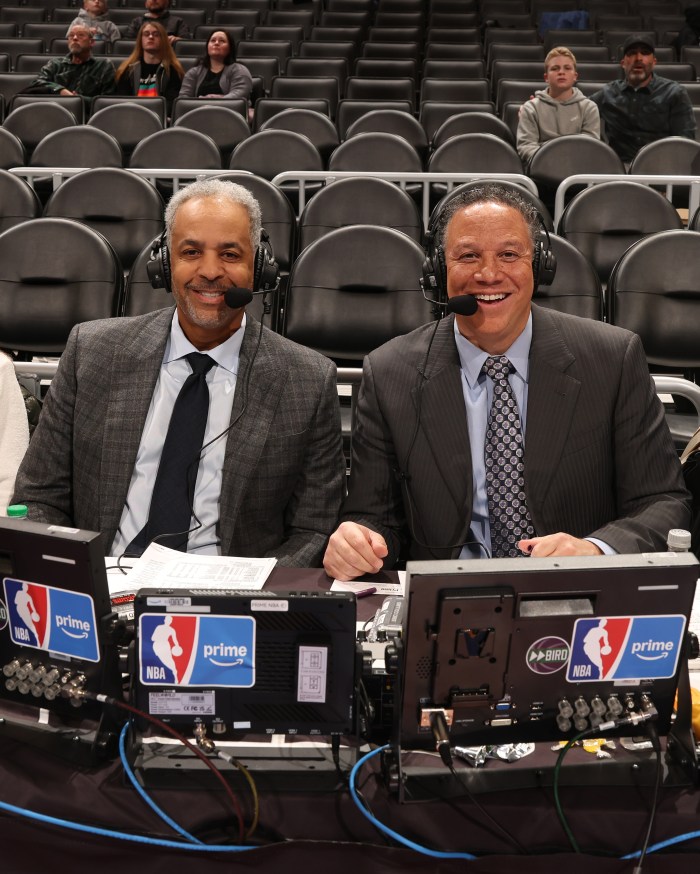 Broadcasters Dell Curry (left) and Eric Collins (right) before a game on Jan. 31 at Spectrum Center in Charlotte.
Kent Smith/NBAE via Getty Images
You still enjoying it at 61 years old? Is the travel tough?
The travel is easy. Yeah. I really enjoy it. I see no reason for me to slow down doing this. I enjoy it. [The struggling seasons] were very difficult to call. But now that we’re getting better, it’s fun to watch. It’s easier to call a game. It’s more enjoyable. I still love going to practices, shootarounds. I still like that part of it as well. Now that we’re starting to build a culture — the new ownership, I see what’s happened, what they’re doing. It’s exciting times…
I’m 61, man. I feel good. I’m in good shape. I don’t get tired. I got nothing else to do. I got six grandkids that live in Charlotte. Offseasons are mine to play golf.
What will it mean for you to have your entire family there?
It means the world, man. My number’s going up for that. So many people had a part in making this happen. Of course, my kids and family, and all my grandkids will be there. The fans, the community. A lot of my buddies have already said, ‘Hey, I’ve already bought tickets.’ My jersey sold out. So, it’s a lot of people. I’m going to probably see some people I haven’t seen in a long time.
Your No. 30 jersey is retired in high school and college. What makes this one with the Hornets much more special?
Well, this is the highest level. High school, I was the best player. Had to be my high school. [I was] one of the best to play at Tech. But to get to this level and have it retired — not only again for what I did on the court, but also in the community and for the organization — that means a lot.
There’s not a long list of African American former NBA players that are in your position as color analysts for games. Are NBA players aspiring to do what you do coming up to you for advice?
With Prime, NBC, the new TV deal, there are some newer guys that are starting to call games. I’ve gotten calls where I listen to guys ask me, ‘What do you think? What do I need to do.’ Yeah, absolutely. The younger guys come in and ask me about it. I think that the way that I come across that it seems like it’s easy. But it’s not.
You got to talk in a way where the average fan can understand, have some rhythm with you and your partners. And that TV, that red light, sometimes it can scare some people. But I enjoy [Hornets sideline reporter] Shannon [Spake] and Eric [Collins]. They make it really easy. We have a great time together.
Your boys have both had amazing NBA careers. Stephen is the greatest shooter of all-time and an NBA star. Seth led the NBA in 3-point shooting percentage last season. What does their success in the NBA mean to you?
As a father, you want your kids to be better than you are and then some. And then to be able to play in the NBA. … Steph, obviously, the things he’s done. Seth carved out a career starting in the G League, injuries, surgeries with his tibia, still having to fight and the dedication — being that role guy, and would still be an important player on every team he’s been on. I’m super proud of them and the people that they are, as well.
They haven’t gotten caught up. You can get caught up in this world. I call it a ‘fantasy world.’ You can get caught up and it can make you a person that you’re really not. But my guys, it does not change who they are. And they still like hanging out with their father.
What are your thoughts on Stephen and Seth knowing about this honor before you found out, as they offered video tributes that you saw when the news was broken to you?
Yeah, they told the boys a couple weeks before so they could get them videoed out. My daughter [Sydel] as well. A lot of people knew, but no one told me. They knew how big a deal it was, so they made sure that I did not get any wind of it.
Why did you pick No. 30?
Actually, I think No. 30 was originally picked for me. I was a freshman on the varsity high school team, and my coach must have just said, ‘Hey, freshman, this is your number right here.’ Wore 30 all through high school. I was a high school All-American, and I played in the McDonald’s All American game and I wore 15. I had a really good game, so I was thinking about changing to 15 in college. But we had a fifth-year senior wearing No. 15, and the coach said, ‘You want it, it’s yours. I’m like, ‘Nah, he’s a fifth-year guy. I’ll just go back to my 30.’ And that was all she wrote.
What are your thoughts on this young and rising Hornets team?
It’s so exciting how the team is playing. The momentum, the excitement we have, not only in the city of Charlotte, but every time they hit the court. They’re a fun team to watch. They have great chemistry. They’re playing together very well, making shots. But the real improvement is on the defensive end of the floor. Coach [Charles] Lee has those guys believing in themselves, each other. And you could tell they like playing and competing with each other on a nightly basis. So, it’s just so much fun to watch right now. Great momentum.
Your thoughts on your late teammate Bobby Phills and joining him in the rafters?
I’m so excited and grateful to have my jersey up beside a guy like Bobby Phills. I played with him. I had a locker beside him. I know what kind of person he was, first and foremost. And then how good a player he was, and how he fought to get to the NBA. We lost him obviously way too soon. But I’ve said this before: He was the type of guy that if you had a daughter, you would want your daughter to marry Bobby Phills. He was that good person on and off the floor. So, I’m just grateful that my jersey’s going to hang up there beside his.”
What does this Hornets franchise mean to you?
It’s everything. It’s done so much for me and my family. They continue to give to us, and I want to give back to it as much as I can. So, I can’t see myself with anyone else. I won’t be involved in any other franchise other than this one. They’ve done so much for me, as has every ownership. But obviously for [Hornets owners] Rick [Schnall] and Gabe [Plotkin] to celebrate me this way when they didn’t have to, I’m a lifer.
Marc J. Spears is the senior NBA writer for Andscape. He used to be able to dunk on you, but he hasn’t been able to in years and his knees still hurt.