
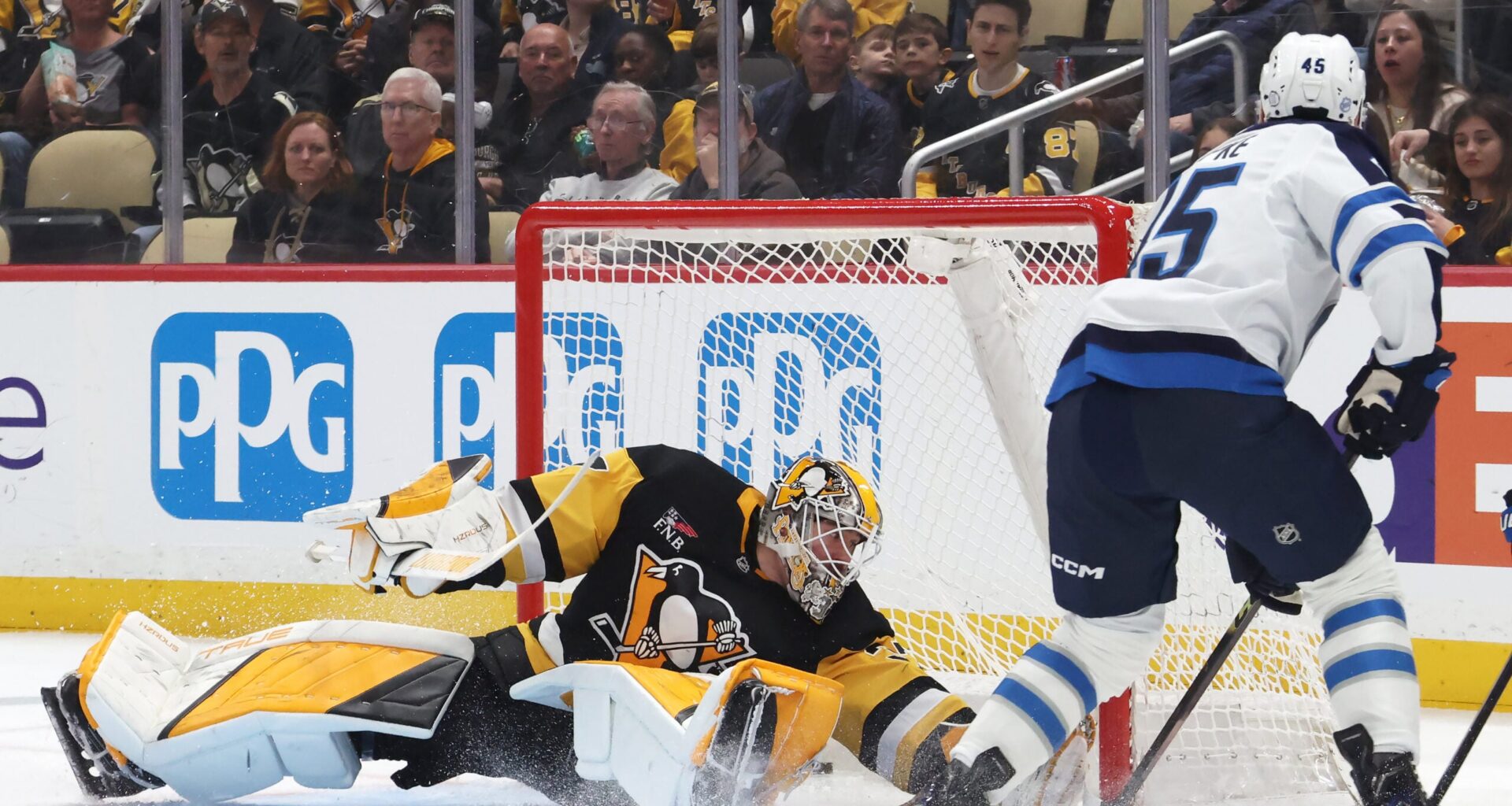
The nebulousness void that is NHL goaltender interference again struck at the Pittsburgh Penguins Saturday afternoon. It seemed a simple decision to the Penguins, but was in fact a simple decision for the NHL to again side against them.
At the direction from above, the team’s PR staff mischievously handed out a full-sized sheet with the goaltender interference rules, and highlighted the portion of the rule most relevant to the NHL’s rejection of the Penguins’ latest contention.
Eight times this season, the Penguins have challenged for interference, and eight times the NHL has rejected their claim.
What follows is not what anyone will want to hear, but after about 25 years covering and working in the game, it is as close to the reality as we can divine. And reality, not truth, is the proper word.
First, it is important context on who and what is deciding. The NHL Situation Room has a “leadership group” of three to five people who are ex-NHL players and coaches. There is also one retired NHL official who is a current supervisor and is intermittently involved.
The core of the situation room remains the same on most nights: Colin Campbell, NHL Director of Hockey Operations; Kris King, NHL Executive Vice President of Hockey Operations; Rod Pasma, NHL vice-president of Hockey Operations; and Senior Director of Hockey Operations Kay Whitmore.
Now, here’s a note that the Penguins might want to heed. King, who spoke to the Canadian Press earlier this season, stated, “When you’ve got a boss, (Campbell) has one more vote than the rest of us. Generally, when we don’t all agree, we stay with the call on the ice. That’s what the GMs want us to do.”
So, it is Campbell making the final call on arguments, and if there’re conflicting opinions in the room, the call on the ice will stand. Generally.
That word “generally” should be a cause for concern.
After all, we know from decades of coverage and email releases in the head trauma lawsuits that Campbell is not exactly a perfectly impartial new-thinking sort, but a throwback to old school cliques who openly mocked certain players and went lighter on punishments for infractions against certain types of players. He had to be removed from as the head of what became the Department of Player Safety because his decisions were so wildly inconsistent with an obvious bias involving players he liked or loathed, and he was upholding an ugliness in the game that the NHL needed to move away from.
Way back in 2011, Greg Wyshynski teed up Campbell’s legacy as the NHL removed him from player safety but kept him as a vice president amidst swirling controversy.
If you remember and/or can wrap your head around Campbell’s long tenure and willingness to exert power to uphold the old-school system and prejudices, you’re up to speed on the challenges of goalie interference.
Saturday, Penguins coach Dan Muse again faced a tough choice of seeing a goal against his team that he believed violated the rulebook. In his postgame explanation, he said that he had met with general manager Kyle Dubas, who had just returned from the recent NHL GMs’ meetings where the GMs discussed the topic. Dubas informed Muse to keep challenging calls and use the letter of the law as his guide.
“The GMs had their meetings recently, and Kyle was down there (in Florida). When Kyle came back, obviously there were some things that came up during those meetings that he wants to inform me on and that we discussed. One of them was goalie interference, which was obviously a topic there. And the instructions to me from Kyle were: We want to go by the book. And so it comes up again now, shortly after. I felt, we felt, that (play) was—by the book.”
However, Dubas and Muse are 100% wrong. They are trying to force clarity in a situation in which none exists. They are seeking rationality in an irrational condition.
The goaltender interference call that went against the Penguins Saturday was, without question, interference, according to the rulebook. And that is why the Penguins organization defiantly used the media, Pittsburgh Hockey Now included, to blast a message to the league.
Penguins team with an absolute shot across the NHL’s bow. PR handing this out to media during intermission. The even highlighted for us: pic.twitter.com/jy7jowtT3D
— Dan Kingerski (@TheDanKingerski) March 21, 2026
However, the point that the Penguins are missing, and the point that could cost them dearly in a playoff battle, is that the rulebook has nothing to do with the rule.
Wait, what?!
Make no mistake, this column does not agree with the NHL’s path nor its application of evolving rules, but the intent is to explain.
The NHL does not want to overturn goals. We first saw that edict in the kicking rule and its evolution. You’re not supposed to be allowed to turn your skate intentionally at the moment of impact to redirect the puck into the goal. That’s the rule, but the evolved reality is that the NHL has redefined the rule without rewriting it as to count more goals. So, it’s now acceptable when a player goes so far as to extend his skate into the puck at the right moment and at a proper angle to score, as long as he doesn’t kick at it.
It’s entirely illegal but completely legal. Get it?
There is no question that Dubas has been keeping track of these GI calls. During his post trade-deadline press conference, he effortlessly rattled off several examples across the league that had antithetical results to the Penguins’ challenges.
Also in that press conference on March 6, Dubas acknowledged that the persistent inconsistencies open the door for the public to question the NHL’s objectivity. Are the Penguins getting hosed on calls because Muse is a rookie? Such thoughts have been raised by this outlet, and while Dubas didn’t necessarily agree, he had to admit the uncanny run of rejection was causing public speculation.
“I think it’s the accumulation and the not knowing that makes it really difficult, and it puts a gigantic amount of pressure, a gigantic amount of pressure on our staff that bust their ass every day and are amongst the best of what they do,” said Dubas. ‘And then, it leads to further discourse. Well, the Columbus one–was it because they have a veteran coach, and we don’t? It just leads to many things that happen in the game that don’t need to be there. I don’t know whether or not that’s true. I’m just saying then (the calls) open up a whole other Pandora’s box. I’ve never had a huge issue with goalie interference (but) I think I’m probably at my wit’s end with it, and it’s tough to give direction to the staff.”
The latest was another the Penguins should have won but were not going to get.
Winnipeg Jets forward Morgan Barron raced toward the net to play a loose puck. Erik Karlsson raced toward Barron. They collided, it happens, and Silovs was the victim. The rules don’t distinguish between intentional or incidental contact, but the referees and the NHL do.
There was no chance the Penguins were going to win the challenge for one simple reason: It was a hockey play that resulted in the puck going into the net.
Fans are correct. The Penguins have been given the butt end of several nasty calls in this 0-for-8 streak that defy logic. Players have contacted the Penguins’ goalies unfettered, but several goals have stood because Penguins defensemen then attempted to clear the offending party. In multiple instances, that has been called a good goal against the Penguins, while in one instance Rickard Rakell wasn’t in the crease and didn’t contact the goalie but a defenseman attempting to clear Rakell contacted the goalie—and that was no goal for the Penguins.
If you look closely, you’ll see that it was the defenseman’s stick that contacted goalie Linus Ullmark (who also initiated the contact with Rakell) and Rakell was outside the crease.
The Rakell overturn remains possibly the worst review of the season and justifiably adds fuel to the Penguins’ frustration.
However, what everyone must understand is that while the Penguins chase the rulebook for answers, they will find none. The rulebook is not the ultimate guide–the rule has evolved and changed. That’s not for anyone to like, but it is the reality.
The questions that need to be asked before each challenge are not about the rules. No, the questions are:
Is there a justification for the NHL to keep the goal?
Did the defenseman play a role in creating the contact or maintaining it?
If the answer to either is yes, the Penguins will probably lose the challenge and cede a power play. Why other teams with veteran coaches have gotten the breaks and the calls the Penguins feel they deserved is another matter that should be scrutinized (but won’t be). Heavily.
But those are the actual rules the Penguins are playing by, and the sooner they realize it’s not by the book but by a reality that has changed, the sooner they will get a call, or at least not give a power play.
Tags: goalie interference Pittsburgh Penguins
Categorized:Penguins Analysis