


Ryan O’HanlonMar 24, 2026, 08:01 AM ET
CloseRyan O’Hanlon is a staff writer for ESPN.com. He’s also the author of “Net Gains: Inside the Beautiful Game’s Analytics Revolution.”
Multiple Authors
“Who is the best soccer player in the world?” used to be an easy question to answer.
It was Lionel Messi.
Now, even though every year a player at either Real Madrid or Barcelona will act like they’ve been smited by God because they didn’t finish first in Ballon d’Or voting, it’s a little more fun to try to figure that out. The world’s best player isn’t obvious, and it changes every year, if not every month.
But there will be plenty of time to debate this, especially because it’s a World Cup year. As always, we will do whatever we can to convince ourselves of two contradictory truths: (1) that soccer is a complex, dynamic game driven by the interplay of the various skill sets of a given team’s 11 players, and (2) that the team that wins the World Cup must have the best soccer player in the world.
For now, though, I want to ask a different question: Who is the best player in the world — at every age?
To give this analysis a little more longevity and coherence, I’ve grouped everyone together by their birth year. So, from the players born in 2009 through those born in 1987, which player is the top of each group?
 2009: Max Dowman, winger, Arsenal
This one might seem obvious because, uh, yeah …
Not only is 16-year-old Max Dowman the youngest goal scorer in Premier League history but he did it by scoring that goal for the best team in England and perhaps the best team in the world. He went coast-to-coast against a team that just beat Chelsea 3-0, and he has the same wispy mustache that I had when my dad joked, “Did you just drink grape soda?” and thus condemned me to years of therapy.
Given that Dowman is two full World Cup cycles away from the beginning of his prime — he will be 24 in 2034 — there can’t be anyone in his age group close to where he is … right?
Well, there’s a 16-year-old in Germany named Kennet Eichhorn who has already played 20 times as many first-team minutes as Dowman and is doing it at a much more demanding position.
One reason we tend to see so many of the youngest players break out as attackers is because mistakes don’t matter as much higher up the field. But a mistake at, say, center midfield, could immediately lead to a counter-attack for the other team. Even though attackers are the most valuable players in the sport, the barriers to a coach’s trust are simply much higher the closer you get to your own goal.
Eichhorn, though, has played 800-plus minutes at defensive midfield for Hertha Berlin this season — and he has been injured since January. Maybe if Dowman were playing for a second-division team, he’d be playing way more minutes than he has played for Arsenal. Maybe if Einchorn came through the academy at a Champions League club, he’d still be getting more minutes than Dowman.
There’s no way to know, and it doesn’t really matter beyond the purposes of this specific exercise. But if there’s one manager who obsesses over the risks his attackers pose, it’s Mikel Arteta, and he’s still giving Dowman minutes. So, we’re giving Dowman the slight nod.
play
0:53
Mikel Arteta calls for calm around ‘incredible’ Max Dowman
Mikel Arteta speaks about Max Downman after his performance for Arsenal against Everton in the Premier League.
 2008: Lennart Karl, attacking midfield, Bayern Munich
This one is way more straightforward. Bayern Munich might be the best team in the world, and Karl has started 20 games across the Bundesliga and Champions League. Karl, who turned 18 last month, scored eight goals and assisted seven more.
We don’t really need advanced data here; playing that many minutes at that age for Bayern is the most powerful indicator of future success. But Karl is averaging 0.79 non-penalty expected goals plus assists per 90 minutes — a world-class rate for an attacking midfielder.
 2007: Lamine Yamal, winger, Barcelona
What more is there to say about 18-year-old Yamal that hasn’t already been said?
play
1:20
How Yamal reached 50 career goals quicker than Ronaldo and Messi
Gab & Juls react to Lamine Yamal scoring his 50th career goal in Barcelona’s win over Athletic Club.
 2006: Warren Zaïre-Emery, midfielder, Paris Saint-Germain
The 2006-born players show just how volatile young-player projection can be. There are so many different factors that go into how any individual person develops, and we can see it in a bunch of the guys born 20 years ago.
Remember when Endrick was going to be the next Pele? And then none of the Real Madrid managers wanted him? And then he went on loan to Lyon and immediately started scoring and assisting goals again?
Or how about Myles Lewis-Skelly? He was starting for Arsenal and England at this time last year, then Arsenal signed a couple more gigantic fullbacks over the offseason, the Premier League became obsessed with being big and fast and scoring on set pieces almost overnight, and now MLS has started one Premier League game and is very unlikely to even make Thomas Tuchel’s World Cup roster.
In the other direction, we’ve got Yan Diomande, who was playing high school in Florida four years ago and now might be the most in-demand player in his age group on planet Earth. In his first year with RB Leipzig, Diomande is doing the thing that everybody wants: scorching defenders off the dribble on the wing and then turning it into actual goals and assists. In a vacuum, he’d probably command the biggest salary on the open market of anyone born in 2006.
But given everything we’ve just mentioned, I prefer to be a little more conservative when I do any kind of player projection and evaluation, so we’re going with the 20-year-old who is second on the list of most career minutes played in the Europe’s Big Five top leagues among everyone in the world who is currently 20 or younger:
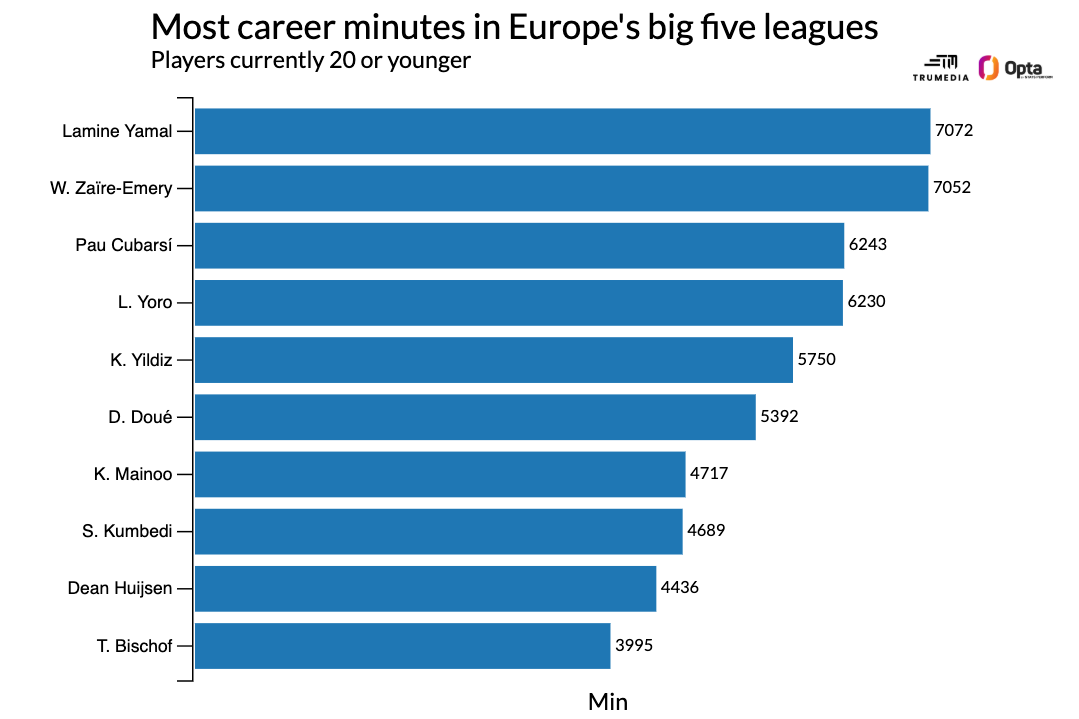
Playing for PSG in Ligue 1 isn’t the same thing as playing for Real Madrid or Manchester City, thanks to the general lack of competitiveness in the French league. But WZE — is this a thing? This should be a thing. Anyway, WZE broke into the PSG rotation three years ago, and he’s played more minutes with each successive season. Maybe, sometimes, development actually is linear.
2005: Désiré Doué, winger, Paris Saint-Germain
I came really close to not choosing the guy who had two goals and an assist in last season’s Champions League final.
Doué, who will turn 21 this summer, played only 900-ish minutes in Ligue 1 this season and he’s started just four more games in the Champions League. His longer track-record of production hasn’t quite matched what we saw against Inter last year, but he’s steadily been stacking really good minutes for four seasons now and we already know he’s good enough to start for a truly elite team.
I’m not quite sure the same is true about Arda Güler because I’m still not quite sure how good Real Madrid have actually been at any point this campaign, but he’s having a breakout season and is already one of the best passers in the world. Passing is generally an old-man skill, and the players who move the ball well at his age tend to go on to have really good careers.
2004: João Neves, midfielder, Paris Saint-Germain
The 21-year-old Neves first joined PSG in 2024 on a five-year deal. A couple of stats:
• Champions League title win rate for PSG in all of the full seasons before they signed João Neves: 0%
• Champions League title win rate for PSG in all of the full seasons since they signed João Neves: 100%
 2003: Jude Bellingham, midfielder, Real Madrid
I don’t know if he’ll ever match his first season in Madrid. In fact, I don’t think he ever will. Despite playing as a de facto midfielder, he scored or assisted a goal every 90 minutes, as Madrid won LaLiga and their 15th Champions League title.
In other words, we’ve seen Jude Bellingham be the best player on the best soccer team in the world. There’s a very small group of people we can say that about, and an even smaller group we can say who did it when they were only 20 years old. Bellingham is now 22 though, so he still has plenty of time to try again.
2002: Pedri, midfielder, Barcelona
Here’s the list of players across the Big Five leagues this season who have a 90-or-better grade from Gradient Sports for passing and carrying:
• Pedri
That’s it. That’s the entire list.
At 23, Pedri hasn’t hit his peak yet.
2001: Michael Olise, winger, Bayern Munich
Bayern have entered the PSG zone: they’re so much better than everyone else in their league that we need to be skeptical of the performance of all of their players in the Bundesliga until we see it translate to dominance in Europe.
PSG exited this zone last season — in large part due to the arrival of Khvicha Kvaratskhelia, who himself is a 2001. But Bayern are still there, in part because they got dominated earlier in the season by Arsenal, who are led by Bukayo Saka, another member of the class of 2001.
So, why is 24-year-old Olise ahead of both of them? Well, averaging more than a goal-plus-assist per 90 minutes immediately puts you into the Messi-Ronaldo realm. Olise did that last year, and he’s doing it again this year, at a higher rate: from 1.04, up to 1.28. The latter is tops in Europe at the moment.
Those stats, of course, are heavily boosted by Bayern’s Bundesliga dominance, but guess what happened the last time we saw Olise playing in a different league? He averaged 1.06 goals+assists per 90 minutes — for Crystal Palace, in the Premier League. That was across only about 1,200 minutes, but the last two seasons are showing that it wasn’t a fluke.
A simpler answer for why I’m slotting in Olise: There’s a chance that he’s the best soccer player in the world right now, and I wouldn’t say the same about Kvara or Saka.
play
0:52
Michael Olise whips in opening goal for Bayern
Michael Olise whips in opening goal for Bayern
 2000: Erling Haaland, forward, Manchester City
Something is clearly wrong with 25-year-old Haaland. His career has been a near-robotic, march of efficient goal-scoring — undeterred by the talent of his teammates, the difficulty of his competition, or anything other than his own body temporarily failing him.
But he’s scored only five goals since the start of 2026, and the easiest explanation — and the most likely explanation — is that he has an injury.
Even with a slight slowdown in output, though, he’s still lapping the field:
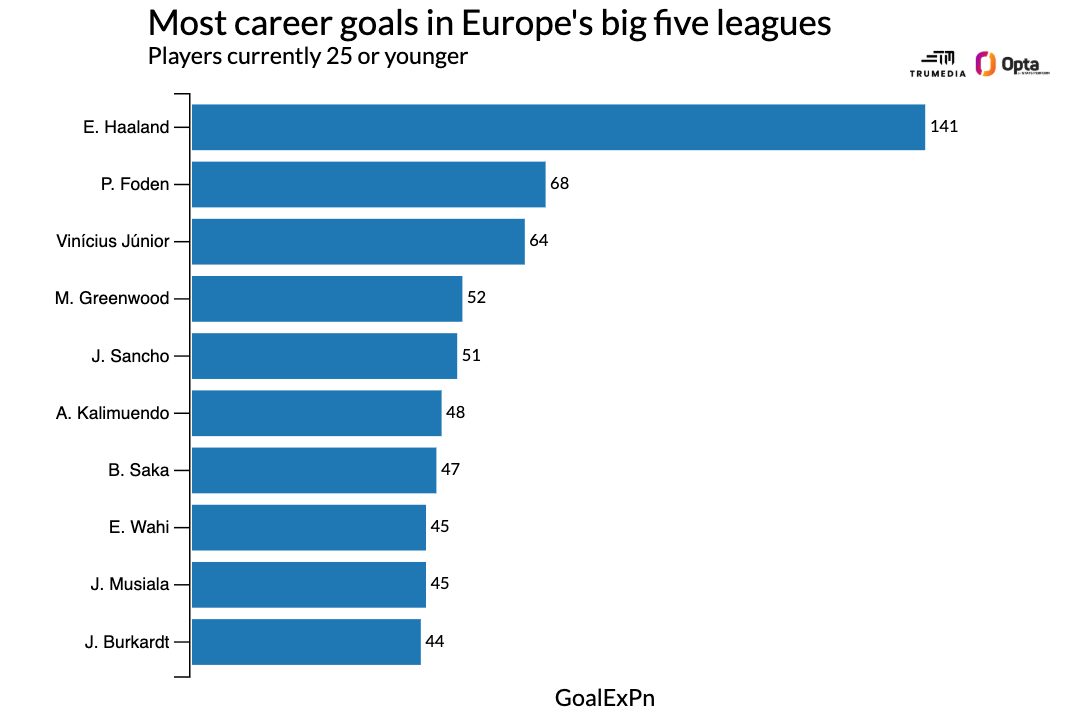
Vitinha, Vinícius Júnior, and Dominik Szoboszlai are all great players, but c’mon. Goals win games and he’s twice the goalscorer of anyone else his age.
1999: Declan Rice, midfielder, Arsenal
This might’ve been a fun conversation if Alexander Isak hadn’t broken his leg, but this is the easiest choice since Lamine Yamal. No other midfielder is this good at every aspect of playing midfield, let alone any other 27-year-old:
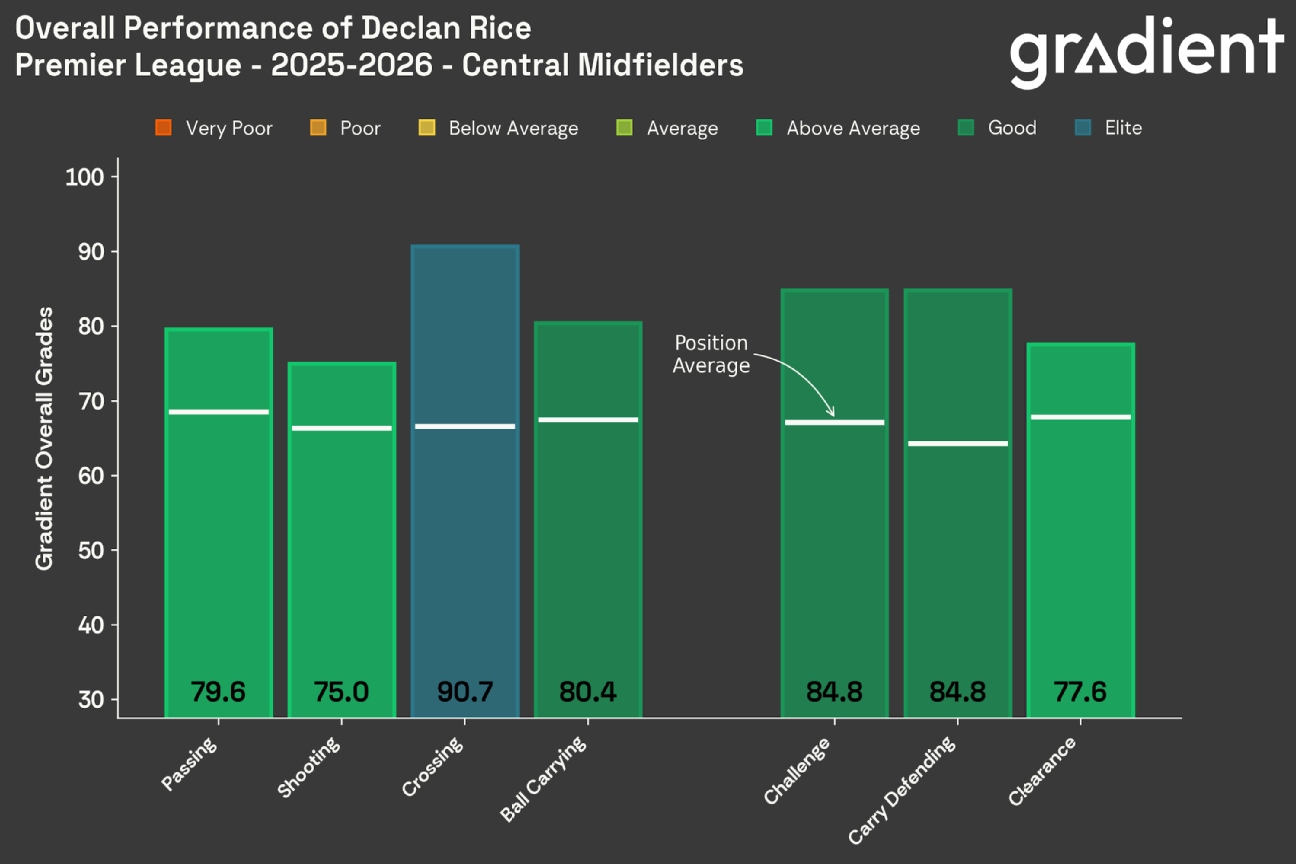
On top of that, he’s also one of the most physically dominant players at his position, too.
Gradient tracks an “Athleticism” score — a combination of speed, stamina, and explosiveness, modified by position and size — and Rice comes in at a 90.6 out of 100.
1998: Kylian Mbappe, forward, Real Madrid
OK, fine. I love Federico Valverde as much as anyone outside of his nuclear family, but this one was easier than Declan Rice. At 27 years old, Mbappe has been one of the best players in the world since he was a teenager.
I keep picking France to win the World Cup whenever someone asks me. An easy way to sum it up: Michael Olise, Kylian Mbappe, and Ousmane Dembélé are French. Dembélé, 28, is the reigning Ballon d’Or winner and you could make a pretty good argument that he’s the worst of those three players.
Now, I wouldn’t make that argument. When he’s healthy, he’s the best player in the world — an argument I made last year. He’s elite with both feet, his off-ball movement, dribbling, passing, and finishing are world-class, and he’s willing to press like a maniac. He’s, of course, just almost never healthy.
1996: Raphinha, winger, Barcelona
This really depends on where you think Rodri is at right now. Let’s compare his Gradient numbers from this season …
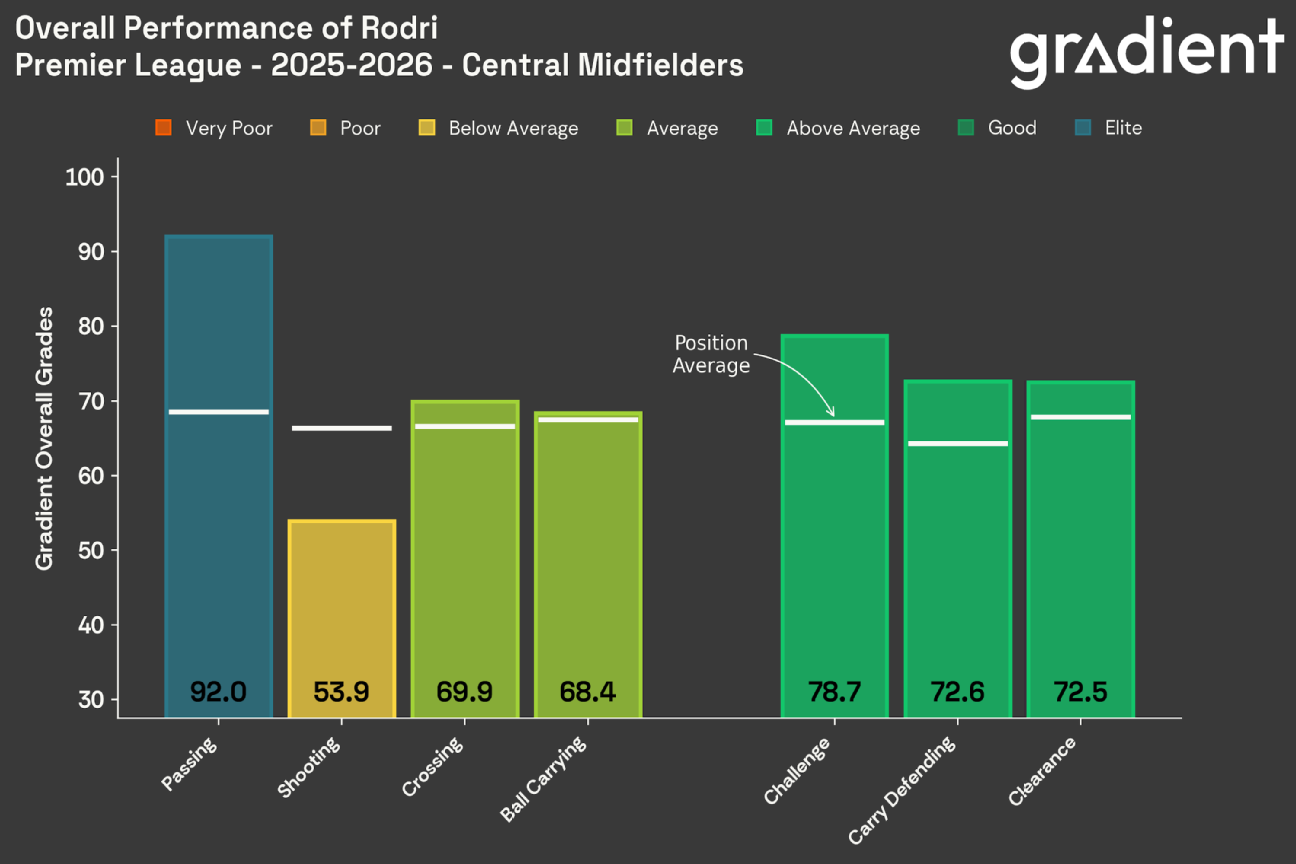
… to his Ballon d’Or-winning season:
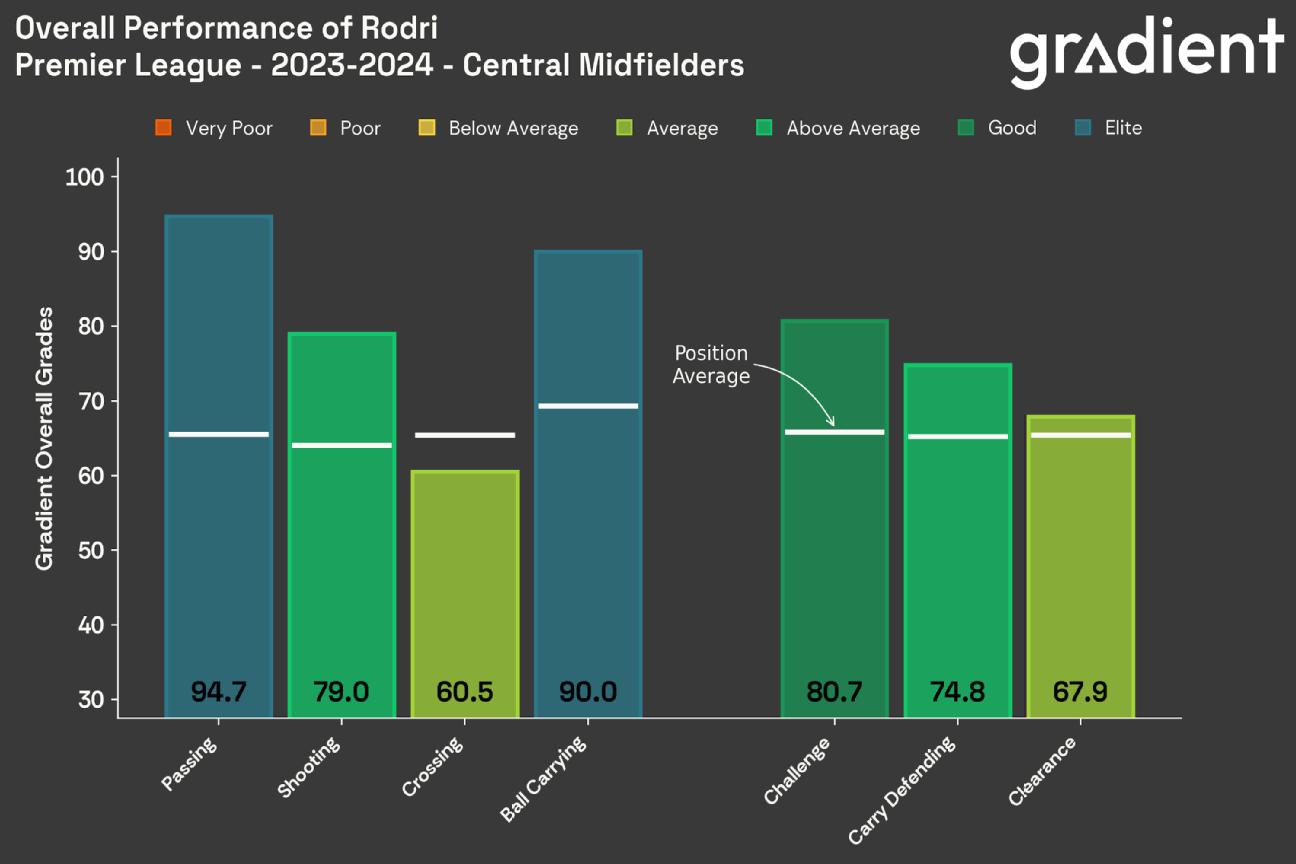
That’s about what you’d expect, right? The passing is still there, but all of the more physical aspects of his game haven’t recovered.
Raphinha, meanwhile, is still a 98th percentile athlete according to Gradient’s physical metrics, and he’s scoring and assisting goals at the same rate as last season, when he finished fifth in Ballon d’Or voting.
What I love about 29-year-old Raphinha is that he can fit into pretty much any team in the world: he can be your primary scorer and creator, he can be the weakside winger who makes runs off the ball, and he’s one of the best pressers in the world, so you don’t have to make any systematic changes to your structure to fit him into the team.
1995: Joshua Kimmich, midfielder, Bayern Munich
There’s a pretty big drop-off from 1996 to 1995. That’s perhaps because we’re now talking exclusively about players who are in their 30s, which is right about when everyone officially enters the downslopes of their career. But it’s also just random; sometimes the highest-end talent clusters in a few different years.
After 31-year-old Kimmich, these are the five highest-value 1995 players according to Transfermarkt: David Raya, Ollie Watkins, Frank Anguissa, Jack Grealish, and Mike Maignan. Kimmich is still one of the best passers in the world, and per Gradient, only four other midfielders have covered more ground per game in the Champions League so far this season.
 1994: Bruno Fernandes, attacking midfielder, Manchester United
He’s been the best player in the Premier League this season, and although he’ll turn 32 in September, he hasn’t really shown any signs of slowing down. Of course, players who are multiple years into their 20s suddenly and abruptly slow down all of the time.
To give you a sense of how impressive Bruno’s performance is, at this age — and with as many minutes as he plays for club and country every season — here are some other guys born in 1994: Rodrigo de Paul, John Stones, Mateo Kovacic, Andy Robertson, Aymeric Laporte, João Cancelo, Memphis Depay, Raheem Sterling…
1993: Harry Kane, forward, Bayern Munich
This is the part of the exercise where I start to feel really old because all of these guys feel like weathered, wizened old veterans whose bodies could fall apart at any moment. They’ve seen some stuff. And these people are all five years younger than me.
Anyway, the answer is obviously Harry Kane.
play
0:57
Harry Kane curls in a beauty for Bayern
Harry Kane curls in a beauty for Bayern Munich.
I wrote an article in 2019 about how Kane’s world-class ability to get shots had declined, how he’d put so many minutes on his body, and how it might be time to worry, given how he’d entered the latter half of his peak years and given how many other great young English attackers seemed to peak early.
In response, one Spurs fan sent me an email, vaguely threatening my health by signing off with the message: “Don’t forget. We’re always watching.” I hope he — it’s always a “he” — is handling Tottenham’s current season with an equal level of equanimity.
Kane, of course, offset the decline in shots by becoming a world-class playmaker and extending his stay among the game’s elite. Few players have had both his peak and his longevity. The 32-year-old England captain has scored 21 non-penalty goals in the Bundesliga this season — two more than anyone else in Europe’s Big Five leagues.
I can make a decent case for 33-year-old Mohamed Salah‘s season not being as bad as you think. He looks terrible — that is undeniable. He frequently looked terrible against Galatasaray last week, and yet he ended the match with a fantastic goal, a beautiful assist, and more shots on target and touches inside the penalty area than anyone else on the field. Domestically, he has more goals+assists than Saka, and among players with at least 1,500 minutes played, he ranks seventh in the Premier League in expected goals+assists per 90 minutes.
That said, Salah is being paid like he’s the best player in the league — not just a pretty good winger.
Courtois, meanwhile, also 33, is probably still the best goalkeeper in the world. If we were battling aliens for the future of Earth or whatever, if your life depended on one guy saving a shot, etc., we’d all pick Courtois.
In a strange way, this season is making me appreciate just how good Van Dijk used to be. There have been a bunch of little moments where his positioning has been slightly off, he hasn’t recovered quickly enough, or a difficult touch goes slightly awry that it makes you realize: (1) how much Liverpool have needed him to be perfect for the defense to work, and (2) how easy he made being perfect look.
With a little more protection, 34-year-old Van Dijk can still play at a really high level for a few more years. And what, you want me to pick Kevin De Bruyne or Antoine Griezmann over him?
Welbeck played 2,000-plus minutes for Manchester United in 2011-12. He is a forward, always has been. This is his 19th Premier League season. He has 42 England caps and made his debut for his country in 2011.
Guess what his career best for non-penalty goals in a season is? It’s 11. And guess when he did it? He’s doing it this year at age 35.
Both 1990 and 1989 are how it should be: everyone is just hanging on for dear life. None of these guys are starting for Real Madrid or Bayern Munich. It’s all players who used to start for those teams and are now providing valuable minutes to the likes of Girona or PSV.
Henrikh Mkhitaryan was the other option here — he’s still playing for Inter Milan, who have a six-point lead atop Serie A — but I went with his former Borussia Dortmund teammate instead. Aubameyang has more goals+assists than anyone on Marseille’s biggest rivals PSG. And unlike earlier in his career, the 36-year-old is providing a good deal of value beyond just the shots he gets.
And here’s the guy Aubameyang replaced at Dortmund. This is the worst year of 37-year-old Lewandowski’s career … and he’s averaging 0.83 non-penalty goals+assists per 90 minutes. That’s still good enough for fourth-best in LaLiga, just slightly behind Mbappe.
 1987: Lionel Messi, attacking midfielder, Inter Miami
Stats Perform has MLS data going all the way back to the 2012 season. That’s 14 full seasons, plus about a month of matches for the current campaign. Over that stretch, 38-year-old Messi ranks 29th in total non-penalty goals+assists. He has played 66 total games, and he joined the league when he was 36.