
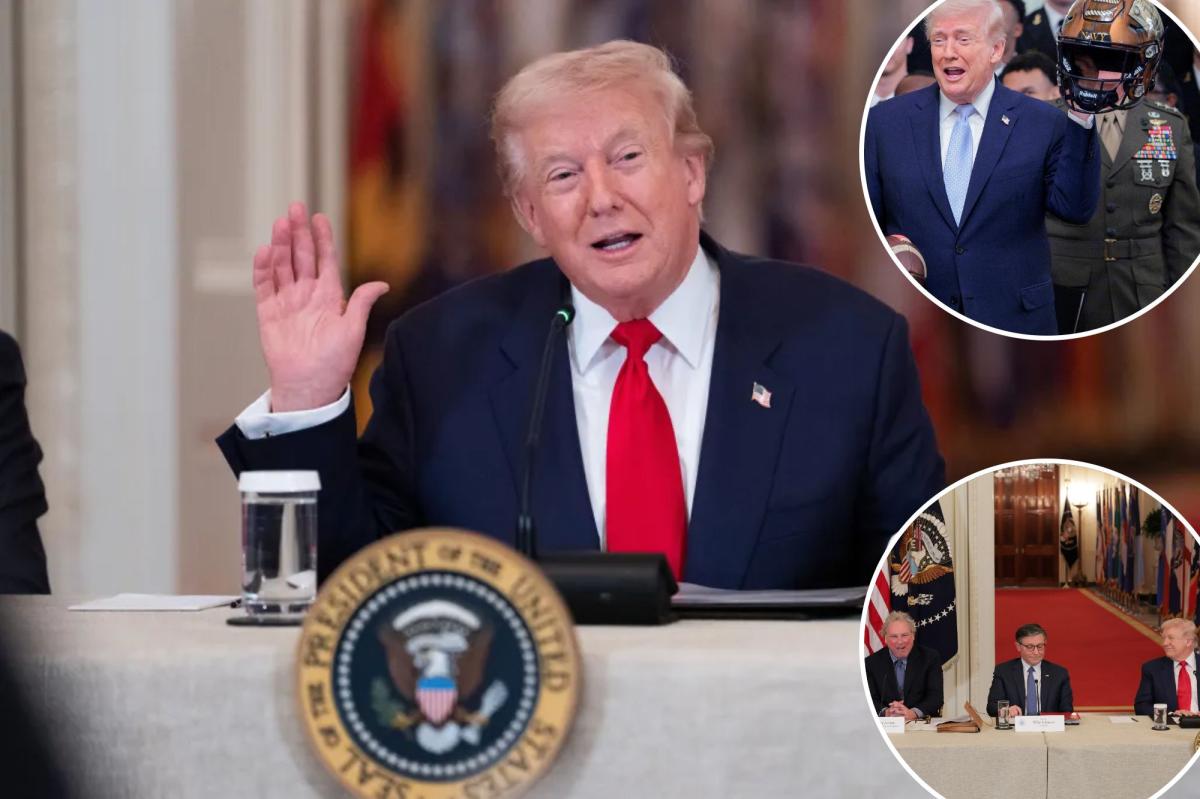
President Donald Trump signed an executive order Friday aimed at reforming the chaotic landscape of college sports in the NIL era.
If it clears the expected legal challenges, Trump’s order would permit student-athletes to transfer only once without the penalty of a redshirt season, limit collegiate playing careers to a five-year window, set funding requirements for non-revenue programs (i.e. women’s and Olympic sports), and introduce federal regulations for the hundreds of multimillion dollar NIL collectives.
Schools that fail to comply with the order — scheduled to take effect Aug. 1 — could risk losing federal funding.
“Why can’t the industry go back to the old system?” Trump said at last month’s “Saving College Sports” roundtable. “I’d like to go exactly back to what we had and ram it through a court.”
US President Donald Trump speaks during a ‘Saving College Sports’ roundtable in the East Room of the White House in Washington, DC, USA, 06 March 2026. AARON SCHWARTZ/POOL/EPA/Shutterstock
College sports morphed into the Wild West in 2021 following a Supreme Court decision that unanimously ruled that the NCAA violated antitrust laws and could not prevent student-athletes from being financially compensated.
The professionalization of college sports accelerated when players no longer had to sit out a season after switching schools, prompting thousands of student-athletes to essentially test free agency in the transfer portal every year.
In July, a House settlement ordered the NCAA to pay nearly $2.8 billion in back damages to former and current players, while schools were given a $20.5 million salary cap to pay its student-athletes, with nearly all of it going to football and basketball programs.
Independent NIL collectives add another layer of chaos to the unregulated environment, often resulting in impermissible pay-for-play benefits being given to teenagers without any oversight.
“Players need to get compensated, no doubt … but one school can’t spend $30 million for players while another school’s spending $3 million,” former Alabama coach Nick Saban — who participated in last month’s White House event — said earlier this year. “The people out there need to know this model is unsustainable.”
U.S. President Donald Trump holds up a helmet and football that were gifted to him during a ceremony awarding the Commander-in-Chief Trophy to the Navy Midshipmen football team on March 20, 2026 in Washington, DC. Getty Images
Speaking at last month’s roundtable — which also featured NCAA president Charlie Baker and multiple commissioners from college power conferences — Trump acknowledged the hurdles his executive order will face, following a similar 2025 edict that failed to bring widespread change to college sports.
A previous threat from the Trump administration to withhold federal funds from a university was struck down by a federal judge’s decision in September, preventing the punitive measure against Harvard.
“We will be sued, and we’ll go before a court, and maybe — maybe — we’ll have a judge that’s realistic, reasonable and wants to do a favor for the country because that’s the only way this is going to be solved,” Trump said.
The president does not have the authority to impose such regulations on the NCAA, a private organization, but his order could spark action in Congress, where discussions about new college sports regulations have occurred since the introduction of NIL.
Yankees president Randy Levine (second from left) during the roundtable. Getty Images
(L-R) Former NBA player Charlie Ward, Florida Gov. Ron DeSantis, New York Yankees President Randy Levine, U.S. Speaker of the House Mike Johnson (R-LA), U.S. President Donald Trump and U.S. Secretary of State Marco Rubio attend a roundtable discussion on college sports on March 06, 2026 in Washington, DC. Getty Images
However, neither the House nor Senate has held a full vote on any legislation related to the issue, and in recent months, the House twice delayed a vote on a proposed bipartisan bill, entitled the SCORE Act (Student Compensation and Opportunity through Rights and Endorsements), which would, among other things, create a federal standard for NIL rights and prevent student-athletes from being classified as employees of a school. ESPN reported that the bill may be amended and reintroduced this month.
“On some of these issues, it’s hard for us to do this without at least some support from the feds,” Baker said at the women’s Final Four. “The courts are one way to settle the debate, but it takes a really long time, and it creates a lot of uncertainty.
“We need congressional action to sort of seal the deal on a number of these things.”