
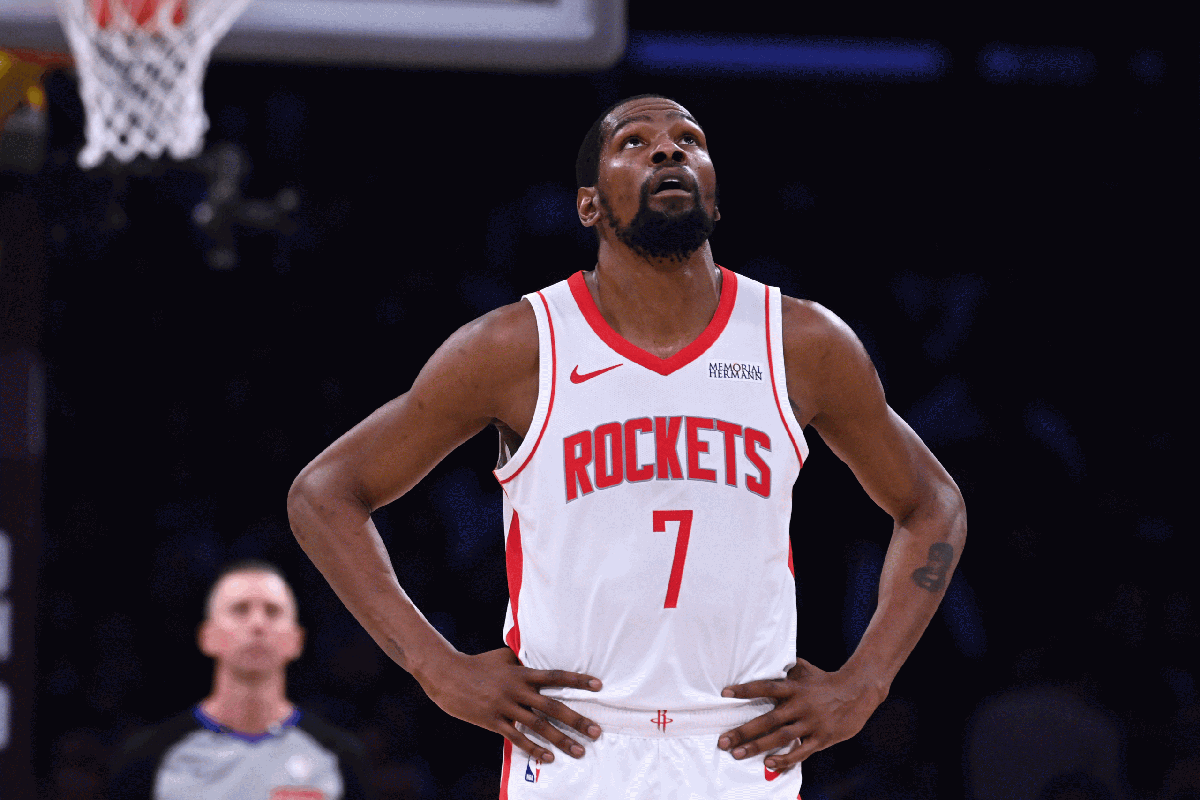
LOS ANGELES — The Houston Rockets are about to experience the longest 48 hours of their season.
Everyone who doubted this team will do a victory lap for the next two days. Everyone who questioned their mental toughness will scream, “I told you so.” Everyone who said their offense was dysfunctional will have plenty of evidence to back up those claims.
Despite their 52 wins in the regular season and the obvious star power at the top of the roster, the Rockets had no shortage of critics who thought they would be exposed once their flaws were put under the bright lights of the postseason. Maybe getting matched up against an undermanned Los Angeles Lakers squad in the first round would give them a chance to taste some success, but the doubters never gave in.
After another horrific road loss against the Lakers, this one a 101-94 defeat on Tuesday night, Houston finds itself down 0-2 against a team that came into this series as major underdogs thanks to the absence of its two leading scorers, Luka Dončić and Austin Reaves.
The Rockets have dug a hole for themselves that may be too deep to escape. They’ve also confirmed every bit of pessimism that’s hung over them like a dark cloud much of the season.
“We needed a win today, but it happens. It’s a long series,” Rockets center Alperen Şengün said. “Hopefully, we’ll protect home and come back here for (Game 5).”
For much of the season, Houston’s biggest flaw has been its offense, particularly when the game slows down. Although they appeared to show some signs of improvement late in the season, the Rockets have cratered on that end of the court in two games against a Lakers team that isn’t exactly an elite defensive unit. They’ve put up two of the worst offensive performances by any team in this year’s playoffs.
Their shortcomings in Game 1 were somewhat understandable given that Kevin Durant was sidelined with a right knee bruise. But somehow, the offense got even worse once Durant was back in the lineup for Game 2.
Per Cleaning The Glass, the Durant-less Rockets put up 83.7 points per 100 possessions in half-court possessions, which is a pretty terrible number on its own. However, that number dropped to 74 points per 100 possessions in Game 2 with Durant. The only team with a worse performance in the half court during this year’s playoffs was the Phoenix Suns, who put up 62 points per 100 possessions in their 35-point loss to the defending champion Oklahoma City Thunder on Sunday.
Durant played fairly well in his return on Tuesday, scoring 23 points on 7-of-12 shooting, but he turned the ball over nine times, tying his playoff career-high. In the second half, the Lakers went back to a strategy that worked for them earlier in the season, trapping Durant at the top of the key every time he touched the ball and forcing the ball out of his hands.
The Lakers also mixed in different looks to clog the paint and prevent Durant from consistently finding his teammates for easy looks. Durant and the Rockets had no answer for what the Lakers’ defense threw at them, and it brought their offense to a screeching halt. Durant couldn’t get to his shots, and the guys around him failed to make enough of their open looks to convince Los Angeles to try anything different.
In the second half, Durant had three points on 1-of-5 shooting with four assists and five turnovers. Only once in Durant’s regular-season career has he been held to three or fewer points in a half while turning it over at least five times. It came against this same Lakers team five weeks ago, when they beat the Rockets 100-92 on March 16.
The Rockets aren’t just feeding into all the doubts people had about their ability to adjust on the fly and prevent teams from taking Durant out with simple double-teams. They’re showing that the Lakers have the blueprint to bring out the worst in them when the game gets tight.
“We’ve played this team before,” Durant said. “They know this is the way for them to stay in the game — it’s to play this type of defense. We’ve got to make them pay.
“They’re going to feel even more confident going into Game 3. They feel confident in us not making shots. It’s that simple. … They’re daring us to shoot. They’re daring us to make plays. They feel confident in that scheme. It’s on us to make them pay for it.”
Although the Rockets are shooting just 29 percent on 3-pointers through two games in this series, this iteration of the team wasn’t built to light it up from the 3-point line.
Where they should dominate a team like the Lakers is in the paint and, in particular, with Şengün, who has mostly been a disappointment this series.
The Rockets have built up Şengün all season and regarded him as the kind of big-time running mate who could help Durant take this team to the promised land. The Lakers are far from the most imposing team in the frontcourt with Deandre Ayton and Jaxson Hayes. Yet Şengün has failed to establish himself as a dominant figure in the paint.
He finished Tuesday’s loss with 20 points and 11 rebounds, but he’s shooting just 38.5 percent from the floor this series. There’s never been a point in the first two games when it felt like Şengün was by far the best center, which is a major issue for the Rockets.
They need their All-Star center to play like an All-Star, especially if the Lakers are going to be so aggressive in their mission to eliminate Durant’s impact. When Durant gets doubled at the top of the key, that should free up space for Şengün to get downhill and bully people below the rim, or at least grab offensive rebounds. But he hasn’t done it enough.
Lakers guard Luke Kennard and Marcus Smart have seemingly put their imprint on this series more than Şengün. That’s a major problem.
“I definitely need to be aggressive when I get the ball to the middle. I’m just missing so many easy shots,” Şengün said. “I need to get back to who I am and dominate the paint when I have the ball. (I’ve got to) help KD a little bit and make my teammates better as well. … I’m not missing from long distance. I’m missing from under the rim. I’ve got to make those.”
Rockets coach Ime Udoka certainly can’t avoid his fair share of criticism as well.
Rather than leaning into some of his better offensive options like Reed Sheppard or Aaron Holiday, Udoka has stuck to his defensive principles and given more time to guys like Tari Eason, Josh Okogie and Jae’Sean Tate. Among those who follow the Rockets, one of the least surprising subplots of Game 2 was Udoka giving up on Sheppard after a couple of rough plays, which, in some ways handcuffed the offense even more.
Sheppard was limited to 11 minutes after going 0-of-4 from the field, and while he certainly had a few mental mistakes on defense, the Rockets desperately needed his shooting and ballhandling. And with Sheppard on the bench, there weren’t many other options who could take some burden off Durant.
“I think we were guarding well enough,” Udoka said when asked about Sheppard’s minutes. “With the unit we had in, we went small and switched a lot of the actions. I stayed with that. Holding them to 101 (points) is good enough; we just didn’t score.”
Game 3 is now the most important moment of the season for the Rockets. Either they show up to fight and prove all the haters wrong, or the world will watch them crash and burn on their home floor.
Over the next two days, a long line of people will point and laugh at this group’s downfall. If Houston continues to spiral at this rate, there will be some justifiable calls for an offseason shakeup.
But Udoka made it clear that there’s one way to quiet all the noise.
“Winning solves everything,” Udoka said. “Our focus is to go home and get Game 3.”