
NFL DraftNFL DraftThe Raiders got their man, the Rams got a surprise new QB, and the Cardinals did what now?? Here are the highlights and lowlights from day one of the draft. Getty Images/Ringer illustration
 By Steven RuizApril 24, 6:10 am UTC • 15 min
The first round of the NFL draft is in the books! Here are the winners and losers from an exciting day one.
Winners: Klint Kubiak and Fernando Mendoza
I probably don’t have to remind Raiders fans of this fact, but it’s been 23 years since the team has won a playoff game. Twelve head coaches have tried and failed to end the drought and only one managed to finish their tenure with more wins than losses. That was interim coach Rich Bisaccia, who led the team to a 7-5 record and a wild-card berth in 2021 after taking over for Jon Gruden in October. And Bisaccia was rewarded for his efforts by getting passed over for the full-time gig for Josh McDaniels. I’m sure new Raiders coach Klint Kubiak considers himself lucky to have one of just 32 NFL head coaching jobs, but based on the last quarter century, he’s not stepping into a dream gig here.
The same can be said for Fernando Mendoza, who instantly became the face of the Raiders organization when they made him the first pick in the 2026 NFL draft. Playing for the franchise may pay well, but recently it hasn’t set quarterbacks up for success. Just ask Geno Smith, whose play cratered behind a porous offensive line last season and with an offensive coordinator, Chip Kelly, who was reportedly calling plays that hadn’t been installed. The environment was so bad, in fact, that previous head coach Pete Carroll felt the need to take full responsibility for Smith’s down year. Or ask Derek Carr, who made just one playoff appearance and ended up getting benched after nine years of productive play. Or Carson Palmer, who lasted just 24 starts.
Based on all of that history, the deck seems awfully stacked against this first-year coach/quarterback duo. But if you set that aside and just focus on the current state of the roster, it’s not that tough of a situation. The Raiders will, in all likelihood, be a bad football team once again in 2026, but if you squint your eyes while looking at the depth chart, you can see the makings of a solid offensive setup. Here’s where things stand, via Our Lads:
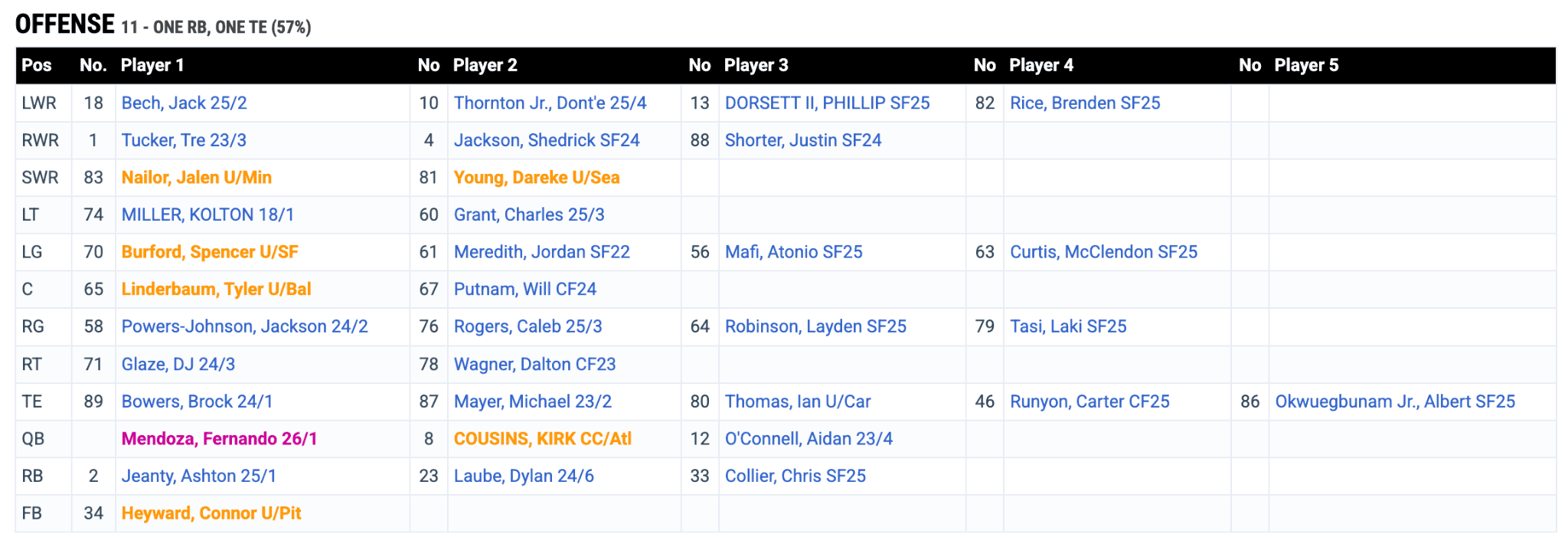
OK, so the wide receiver position needs a lot of , but the rest of the pieces are in place for Kubiak to operate his version of Kyle Shanahan’s offense. Prying center Tyler Linderbaum away from Baltimore could be the Raiders’ most significant offseason acquisition. The Shanahan offense works best with competent center play, and Linderbaum might be the best in the league at the position. Las Vegas also brought in former 49ers guard Spencer Burford, who put up good tape in San Francisco. Kolton Miller is one of the better left tackles in the league, and Kubiak seems to like what he sees in right tackle DJ Glaze, a good athlete who should be a better fit in a zone run scheme compared to what Las Vegas has used in the past few seasons. The Raiders have fielded historically putrid run games over the past two years, but with upgraded line play and Ashton Jeanty entering his second season, a top-10 run game is within the range of realistic outcomes.
I’m sure Mendoza would rather be throwing to Ja’Marr Chase and Tee Higgins rather than Jack Bech and Jalen Nailor, but solid pass protection and a productive run game can do wonders for a young quarterback. And the first overall pick has a true “easy button” in the pass game with tight end Brock Bowers, who can turn a short dump-off pass into an explosive gain. As an added bonus, the Raiders brought in Kirk Cousins, who will either start while Mendoza finds his footing in the league or provide mentorship as a veteran backup who has plenty of experience in the offense. Though it didn’t provide any benefits to last year’s squad, having team minority owner Tom Brady around the facility could also be considered a plus for a developing quarterback. We’ve seen highly drafted passers step into far worse situations.
Both Kubiak and Mendoza seem to be genuinely pumped to be Raiders. That would normally draw a “you sure about that?” from me—or anybody who has been watching this franchise flail for the last 20-plus years. But I can actually see the vision.
Winner: Ty Simpson / Loser: L.A. Rams
Mendoza wasn’t the only quarterback who knew where he was headed before the draft kicked off on Thursday night. Hours before the first pick was announced, Rams general manager Les Snead let Ty Simpson know that he wouldn’t make it past Los Angeles at 13. Snead kept his word and selected the undersized Alabama quarterback, who was widely projected as a late first-rounder throughout the draft cycle.
The Rams weren’t exactly hiding the fact they were enamored with Simpson—who was hesitant to declare for the draft before Snead told him he’d be a first-round pick earlier this year—but you won’t find a mock draft anywhere on the internet that had L.A. taking him at that spot. And for good reason. Simpson may be a fit in Sean McVay’s offense, thanks to his willingness to make tight-window throws over the middle of the field, but he’d have to buck some historical trends for this pick to work out long term.
Simpson’s smaller frame is the most significant one. At 6-foot-2, Simpson is on the shorter side for an NFL quarterback, and his weight (208 pounds) ranks in the 17th percentile among passers, per Mockdraftable. He’s also got less than ideal hand size, which may have contributed to his issues with fumbles last season at Alabama (he lost six, the most by any FBS player in 2025). We don’t really have to project how that smaller frame might affect Simpson. We saw it last year when Simpson, whose playing style leads to a lot of hits, suffered a rib injury that tanked his performance over the second half of the season.
It would be easier to overlook that decline if Simpson had a longer track record of success, but the guy didn’t play a lot of football over his college career. He logged just 15 total starts, with all of them coming in 2025, after sitting behind Jalen Milroe his first two years in Tuscaloosa. The history of quarterbacks entering the league with similar levels of experience is bleak. Anthony Richardson, Trey Lance, and Mitch Trubisky are notable examples from recent drafts. Per ESPN, only three first-round quarterbacks who made fewer than 20 college starts earned a second contract from the team that drafted them—and that list includes Cam Newton, whose JUCO starts at Blinn College weren’t included. Excluding Newton, only one quarterback who made 15 or fewer starts went on to make a Pro Bowl, and that was Trubisky. Getting to sit behind Matthew Stafford for a year or two may seem like a positive for Simpson’s development, but he’s got a lot of time (and live reps) to make up for.
It’s unclear how many seasons the 38-year-old Stafford has left in him even after his superlative 2025 campaign. He’s contemplated retirement in recent years and had to be held out of training camp last offseason due to a back injury. Los Angeles should be thinking about its future at quarterback—but not at the expense of its short-term outlook. It feels like the Rams are chasing a championship in 2030 when they’re just one or two pieces away from winning a title in the present.
As questionable as this pick is from the Rams’ perspective, Simpson could not have asked for a better landing spot. McVay’s style of offense has made stars out of quarterbacks with similar skill sets, like Kirk Cousins and Jared Goff. If Simpson can stay healthy, he’ll put up numbers. He’s got enough talent to hold down a starting job. But the same could have been said for Goff, who made a couple of Pro Bowls playing for McVay before the Rams coach grew frustrated with his limitations, ultimately leading to the trade for Stafford.
Snead and McVay were looking toward the future when making this pick, while ignoring history—including their own—in the process.
 Getty ImagesLoser: Jeremiyah Love
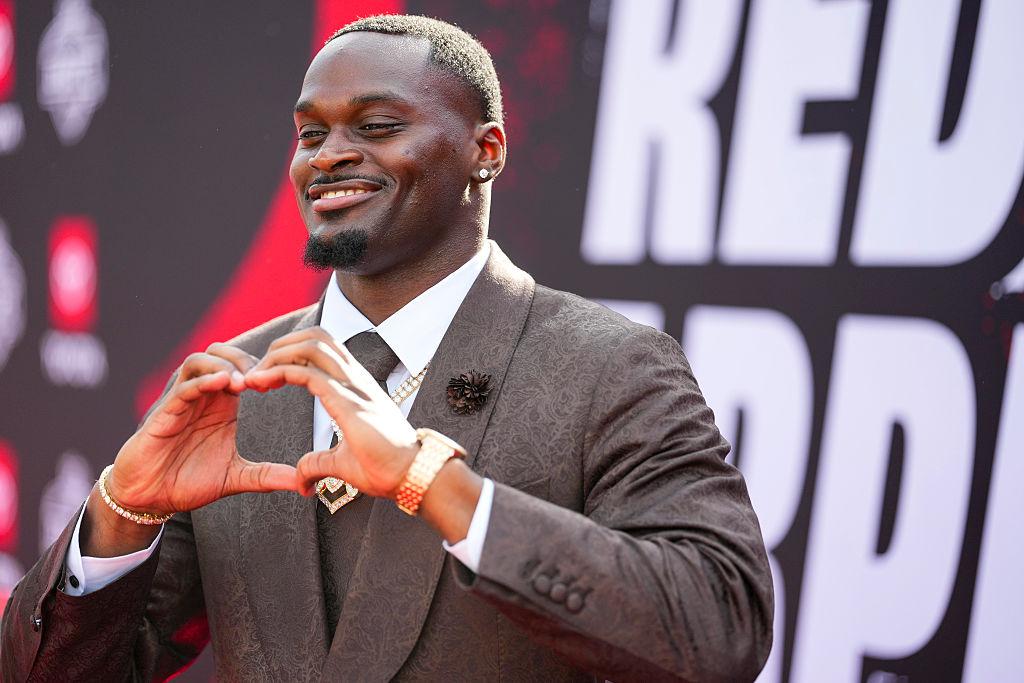
This is no knock on the player. Love is tremendously cool, so it brings me no pleasure to rip the Cardinals for taking him with the third pick. Look, I get it. I’ve watched his tape too. He’s an explosive running back with the kind of speed and contact balance worthy of a first-round selection. But context matters, and the context here is that Arizona is a bad football team, with a roster full of holes, that is incapable of supporting a talented back like Love. And this team certainly wasn’t in a position to eschew positional value—or turn down the opportunity to trade down and accrue draft capital—and make a luxury pick.
And like any luxury, Love is going to cost the Cardinals a significant chunk of money. Since Love was taken third, his rookie contract will include over $50 million in guaranteed money. That’s a record figure for a running back, blowing away the previous high ($36 million) set by Saquon Barkley last offseason. By average annual salary, Love enters the league as the seventh-highest-paid back, putting him just ahead of Pro Bowlers like James Cook and Alvin Kamara. First-round picks typically provide teams with surplus value thanks to their cheaper deals, but that’s unlikely to be the case with Love. He would have to play at an elite level over the course of his four-year rookie deal to outplay his salary. He’ll need to be a top-10 back from the start for Arizona to break even from a value standpoint. That, more than anything, is the main explanation for why running backs are rarely taken at the top of the draft.
We hadn’t seen a back go that high since the Giants used the second pick on Barkley in 2018. The pick was widely panned at the time for all of the same reasons, and that criticism did not age poorly. Barkley had some great moments in New York, but the Giants lacked the offensive infrastructure to sustain his success, and they eventually let him walk in free agency. That decision looked silly when Barkley finally reached his full potential behind Philadelphia’s dominant offensive line. But even Barkley’s tenure with the Eagles shows how many factors contribute to the success of a star running back. He played at an MVP level in his first year in Philly in 2024. But when the Eagles’ offensive line and play calling regressed in 2025, he couldn’t reach those heights a second time. His rushing total dropped by nearly 900 yards, he scored six fewer touchdowns, and his rushing average fell by nearly 2 full yards.
If Love can reach the pedestrian numbers Barkley put up last season, that would be considered a win for the rookie back. The Cardinals’ offensive line is a mess, and there isn’t a quarterback on the roster who can punish defenses for loading up the box to stop the run. It’s not a stretch to say that Love will have the highest degree of difficulty for any running back in the league, to go along with equally high expectations. We still have five months before the Cardinals play a game, so there’s plenty of time for Arizona to improve its roster and provide Love with more help. But it’s difficult to fathom a scenario where the rookie running back meets such lofty expectations. It seems silly to consider Love a “loser” on a night when he secured at least $50 million, but the Cardinals have set him up for a disappointing start to his career.
Winner: A.J. Brown’s Escape From Philadelphia
If it wasn’t already likely that Brown had played his last game in an Eagles uniform, it is now after Philadelphia traded up to take USC receiver Makai Lemon with the 20th pick of the draft. Earlier in the week, ESPN’s Adam Schefter reported that Brown’s exit was pretty much a done deal, with the Eagles waiting until June 1 to make a trade that would send the disgruntled receiver to New England—though certain, um, developments in Mike Vrabel’s life may end up complicating matters there. Regardless, even if the deal with the Pats falls through, it shouldn’t be difficult for Howie Roseman to find a willing trade partner, and it’s unlikely that the Philadelphia general manager will have a change of heart now that Lemon is on the roster.
Lemon will be viewed as Brown’s replacement, but this isn’t a like-for-like switch. In fact, the two receivers couldn’t be more different. Brown is a hulking ball winner who does his best work deep and on the perimeter, while Lemon is undersized and mostly operates out of the slot. Brown doesn’t create a lot of separation and relies on his frame and ball skills to box out corners. Lemon’s route-running and separation skills are what got him drafted so high. Brown has been known to skirt on his blocking responsibilities, while Lemon is a willing blocker.
That last point is significant, as the Eagles are adopting a style of offense that requires their receivers to play a role in the run game. New offensive coordinator Sean Mannion comes from the McVay coaching tree, which often uses condensed sets. In those, receivers line up tight to the offensive line and are asked to block linebackers on inside runs and seal the edge on runs to the outside. In past iterations of the Eagles offense, which was built around run-pass option concepts, receivers were often running routes, so blocking wasn’t a significant aspect of the job. That’s going to change under Mannion.
Brown may not be a fit for the new offense, but he has always been a crutch for quarterback Jalen Hurts. The Eagles’ franchise QB has typically shied away from throws to the middle of the field and has been at his best when throwing deep balls outside the numbers. In Brown, he had a receiver who excelled in that space. Now it looks like he’s on his way out, which could force Hurts to evolve his game after a few years of stagnation. According to a scathing recent report from ESPN about Hurts, the Eagles front office wants to see whether the QB can make that adjustment before signing him to an extension. By replacing the league’s best ball winner with a receiver who lives in the middle of the field, Philly is forcing his hand.
Arvell Reese
Getty ImagesWinner: New York Giants … Mostly
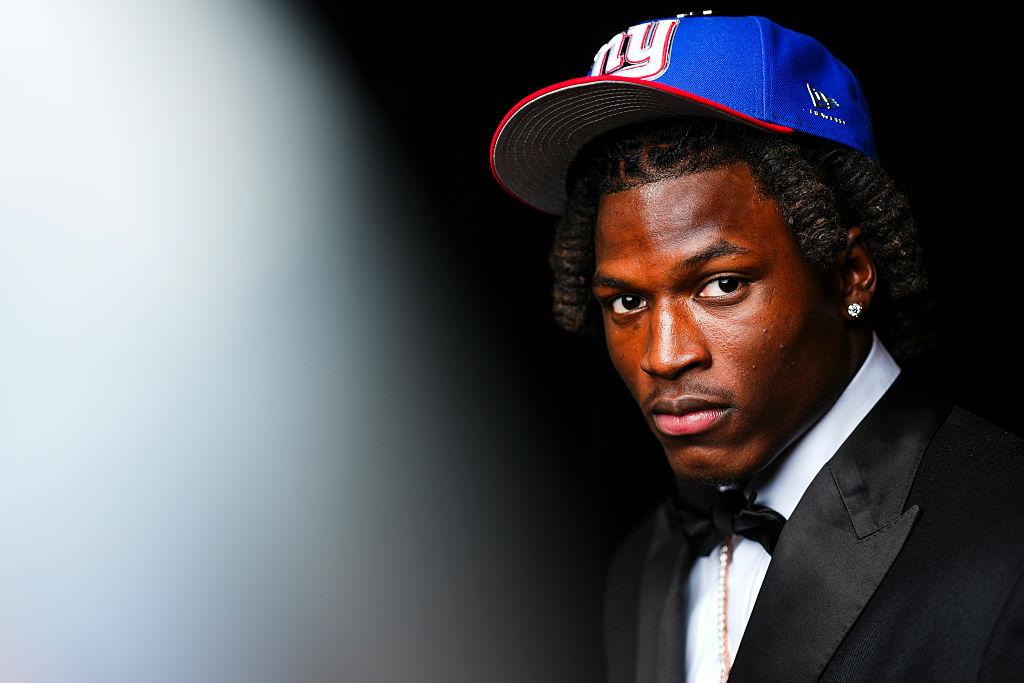
I was ready to declare the Giants the biggest winners of the night before the 10th pick of the draft was announced. New York had already landed linebacker Arvell Reese—who may have been the best prospect in the entire class—at no. 5. And his Ohio State teammate Caleb Downs—whom many believed they were considering with their first pick—was still on the board. Instead of taking Downs, though, the Giants went with Miami offensive tackle Francis Mauigoa.
Mauigoa was a solid pick. Some analysts had him as the best tackle in the draft, and he may have gone higher if not for a herniated disc that’s considered asymptomatic for now but could require major surgery if it gets worse in the future. I don’t have any medical expertise, but back health isn’t the sort of thing that tends to improve with age—especially not when your job requires repeated collisions with 300-pound men.
I would have preferred Downs, who would have been a perfect fit for New York’s new defensive scheme, but coming away with two top prospects at premium positions is a major win for a team that’s in desperate need of talent in those spots. After contract talks broke down with disgruntled star Dexter Lawrence II, the Giants traded him to Cincinnati for the pick they wound up using on Mauigoa. And with that pick in his back pocket, general manager Joe Schoen could focus solely on taking the best player available at no. 5, knowing that he could address the roster’s holes later.
Now that Reese is in the fold, joining a stacked pass rush with Brian Burns and 2025 first-round pick Abdul Carter, Kayvon Thibodeaux is expendable. Trading him could allow Schoen to pick up even more draft capital or another useful player. That would be the perfect cap to perhaps the first offseason under Schoen that Giants fans can be proud of. New York brought in a proven head coach in John Harbaugh, added plenty of veteran talent to a promising young core, and drafted Reese and Mauigoa in the first round. Winning the offseason doesn’t always translate to success on the field, but this sure as hell beats what the Giants have done in the past few offseasons.
Loser: Mock Drafts
I’m going to defend my colleagues and friends who poured hours into their mocks. It’s not their fault the teams at the top of the draft went rogue on them and started making incomprehensible picks, which had a cascading effect on the rest of the board. The Raiders may have given everyone a freebie by telegraphing the Mendoza pick, but teams like the Jets, Titans, Cardinals, and Rams made this an impossible draft to accurately forecast.
The Jets kicked off the madness by defying the betting markets, which had Reese as a heavy favorite to be the second player drafted, and taking Texas Tech pass rusher David Bailey. That poor fan base was convinced that Reese would be their pick. He’s viewed as the player with the higher upside—drawing comparisons to Micah Parsons—while Bailey is seen as a designated pass rusher who will need to add some bulk to be able to play on early run downs. The Jets seemed to confirm that Bailey was lower on their board when they canceled his top-30 visit earlier in the month. It turns out that was just a good old-fashioned smokescreen, but there was no need for subterfuge. The Jets owe their fans—and the mock drafters—out there an apology.
The Love pick was the first big shock of the draft, but we probably should have seen that coming. It’s not out of character for the Cardinals to do something dumb. It would have been more shocking if they had made a competent move. This team couldn’t even get Love’s phone number right.
That seemed to inspire the Titans to make a wacky pick themselves. I’m a big fan of Carnell Tate, a ball-winning receiver who should pair well with Cam Ward, but the fourth pick was a rich price for a player who wasn’t the consensus WR1.
The surprises at the top led to some odd fits in the bottom half of the top 10. Tennessee taking Tate where they did inspired the Chiefs to trade a pair of day two picks to move up three spots for cornerback Mansoor Delane, which was viewed as a bit of a reach even before considering the capital Kansas City gave up for the pick. Reese fell to the Giants at no. 5, which wasn’t on any mock drafts I’ve seen this offseason. Ohio State linebacker Sonny Styles, whom many had pegged for the Giants, ended up falling to the Commanders, who were linked with offensive prospects in most mocks. Things seemed to get back on a more predictable track after that, but then the Rams sent the football world into a frenzy with the Simpson pick.
Mock drafts are difficult to nail even in the chalkiest year. If you’re batting .300, you’re doing better than most. Typically, the top 10 is the easiest part to predict and accuracy rates decline drastically from there. Not this year. The mock drafters never stood a chance.
 Getty ImagesWinner: The New Eight-Minute Pick Timer
I’m old enough to remember a time when NFL teams had 15 minutes each to make their selections in the first round. It wasn’t that long ago. The league finally came to its senses after the 2007 draft when the first round stretched over six hours. Six! That’s enough time to watch two-thirds of the Lord of the Rings trilogy with a few pauses for bathroom breaks.
Even after the change to a 10-minute clock, the first round was excruciatingly long, but Roger Goodell and Co. may have found a sweet spot with their latest tweak, which shortened the clock by another two minutes. That produced a first round which breezed by in a tidy three hours. That’s roughly the same length as the average NFL game, which feels like the appropriate amount of time to commit to watching a guy read off 32 names.
I get that we’re all football sickos who are desperate for any NFL content in the offseason, but the league had a responsibility to protect us from ourselves. I’m grateful they finally took that seriously and sacrificed some ad revenue to force us to spend more time with our friends and families. With that said, I can’t wait for the schedule release show—and you know you can’t either. We’re only a few weeks away.
Steven Ruiz
Steven Ruiz has been an NFL analyst and QB ranker at The Ringer since 2021. He’s a D.C. native who roots for all the local teams except for the Commanders. As a child, he knew enough ball to not pick the team owned by Dan Snyder—but not enough to avoid choosing the Panthers.