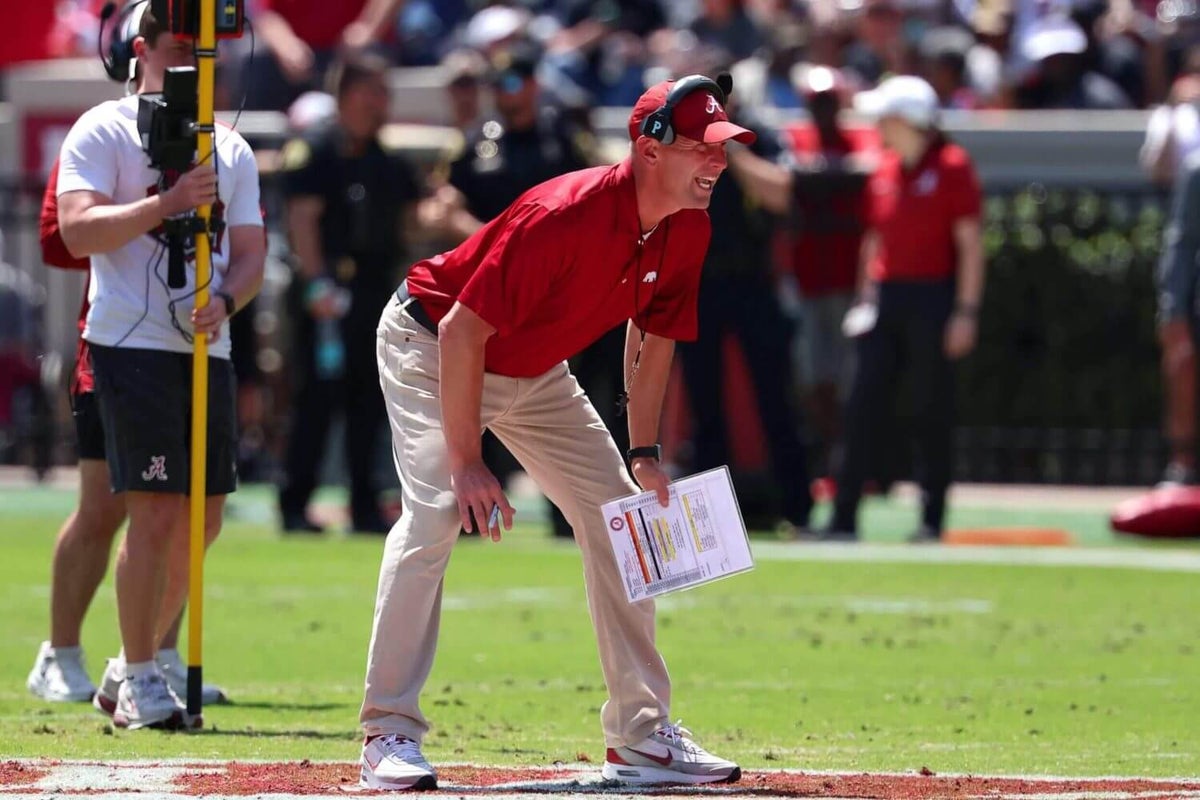
While Alabama fans ponder whether it was prudent to give head coach Kalen DeBoer a contract extension with a raise after the Crimson Tide went 20-8 in his first two seasons as Nick Saban’s replacement, there is plenty of optimism inside the program.
Coaches are especially excited about the direction of the defense. The Tide have gotten bigger on that side of the ball, and we’re told it now looks more like what Alabama had been accustomed to under Saban, especially on the interior of the line. Last year, the starting lineup just wasn’t bulky, ranking in the SEC’s bottom four in height and weight. This season, coaches expect to rank in the upper half of the conference.
USC transfer Devan Thompkins (6-5, 300 pounds) turned heads in the spring, looking even better than some in Tuscaloosa were expecting. He brings physicality on a level the Tide have lacked at times over the past two seasons.
“He really had a good spring,” DeBoer, whose new deal is worth a total of $87.5 million over seven years, told The Athletic this week. “He’s very versatile. He can play inside and outside. He can get that push in the pocket with his strength but also has a little juice to come off the edge.”
Oregon transfer Terrance Green (6-5, 320) has been another big plus. The secondary is long and athletic and has five starters back.
Last year, Alabama ranked ninth in the SEC in run defense (3.74 yards per carry allowed), the continuation of slippage that started during Saban’s last couple of seasons.
Even in last September’s victory against Georgia, the high point of the season, Alabama allowed 227 yards on the ground and 6.9 yards per carry. That was after allowing 230 rushing yards in the opener at FSU. The season ended with a blowout loss to Indiana in the CFP quarterfinal at the Rose Bowl, where the Hoosiers ran for 215 yards.
If the Crimson Tide have in fact become more stout, more physical and more disciplined up front, it will go a long way toward getting the program’s identity back.
Quarterback, of course, is Alabama’s biggest question going into 2026. Ty Simpson, drafted with the No. 13 pick by the Rams last week, threw 28 TDs and just five INTs as a first-year starter in 2025, but his efficiency fizzled down the stretch as defenses tuned out the Tide’s suspect running game.
The Tide have two strong options at quarterback in former five-star recruit Keelon Russell and Austin Mack, who followed DeBoer from Washington to Tuscaloosa. Both QBs are adept at making off-schedule plays and operating with run-pass options. Opposing coaches have said RPOs weren’t Simpson’s strong suit, and his predecessor Jalen Milroe also didn’t excel in that part of the offense.
The 6-3, 200-pound Russell, who just turned 19 earlier this month, has an intriguing skill set with a very quick release. The question with both quarterbacks: How consistent can they be?
“Both Austin and Keelon really had good springs,” DeBoer said. “A year ago, it was solid in the spring and then Ty really made a big jump in the summer going into fall camp. And since there’s only two of them, they were able to take more reps. They’re playmakers. They’ll take calculated risks. I like that about them. They weren’t timid in any way.
“They can get the ball from the hash to the opposite sideline; they can throw hole shots and are accurate passers down the field. Ty was really good at those deep in-breakers, and they’ve gotten better with those. They’re good with fade balls, back-shoulders. These guys are very diverse in what they can do at a high level.”
DeBoer anticipates that he’ll name a starter two weeks before the season opener against East Carolina.
It would certainly help if the ground game improved. DeBoer brought in former Oregon offensive line coach Adrian Klemm to provide a jolt in the trenches, and he has the Tide coming off the ball better.
It’s been five years since Alabama had a 1,000-yard back (Brian Robinson Jr. in 2021, the year after Najee Harris ran for 1,466 yards and 26 TDs.) The player to keep an eye on is EJ Crowell, who is said to have elite vision and cutting ability. The 5-11, 220-pound five-star freshman impressed teammates early but was sidelined for most of spring while dealing with a soft-tissue injury in his lower leg. DeBoer said he expects Crowell to be ready to roll by June.
“He’s got great balance,” said DeBoer. “And he’s got that mindset of he’s just not gonna go down. He’s got a lot to learn though with getting those reps in the offense. It isn’t just about his knowledge. It’s about getting those reps especially in pass protection. It’ll be how quickly can he catch up with that part.”
Another Hurricane warning
Folks inside the Miami program feel like this 2026 team may be even more talented than the one that almost won the national title. The Hurricanes lack last year’s experienced core, and it remains to be seen whether they can foster the same mature approach that helped them regroup after two October losses.
The staff is hoping vocal leaders emerge by the time fall camp rolls around.
The Canes have to replace four starters on the offensive line, including top-10 pick Francis Mauigoa, and defensive ends Rueben Bain and Ahkeem Mesidor, who were both selected in the first round, too. Those three were tone-setters.
Nickel back Keionte Scott and safety Jakobe Thomas were also rocks in the secondary, flourishing under first-year defensive coordinator Corey Hetherman.
“(Scott) was a guy who was always in the building, connecting the team, always getting guys over here,” Hetherman told The Athletic. “Jakobe brought guys over to the building. It was the way those guys practiced, how they communicated, how fast they played.”
Replacing those leaders and their voices is easier said than done. Safety Omar Thornton, a transfer from Boston College, has played a lot in the ACC and might emerge as one of those leaders. Bryce Fitzgerald, who had six interceptions as a freshman last year, offers proven production and talent. True freshman JJ Dunnigan has people inside the program raving and is another name to remember.
Replacing Bain and Mesidor up front won’t be easy, but Miami looks well equipped to again have one of the best pass rushes in the country. Expect Marquise Lightfoot, a twitchy 235-pound edge rusher, and Mizzou transfer Damon Wilson to step in for the departed first-rounders. Armondo Blount, who can play all over the D-line, also is expected to have a big year. Inside, Ahmad Moten, a disruptive 300-pounder, could be the next first-round pick off the line.
Reinforcements also came from Ohio State (Jarquez Carter) and Nebraska (Keona Davis) through the transfer portal. And there are a lot of explosive youngsters pushing for playing time.
Head coach Mario Cristobal’s program is just bigger and nastier than it used to be on both sides of the ball. One of the new expected starters on the offensive line is agile five-star freshman Jackson Cantwell, the son of two Olympic shot putters. Cristobal told The Athletic that the 6-8, 330-pound Cantwell “has insane strength” and is “really smart and instinctive.” But the transition from Missouri high school football to major college football isn’t an easy one.
Quarterback Darian Mensah, who led Duke to the ACC title last year, entered the transfer portal on the final day it was open and committed to Miami in late January, has had a seamless transition. Coaches see him as a mix of the program’s last two transfer quarterbacks, Cam Ward and Carson Beck. Mensah’s strengths are accuracy and anticipation. His outgoing personality also has been a plus. Mensah brought with him Duke’s top receiver Cooper Barkate, who adds to a deep and athletic group of receivers, headlined by Malachi Toney. In Toney and running back Mark Fletcher, Miami returns two homegrown leaders who look primed to pick up where they left off in the Playoff.
QB competition in Gainesville
New Florida coach Jon Sumrall had a quarterback competition in each of his first four seasons as a college head coach, and he’s got one in his first year with the Gators, too. That might come as a little bit of a surprise.
Georgia Tech transfer Aaron Philo followed new Florida offensive coordinator Buster Faulkner to Gainesville and was immediately presumed to be QB1. Not so fast. Tramell Jones Jr., a sophomore holdover from Billy Napier’s final Gators roster, has given the coaches something to consider.
Sumrall and Faulkner believe they have two players with good arms who are athletic enough to take advantage of a gifted group of skill players.
Philo, who has a little more game experience and a bigger arm, probably has a slight edge, but Jones flashed in the spring and could push for the job if he gets more consistent.
The Gators are loaded at receiver. Dallas Wilson, the five-star talent whose freshman season was disrupted by injury, has great ball skills; Auburn transfer Eric Singleton, who started his college career at Georgia Tech with Faulkner, can fly; Vernell Brown III is a slick route runner. Wake Forest transfer Micah Mays shined in the spring, as did Bailey Stockton, another Tech transfer.
Running back Jadan Baugh should power the running game with help from Cincinnati transfer Evan Pryor and ECU transfer London Montgomery. Duke Clark, a redshirt freshman with home-run potential, is another name to remember.
On defense, watch out for 255-pound edge rusher Jayden Woods. He was No. 40 on the Freaks List last year before posting 3.5 sacks, five tackles for loss and an interception as a freshman.
“He’s a baller,” Sumrall told The Athletic this month. “He’s strong, runs a legit 4.4. He’s really an unbelievable kid. He’s just a special, unique human.”
LSU’s exciting targets
LSU’s offense finished second-to-last in the SEC in yards per play. The Tigers didn’t just pony up to replace head coach Brian Kelly with Lane Kiffin, they spent a bunch of money to bring in quarterback Sam Leavitt from Arizona State, a host of new wideouts and the top left tackle in the portal, Jordan Seaton from Colorado.
Leavitt is still recovering from season-ending foot surgery, so he wasn’t able to participate in spring ball. USC transfer Husan Longstreet was ready to go, and he turned heads with his wheels.
The Tigers have enjoyed a remarkable run of gifted receivers over the past 15 years, and they brought in some intriguing options for Kiffin and offensive coordinator Charlie Weis Jr. Kansas State transfer Jayce Brown is super fast. Jackson Harris, who made first-team All-Mountain West at Hawaii, is big and physical. Florida transfer Eugene Wilson III is a smooth route runner who is great in space. Illinois transfer Malik Elzy is strong and sturdy at 6-2, 215. And that’s just a few of the nine transfer receivers that have LSU’s staff excited about the passing game’s potential.
But the target that has the new staff most fired up is a tight end who was already in the program: Trey’Dez Green, who caught 33 passes for 430 yards and seven touchdowns last year. “When you see him, you’re like, ‘What!?’” one LSU assistant said. “He’s 6-foot-7 with that crazy long wingspan but runs like a wideout. He can really get in and out of his breaks, he can bend, and I’ve also been impressed with his in-line blocking.”
Tale of two Tigers
Memphis has one of the country’s most intriguing quarterback battles after new Tigers head coach Charles Huff brought in two former four-star high school recruits from the portal.
Air Noland began his college career at Ohio State before transferring to South Carolina and then to Memphis to make it three schools in less than three years. In his two years of college football, he’s thrown three passes, completing two for 13 yards in a blowout win over Coastal Carolina last November. Noland was back in the portal less than a month later.
“The Air we’ve gotten has been knocked down,” Huff said. “He’s more grounded, more mature. Going to two places and not really having a ton of success has given him the perspective to know, ‘OK, I’ve gotta work at this thing. It’s not just going to be given to me.’”
Noland’s top competition has also taken a circuitous route to Memphis. Marcus Stokes initially committed to Florida but never got to UF after a video surfaced of him rapping along to song lyrics that included a racial slur. Stokes ended up at Division II West Florida, where he put up big numbers over three seasons and was named the 2025 Gulf South Conference offensive player of the year.
Stokes was more consistent in the spring and a little bit ahead of Noland, but the stage is set for a competitive battle in the preseason.
“I really wanna see in the summer who becomes the leader,” Huff said. “Who galvanizes the team, who’s having the barbecues, organizing the 7-ons. I feel good about both of them.”
From Harvard to Horned Frog
TCU coach Sonny Dykes caught some flak earlier this offseason for remarks that came across as disparaging of his former quarterback Josh Hoover, who had just transferred to Indiana after committing 42 turnovers in 31 starts in Fort Worth.
Hoover’s new coach, Curt Cignetti, came to the quarterback’s defense, implying he might be supported by a better defense and run game in Bloomington. It all made for interesting, if fairly mild, offseason fodder.
Dykes’ broader point that his team needs to better protect the football underscored an offseason makeover of TCU’s offense, including intriguing additions at coordinator and quarterback.
Gordon Sammis was brought in from UConn to replace Kendal Briles (now South Carolina’s offensive coordinator) and move the Horned Frogs more toward — to oversimplify it — a pro-style attack. The Frogs will line up under center more, play more multiple-tight end formations, run more play-action passes and generally emphasize the running game more under Sammis, a former offensive line coach.
For Dykes, an early member of the Mike Leach coaching tree who grew up in the Air Raid, it’s a different approach for a changing style of play in college football.
“The way football’s played now with the clock rules, with people huddling, all the things, possessions are down,” Dykes told The Athletic. “And so to me, the game is much more like the pro game. And the pro game is really pretty simple. It’s which team screws up the least? So football has gone from you got to go outscore everybody, to now it’s, OK, we just don’t want to screw up as bad as everybody else is screwing up.”
UConn finished 12th in the nation in yards per play (6.73) last year under Sammis, giving defenses a lot of different looks.
“You can be very unique in your personnel, and it just allows you a lot of flexibility,” Dykes said. “And then I think the biggest thing it does is it allows you to be kind of simple because you are running the same plays out of different presentations. And then you can execute at a high level. And then, theoretically, that will help limit your turnovers.”
Directing the new offense will be Jaden Craig, who transferred from Harvard after leading the Crimson to the Football Championship Subdivision playoffs last year. There is no competition heading into the summer at TCU. The 6-3, 230-pound Craig is QB1.
“He’s really smart, he’s mature. He’s got probably as strong an arm as anybody I’ve ever coached,” said Dykes, who coached Detroit Lions quarterback Jared Goff at Cal.
Dykes is most impressed with Craig’s comfort in the pocket, throwing the ball accurately under duress.
“He’s going to be mobile enough to be able to run and convert some first downs. He’s going to be big enough and be able to take the pounding physically, where you can run him enough, where you’re not scared he’s gonna get hurt all the time,” Dykes said. “He’s really, really good in the pocket, which is vastly underrated. I’m not so sure that’s not the most important characteristic for a good quarterback. He does a good job creating throwing lanes and space for himself, so I think he’s got a chance to be really good.”
Tight End U
Top-notch tight end play is as much a tradition at Penn State as excellent linebackers, from Kyle Brady in the early 1990s to Tyler Warren just a couple of seasons ago. Expect that to continue under new head coach Matt Campbell. Iowa State has been running a tight-end heavy offense for years under Campbell, and two excellent players at that position followed offensive coordinator Taylor Mouser from Ames to Happy Valley. Ben Brahmer is the headliner, and Gabe Burkle is a strong No. 2 at 6-6, 255. Coaches love what they have seen out of holdover Andrew Rappleyea, who plays with a mean streak. The third-year player took advantage of increased opportunities late last season, catching touchdowns in each of the final three games. Mouser likes to have two or three tight ends on the field most of the time, and Rappleyea should continue to find plenty of opportunities even with the Iowa State imports.
Campbell imported 24 players from Iowa State to accelerate the rebuild at Penn State, but coaches have also been happy with the transfer defensive linemen they landed from other schools. Keanu Williams from UCLA and Armstrong Nnodim from Oklahoma State in particular made their presence felt this spring.
Around the country
Washington is replacing two major playmakers this season in wide receiver Denzel Boston (second-round draft pick) and running back Jonah Coleman (fourth-round pick), but the Huskies are feeling much better about their offensive line in Year 3 under head coach Jedd Fisch. Five-star freshman Kodi Greene is looking like a plug-and-play starter. … The most interesting part of Kansas State’s transition after Chris Klieman’s retirement is the marriage of new coach Collin Klein and returning quarterback Avery Johnson. Klein did a good job in two years as Texas A&M’s offensive coordinator. Johnson’s three seasons at K-State have been good but not star-caliber. “He’s got great football IQ, great work ethic, absolutely a joy to coach,” Klein told The Athletic. K-State coaches also like what they have at cornerback, with a pair of players with enviable size: Zashon Rich (6-1, 205 pounds) and Donovan McIntosh (6-3, 195). … BYU’s staff is excited about quarterback Bear Bachmeier’s development after he was thrust into a starting role as a freshman last season. And Cougars coaches think they have found a new weapon in Oregon transfer Kyler Kasper, who caught only six passes over four seasons with the Ducks as he battled knee and foot injuries. BYU needs a top target to emerge with Chase Roberts out of eligibility and leading receiver Parker Kingston off the team and facing a rape charge in Utah. Kingston has pleaded not guilty.