
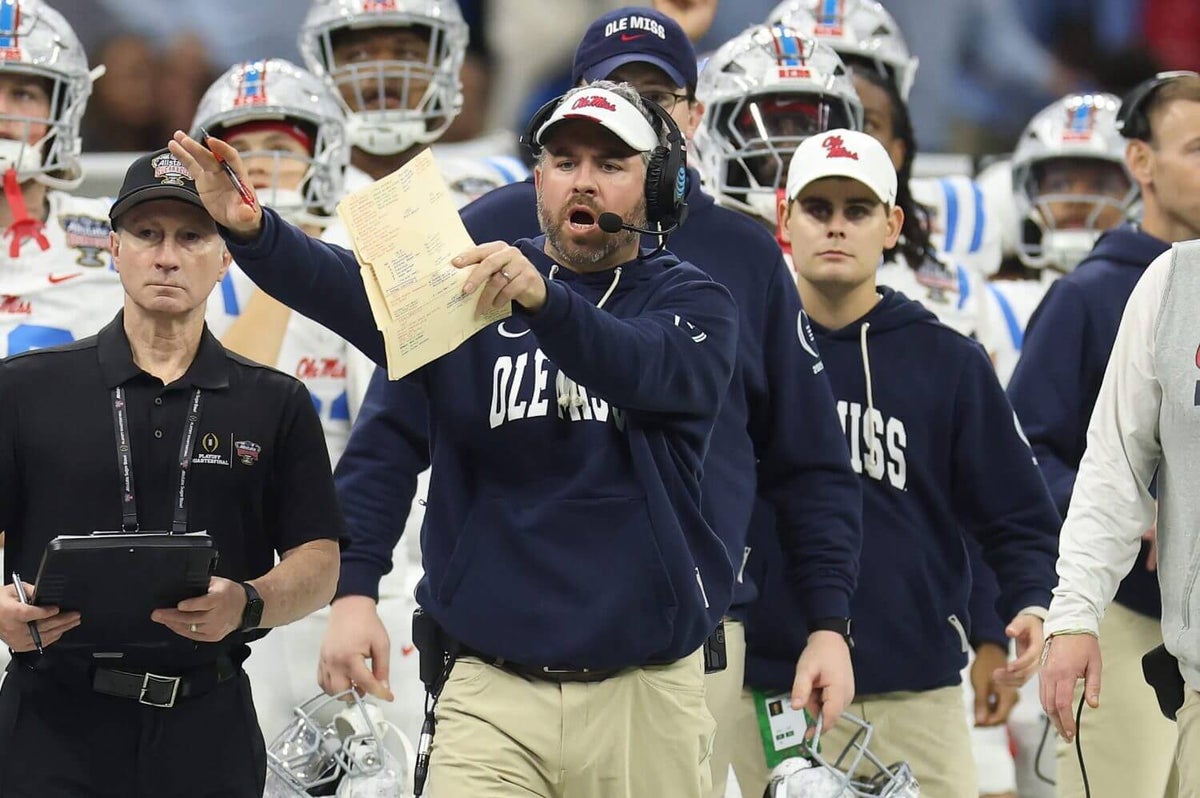
MIRAMAR BEACH, Fla. — Ole Miss coach Pete Golding remains the subject of an NCAA investigation after Clemson coach Dabo Swinney called him out for tampering. Golding on Wednesday offered up a defense of his actions, along with a question: Why isn’t another program, whose tampering Golding hinted led to the Clemson situation, also being investigated?
Golding didn’t name the program, but the player Golding was referencing transferred to LSU.
The refresher for those who need it: On Jan. 23, Swinney held a press conference in which he alleged Ole Miss tampered with linebacker Luke Ferrelli, a Cal transfer who had signed with Clemson and moved to campus before re-entering the portal and landing at Ole Miss. Swinney told the media that Golding texted Ferrelli while he was in a class at Clemson.
Golding did not respond publicly until March 31 and did not directly address Swinney’s allegations. Golding recounted that Ole Miss had hosted Ferrelli on a visit but had told the player there was no spot available for him because starting linebacker TJ Dottery was still on the roster, and that Dottery’s transfer to LSU on the final day of the portal window opened the spot for Ferrelli.
On Wednesday, in an interview with a handful of reporters at SEC spring meetings, Golding went a bit further. He began by pointing out that Ferrelli’s visit came when Ole Miss was preparing for the College Football Playoff quarterfinal, which it won to advance to the semifinals.
“The kid we’re talking about with tampering was on an official visit that weekend,” Golding said. “You’re talking now 10 days later, from an official visit, all of a sudden that this is now so wrong to reach out to a guy that OV-ed you, that wanted to be there, that you didn’t have a spot for, that I had no idea where the hell he had signed or not, because I had been getting ready for Miami and playing in the Fiesta Bowl.
“And we’re not comparing that to a guy that was a three-year starter somewhere, that wasn’t in the portal that’s at a new school now? What are we doing? I think that’s the piece that everybody’s at, there’s an enforcement on this that just took an OV, but there’s not an enforcement of this, that he just ruined his brand over three years, who’s been tampered with his entire time? What are we doing?”
Dottery would have been a three-year starter for Ole Miss if he had stayed for the 2026 season. Instead, he entered the portal on Jan. 15 and signed with LSU the next day, becoming the fourth player to go from Ole Miss to LSU following head coach Lane Kiffin’s move.
Golding was elevated to replace Kiffin after the regular season and coached the Rebels to the semifinals, but his first offseason in charge has been marred by the tampering allegations and more recent shots at Ole Miss by Kiffin and Texas coach Steve Sarkisian.
Golding, asked whether he or anyone on his staff had illegally tampered with a player from Clemson, deferred to the Ole Miss compliance department: “All that stuff will come out. Obviously we know the guidelines in place, it’s my responsibility to hold them accountable, set a good example.”
Then Golding echoed a complaint many coaches have had here at SEC meetings, that enforcement of rules, including tampering, “is a real problem.”
But he also wondered why the tampering issue is related to players. And he invoked the so-called Lane Kiffin Rule, part of the newly announced college sports bill in the Senate, that would bar coaches from moving schools during the season.
“My thing when they talk about tampering, you don’t think the coaches get tampered with? You don’t think ADs meet with head coaches?” Golding said. “I mean we’re talking about this new Kiffin rule and this s—, who do you think’s meeting with these guys and offering them the job before? Now these are the guys that are —“
Golding stopped himself.
“So I’m not getting into all of that, but holy cow.”
Golding was also asked about the open season on Ole Miss this month, in the wake of Kiffin telling Vanity Fair that the school’s racial history hurt him in recruiting and Sarkisian saying Ole Miss could count basket weaving toward transfer credits. Sarkisian backed off that comment slightly on Tuesday, saying he should have chosen his words differently, but his basic point about Texas having higher academic standards stood. Kiffin apologized for his comments days after the Vanity Fair story was published and said that it wasn’t a “calculated” decision to bring up the school’s past.
Golding said the remarks were a byproduct of Ole Miss football’s success the last two years, and they reminded him of his time as Alabama’s defensive coordinator.
“That was the best thing for me, those five years at Alabama, when you start having success, now the bull’s-eye is on you, and everybody is going to be looking through everything,” Golding said. “Now the focus is on us, what can we do better, what do we need to do better. So I can care less what everybody thinks about us. That’s not my job. Same people that are going to bring you up are going to bring you down. I think our players understand there is a bull’s-eye and a circle on them based on their success on the field over the last couple years. So that’s going to be consistent going forward.”