MINNEAPOLIS — The large sign on a wall in Jordan Halverson’s office is written in varsity font, like something an athlete taps for good luck on the way out to the field. It reads as a coaching mantra; a set of core values to help teams develop an identity:
Do I belong?
Is this meaningful?
Can I do this?
Halverson had the sign made last year when he became the principal at Fridley Middle School.
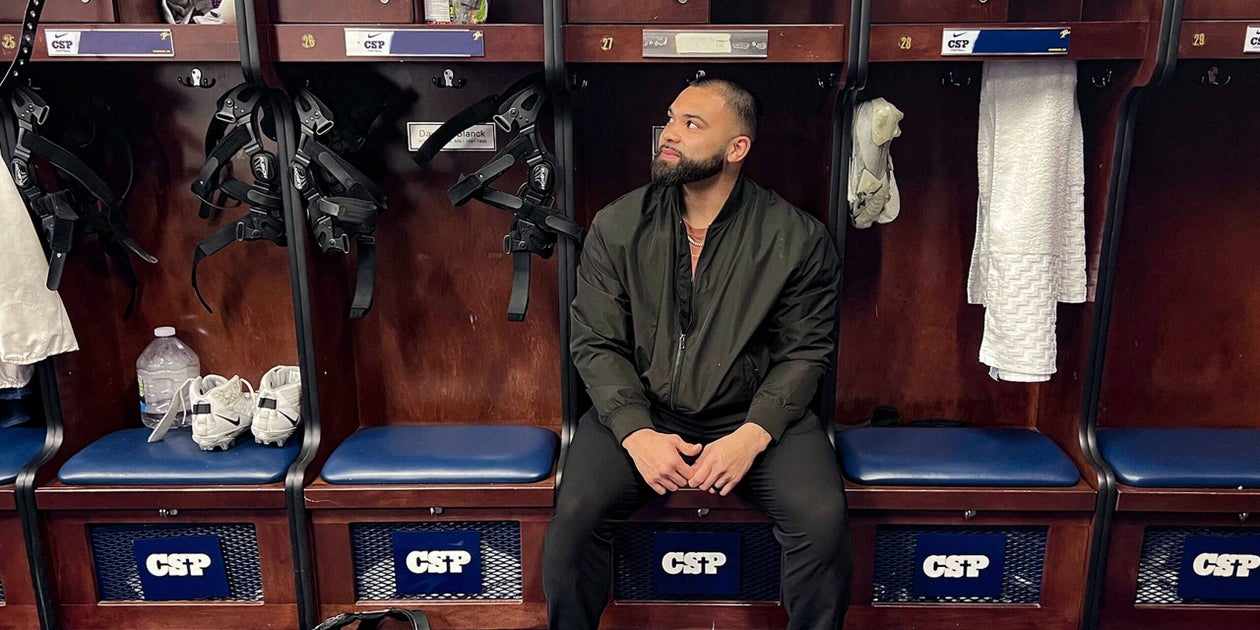
His appointment sent a buzz through the 800-student school of fifth through eighth graders. Halverson was just 34 and a former local football star. Two of his old jerseys hang on his office wall: one a basketball jersey from Fridley High School, which is across the street, and the other from Concordia University-St. Paul, a small Division II college 20 minutes south.
At Fridley High, Halverson was a quiet ninth-grade transfer as summer football practices started. He seemed to his teammates to already be an adult. He was the only underclassman on the team with a mustache; he was bigger and faster than most of his older teammates, too. He eventually became a team captain, broke the tackles record at CSP and even got a chance in the NFL at a rookie minicamp with the Minnesota Vikings. That was more than a decade ago.
Halverson gestured to a telephone behind him on his office desk. Its red-orange voicemail button blinked constantly throughout the winter, when thousands of masked and heavily armed ICE agents descended upon the Twin Cities — the target of the Trump administration’s “Operation Metro Surge.”
ICE said it was focused on undocumented immigrants with criminal records; its internal data showed that three-quarters of those taken into ICE custody during the operation had no criminal record at all.
Minnesota leaders said federal agents were targeting schools — “All it does is cause terror and trauma to the children,” Gov. Tim Walz told the New York Times — and Fridley Middle, which draws from immigrant communities, was among several schools in the area that were directly impacted by the raids.
Halverson knows multiple students who had a parent or other relative taken by ICE. At the height of agents’ activity, he said, between 100 and 150 of his students did not attend school in person because parents feared leaving their homes to transport their children or were afraid to send them via bus.
Some mornings, Halverson estimated, he had 100 or so voicemails waiting for him, the phone’s light blinking constantly. Most were from parents.
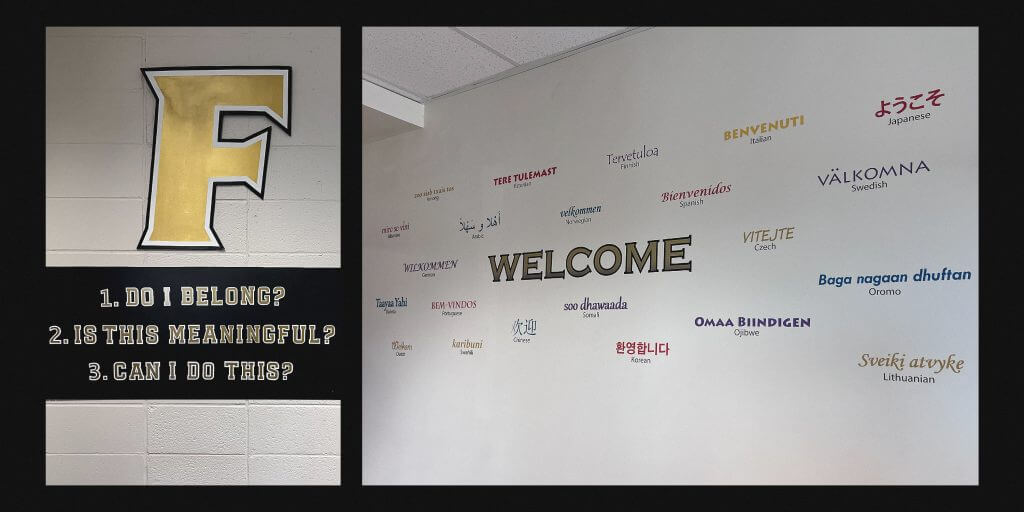
Jordan Halverson had a sign made featuring three core pillars when he took over at Fridley Middle school, which celebrates its diverse student body. (Jourdan Rodrigue / The Athletic)
“You could hear the pain, the sadness. They’re asking me, ‘How are you going to protect my child?’ ” he said. “… You sit there, you’re a first-year principal, and you’re like, ‘I don’t have all the answers. I can’t guarantee 100 percent safety for your child.’ It was a lot of helplessness, and sitting in that.”
Halverson goes back to No. 1 on his sign. Do I belong?
“What I always tell people is that we’ve got to control the controllables,” he said, using a phrase commonly heard in football. “(We can) welcome these kids into the building each day and make them feel safe and that they are home.”
Halverson knows firsthand how much that matters. As a teenager, he may have appeared to some as the imperturbable football star of Fridley High. In reality, his home life was turbulent. Food and shelter were frequently uncertain. Halverson’s friends, teachers and coaches across Fridley supported him — with meals, a bed and more.
Now, the Fridley Middle staff and students looked to Halverson, their rookie principal, to lead them through a frightening and uncertain winter.
No. 3. Can I do this?
By the time Halverson’s mother moved them to Fridley the summer before he entered ninth grade, he was old enough to understand that something was wrong, but not old enough to understand what it was. All he knew was that they couldn’t ever keep an apartment for very long.
“I was used to my mom calling me or sending me a text like, ‘We gotta get out of the house by this time because we can’t live there anymore,’ ” he said.
During a particularly challenging episode with her mental health, Halverson said, his mother went to stay with her sister in Wisconsin. Halverson had just started to settle in at school. He was making friends and gaining the attention of coaches who saw him play football and also wanted him on the basketball and track teams. Halverson wanted to stay in Fridley and finish school, yet he no longer had a permanent home there.
(He didn’t see his father from age 2 until he was in high school, when his dad showed up unannounced at one of his basketball games. They don’t keep in touch, Halverson said, although he has relationships with other half-siblings on both his dad’s and mom’s side.)
Coaches, teachers and friends’ parents recognized the truth of Halverson’s situation and were keeping an eye on him. Halverson crashed on couches all across Fridley. His mom sent money to the families who took him in for food and clothing, but he wasn’t always sure where his next bed or meal would be.
Eventually, Halverson moved in for a months-long stay with one of his best friends and football teammates, Travis Zerwas. Zerwas, his four siblings and his parents lived in a modest house near the high school and had little to spare. However, everyone was welcome at their table regardless of background or circumstance, and Zerwas’ parents gave what they could.
Finally, Halverson had a consistent roof over his head. Some of his fondest memories are from conversations at the dinner table with the Zerwases.
“You don’t need the best to do your best,” Zerwas remembers his parents often saying. Halverson came to understand that many Fridley families held those same values.
His mother later moved back to Fridley, and Halverson returned to live with her, but they still moved around town a lot. She was a fierce advocate for Halverson’s education, though, and pushed him to make at least a 3.0 grade point average so he could draw more scholarship consideration from colleges. Concordia-St. Paul recruited him and offered financial aid.
At CSP, Halverson again emerged as a standout player and a quiet leader. Others around the team at that time noted that Halverson did not speak up much but took it upon himself to check in on teammates and the locker-room dynamics — and recalled that when he did voice an opinion, people listened.
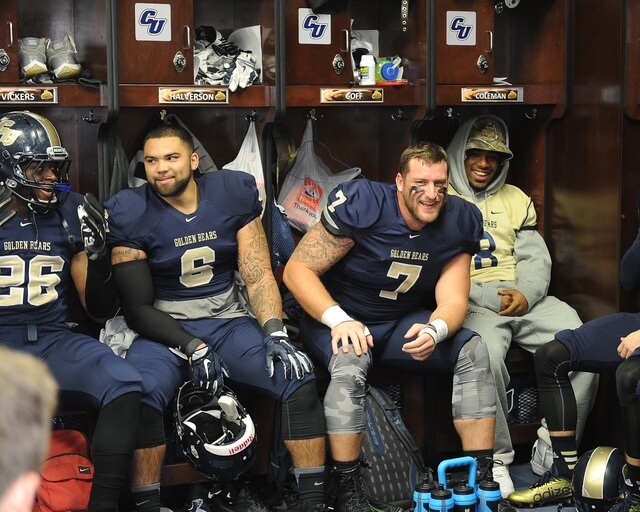
Teammates considered Halverson (6) a leader, both in high school and in college. (Courtesy Justin Oakman Photography)
Shortly into his junior season, Halverson tore his ACL. Because he had an extra year of eligibility due to the injury, he and a college adviser realized he could pursue a secondary degree. He chose educational leadership, thinking about the people who had once helped him and how he might give back.
When he returned to the field for his final season, Halverson set CSP’s career tackles record. He started hearing about interest from NFL scouts and thought professional football might be a possibility.
Buzz about Halverson’s potential football career was circulating back in Fridley, too. He was their hometown player, who was first preparing for a regional NFL combine and was then invited to the Vikings’ rookie minicamp. He even had an agent. Teachers at Fridley Middle still mention that Halverson once trained at the same facility as other local stars, Detroit Lakes’ Adam Thielen and CSP’s Zach Moore.
At the rookie minicamp, Halverson was honest with himself. He could hang with the guys on special teams — he flew around with effort and hit people — but between the level of competition to make the roster and lingering effects from his college injury, his football career was likely over (he did make it long enough for then-Vikings head coach Mike Zimmer to cuss in his direction after a play, he jokes).
Halverson had known that he wanted to be a teacher when football was over. Eventually, he thought, he could become a principal, a natural match for a team leader.
He taught health classes and coached at Wayzata High, a well-to-do school in a Minneapolis suburb, for seven years, becoming the defensive coordinator of its state championship football team in 2019.
However, his path shifted again. He and his wife, Kaliah, had a daughter in 2018. The long nights and weekends he spent coaching began to pile up, and Halverson did not want his daughter to grow up without him as a constant presence. He had missed his father too much. He eventually shifted fully to administration, and one day last summer, Halverson saw the opening for a new principal at Fridley Middle.
Without hesitation, he applied. The interview process began. It felt like fate that he might be able to lead in the community that raised him. When the school board announced Halverson as the new principal, he wept.
“I was speechless. Instant tears,” he said. “This community means so much to me. It’s done so much for me. They all wrapped their arms around me when I needed them.”
As Halverson came of age in Fridley, he thought football would be his path to becoming extraordinary somewhere else. Now, he believes he was always supposed to come back.
Fridley Middle enrolls students from all over the metro area and is very diverse, a fact the teachers and administrators are proud of. In the front lobby and outside Halverson’s office, a large wall features a mural that welcomes people to the school in 24 different languages, next to it, an American flag.
Halverson himself is multiracial (Black, Vietnamese and White) and believes it’s important for his students to see someone from a diverse background in such a vital role.
One frigid, gray day last winter, Halverson received word from his district network that ICE agents were in Fridley and would possibly come by the high school and middle school. He acted quickly. He sent a staff-wide email asking teachers and administrators to stand outside the school at dismissal that afternoon, and urged staff over the school loudspeaker to check their emails. If agents did arrive, Halverson wanted them to see all the adults, not just the kids.
Staff only needed to show up if they felt comfortable, he stressed.
At dismissal, Fridley Middle’s teachers and many support staff put on their jackets, scarves and gloves and walked outside. There they stayed, helping to get students safely into vehicles.
“I think we had 100 percent of our teachers out there,” Halverson said.
The next morning, in the frigid dark of the Minnesota winter, teachers were outside again to greet students as they arrived. For weeks, as the raids continued, the staff kept it up.
Fridley Middle has three social workers, including Jaimie Beran, a Fridley native who returned to the school after graduating from Florida State University. She also knew Halverson in high school, though she was a few years younger.
In a normal year, the social workers network with students and families throughout the entire Fridley community and into the greater metro area — anywhere there might be a student in need. They keep an eye on students who might not have a stable situation once they leave class; the Jordan Halversons of a different era, as Beran put it.
When ICE came to the area, the social workers became the heart of a vast resource system, built on the fly and coordinated by Halverson and other administrators. They delivered food, clothing, and other supplies to families whose parents or caregivers feared going to work, in collaboration with food banks and other organizations throughout the area.
Staff helped the social workers pack their cars, keeping in-person delivery contacts to a small group so that families could build trust with the people showing up at their homes. They helped families pay rent, tapping into national and local donation programs built by volunteers and neighbors.
“My staff here, I would put them up against anybody in the world,” Halverson said. “What they did during this time and beyond this time has been second to none. They held still. They were stable for all of our students. That was powerful for me to see and inspiring.”
After federal immigration agents shot and killed Minneapolis residents and U.S. citizens Renee Good and Alex Pretti in January, volunteers and social workers began traveling in pairs. If they encountered ICE or suspected they were being followed by agents to a family’s home, they would return to designated safe places and map a different route for their next delivery.
“It was terrible, it was absolutely horrific,” Beran said, “… and we just did what we could and filled in gaps.”
Halverson said that volunteer legal observers, with the district’s approval, began lining the streets in surrounding neighborhoods to ensure kids were being looked after on their walks to and from school. Tens of thousands of people did the same for their neighbors across the metro area and beyond.
“That shows what kind of community we have,” Halverson said, adding, “There wasn’t any pushback. The view was, ‘What is best for our kids?’ Nothing political. We just needed to make sure our kids were getting home safe, and I think everyone can agree to that.”
As the raids continued for weeks, Halverson and his staff set up an e-learning program for students who had to stay at home, whether because their parents feared for their children’s safety or their own.
Social workers got computers and WiFi hotspots to those families. Teachers took on a hybrid role, instructing in their classrooms while also accommodating the online learners. Many teachers also volunteered extra time to help build lesson plans with Halverson and his assistant principals. Fridley Middle began operating what was essentially two schools: one in person and one remote.
“You have 600-plus kids in the building while you’re also trying to support, I think our most was 150 students out at a time. … That was unique,” Halverson said. “And then what they were seeing in the news. People were getting shot and killed by federal agents.
“I just remember one of my fifth graders coming up to me. She’s like, ‘Mr. Halverson, are you gonna protect us if ICE shows up?’ It stopped me in my tracks. You’re 11 years old. You should not be worried about this.”
Halverson began walking that student to and from her transport van every day.
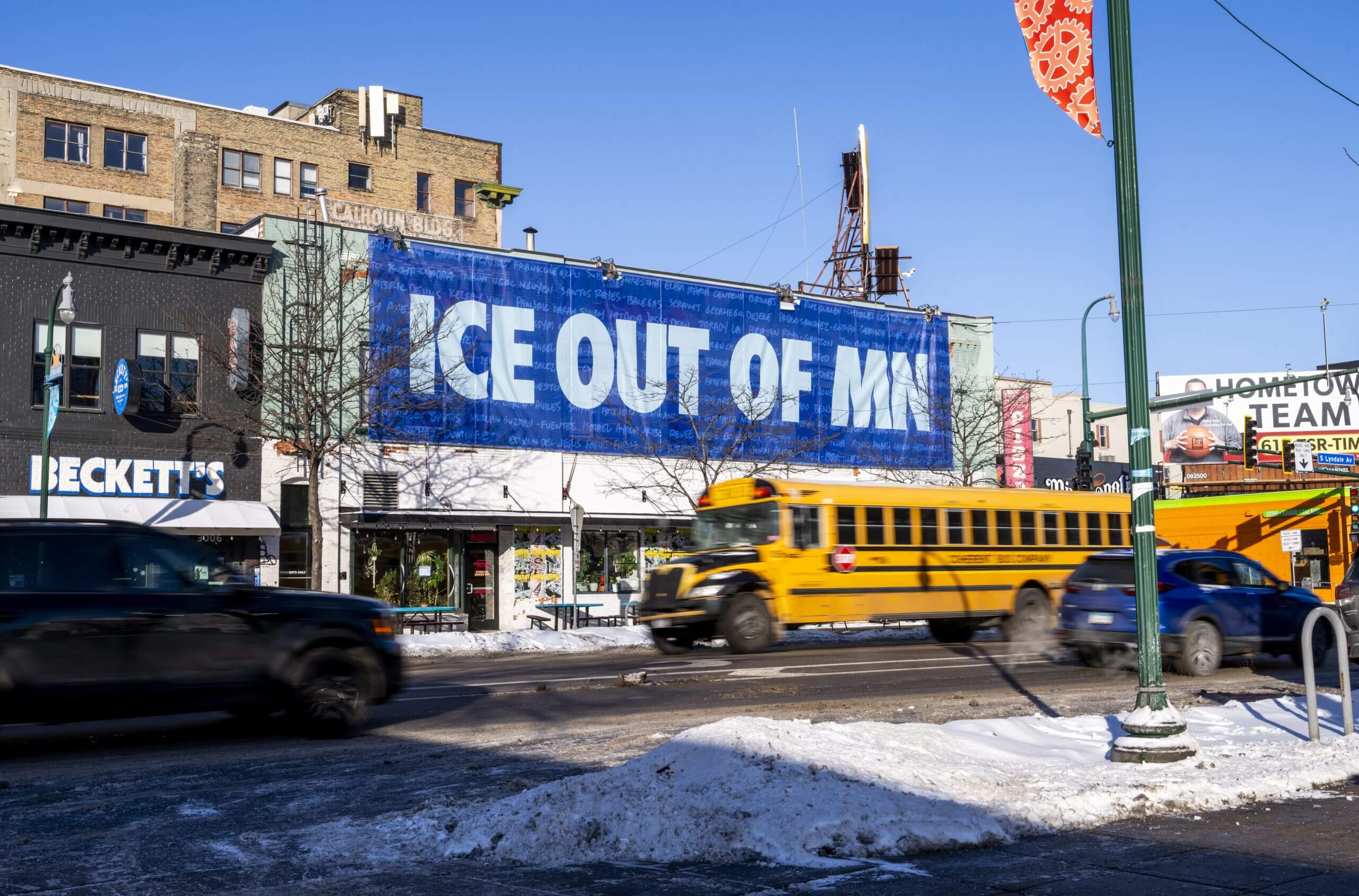
Protests against ICE raids cropped up around the Minneapolis metro area during the winter of 2025-26. (Stephen Maturen / Getty Images)
There were two occasions when Fridley Middle had to cancel school altogether due to safety concerns, he said. Halverson watched his teachers take on more weight as the weeks passed.
He tried to help. Instead of their routine after-hours professional development coursework, Halverson and the staff would sometimes play music over the loudspeakers and walk through the school’s hallways. He checked on people in different ways, relating that time to his experience as a leader on a football team and in a locker room.
“It’s just like football: Which people I can push, which people are going to open up more (or) aren’t, who is going to be more outspoken, who is not? And just being strategic in talking to those people, (and) those (who) may be a little quieter but you know that they may be struggling,” he said.
“You can tell he’s a coach,” Beran said. “That’s the way he leads.”
But privately, there were times Halverson struggled. One evening at home, their 7-year-old daughter asked Halverson and Kaliah where some of her classmates had gone. They still had name tags in her classroom, she said. But where were they?
Halverson started crying. “My 7-year-old baby is seeing it. … I never thought I would have to explain that to her at this age,” he said.
He and Kaliah sat down with her and a classroom picture to see who she was talking about. Halverson felt he might be at his breaking point.
“I’m day-by-day; let’s get through it,” he said. “That’s when I was like, my bucket is empty.”
Beran and other Fridley staff said that to them, Halverson remained consistent and composed.
“There wasn’t really time to break down, though,” Beran added. “The needs stayed great.”
Halverson’s drive to Fridley Middle School takes him past the neighboring high school and the football field where he once starred.
The field looks the same to him as it did then, with large and well-worn bleachers behind the home sideline and a tiny section on the opposite side for rival fans. On Friday nights in the fall, the field lights are visible from many of the front yards of the small homes and apartments in the area.
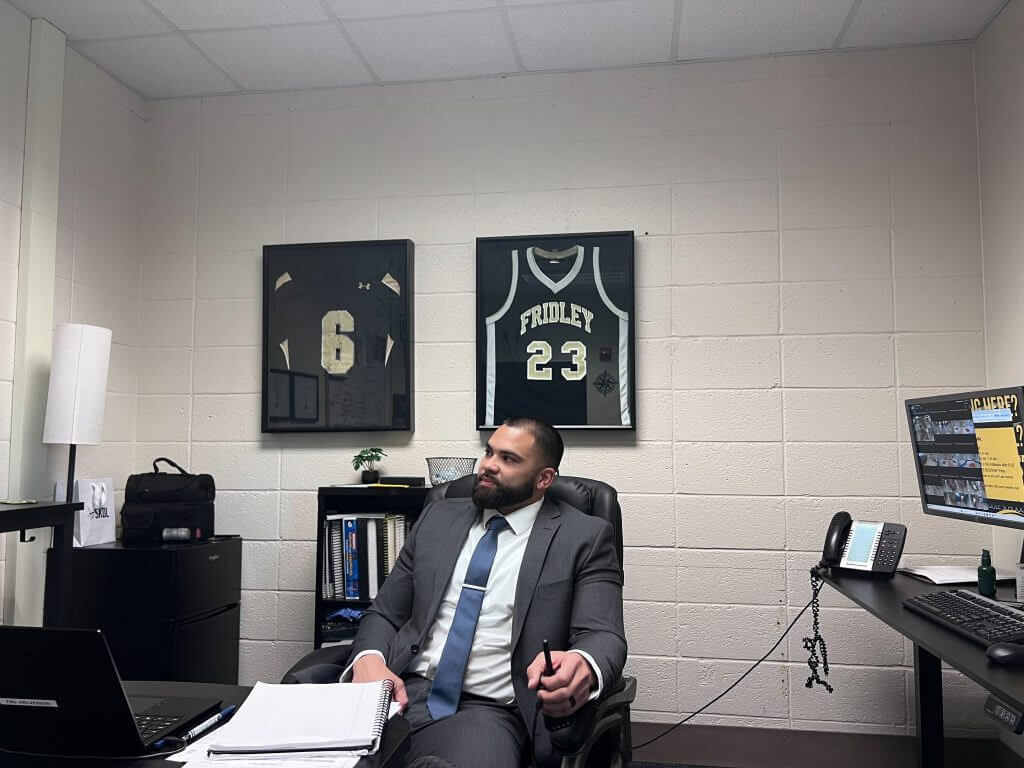
Halverson sits behind his desk at Fridley Middle School. (Jourdan Rodrigue / The Athletic)
One of those is still the Zerwas’ house, the best home a teenage Halverson ever knew. Halverson, Zerwas and the rest of their friend group stayed tightly knit throughout college, weddings, the births of children and beyond. They still watch the high school football games together. Only now, the friends proudly tease Halverson about his new job and how he “looks like a principal” at the games.
“He’s just a really solid human being. People seem to gravitate to him. That’s why he’s perfect for being a principal,” Zerwas said. “He’s a role model, he’s someone you can look up to. Honest, dependable. … He’s a good man on this Earth.”
In late March in Fridley, what locals hoped would be the last winter storm of the year had just passed through. All that was left of the snow was shoveled into melting mounds at the edges of intersections and crosswalks. At the front desk outside Halverson’s office, a secretary had written a reminder to herself on a sticky note: “Turn heat off.” She had doodled a smiley face next to it.
Fridley Middle was just a few days away from spring break. ICE, the federal government said, was pulling back from the area. Anxiety remained high among the school’s teachers and social workers, who worried about sending students away for the break. Many would be in communities that had been fundamentally altered — now missing parents, friends, even entire families.
Some Fridley Middle staff wondered aloud how they might help ease the pain of those empty spaces for their students, while also processing their own trauma. Beran shed a few tears in her office before wiping her eyes with a tissue, straightening her shoulders and heading into the hallway. She only wanted her students to know her as a helper, not as someone still apprehensive about the uncertain days and weeks ahead.
Halverson continued to aim for consistency and dependability. Controlling the controllables. On the Monday morning before spring break, he stood alongside a couple of the social workers at the school’s entrance, greeting students as they walked in. He does this at the start of every school day, and then he walks the halls and visits classrooms. Halverson wants students to see him as a constant in their routines. He wants them to know they can count on him, just as he once counted on Fridley.
“The Fridley roots are so deep. For him to come back here …” Beran said, her voice cracking, “he could be anywhere. He was anywhere. And he chose to come here.”
Later, Halverson would sit in his office and prepare to broadcast an episode of “Tiger Talk” from his computer into the classrooms. Soon, he will have another piece of football memorabilia to display next to his old jerseys on the wall behind him. He will be inducted into the Concordia-Saint Paul Athletics Hall of Fame this fall.
During “Tiger Talk” (named after the school mascot), Halverson updates students on any goals or events for the week. He likes to remind the students and their teachers of his core pillars — the words on the sign on his office wall.
In doing so, he is also reinforcing the words within himself. Halverson needed them in his rookie year as principal of Fridley Middle. He might need them again.
Do I belong?
Is this meaningful?
Can I do this?