
SPRINGFIELD — Faced with the collapse of a yearslong tax relief plan aimed at encouraging a Chicago Bears move to Arlington Heights, state lawmakers spent Sunday, the last scheduled day of their spring session, scrambling for a Hail Mary plan that could get the votes to coerce the team to stay in Illinois.
Late Sunday, lawmakers were still fashioning that plan, which would allow Cook County cities of more than 70,000 but aimed at Arlington Heights and Chicago, to create their own stadium finance authorities, essentially establishing a public-private partnership in which sports teams like the Bears could build a stadium on public land to avoid paying property taxes on the facility.
“We’re working on a public ownership model for the stadium. So it would be owned by a public municipality,” said state Sen. Bill Cunningham of Chicago, who has spearheaded Bears stadium talks in the Senate, where legislation has been bottled up for weeks. “(But) privately financed. The Bears have said they’ll spend upwards of $2.5 billion of their money on (the) stadium. So the setup would be, they would essentially pay for the stadium, enter (into) an agreement with the municipality. Could be any municipality.”
The latest effort comes after Cunningham on Saturday acknowledged that there was not enough support for a plan to provide the Bears with the property tax certainty they sought to build on the 326-acre Arlington Heights site the team acquired for $197.2 million in 2023. In April, the House passed a bill, sponsored by state Rep. Kam Buckner of Chicago, that would have allowed the team to have its property tax assessments frozen for 25 to 45 years in exchange for making payments to local taxing bodies in lieu of taxes, known as PILOT.
Meanwhile, an offer from the state of Indiana stands in the wings. The state has created an agency to construct a taxpayer-financed stadium and surrounding mixed-use entertainment district for the Bears in Hammond, near Wolf Lake, 20 miles southeast of Chicago. The team has expressed interest in the stadium site, sparking the Springfield efforts that have floundered.
For all of the Sundays that the Bears, one of the National Football League’s charter franchises, have competed in their 105 years — from Decatur’s Staley Field, then to Chicago’s Wrigley Field and Soldier Field — it was an off-season Sunday, far away from the gridiron, that could prove to be one of the most consequential in team history. But by 10:30 p.m., no bill had been introduced. The spring legislative session is scheduled to end at midnight.
Legislation passed after the midnight deadline requires a three-fifths majority in each chamber, rather than a simple majority, to take effect immediately. That means 72 votes in the House instead of 60 and 36 votes in the Senate instead of 30. While Democrats have supermajorities in both chambers, achieving the higher vote total would likely require help from minority Republicans to supplement opposing Democrats. A simple majority vote in overtime would still result in the bill’s passage, but the effective date would be pushed to July 1, 2027.
 State Rep. Kam Buckner, center, rises after attending an Illinois House Executive Committee hearing on the budget bill during the spring legislative session at the State Capitol on May 31, 2026, in Springfield. (John J. Kim/Chicago Tribune)
 State Sen. Bill Cunningham stands in the Senate chamber during the spring legislative session at the State Capitol on May 28, 2026, in Springfield. (John J. Kim/Chicago Tribune)
Though lawmakers waited for official legislation to be filed, Cunningham described the rough details of the idea.
The bill would allow municipalities in Cook County with populations of 70,000 or more to establish their own stadium authority, which, in turn, could take ownership of a stadium site and therefore exempt the location from property taxes. Cunningham said the exemption would apply only to the stadium parcels, not to surrounding areas such as an entertainment district the Bears have pitched for the existing site around a new stadium in Arlington Heights.
“This approach would allow municipalities, municipalities of a certain size, to set up their own stadium authority, which would then allow the Bears, should they choose to enter into an agreement with the municipality, to privately finance the stadium, and then the stadium would be owned by the municipality. Because it would be a public building, it would not pay any property taxes,” Cunningham said.
One reason for the latest proposal is that it would allow Chicago to theoretically pitch a stadium plan to the Bears. A significant stumbling block in Springfield for the PILOT measure was that many Chicago lawmakers felt the city was not getting a fair shake and the legislation was helping push the team into the suburbs.
“So, the way that we are designing the law, it would be any municipality in Cook County with a population over 70,000. So Chicago would be one of them,” Cunningham said.
Chicago in 2024 pitched a new domed stadium next to Soldier Field, but the plan required massive public financing, a proposal that Gov. JB Pritzker and top lawmakers rejected out of hand as too costly to taxpayers.
While a municipal stadium owned by Arlington Heights or Chicago would allow the Bears to avoid paying property taxes on the new facility, the stadium authority could negotiate with the team over the distribution of revenues from the facility.
“The Bears have been briefed on them,” Cunningham said of the legislative broad strokes of the latest idea. “I can’t tell you if they’re on board as of yet.”
Bears’ spokesman Scott Hagel did not respond to requests for comment about the status of negotiations on Sunday.
Cunningham noted that Soldier Field is owned by the Chicago Park District and sits on publicly owned land, so it doesn’t pay property taxes.
“I think all but three NFL stadiums are publicly owned right now, so it’s a pretty common model,” he said.
Such a stadium finance authority already exists on the state level under the Illinois Sports Facilities Authority, or ISFA, which oversees the renovations and construction of sports stadiums in the state. ISFA is the owner of Rate Field, home of the Chicago White Sox, and financed the 2003 renovation of Soldier Field.
 Vehicles are parked in office building lots west of the former Arlington International Racecourse on April 21, 2026, in Arlington Heights. The vacant land is a possible future site of a new stadium for the Chicago Bears. (John J. Kim/Chicago Tribune)
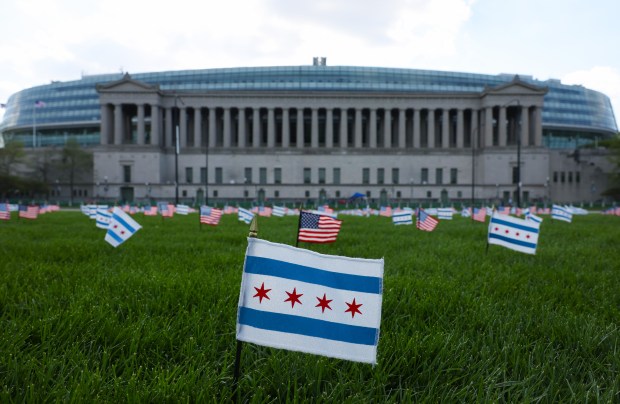 Chicago and U.S. flags are planted on the grass across the street from Soldier Field on April 23, 2026, in Chicago. (John J. Kim/Chicago Tribune)
The last-minute plan left numerous questions about how such a plan would be carried out, let alone whether it would garner support in both the House and Senate. Crain’s Chicago Business was the first to report about the alternative plan. The absence of details left many questions, not the least of which is whether the Bears would accept an alternative proposal. There also were questions about how a local stadium authority would work or own a stadium site and how it would generate revenue.
Also unresolved was the Bears’ request for roughly $855 million in infrastructure funding related to the Arlington Heights property.
Buckner said he did not know the specifics of Cunningham’s plan.
“The Senate has been very clear that they’re kicking around some new ideas with their caucus on what a last-ditch effort may look like. And so I’m looking forward to hearing what the response is in the Senate, and we’ll see what can happen before the end of the night,” Buckner told reporters.
“The language is what is going to drive the day when it comes to what happens here,” he said. “Details matter.”
Some of the dysfunction that plagued other legislation in this spring session also was on display with the Bears issue.
Rather than meeting together during the spring session, the Illinois House and Senate often convened on alternating weeks. The schedule effectively put each chamber into separate silos, leaving them unaware of what the other was doing and creating an atmosphere that made it hard to build momentum to move bills from one chamber to the other.
But the Bears issue has also been particularly difficult. Cunningham said some senators have long opposed giving property-tax breaks to a professional sports franchise worth billions of dollars. He also noted Chicago Democrats were opposed to allowing the team to move to a suburban location and wanted a city stadium site to be an option.
“I think there’s always been, from day one, there has always been a Chicago problem with the Bears proposal,” Cunningham said. “The Bears have had a proposal on the table for a couple of years that asks Chicago members of the legislature to vote for a tax credit that would encourage a business to leave Chicago. Legislators generally don’t do that. That’s always been an obstacle to passing this bill. That’s something we’re working on addressing with our proposal.”
Lawmakers, Cunningham said, “want to be comfortable with something that protects the taxpayers, something that their constituents can live with, whether or not the Bears are supportive of it, (which) is very much a secondary concern.”
Pritzker and the Bears had said publicly that the team’s choices to relocate from Soldier Field, its home since 1971, came down to the Arlington Heights property, the site of the former Arlington International Racecourse, and the site in Hammond.
Also upending the focus on Arlington Heights was Chicago Mayor Brandon Johnson’s early May visit to Springfield, where he touted resurrecting the $4.7 billion lakefront stadium proposal south of Soldier Field from 2024.
Cunningham contended on Saturday night that despite the team’s public pronouncements, “the Bears have met repeatedly with the city of Chicago over the last several months to talk about” a city stadium proposal.
“Obviously, the city has made it clear they would like to be considered for a new stadium,” he said on Saturday night. “We’d like to come up with some sort of proposal that would put them on an equal plane” as Arlington Heights.