
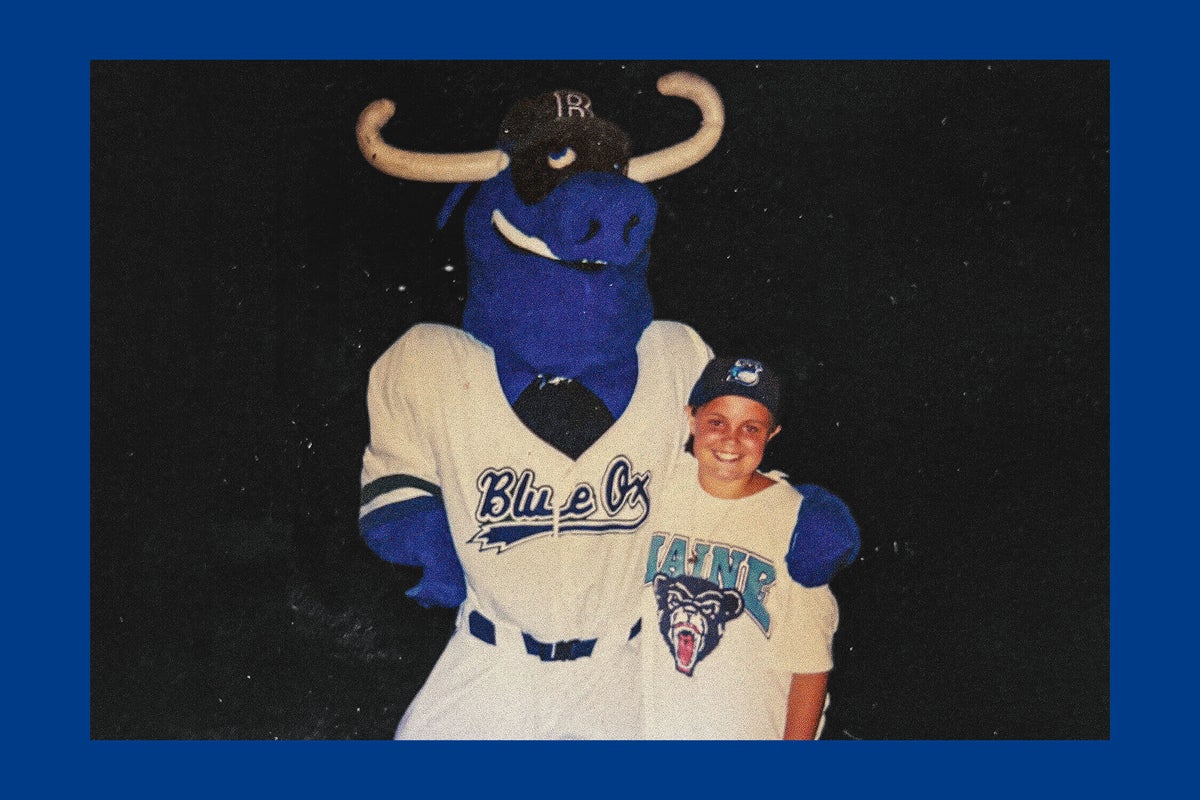
COOPERSTOWN, N.Y. — Marissa MacDougall has fond memories of attending Bangor Blue Ox games during the summer of 1996, the year she turned 11. She remembers the night her dad caught a foul ball, and how, after the game, Dave MacDougall took his little girl down to the railing to collect autographs. Since this was independent minor-league baseball, the players were happy to sign. Marissa even got an autograph from Dennis “Oil Can” Boyd, the crowd-pleasing former Boston Red Sox right-hander who in 1996, at age 36, ventured to Maine’s second-largest city and fashioned a 10-0 record for the Blue Ox in a bid to make it back to the majors.
But as much as Marissa loved The Can, her favorite member of the Blue Ox was the mascot. That would be Babe the Blue Ox, modeled after the sidekick to the mythical Paul Bunyan, who, legend has it, hailed from Bangor. Babe, a floppy, anthropomorphic ox decked out in a Blue Ox uniform with No. 3 on the back (of course), would cavort with fans, pose for photos and engage in the kind of zany on-field antics that are expected from sports mascots throughout the world.
But for the longest time, Marissa didn’t remember she once wrote a fan letter to Babe the Blue Ox. Time marches on, right? The family has long since relocated from the old home on Cumberland Street in Bangor to Phoenix. Now 40, Marissa MacDougall Johnson and her husband, Dave, have three children, including David III, just two months old. Her oldest son, Dominik, is in the Navy, stationed in San Diego. And then there’s her own little girl, 4-year-old Shyloe. With so much on her plate, it’s understandable she might not recall writing a fan letter to a minor-league baseball mascot when she was 11.
This takes us to a ceremony that took place a week ago at the National Baseball Hall of Fame and Museum. Though the Bangor Blue Ox lasted just two seasons, a not uncommon fate in the seat-of-the-pants world of indy minor-league baseball, the Hall of Fame was impressed that much of the team’s papers and correspondence — including dozens of fan letters that had been sent to Babe the Blue Ox — had survived over the years. The Hall reached out to staff members of the ill-fated Blue Ox and said it would be happy to accept the two box loads of material at its A. Bartlett Giamatti Research Center. And so on Friday, May 29, after former Blue Ox president Dean Gyorgy headed up a lecture on the team as part of the Hall’s annual Symposium on Baseball and American Culture, everybody stepped into another room for the formal handing-over of all that cool stuff.
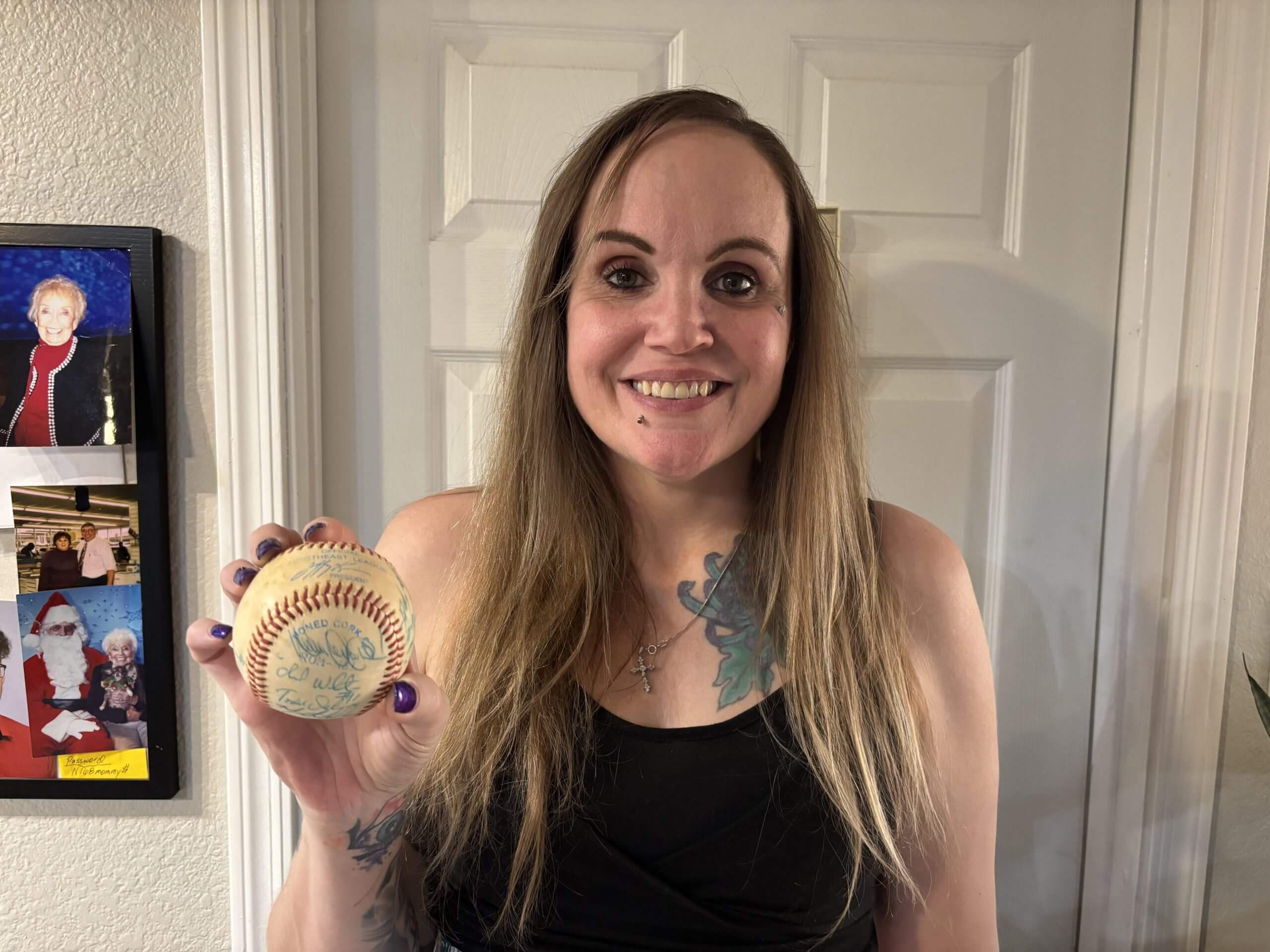
Marissa MacDougall Johnson holds up a ball signed by Dennis “Oil Can” Boyd and other members of the Bangor Blue Ox. (Courtesy of Marissa MacDougall Johnson)
It’s the letters to Babe the Blue Ox from all those youthful, wide-eyed baseball fans from Greater Bangor that really pop. Festooned with stickers, exclamation marks and the kids’ own renderings of the Babe, the letters illustrate how much team mascots resonate with children. Gyorgy and his old buddies from the Blue Ox days had attempted to track down some of those now-grown kids in the weeks leading up to the ceremony, but without much success.
And then the phone rang. It was Marissa. Her husband had received a message on his cell phone, something about an old minor-league baseball team from Bangor. Something about a team mascot called Babe the Blue Ox. Something about a fan letter Marissa is said to have written 30 years ago this summer.
She said she had no recollection of having written such a letter.
An image of the letter was texted to her.
“Oh my goodness,” Marissa said over the phone, her voice cracking with emotion. “I do remember writing that letter, now that I’ve seen a picture of it. That’s … wow! Just wow! I didn’t know that they saved those.”
There was a pause.
She began to sob.
Scattered pictures
About four years before the Bangor Blue Ox even existed, Marissa was diagnosed with epilepsy. She was in the first grade at Bangor’s Abraham Lincoln School and doing just fine until reports were sent home about dizziness and, as her mother, Belinda MacDougall, put it, “just sort of dozing off into space. I was running a daycare center out of my home at the time, and Marissa came home one day from school and fell on the floor and then kept falling as she tried to get up. The little kids thought she was playing with them.”
Marissa underwent tests. The epilepsy diagnosis was confirmed. Her parents were comforted to know that with proper medication, Marissa could live an otherwise normal life.
But she suffered seizures. In 2009, six years after graduating from Bangor High School, she was out shopping with friends when one of those seizures sent her crashing to the pavement. She suffered a fractured skull.
“It was an epidermal hematoma blood clot,” Marissa said. “I almost died. And because of that, a lot of my childhood memories are very scattered.”
Which is why seeing the fan letter she wrote to Babe the Blue Ox relit the burners to a forgotten time in her life.
“Today is awesome,” she said. “As soon as I saw it, I totally remembered doing that. When I see a picture, or smell something, or hear something about something that happened in my past, it gives me that memory back. And just seeing the letter, it’s just really cool.”
It also gave her another memory of her beloved dad, Dave MacDougall, who by day worked as manager of the Strictly Formal out by the Bangor Mall and at night loved nothing more than spending time with his wife and their two kids, Devin and Marissa. This included lots of Bangor Blue Ox games. Dave MacDougall died in 2025.
Marissa’s fan letter was the byproduct of a clever marketing campaign by the Blue Ox. The team arrived in Maine on a cold January night in 1996 as a newly minted franchise of the independent Northeast League, with more than 500 fans turning out for a rally at the Bangor Auditorium. It didn’t hurt that the team’s ambitious founders recruited Oakland Athletics shortstop Mike Bordick, a former standout at the University of Maine, to make an appearance. The team also pulled out the tried-and-true “Name the Team” contest, held in concert with the Bangor Daily News. More than 1,200 entries arrived within days.
Among the suggestions were the Bangor Langoliers, a nod to a novella from Maine native Stephen King’s “Four Past Midnight,” published in 1990 and then adapted as a TV miniseries that was primarily filmed in Bangor. Somebody suggested the Bang Gorillas. This being Maine, a few wise alecks believed Bangor Black Flies would be a fitting name.
Here’s where the team belted its first home run. Entry forms included a line for age and mailing address, and soon enough, the newly christened Bangor Blue Ox were sending out birthday cards to fans 14 and under. The cards were sent not by the team, but by its mascot, Babe the Blue Ox.
Marissa MacDougall, who turned 11 on July 28, 1996, received a birthday card from the Babe.
In a letter dated July 31, 1996, Marissa replied as follows:
Dear Babe,
Thank you for my birthday card and I had a great birthday party and I’m a very great fan of yours.
Thank you, Marissa
P.S. If you ever have any spare time, please write again.
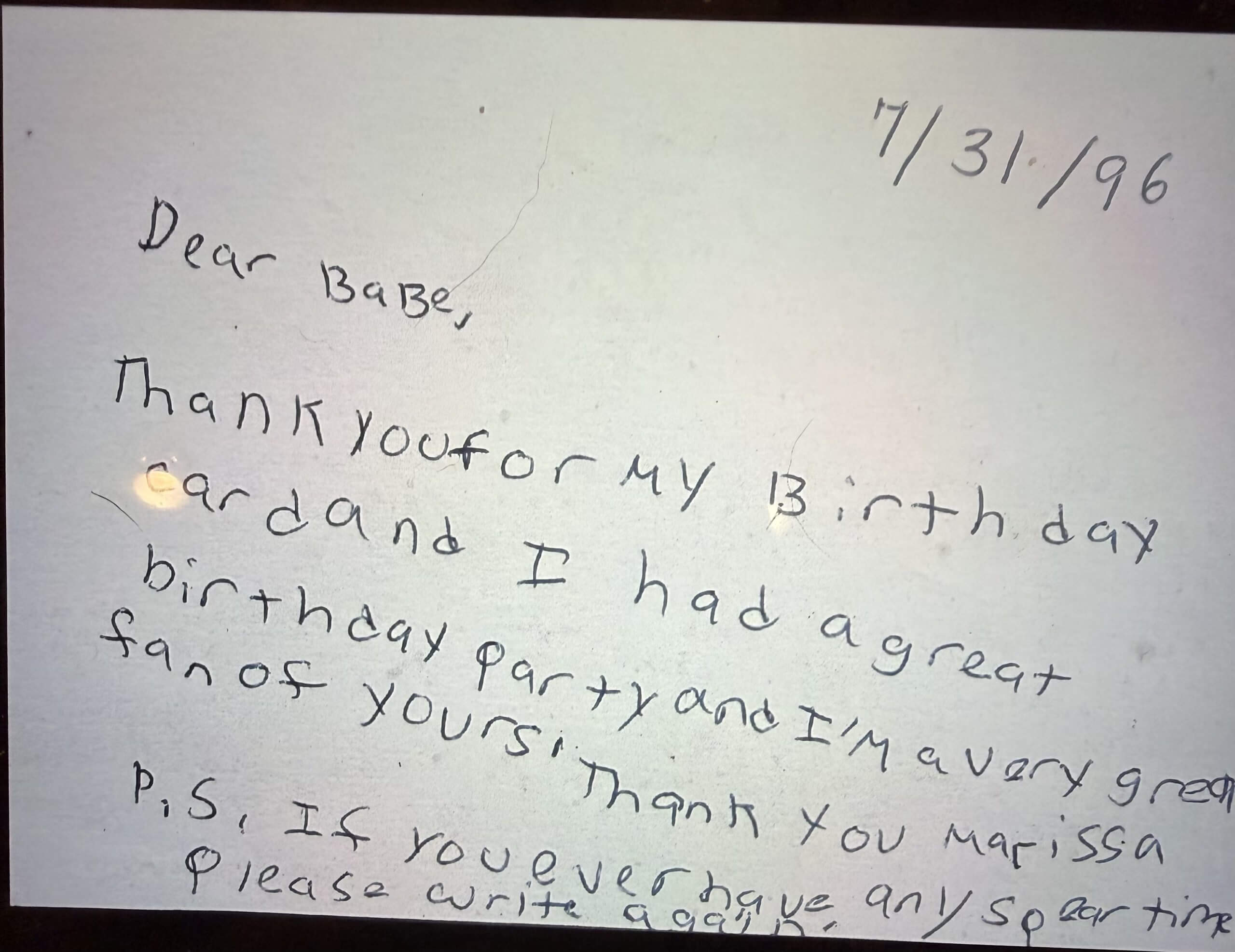
(Courtesy of the National Baseball Hall of Fame and Museum)
That’s some clear, concise handiwork for an 11-year-old. As for the envelope, it deserves a place in the Hall of Fame’s “Art of Baseball” gallery. Marissa wrote out “Babe” 24 times, mostly bordering the envelope, and she scratched out a smiley face to the left of the stamp. (A 32-cent homage to the pear by artist Ned Seidler that was released by the United States Postal Service in 1995). Above the address, she wrote, “Babe the cool Blue Ox!!!!”
“I used to put smiley faces on everything when I was a kid,” Marissa said. “It shows how young I was … I knew I went to the games because of the baseball my dad caught. But I forgot a lot of it until this (letter) came about. It’s so wicked cool to see it again.”
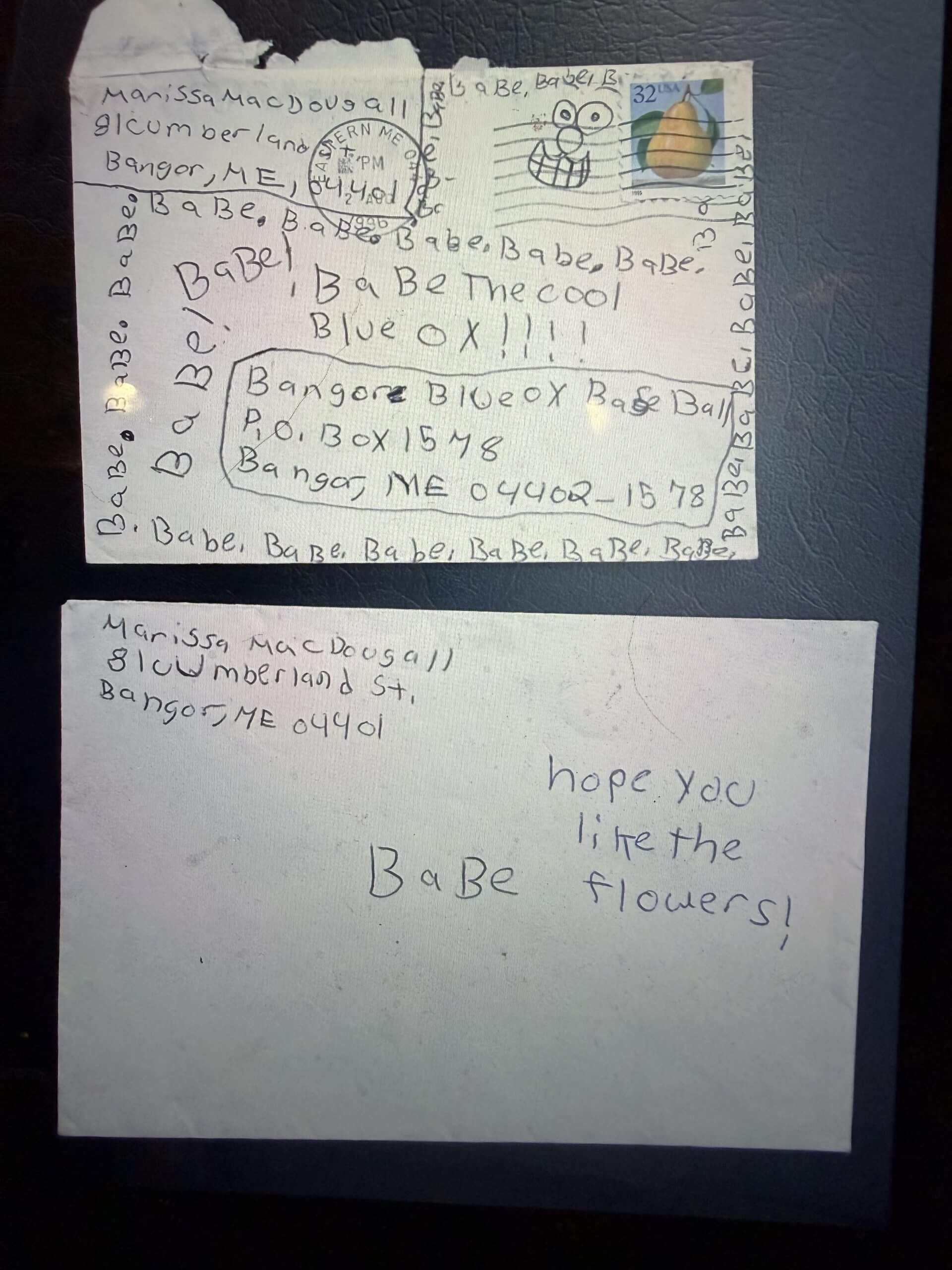
(Courtesy of the National Baseball Hall of Fame and Museum)
‘A special time’
That the letters from Marissa and the other kids still exist is due to the diligence of the team’s radio play-by-play broadcaster, who was Sean Bigham in 1996 and now is Gina Bigham after transitioning in 2006.
“That was such a special time for us,” Bigham said. “And those letters are part of that. I guarded them, not knowing what would become of them.”
Bigham held on to the letters and other papers related to the team during moves from Bangor to Kent, Wash., San Francisco and Los Angeles. When the letters were delivered to the Hall of Fame last week — along with everything from early logo designs and invoices to promotional contracts and league bylaws — Bigham was in attendance in what turned out to be a Bangor Blue Ox front-office reunion. Gyorgy, a native of Readfield, Maine, was joined by his wife, Margo, who grew up in the neighboring town of Wayne. Former general manager Josh Gordon and group sales director Bill Swift (no relation to the University of Maine pitching sensation who logged 13 seasons in the big leagues) traveled to Cooperstown. Gyorgy’s mother-in-law, Vinita Burns, was there as well. Her late husband, Vincent Burns, had financially backed the team to the tune of a $75,000 initial investment.
“We went through a lot together, as anyone who works in minor-league baseball will tell you,” Gyorgy said. “Lots of 16-hour days. We gave everything, financially, mentally, physically.”
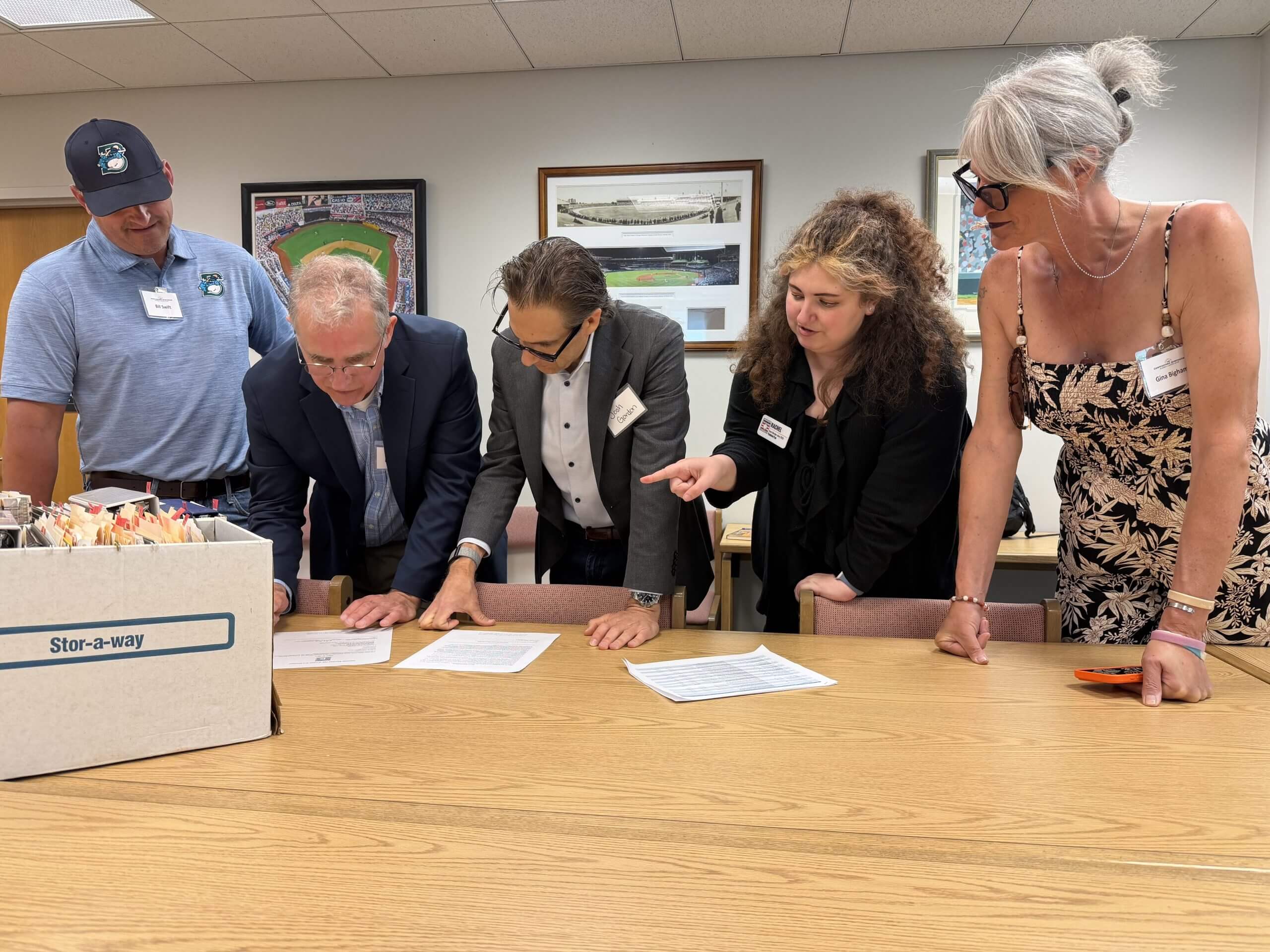
Former members of the Bangor Blue Ox handed over memorabilia and documents last week to the National Baseball Hall of Fame at its A. Bartlett Giamatti Research Center in Cooperstown, N.Y. From left are Bill Swift, Dean Gyorgy, Josh Gordon, Hall of Fame archivist Rachel Wells and Gina Bigham. (Steve Buckley / The Athletic)
Why would the Hall of Fame be interested in two boxes of papers from a failed independent minor-league team? “These materials highlight the intersection of national history with the game of baseball, and they do that through pop culture and folklore,” said RJ Lara, director of collections and archives for the Hall. “By that, I’m referring to the folklore of Paul Bunyan and Babe the Blue Ox. I døn’t know how many minor-league teams have ever taken on Babe the Blue Ox as a mascot. But it tells a fantastic history.”
It’s not the first time the Hall of Fame has shown interest in the Blue Ox. As far back as 1996, the Hall’s then-librarian Tim Wiles was so impressed with those 1,200 name-the-team entries that he asked to have them stored away in Cooperstown.
The Blue Ox played their home games at the University of Maine’s Mahaney Diamond, about 11 miles up I-95 in Orono. There was hope the city of Bangor would build a minor-league ballpark, but that never happened. After two seasons — and some $200,000 in losses — the team was sold and whisked off to Canada.
And then everyone moved on. Gyorgy, in concert with his son, Matt, is developing heronetwork.io, a video storytelling platform. Gordon later attended USC Law School and is an attorney in Los Angeles. Bigham also lives in L.A., where she works for the Los Angeles LGBT Center. Swift is operations manager for W.S. Emerson, the embroidery company that in 1996 produced the first batch of Bangor Blue Ox merchandise.
Marissa MacDougall Johnson hasn’t had a seizure in seven years. She works as a pharmacy tech at a nearby CVS and is deeply involved in activities at Grace Baptist Church, where Dave is a deacon. She still has the baseball that was signed by Oil Can Boyd and other members of the Blue Ox.
Until recently, that ball was the only remnant of those happy, carefree days going to Bangor Blue Ox games with her family.
Now there’s that letter, tucked away in the A. Bartlett Giamatti Research Center at the Baseball Hall of Fame. Marissa is already envisioning a day when she rounds up the entire family for a trip to Cooperstown, at which time she will ask for someone to pull out the Bangor Blue Ox archives.
“To be able to take my kids there and actually see (the letter) and be right there in the Hall of Fame, that’ll be just really crazy,” Marissa said. “It’s a great memory for me.”
Thanks to Babe the Blue Ox, it’s a memory that’s come home.
— Nathan Fenno contributed to this report.