
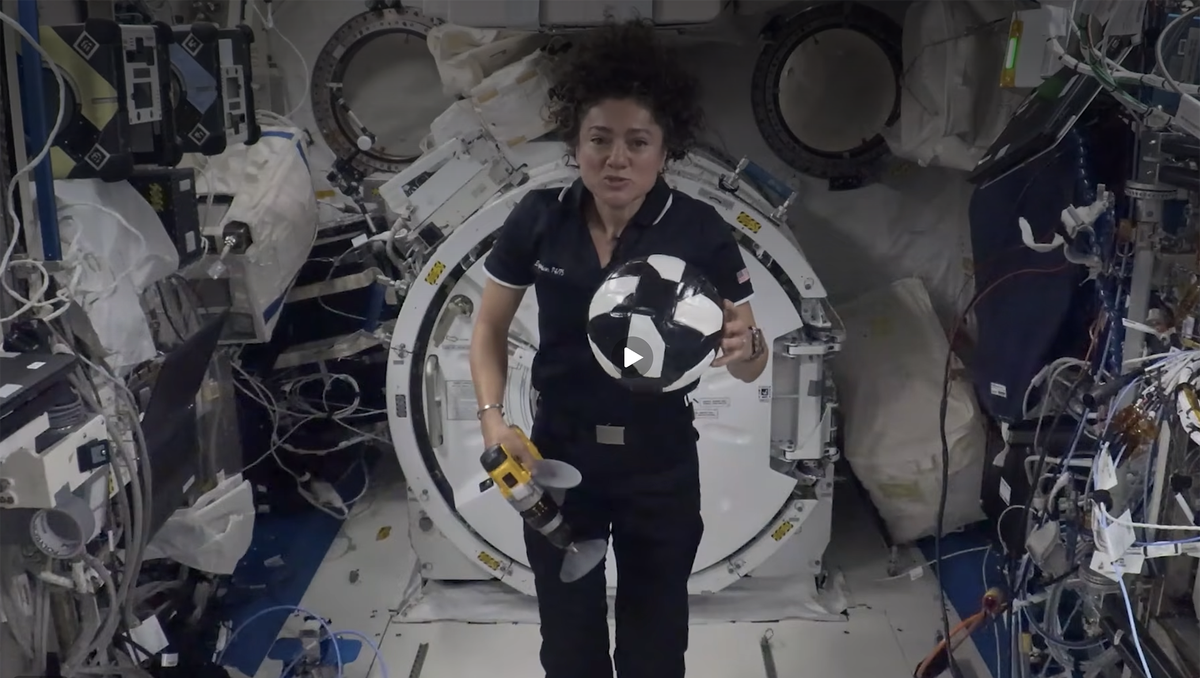
A NASA astronaut aboard the International Space Station demonstrated a few soccer ball tricks in low gravity – just in time for the World Cup.Astronaut Jessica Meir showed spinning different soccer balls in low gravity, showing how a soccer ball’s design affects its physics in such an environment.”What you see here is a soccer ball that passes one of the most important tests in sports engineering: Balance-mass distribution,” she says in the video, which is part of the agency’s “STEMonstrations” series.But the demonstration goes beyond showing the difference in quality. See the demonstration in the video above to learn more.In 2019, International Space Station researchers took advantage of the microgravity environment to specifically study soccer balls – keying in on motion, stability and rotation.”The findings have improved understanding of how embedded technologies, including match-ball sensors, can influence performance during play,” according to a NASA news release. “The research contributed to studies used in the development and evaluation of soccer balls for major international tournaments, including FIFA World Cup competition.”CNN contributed to this report
A NASA astronaut aboard the International Space Station demonstrated a few soccer ball tricks in low gravity – just in time for the World Cup.
Astronaut Jessica Meir showed spinning different soccer balls in low gravity, showing how a soccer ball’s design affects its physics in such an environment.
“What you see here is a soccer ball that passes one of the most important tests in sports engineering: Balance-mass distribution,” she says in the video, which is part of the agency’s “STEMonstrations” series.
But the demonstration goes beyond showing the difference in quality.
See the demonstration in the video above to learn more.
In 2019, International Space Station researchers took advantage of the microgravity environment to specifically study soccer balls – keying in on motion, stability and rotation.
“The findings have improved understanding of how embedded technologies, including match-ball sensors, can influence performance during play,” according to a NASA news release. “The research contributed to studies used in the development and evaluation of soccer balls for major international tournaments, including FIFA World Cup competition.”
CNN contributed to this report