
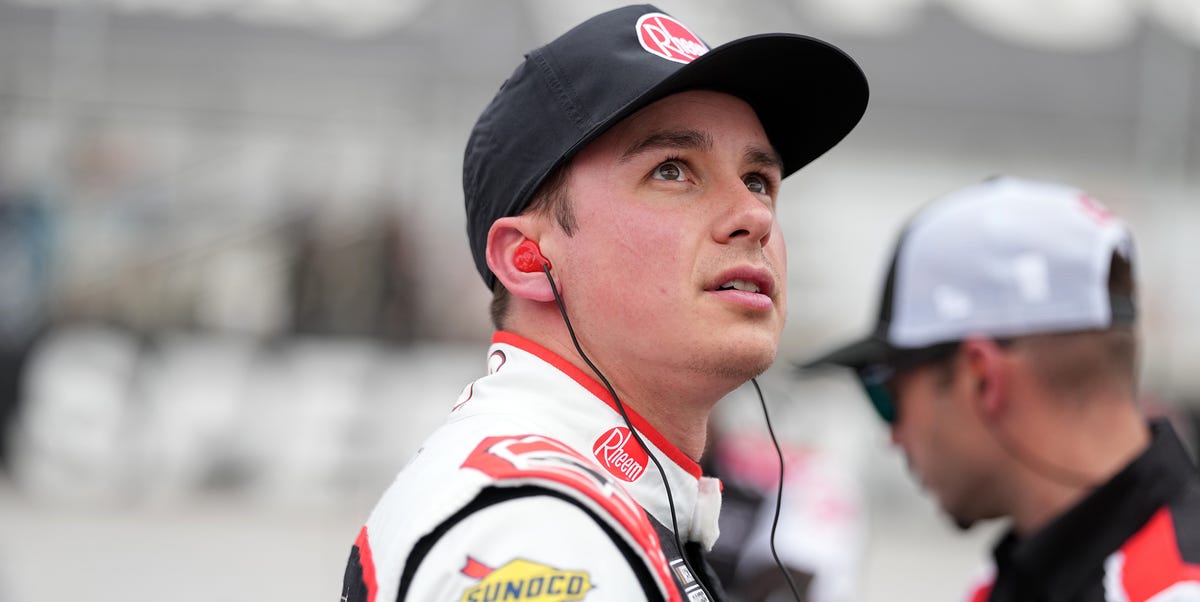
Christopher Bell knew immediately after his vicious crash at Michigan International Speedway that he had broken his left wrist, but it never occurred to him that he might not race the following week.
“As long as I can hold the steering wheel, I’ll be fine,” Bell said Saturday at Pocono Raceway. “I did fine in the simulator. Really, there was no thoughts of me missing a race since my head was fine.”
Bell plans to go the distance in Sunday’s Great American Getaway 400, but just in case things change, Brandon Jones will relieve him. Veteran driver Max Papis helped Bell alter his steering wheel to accommodate his hand and cast.
“We took a lot of material off of the left side of the wheel just to make it skinnier, because I have so much material in my palm to help my hand get around the steering wheel,” Bell said. “I’m going to have to acclimate to driving primarily right-handed.”
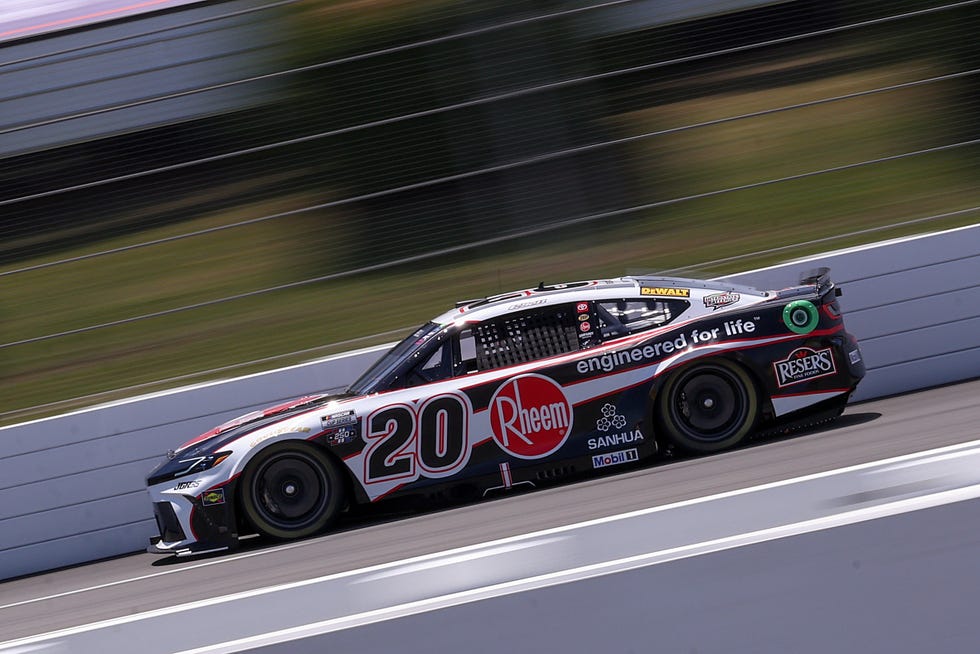 David Jensen//Getty Images
Christopher Bell driving at practice ahead of this race at Pocono this Sunday.
NASCAR revealed on its podcast Hauler Talk that Bell’s Joe Gibbs Racing Toyota sustained the hardest impact of the Next Gen era when his car slammed into Michigan’s fourth-turn wall after being hit by Chase Elliott’s Chevrolet. The race was stopped for 20 minutes 31 seconds while the wall was repaired. During the podcast, Mike Forde, NASCAR’s vice president of racing communications, said the Delta-v, or the change in velocity of his car, was the largest number recorded since the current Cup car made its debut in 2022. Forde said he couldn’t release the Delta-v number for Bell because that data was proprietary.
“Once I hit the wall, my earpiece popped out, so I scared the crap out of my wife and probably everyone else listening because I didn’t respond.”
Matt Harper, NASCAR’s managing director of safety systems, said it also was the hardest hit recorded in at least a decade. Bell didn’t know the Delta-v number, but he said he had been told it was 63 gs on impact.
“I’m just so, so incredibly fortunate and thankful and blessed that my head was okay,” said Bell, who described the incident as a racing accident. “To get out of there with just a fractured wrist is pretty immaculate.
“Once I hit the wall, my earpiece popped out, so I scared the crap out of my wife (Morgan) and probably everyone else listening because I didn’t respond to Tab (Boyd, spotter) whenever he was checking on me. I didn’t have any communication, and then I saw the car was on fire. I was trying to get out as quick as I could.”
Bell knew his wrist was broken because he couldn’t squeeze the button to disconnect his shirt with his left hand. Once outside the car, he discovered he couldn’t undo his helmet’s chin strap. He also experienced severe pain in one of his feet, but X-rays showed it was only bruised.
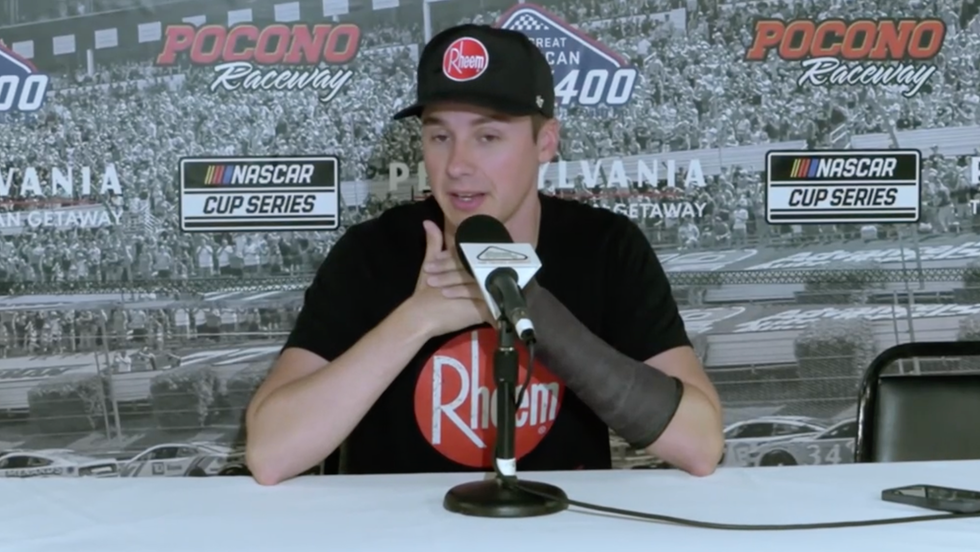 NASCAR
Christopher Bell speaking with the media, his cast on his left arm.
The 31-year-old Bell said his left hand was on the wheel’s underside when it broke. It will take six weeks to heal, and he will assess his driving duties week-to-week. He is driving with one hand. Prior to arriving in Pocono, he had driven a passenger car but not a race car. He qualified 22nd.
The JGR driver declined to reveal his medical treatment for the weekend but noted the OrthoCarolina team made sure his cast was molded so he could grip a steering wheel. Everything that he would do left-handed, such as drink bottle, radios and helmet blower, were moved to the car’s right side.
Bell said his telephone was the busiest it had ever been the week following the crash.
“It’s been eye-opening how much love I have received from everybody, all of my competitors throughout the NASCAR garage, all of my peers and coworkers throughout the NASCAR garage, friends and family members, even drivers and competitors that I raced against on the dirt side that have reached out to me,” Bell said. “It has been surreal to see that.”
Bell is thankful for today’s safety equipment.
“All of the previous drivers who have paid somewhat of a price to make these cars as safe as they are today, NASCAR from learning from every experience that they’ve had in every moment, every crash; it all paid off last Sunday,” Bell said.

A North Carolina native, Deb Williams is an award-winning motorsports journalist who is in her fourth decade covering auto racing. In addition to covering the sport for United Press International, she has written motorsports articles for several newspapers, magazines and websites including espnW.com, USA Today, and The Charlotte Observer. Her awards include the American Motorsports Media Award of Excellence, two-time National Motorsports Press Association writer of the year, and two-time recipient of the Russ Catlin award. She also has won an award in the North Carolina Press Association’s sports feature category. During her career, Deb has been managing editor of GT Motorsports magazine and was with Winston Cup Scene and NASCAR Winston Cup Scene for 18 years, serving as the publication’s editor for 10 years. In 2024 she was inducted into the NMPA Hall of Fame.