
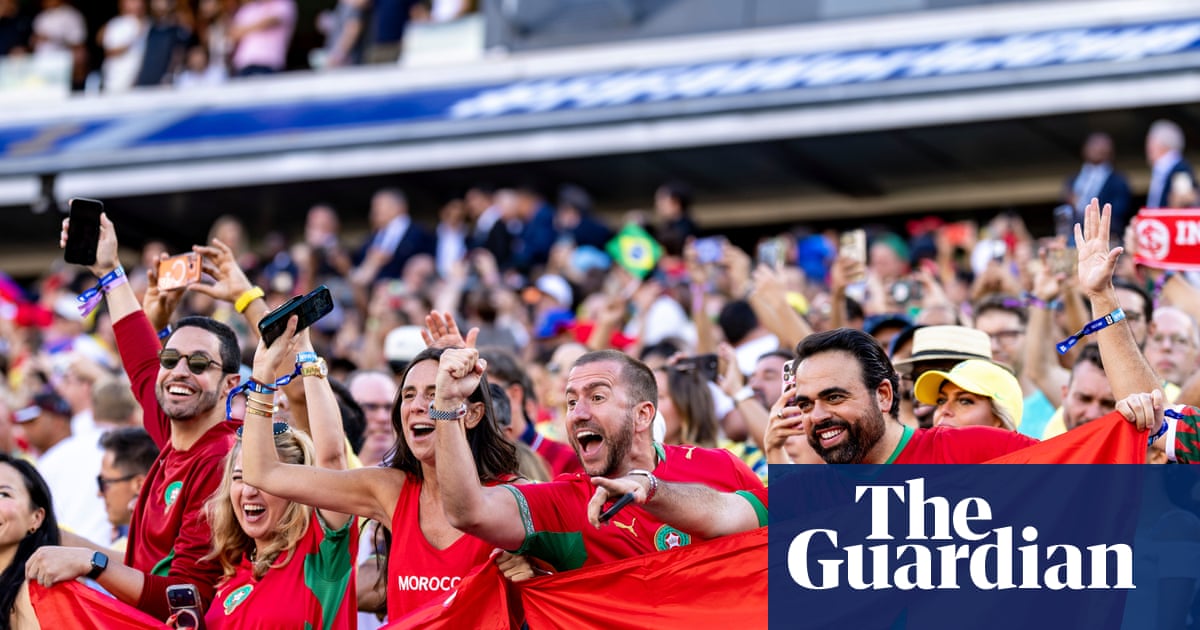
They had come from the United Kingdom and from Dubai. A surprising number had come down from Montreal. They had come from Morocco, of course, from Marrakech and Casablanca, to witness their team take on mighty Brazil. To support Morocco, the administrative, off-again, on-again champions of Africa, and semi‑finalists at the last World Cup in Qatar.
“We had a good World Cup in 2022 and a good African Cup of Nations,” Kamal Ait El Hadj said before the game, lounging in his seat in the New York New Jersey Stadium’s lower bowl. Soon enough, his section would be colored by Morocco’s blood red and splotches of green. “It was a minimum for me to be here.”
Ait El Hadj, a 47-year-old who “builds villas” in Morocco, figured his travel from Marrakech just for this match would set him back $5,000 (£3,700), even though he had a free ticket. He would go home after the game and planned to return for a last‑16 match – hopefully featuring Morocco – which would cost him another $5,000.
Houssam Jeboni, a 33-year-old fish wholesaler, was high up in the second tier. He said it would cost him $6,000 to follow his team through the group stage, from New Jersey through Foxborough and Atlanta, before flying home to Morocco via Miami.
Salma Sebti, sitting in the second tier behind one of the goals with her husband and daughter, had booked their travel for all three group matches as well. “And inshallah, we stay,” she said. They were here because she had a feeling the Atlas Lions required their presence to succeed. Sebti and her family would spend at least $15,000 on this trip, she estimated. They own a gas station in Marrakech.
We spoke to a dozen or so fans who had traveled from Morocco for the match and none of them reported any problems getting into the US, although some had faced waits in the immigration line as long as three hours. There was also consensus among them that Morocco are the rightful African champions.
Morocco fans watch their side draw with Brazil. Photograph: Brad Smith/ISI Photos/Getty Images
But from those who managed to make it from Morocco to the Meadowlands on Saturday, a clear picture emerged of just who gets to witness this World Cup, of who can decide it’s “a minimum” for them, as it was for Ait El Hadj. After all, the average annual salary in Morocco is estimated to be less than $7,400.
Morocco is a rising power in the global game. The rapidly developing country, which is building impressive infrastructure, has become the power player in African soccer and stands accused of wielding its swelling influence to wrest away Senegal’s continental trophy. In four years, Morocco will be the second African country (after South Africa in 2010), and the second Arab one (after Qatar), to host a World Cup, when it shares the duties with Spain and Portugal – and, briefly, Argentina, Paraguay and Uruguay.
Judging from this random sampling, only Morocco’s well-off are sharing in the soccer spoils. In a soccerfootball-mad country like Morocco, as in many others, traveling to this World Cup is a luxury, costing what the average citizen would earn in an entire year or even two.
“I trust our team and I think this is our year,” said a 32-year-old Morocco fan who works in the travel industry and asked not to be named. He expected to spend up to $10,000 over 10 days. To him, this World Cup represents an appetizer for the one Morocco will co-host. “We will show the world we are ready to host the best World Cup in history,” he said.
He shared this abundant pride with Mohammed Smouni, the deputy director general of Morocco’s national railway. “We’re in training [to host],” he said.
Smouni is a World Cup regular, this is his fifth, and did not want to miss this fixture, the only group-stage contest between teams ranked in Fifa’s top 10, which would end 1-1. “We got a taste in Qatar,” he said. He was in the stadium’s second tier beside his son, who had come from Montreal to meet him. “Seeing my team has no price.”
It did have a price, though – a $1,500 flight. A friend had given Smouni their tickets and was putting them up, making this a relatively affordable trip for him and his son.
That made Smouni one of the lucky ones. Ait El Hadj, the builder of villas, had saved up for a long time. But then he was lucky, too. “Not everyone can afford it,” he said.
Leander Schaerlaeckens is the author of The Long Game: U.S. Men’s Soccer and Its Savage, Four-Decade Journey to the Top, or Thereabouts, which is out now. He teaches at Marist University.