
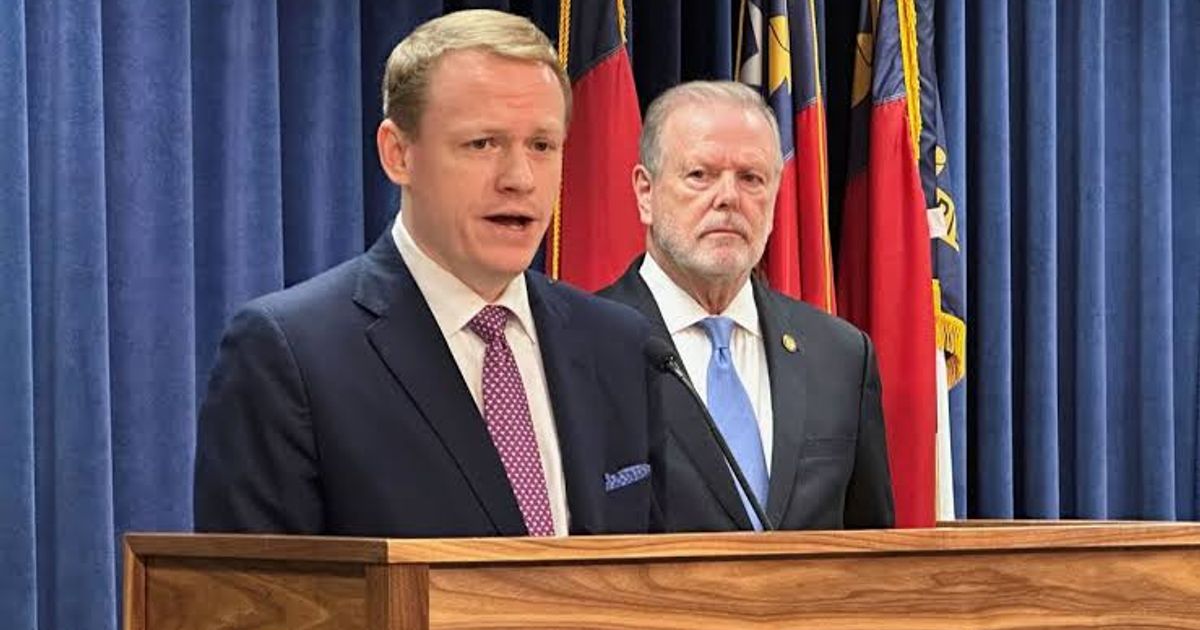
A state-supported plan for a potential Major League Baseball stadium could still become reality, North Carolina House Speaker Destin Hall said this week. He just wants to pump the brakes on the plan for now while pressing ahead with a proposed state budget.
“I wouldn’t say that it’s dead,” Hall told reporters late Tuesday. “… Whether there’s a future for it, in [the legislature] doing something, is an open question.”
North Carolina lawmakers, who began voting Wednesday to approve a new $34 billion budget, had considered including a framework for a $1.7-billion Raleigh stadium in the new spending plan. But lawmakers ultimately opted to leave it out. Details of the plan were first reported by WRAL.
The proposal — seen as a critical element of an expected Major League Baseball expansion bid in the state — was supported by the Senate, but House leaders expressed wariness over public funding for the project.
Lawmakers could revisit the idea, or a pared-down version of it, outside of the budget process or in a future budget.
“It’s not a matter of us just philosophically saying we would literally never do anything to promote this,” Hall said. “It’s more of a question of smartly using taxpayer dollars, looking to see what other places are doing.”
Major League Baseball Commissioner Rob Manfred has said he wants to choose two new cities for expansion before his term ends in January 2029. The cost of acquiring a franchise and building a stadium is projected to be at least $4 billion.
Carolina Hurricanes owner Tom Dundon and North Carolina Courage investor Marc Lasry — both billionaires — separately have expressed a desire to bring a MLB franchise to Raleigh. But additional financial support, particularly with the bipartisan backing of state and local governments, is seen as essential to a successful bid. Cities across North America have expressed interest in MLB expansion, including Nashville, Salt Lake City, Sacramento, Montreal and many others.
North Carolina’s stadium-finance plan calls for $500 million in state funding, with the rest of the stadium money coming from local revenue sources, sports gambling taxes, personal income tax withholdings from players and performers at the facility and the creation of a sports and entertainment taxing district.
Hall said his chamber wasn’t immediately comfortable with the mix devised to pay for the stadium. “Our feeling on it was maybe it’s too much too soon,” Hall said.
He noted that collective bargaining discussions between Major League Baseball and its players could drag on, perhaps giving the state more time to think about its plan. Furthermore, he said, North Carolina’s effort to land a franchise could be hurt if it moved first on legislation to fund a stadium. Governments in competing Canadian and East Coast markets haven’t passed similar legislation. If North Carolina shows its hand first, he said, other states could one-up its plan.
“If you do everything at once, right now, in many ways you set the floor for what the next city may do,” Hall said. “It sort of ups the bidding war. And we just don’t think that’s the wise way to go about using taxpayer dollars.”
Senate leader Phil Berger has been the top proponent of the plan, people familiar with negotiations have told WRAL. In a separate conversation with reporters on Tuesday, Berger said Hall never offered any sort of counter-proposal that House Republicans might back.
“When it became clear that their position was that they were not going to be interested in moving forward, it was important for us to just to just recognize that, acknowledge that, and get on with the other things,” said Berger, who has led the state Senate for the past 15 years and will leave office at the end of the year after losing the GOP primary for his seat.
Berger indicated that waiting for a response delayed the entire state budget, which was made public Tuesday ahead of votes Wednesday. While Hall sees the details of any potential baseball expansion bid as an open question with plenty of time left to resolve, Berger said he still believes the time is now to act.
“Whether another opportunity will come up as we go forward, I don’t know,” Berger said. “I think it would be beneficial for the state if that were the case. But again, for us to move forward with initiatives like that, it requires a good bit of consensus, and that consensus was elusive.”
Democratic Gov. Josh Stein, Republican State Treasurer Brad Briner, and Raleigh Mayor Janet Cowell, a Democrat, have endorsed the stadium-finance idea, with many pointing to the support for the Carolina Hurricanes as evidence of the market’s readiness.
Some House Republicans balked at the proposed occupancy tax increase, saying they’d prefer a proposal that distributes more money to other parts of the county and state.
Hall said that because there wasn’t consensus among Republicans in the House, the chamber chose to press ahead on the budget plan without the baseball proposal. “We’re down here to the wire and want to pass a budget,” Hall said, “so that was sort of the end of those discussions.”
Lawmakers began debating the budget on Wednesday and are expected to pass the spending plan this week.