
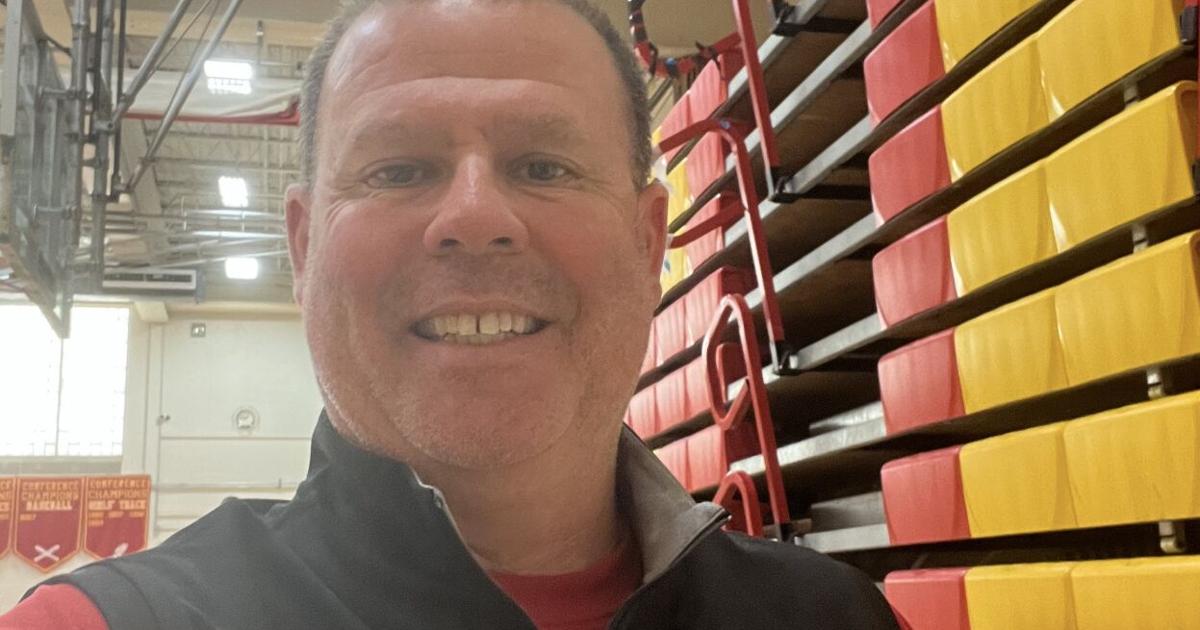
Brian Grant has been coaching high school soccer in Delaware for 29 years.
He has served as the head coach of the Glasgow boys team for the past 16 years and the girls team for 11. He also served as an assistant for both teams for more than a decade prior to becoming head coach.
Before arriving at Glasgow, he was the boys head coach at Hodgson Vo-Tech for four years, where he was named the 2002 Blue Hen Conference Coach of the Year. He also served as head coach for the Delcastle boys for three years and girls for two.
This past school year, both the boys and girls varsity teams at Glasgow had outstanding seasons.
The girls won nine games, which was the most since 1998 and second best in program history. Their 9-6 record marked the team’s second straight season with a winning record, which had never been done before. The offense scored 55 goals, and the defense recorded eight shutouts. Both stats were program bests.
The boys finished 8-7, and it marked the first back-to-back winning seasons since 2002 and a third-straight season with a .500 or better record for the first time since the 2001-2003 seasons.
I met with Grant, who is a High Point University graduate but didn’t play soccer in college, to talk about his coaching career, which also includes voluntarily coaching his own boys for the past nine years at Kirkwood Soccer Club.
Question: What is the primary difference coaching boys versus girls?
Answer: “At Glasgow, the difference is we get a lot of girls who have never really played the game before. I feel like they are a lot more receptive to the coaching, where the boys, a lot of them are travel club players and they play at a higher level. I feel like sometimes there’s an ego involved with the boys that you don’t see on the girls’ side.”
Q: How has coaching at the high school level changed since you started?
A: “I think the kids have changed a lot over the years. When I started this, you could be a lot more hardcore, like yelling, etc. Now, a lot of them kind of shut down because they don’t react well to that type of coaching. And I think today, the psyche of the teenage athlete has changed so much that you really are, at least at Glasgow, you’re everything to these kids. You’re the coach, you’re the mentor. Sometimes, you’re that pseudo-parent for them because their parents aren’t around a lot because they’re working. I just think that in the time I’ve been at Glasgow, we’ve gone from where you basically just focused on the X’s and O’s, and coaching the game, and coaching your team, to now having to kind of be everything for these kids.”
Q: With a lot of the Christina School District sports programs dwindling in terms of participation numbers, how has soccer survived at Glasgow High?
A: “We have very high Hispanic and African populations within our programs. So I think that’s part of it because they come from countries where soccer is a huge part of the culture. I also think stability. I’ve been with the boys program since 2010. I’ve been in the girls program since 2004. I think that stability helps, along with the fact that I teach in the building and I’m able to create relationships with kids that go above and beyond the soccer field. … And then winning doesn’t hurt, because when you win, people want to be a part of it. We’ve had some pretty good success over the past three years in both programs, so it starts breeding that interest. I think that’s a big part of it — that if you can sustain some level of success and you create that environment, the kids want to be a part of it, and that’s how you keep those numbers up.”
Q: What’s the toughest part about being a high school head coach in a public school?
A: “At times, I don’t feel like the playing field is level. A lot of the private schools get all these really good athletes that they can pick from. And then you look at public schools like Glasgow, Newark, Christiana and some others, and you don’t have that pool of athletes to pull from. So you’re already working behind those other schools. And I think that’s one of the toughest things because there are kids that are playing at those schools who I know are supposed to be at a public high school. And it’s like, if they were here, how much better would we be?”
Q: Is there a Delaware Interscholastic Athletic Association rule that you would change if you could?
A: I’m not in favor of the newer academic eligibility rule that you have to pass five classes and two have to be core classes you need to graduate. I was not in favor of doing away with the grade point average requirement. We had a situation at Glasgow a few years ago where a player got straight D’s and was eligible to play. Another girl failed one class that she needed to graduate, but had a three-point-something GPA. But because she failed that one class, she was ineligible. So the one girl did little to no work and ended up with a one-point-something GPA, she’s allowed to play. But the other girl had like a 3.2 GPA but failed this one class, and she’s not allowed to play. I just really think the GPA thing gives kids something to kind of shoot for, and sometimes college scholarships are linked to it.
Q: Why do you still coach after 29 years?
A: “I just really enjoy it. There’s something about going out there every day and being around 25 to 40 kids every day, imparting that knowledge on them. I just feel like I have something to say to these kids. Especially the kind of kids that we have at Glasgow where you become that mentor and you get to see these kids go from freshman year, where they may not have been a very good player or just not understanding the game at that level, and then seeing them get to where they end up going, whether it’s all-conference, all-state, whatever it is. And then just life, teaching life lessons.
“I coached with Bob Bussiere for 11 years in the girls program and I tell people all the time that I learned so much from him. And it wasn’t just soccer. Bob always said to his players, ‘I’m not here just to teach you soccer. I’m here to make you better people.’ And that’s always kind of stuck with me.
Q: When will you know it’s time to retire from coaching?
A: Right now, coaching doesn’t feel like a job. Teaching, at times, feels like a job. Coaching, to me, doesn’t. When it starts feeling like a job, then I think that’s when it’s time to get out.”
Have a great sports week!
Send comments to JonBuzby@hotmail.com and follow on “X” @JonBuzby.