
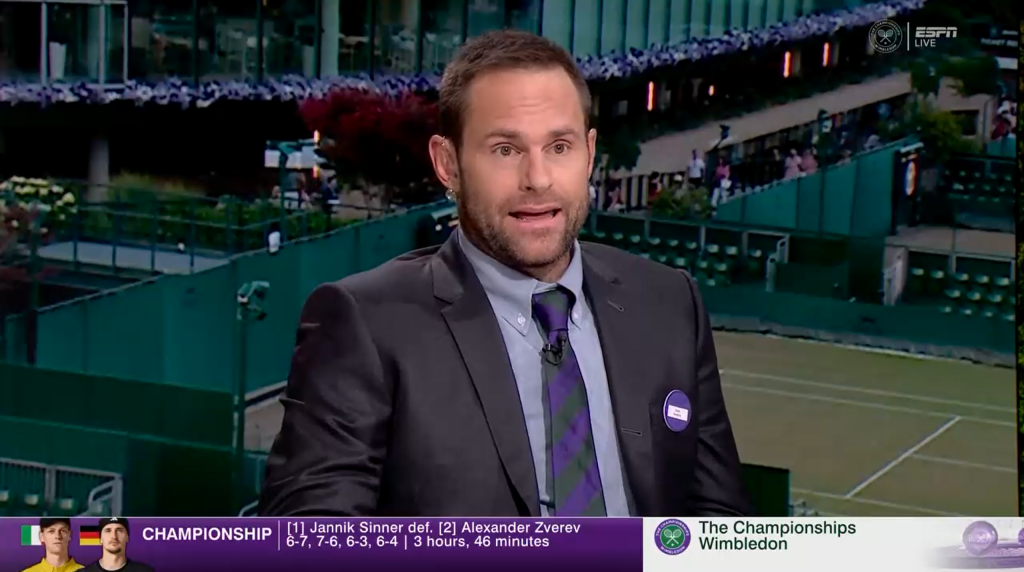
As ESPN wrapped up its Wimbledon coverage on Sunday, host Malika Andrews asked Andy Roddick some questions about the sport’s future. The questions and answers aren’t that important–whether Serena will play the U.S. Open, whether Carlos Alcaraz will return, and whether anyone can beat Jannik Sinner. What jumped out to me is that as she queried him, he took notes. Anyone who has watched the grass court tourney would not be surprised after a fortnight of detail and insight that gushed from the last American man to win a Grand Slam (kids, you have to go back to pre-iPhone days to find his victory).
Now, I have no idea what he wrote down–presumably a response he did not want to suddenly forget. But the discipline couldn’t have been starker than with Roddick’s far more glorified peer, John McEnroe, who just completed announcing the men’s final during which he butchered the pronunciation of finalist Alexander Zverev’s name.
Go on Reddit, X, or any social media platform, and you’ll find large samples of disdain for McEnroe and enthusiasm for Roddick. I like McEnroe; he deeply cares about tennis, he put his name into improving American tennis, and he is obviously a legend of the game whose catchphrase, “You cannot be serious,” he trademarked. But it’s time for ESPN to call it a day with him, at least as lead announcer, and turn the booth over to the likes of Roddick and other young former players like Chris Eubanks, who is also killing it.
If you are reading this column, then I am sure you have read former Washington Post columnist Sally Jenkins’ brutal takedown of McEnroe last year.
His mispronunciation of Zverev’s name is not unique–I will admit I have a tough time with it, but I am not paid handsomely to make it my business to get it right. Jenkins in her column ran through a few examples–Flavio Cobolli: Pronounced by McEnroe according to Jenkins as “Carbelly,” “Cowbelly,” and “Chabally.”
Look, it’s tough in a sport that draws its players from all corners of the globe to always get the names right (as an aside, Rob Manfred, the MLB commish, apparently botched the number-one pick’s name this week). But that is why doing your homework is so important. At college graduations, hundreds, if not thousands, of names are read out. Roger Goodell, the NFL commissioner, gets a briefing on the names of players he may announce at the Draft. And the ATP and WTA Tours have a neat website feature where each player pronounces their own name. Here is Zverev doing his.
It’s not that mangling a name is a cardinal sin, it happens. But for it to be a persistent offense, and to occur on the holiest of days in tennis, a Wimbledon final, shows a lack of preparedness, or dare I say seriousness about the craft.
Listening to Roddick is a pleasure, likely a result of honing his voice on his popular podcast Served. Served is not some tennis bros podcast. Roddick has real journalists like Jon Wertheim working with him. The podcast had been digging so deeply into what, at the time, was still-brewing civil war within the Professional Tennis Players Association that the PTPA hired a defamation law firm to handle the queries.
In a letter that firm, Clare Locke, sent to one of the executives at the heart of the now-open civil war at the PTPA, the firm wrote, “You communicated with the media outlet Served and its reporters without the knowledge or approval of the Executive Committee or Executive Director, including falsely representing or implying to Served that our firm no longer represents the PTPA.”
Now, the civil war at the PTPA is another story, a long one. The point, though, is that Roddick’s podcast was doing real journalism in trying to get to the bottom of that story (I am told Clare Locke sent threatening missives to Served, which did not end up reporting on it). Roddick clearly cares about the sport and getting things right. This shows up clearly in his preparation, his incisive commentary, and his overall demeanor these last two weeks.
I watched the Wimbledon final with my 17-year-old son–he’s a tennis junkie–and my father, who only watched because we were. After about 10 minutes, my dad exclaimed that these commentators wouldn’t stop talking, to which my son and I shared a resigned sigh. If only it could have been Roddick selling the sport to casual fans who watch the finals.
If I ran ESPN tennis (yes, envision a red-clad devil, tail and pitchfork, cackling with delight), I would start my transition from the McEnroe era soon. The only question is, will Roddick want to take on a far more involved role from speaking in the studio in bursts, to the all-consuming play-by-play of a tennis tournament. Roddick put out Served content during Wimbledon and handled limited broadcast booth commentary, a dynamic that will likely continue during the U.S. Open. Would he shut down Served for fortnights to take on a bigger role? So much of sports and media happens outside of TV that the answer might not be as easy as it once was.
The McEnroes (John’s brother Patrick shares the booth with him) still have their defenders; here is one example.
The most entertaining part of the Wimbledon Final is easily enjoying McEnroe plural in the booth
How much McEnroe is too much McEnroe
The answer is Mr Deeds rhetorical #Wimbledon pic.twitter.com/nsAnXPoGGw
— Alex Monaco (@Alex__Monaco) July 12, 2026
And another.
@cbfowler and the McEnroe brothers might be the best broadcasting team in all of sports.
— Joe Concha (@JoeConchaTV) July 12, 2026
They have instant brand recognition and are synonymous with the sport.
And honestly, grading a broadcaster is subjective. The aging demographic that tennis clings to might get a nostalgic high listening to the McEnroes, no matter their foibles. For me, watching the new takes from Roddick, Sam Querrey, and Eubanks makes it obvious that new voices are needed at the top in a sport that struggles for attention. And ESPN, with the addition of Andrews and Roddick, implied that a fresher approach is needed. But their success in this tournament only makes it clear what the main commentary booths have been missing.