

If we turn the clock back four months to the opening round of the 2026 season, many things in Formula 1 looked very different from how they do now. Kimi Antonelli had never won a race, Toto Wolff was still convincing people in the paddock that Red Bull would be “the absolute benchmark”, and Cadillac had yet to complete its first official F1 miles.
A lot has changed, but one thing has not. Ahead of a race weekend, most media sessions in the paddock still revolve around energy management – much to the frustration of many, the drivers included. Fortunately, that topic has been slightly less prominent over the past few months following the tweaks introduced by the FIA, although it must be noted that this was largely due to the circuit layouts. At tracks such as Miami, Monaco or Montreal, there were enough places to recharge the battery.
At Silverstone and Spa-Francorchamps, energy management is firmly back in the spotlight. The reason is obvious: both layouts consist largely of fast corners and straights, leaving hardly any opportunities to recover energy.
The irony of the whole situation is that these should really be the ultimate circuits for which F1 cars are built, the places where those machines truly come alive, as drivers so often put it. How many times have we heard drivers say that F1 cars are not really made for street circuits and only truly show what they can do on old-school tracks filled with high-speed corners?
Unfortunately, the situation is very different in 2026, almost the opposite. Or, to add a small nuance: the above still applies from a chassis perspective. The chassis regulations are far from bad – in fact, they are arguably a step forward compared to the ground-effect era – but power unit limitations overshadow that at many of the tracks where F1 should theoretically be at its best.
Ahead of Spa, my thoughts go back to a question I asked Lando Norris in China about whether the challenge of F1’s most iconic corners would be different this year. In his answer, Norris himself immediately pointed towards Spa-Francorchamps.
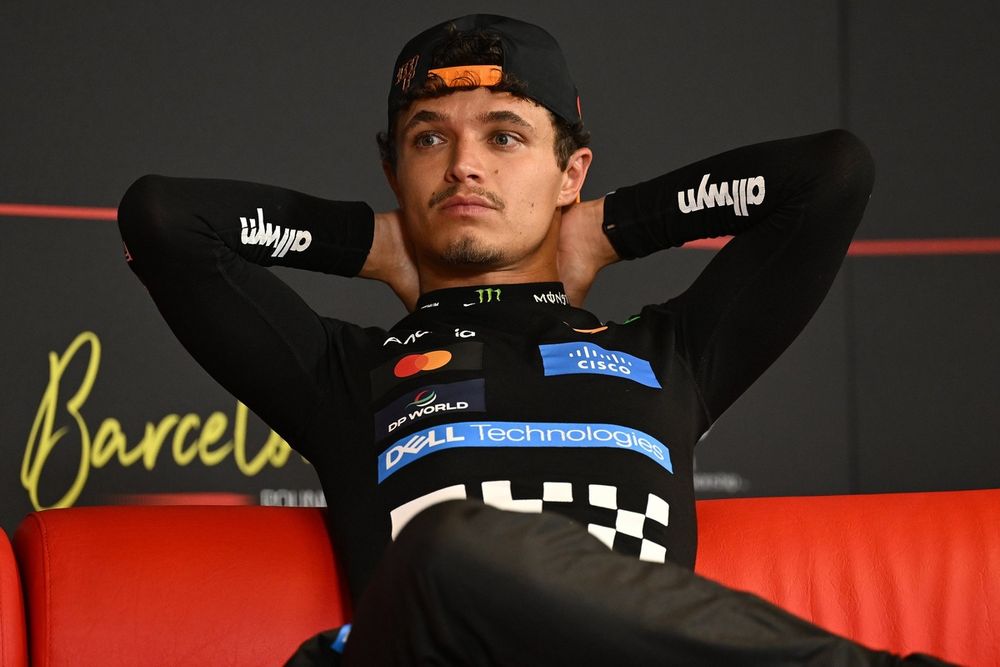
Norris fears F1’s iconic tracks have lost their challenge with the 2026 cars
Photo by: Sam Bagnall / Sutton Images via Getty Images
“You’re not going to go into Pouhon now and see who has the biggest balls,” the reigning world champion smiled. “You’re not going to see that. You’re just going to see who can lift at the correct point and use the amount of throttle that you have to use, so that it doesn’t use the battery and those kind of things. The driver can still make a difference by driving the power unit to the maximum of its ability, but that’s quite a different style to just saying who can carry the most speed through Pouhon.”
It is no coincidence that Norris mentioned Pouhon. Eau Rouge-Raidillon has been “easy flat” for years, meaning that with the ground-effect cars many drivers spoke with particular reverence about Pouhon, the double left-hander that, according to Lance Stroll, makes drivers feel the adrenaline no matter how many times they’ve been there. Well, except for 2026.
Is Alonso’s F2 warning justified?
The Spa experience will be different in two ways this year. Firstly, the challenge of so-called “big balls” corners such as Pouhon is gone, just as it was at Silverstone through the fast section of Copse and Maggotts-Becketts – which Alonso described as “charging stations”.
Read Also:
“We anticipate seeing a significant amount of super clip, which will test both the car and the drivers” Neil Houldey
More important is the energy management over the full lap. And it is precisely in that respect that several drivers have already expressed concerns about Spa, with Alonso leading the warnings.
“You cannot deploy in all the straights. If you deploy in Spa from Turn 1 to 5, it is finito for the rest of the lap,” the two-time F1 world champion said. “So, you need to save a little bit there to have deployment from Turn 14 to the Bus Stop chicane. But if you deploy in those two straights, which is the optimal deployment, then there is one minute in sector two with no deployment at all. And with no deployment at all, we cannot forget that this year we have significantly less power than last year and less power than F2.”
Without MGU-K deployment, this year’s F1 cars produce roughly 540bhp from the internal combustion engine, while the Mecachrome engines used in F2 deliver around 610bhp according to the official figures.

From charging station to slower than F2, Alonso has painted a damning picture
Photo by: James Sutton / LAT Images via Getty Images
Taken over an entire lap, the F1 cars will certainly not be slower than F2 cars, meaning Alonso’s comments only relate to certain sections of the second sector, rather than the overall lap time.
It should also be noted that drivers have often painted a particularly bleak picture in 2026, including during the media day at Silverstone, whereas in practice – apart from the yo-yo racing in the sprint and Mercedes’ unnatural qualifying trick – the reality perhaps looked slightly more natural than the darkest forecasts suggested.
McLaren and Williams expect “a significant amount of” super clipping
That said, it is not only the drivers who fear deployment pain at Spa. The teams are also very sceptical ahead of the race weekend. In its Belgian Grand Prix preview, McLaren even described Spa with the 2026 machinery as “a shock to the system”.
“The Belgian Grand Prix is going to be incredibly challenging from an energy management perspective; it’s one of the most energy-starved tracks on the calendar,” explained Neil Houldey, McLaren’s technical director of applied engineering. “We anticipate seeing a significant amount of super clip, which will test both the car and the drivers.”
That super clipping is expected, among other places, on the run towards Les Combes at the end of the Kemmel Straight and again towards Blanchimont later in the lap, although on Friday in particular it will differ from team to team where and how much energy they choose to deploy.
Williams, which likewise expects a battle of the batteries in the Ardennes, has already shed some light on the main pain points of the circuit in 2026.
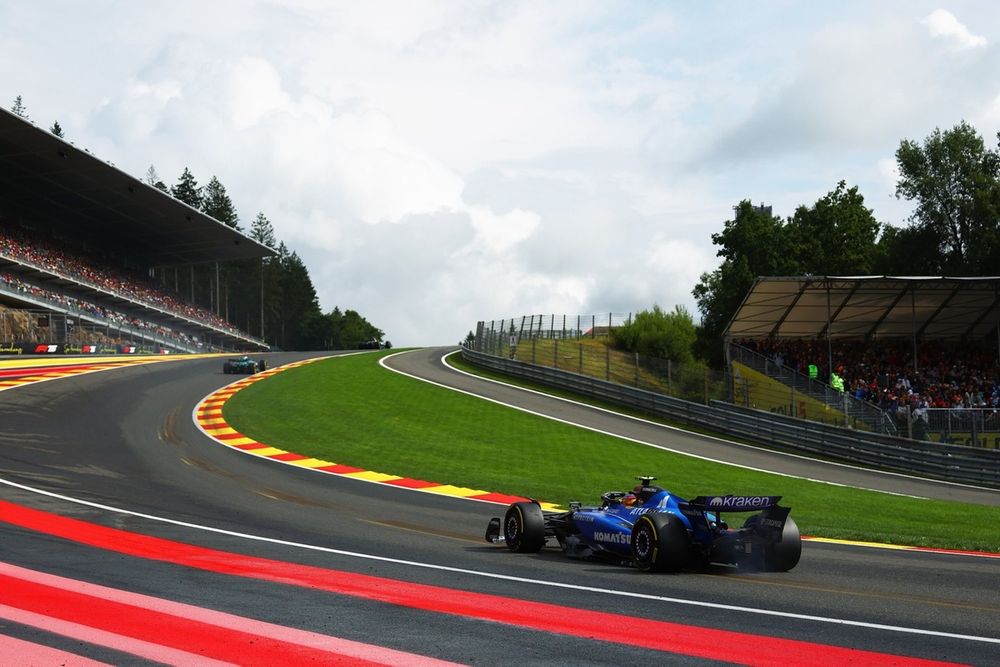
Choosing where to deploy the battery power will be the key focus going into the Belgian GP
Photo by: Zak Mauger / LAT Images via Getty Images
“Spa is the most energy-sensitive circuit we’ve encountered so far this year, by some margin,” said Williams chief trackside engineer Paul Williams. “The approach to Eau Rouge can be varied by trading off deployment profile, energy optimality, and the ride-height gains available from the set-up on the run up the hill.
“We expect to utilise the full energy pack window: full at Turn 1, depleted by Turn 5, then full again at the Turn 14 exit before emptying by Turn 18. This leaves Sector 2 significantly starved of energy, with super clipping likely on both low- and high-fuel runs.”
Williams’ expectation is therefore in line with Alonso’s warning above. Using the available energy on the Kemmel Straight and then again towards Blanchimont and the Bus Stop chicane is the most logical approach, but that could turn the second sector into a particularly painful affair.
F1’s data, however, indicates that Spa will not be dictated entirely by energy management and that, in that respect, it should offer more variety than Silverstone. In Belgium, deployment is not expected to be the only decisive factor. Unlike two weeks ago, different downforce levels should also become a factor – something that has traditionally been a defining characteristic of Spa, where teams can pursue different setup philosophies yet still arrive at similar lap times. That element should still remain intact under the new regulations.
In that sense, there is a belief that Spa will demonstrate that racing in 2026 is not entirely “one-dimensional”. Within F1, there is a clear distinction between outright performance and the entertainment value of the racing itself, and Spa is expected to highlight that distinction once more.
While fan surveys have so far returned largely positive feedback about the racing, the pure performance aspect remains a slightly different story at what Andrea Stella has called ‘energy-starved’ circuits.
F1’s most iconic circuits are also proving to be its most painful, and that is a sad conclusion
The Spa circuit offers scope for different deployment strategies in 2026, and analysing the data will certainly be interesting after the first practice session. But in all honesty, that is absolutely not the way Spa – still one of the most legendary circuits on the calendar – should be interesting.
Fortunately, the balance will shift slightly back towards the combustion engine next year, although Spa will be absent from the calendar under the new rotation system. The only positive note is that when the championship returns to Belgium in 2028, the split will be 60-40 and this kind of analysis – including from the teams themselves – will hopefully be a thing of the past.
But the reality in 2026 is still very different from that. F1’s most iconic circuits are also proving to be its most painful, and that is a sad conclusion. The pinnacle of motorsport must learn from that – not only for the years ahead, but permanently.

Engine rules changes are coming, but 2026 will be a lesson to learn from for F1
Photo by: Alastair Staley / LAT Images via Getty Images
We want to hear from you!
Let us know what you would like to see from us in the future.
– The Autosport.com Team